
Personal Loan Quick: How to Get Funds Fast in 2026

The repair shop needs payment by Friday, your car is how you get to work, and your paycheck won't cover the bill. You're searching for a personal loan quick enough to meet the deadline, but a fast response on your phone isn't the same as money you can spend.
The useful question is which stage can happen quickly, and what still has to happen afterward? Separate the request, lender decision, electronic signature, and deposit before you plan around an advertised timeline.
Table of Contents
- What Quick Means at Each Stage
- Documents and Eligibility to Have Ready
- How to Apply for a Personal Loan Step by Step
- Speed Up Approval and Funding
- How a Marketplace Speeds Up Matching
- Confirm the Terms Before You Accept an Offer
What Quick Means at Each Stage
Say you send your loan request on Monday morning for that Friday car repair. Your form might reach participating lenders immediately, but you still need an acceptable offer, completed verification, and available funds before you can pay the shop.
Unexpected bills are common. The Federal Reserve's household well-being survey found that 59% of U.S. adults experienced at least one major unexpected expense during the prior year, with vehicle repairs affecting 30%.
Typical timing for each stage of a quick personal loan
| Stage | Typical time | What you control | What the lender decides |
|---|---|---|---|
| Submit the request | Minutes | Loan amount, personal details, reason, deposit account | Nothing yet |
| Lender response | Usually within minutes through our network | Answering verification questions promptly | Whether you qualify and which offer you receive |
| Review and e-sign offer | Your reading and verification pace sets the timing | Checking APR, fees, and repayment schedule before signing | Final terms as presented |
| Deposit to bank account | Usually next business day after qualification, subject to processing | Accurate bank details and prompt signing | Funding processing, alongside bank timing |
Our real-time process lets users find out whether they qualify in minutes. However, submitting information doesn't guarantee approval, and the path from registration to a lender offer can be as fast as one business day rather than an immediate final decision.
Plan around available funds
A phone lets you submit without visiting a branch, but it doesn't bypass underwriting. An evening or weekend submission also doesn't mean the lender or receiving bank completes every remaining task immediately. Our guide to how long loans take to process helps distinguish those separate checkpoints.
Planning rule: Allow at least a business day after qualification for funding, plus any unfinished review time. Treat same-day money as a best case, not a commitment.
For the Friday repair, ask the shop when payment becomes due. That gives you a usable deadline rather than a guess based on the application screen.
Documents and Eligibility to Have Ready
Our basic eligibility requirements are being at least 18, having a checking account, and being employed with regular income and a known pay frequency. Meeting those requirements lets you start the process, but the lender still evaluates your request.
Prepare your information before opening the form. Switching between a banking app, payroll portal, and unfinished application makes avoidable mistakes more likely.
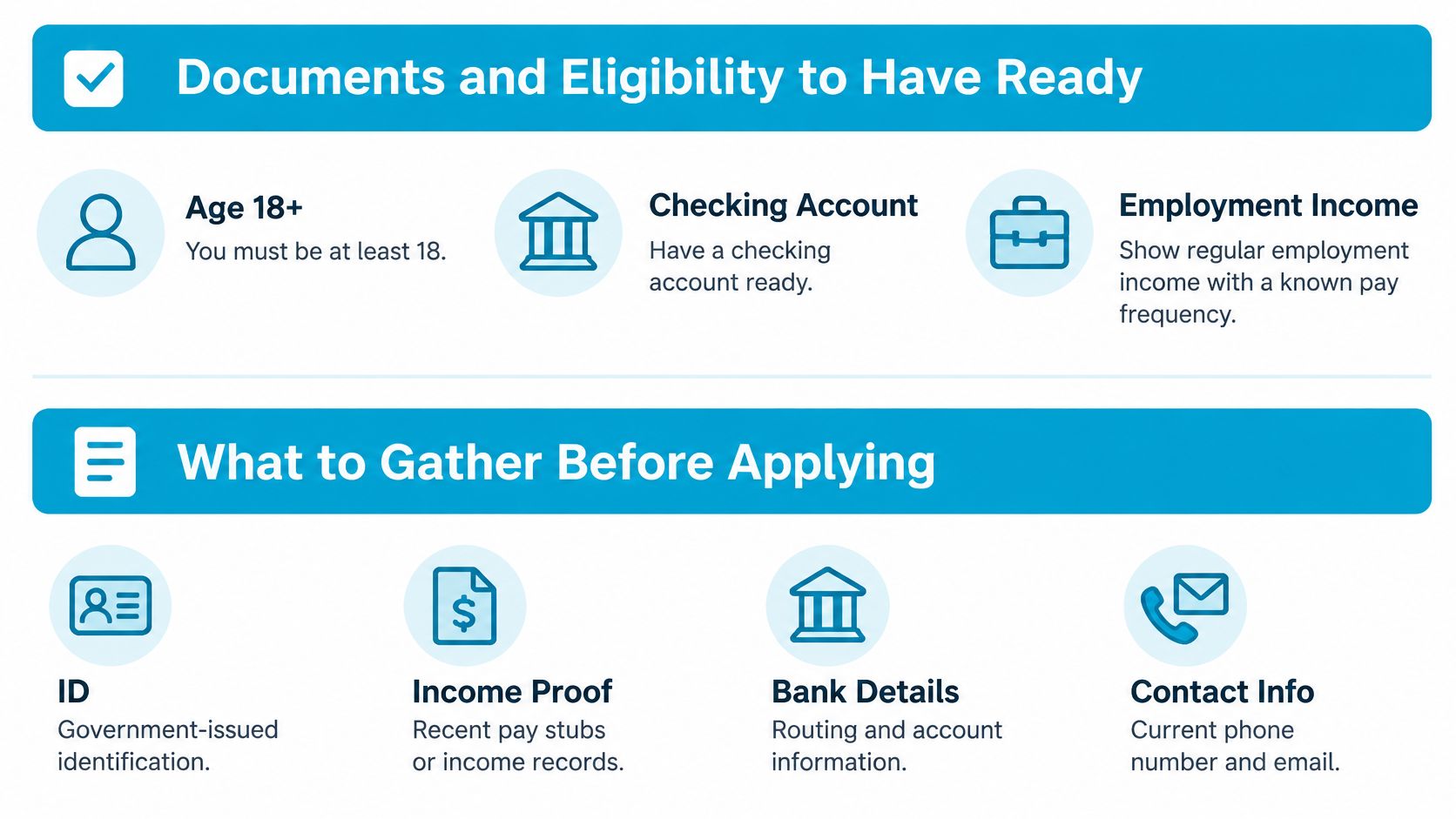
Your application checklist
- Identity: Have a valid government-issued photo ID and your Social Security number available. Use your legal name consistently.
- Income records: Gather recent pay stubs or bank statements in case the lender requests them. Know your employer's name and your pay frequency.
- Deposit information: Open your bank's account-details screen for the routing and account numbers. Your debit card number isn't your checking account number.
- Contact details: Use a current phone number and an email inbox you can access during the request.
- Purpose and amount: Write down the actual shortfall. Our form includes reasons such as debt consolidation, emergency situation, auto repair, medical, moving, rent or mortgage, wedding, and major purchase.
- Monthly obligations: List housing, utilities, existing loan payments, and other essentials so you can judge affordability before an offer arrives.
Prepare for circumstances that need explanation
Self-employed applicants should gather tax returns and bank deposit history, then confirm whether the responding lender accepts that income arrangement. Don't describe irregular business receipts as a regular paycheck just to make the form easier.
A recent job change may require an offer letter, your start date, or a new pay stub. Keep those records available, but upload only what the lender requests through its designated channel.
An account held solely in someone else's name may not satisfy the lender's deposit requirements. Use an account you're authorized to receive funds into, and resolve ownership questions before signing.
Before starting, make sure you can name the amount, explain the purpose, and locate the deposit account details without searching. Those are small preparations, but they remove unnecessary pauses.
How to Apply for a Personal Loan Step by Step
Our request process has three broad parts: request a loan, agree to terms, and get your money. The important work happens inside those stages, especially when you compare what you'll receive with what you'll repay.
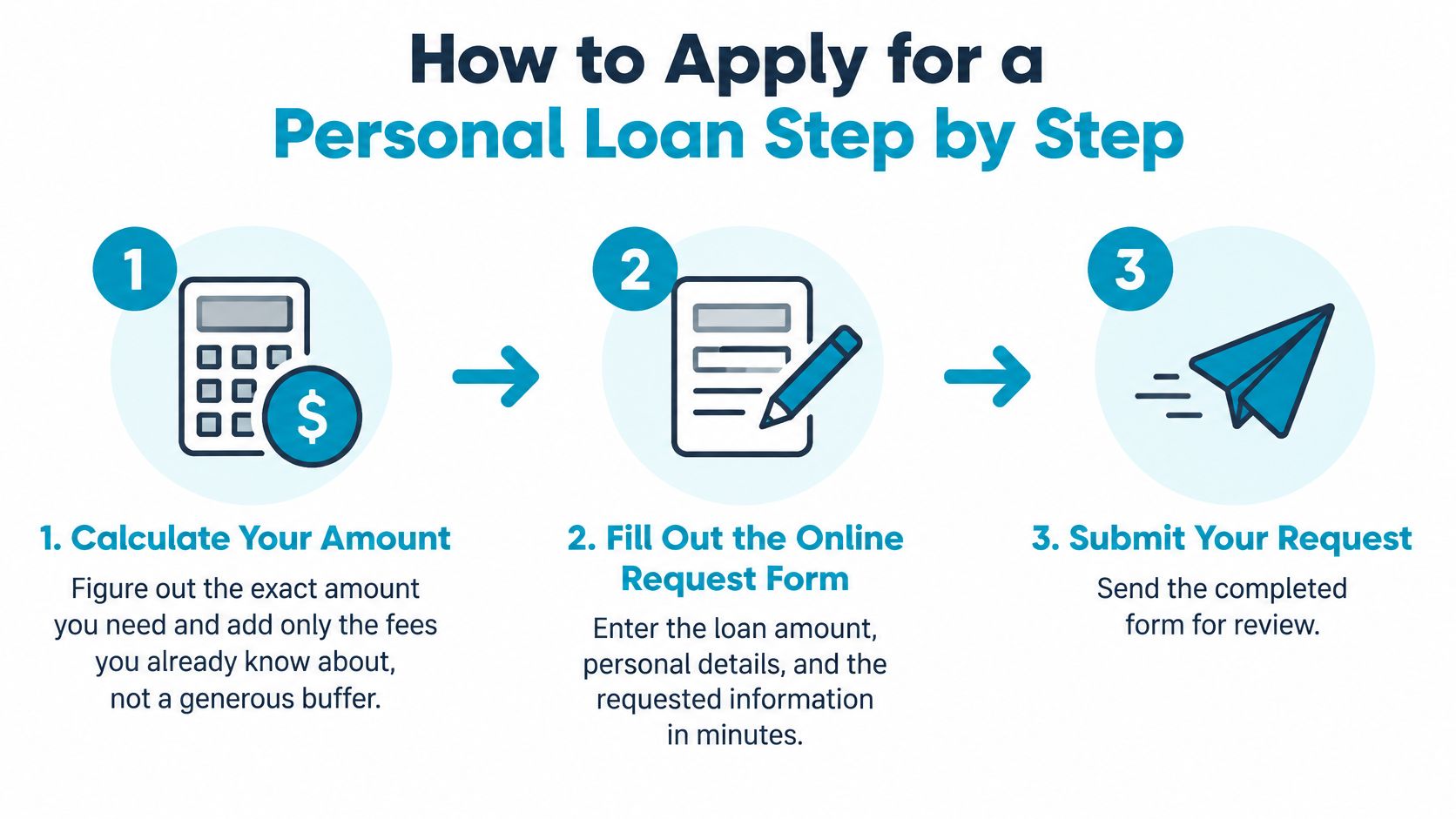
Build and submit an accurate request
Calculate the amount you need. Start with the bill or written estimate, subtract money you can safely contribute, and include only confirmed costs. Don't request a generous cushion when the form allows a larger amount, because you'll repay the extra borrowing too.
Complete the online request form. Our form takes minutes and asks for the loan amount, personal information, and where the funds should be deposited. Check the entries before submitting, particularly account numbers, since a transposed digit can create a problem that isn't obvious from the confirmation screen.
Compare the lender responses you receive. Put APR, origination or documentation fees, repayment term, and payment amount beside each other rather than choosing the first response. A common slip is comparing one offer's interest rate with another offer's APR, which doesn't give you a like-for-like cost comparison.
If the lender asks you to correct information, use its requested process rather than guessing at an answer. An accurate explanation of your income or employment is more useful than an application that looks tidy but conflicts with your documents.
Evaluate, accept, and verify
Check total repayment and net proceeds. Find both the amount arriving in your account and the total scheduled amount you'll repay, then check whether any fee is deducted before funding. A longer term can lower the payment while increasing total interest when other terms are comparable, so don't judge affordability from the monthly figure alone.
Read the agreement before electronically signing. Confirm the payment dates, payment method, rate structure, fees, and any early-repayment conditions. You accept the loan when you electronically sign the lender's offer and send it back, so don't treat that button as merely reserving a quote.
Confirm the deposit in your bank account. Check your available balance rather than relying only on an approval email or a funding notification. Don't commit the money to the repair shop or another bill until your bank shows that you can use it.
An offer is worth considering only if the money you receive solves the shortfall and the repayment schedule fits the budget you actually have.
Save the signed agreement somewhere you can find it without reopening the application. Keep the lender's name, servicing contact details, and payment instructions with it, because that lender handles questions after funding.
For automatic payments, note the withdrawal date in your calendar and compare it with your expected payday. Automation can help with organization, but it won't fix a payment scheduled before enough money reaches your account.
Speed Up Approval and Funding
Verify your routing and account numbers before submitting. Use your bank's own records, not a number copied from an old message, and confirm the account is open and can receive the deposit. Incorrect banking details can stall funding even after the lender has completed its review.
Keep employment and income entries consistent with your supporting records. If a form asks for gross income, don't enter take-home pay, and don't convert a pay frequency by guesswork. When the lender requests clarification, respond promptly through its designated channel after confirming who contacted you.
Common delays in a quick personal loan and how to fix them
| Delay | Likely cause | Fix |
|---|---|---|
| No lender response after several minutes | Incomplete form, incorrect contact details, or review still underway | Check fields and contact details, then confirm submission |
| Verification request still open | Missing or unreadable identity or income documents | Send clear, complete images through the requested channel |
| Deposit hasn't arrived by the expected business day | Incorrect account details, a closed account, or processing still underway | Compare details with bank records, then contact the lender |
| Request sent on a weekend or holiday | A required review or funding step awaits business-day processing | Confirm the lender's next processing date rather than resubmitting |
| Offer declined or reduced | Requested amount doesn't meet the lender's affordability or credit criteria | Consider a smaller affordable amount, a co-borrower only if allowed, or alternatives |
| Repeated requests complicate follow-up | Multiple applications or duplicate records | Track the original request before starting another |
Fix the bottleneck, not the whole application
A pending request doesn't tell you whether the hold-up is identity verification, underwriting, or bank processing. Ask the lender what remains outstanding, who needs to act, and when the next update is expected. Those answers are more useful than submitting the same information again.
Once qualified, funds are sent directly to your bank account, usually within one business day. That's a typical processing timeline, not a guarantee that every request submitted late on Friday produces spendable money immediately afterward.
You can control document quality, accurate entries, and your response to legitimate questions. You can't control the lender's underwriting decision, final terms, or the receiving bank's posting process.
When a deadline is close: Tell the biller you're arranging payment and ask what flexibility exists. Don't promise a payment date based only on a pending loan request.
If the lender's stated timeline passes, contact it directly with your request reference and the date of your last completed action. Resubmitting doesn't resolve an existing verification issue and can make it harder to track which application needs attention.
How a Marketplace Speeds Up Matching
Applying directly means choosing a lender before you know whether its criteria fit your situation. A marketplace changes that starting point: you complete a shared intake, and participating lenders can evaluate the request without asking you to begin every search from scratch.
Our role at NextStopLoans is to connect you with a lender from our approved network. Independent lenders make credit decisions, present terms, and handle funding. They're standing by to respond in minutes, but matching quickly doesn't remove their underwriting requirements.
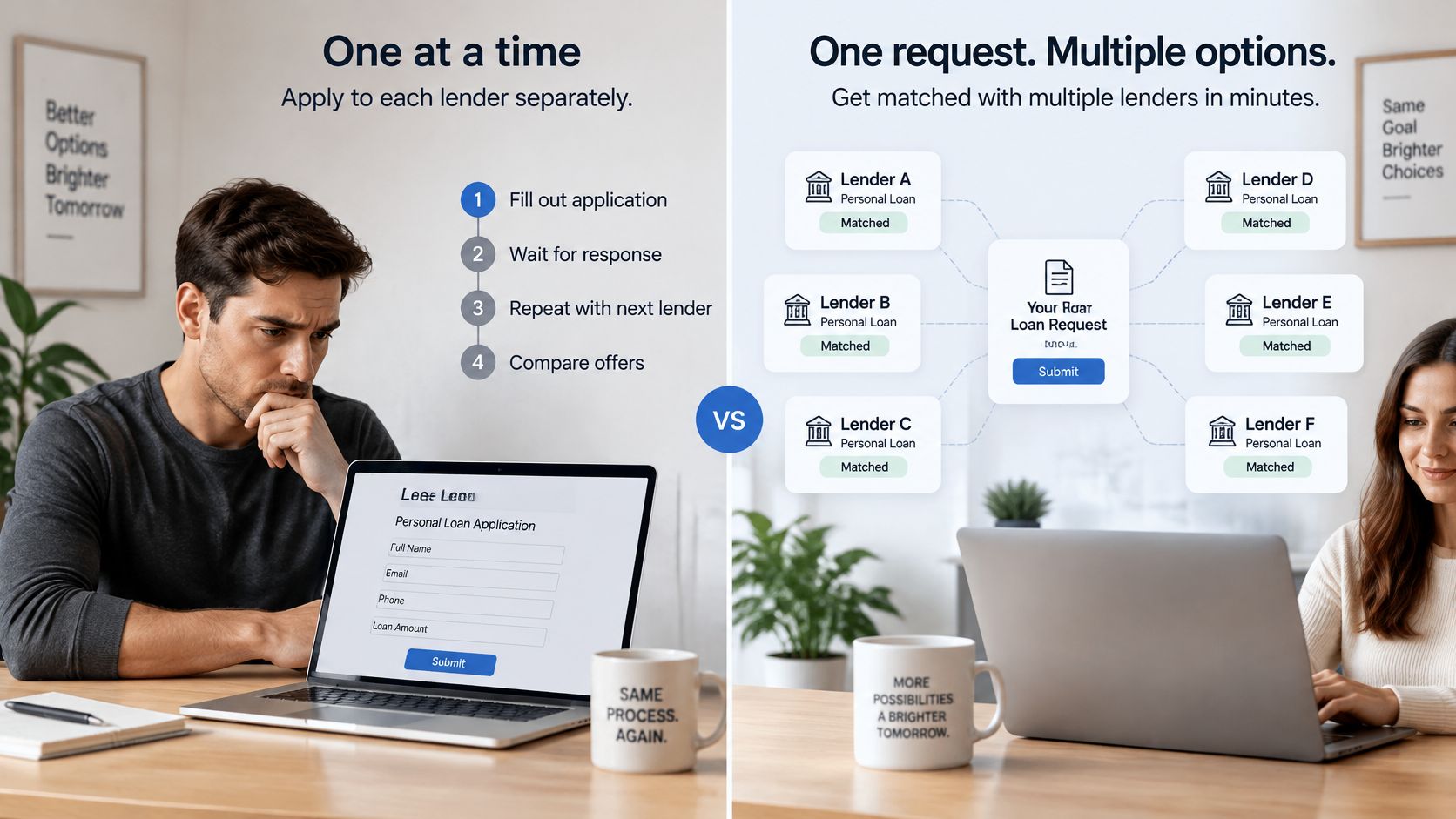
Where the time saving comes from
Suppose you want lenders to consider the same repair bill, income information, and requested amount. A shared request reduces repeated typing and lets participating lenders assess those details through the network. It doesn't mean every lender will respond or that you'll receive competing offers.
Our explanation of quick credit matching describes the connector model. The practical advantage is less repeated intake, not a special exception to a lender's approval standards.
Understand the boundaries
- Credit checks: We don't pull your credit. Participating lenders may check major and alternative credit bureaus, so don't assume every lender evaluation is inquiry-free or that multiple evaluations create only one inquiry.
- Borrower profiles: Our network includes lenders that consider different borrower circumstances, including information beyond traditional credit scores. Poor credit still doesn't guarantee an offer.
- Location: The service is for eligible U.S. residents and isn't available everywhere. Excluded states include Arkansas, New York, Vermont, and West Virginia.
- Choice: You aren't obligated to accept an offer. A response is an opportunity to review terms, not an instruction to borrow.
A marketplace makes sense if you're in a covered state and want a shared request considered across a lender network. If you already know which lender you want and have confirmed its requirements, applying directly may be simpler.
Confirm the Terms Before You Accept an Offer
The fastest money isn't automatically the best solution. Start with the shortfall and your next pay cycle, not the headline funding speed.
Before accepting, answer these questions:
- How much is necessary? Separate the urgent bill from expenses that can wait.
- When is repayment due? Compare the first payment date with incoming pay and existing withdrawals.
- What will borrowing cost? Check the disclosed finance charge, origination and documentation fees, and separate charges that could apply after missed payments.
- What remains after essentials? Leave room for housing, food, utilities, transport, and existing debt payments.
Compare ways to solve the shortfall
Quick loan versus alternatives for a small shortfall
| Option | Cost and risk | Best when |
|---|---|---|
| Personal installment loan | Scheduled payments; origination charges may apply, with separate late-payment penalties | The shortfall fits an affordable repayment schedule |
| Credit card paid off quickly | Interest treatment follows the card's terms and grace-period eligibility | You can clear the balance promptly and have checked the actual cost |
| Employer or community assistance | Grants may require no repayment; advances may reduce future pay | An available program covers the expense |
| Negotiating a medical or utility bill | May reduce the bill or spread payments without a new loan | The biller offers an affordable arrangement |
| Buy now, pay later | Scheduled withdrawals can expose a tight account to overdraft or nonsufficient-funds fees | Every scheduled payment fits after essentials |
Among BNPL users, 11% incurred an overdraft or nonsufficient-funds fee, rising to 18% among people with less than $100 in emergency savings, according to the Federal Reserve's Consumer & Community Context. A low advertised financing cost doesn't remove the risk of an unaffordable withdrawal.
Read the costs that speed can hide
Use our guide to personal loan APR and rates to distinguish the interest rate from the broader borrowing cost. Then read the actual agreement's total repayment, fee schedule, and missed-payment provisions.
Origination, documentation, and other additional fees may apply to online personal loans. Late-payment, non-payment, and other penalties may also apply, so check those separately rather than assuming the advertised payment captures every possible charge.
If you expect difficulty meeting a scheduled payment, contact the lender as soon as possible, preferably before the due date. You can decline any offer that doesn't fit, even when you need money urgently.
NextStopLoans connects eligible borrowers with independent lenders through a single online request, helping reduce repeated applications when timing matters. Gather your income and bank details, decide what payment you can afford, and visit NextStopLoans to request lender consideration without an obligation to accept an offer.