
Personal Loan APR Rates: A 2026 Borrower Guide

You're comparing two personal loan offers, and the lower advertised interest rate appears to be the obvious winner. Then you notice that one lender charges an origination fee while the other doesn't. The monthly payments look close, but the amount you receive and the total amount you repay may tell a different story.
That's why personal loan APR rates matter more than the interest rate alone. APR gives you a standardized way to compare borrowing costs after considering the interest rate and certain mandatory fees. It won't answer every question about a loan, but it gives you a much clearer starting point for comparing lenders, terms, and fee structures.
Table of Contents
- What Personal Loan APR Actually Means
- How APR Is Calculated Step by Step
- Typical APR Ranges by Credit Tier and Term
- Fees vs APR and the True Cost of a Loan
- How APR Shapes Your Monthly Payment
- Why Comparing Multiple Offers Changes Your APR
- A Practical APR Checklist Before You Apply
What Personal Loan APR Actually Means
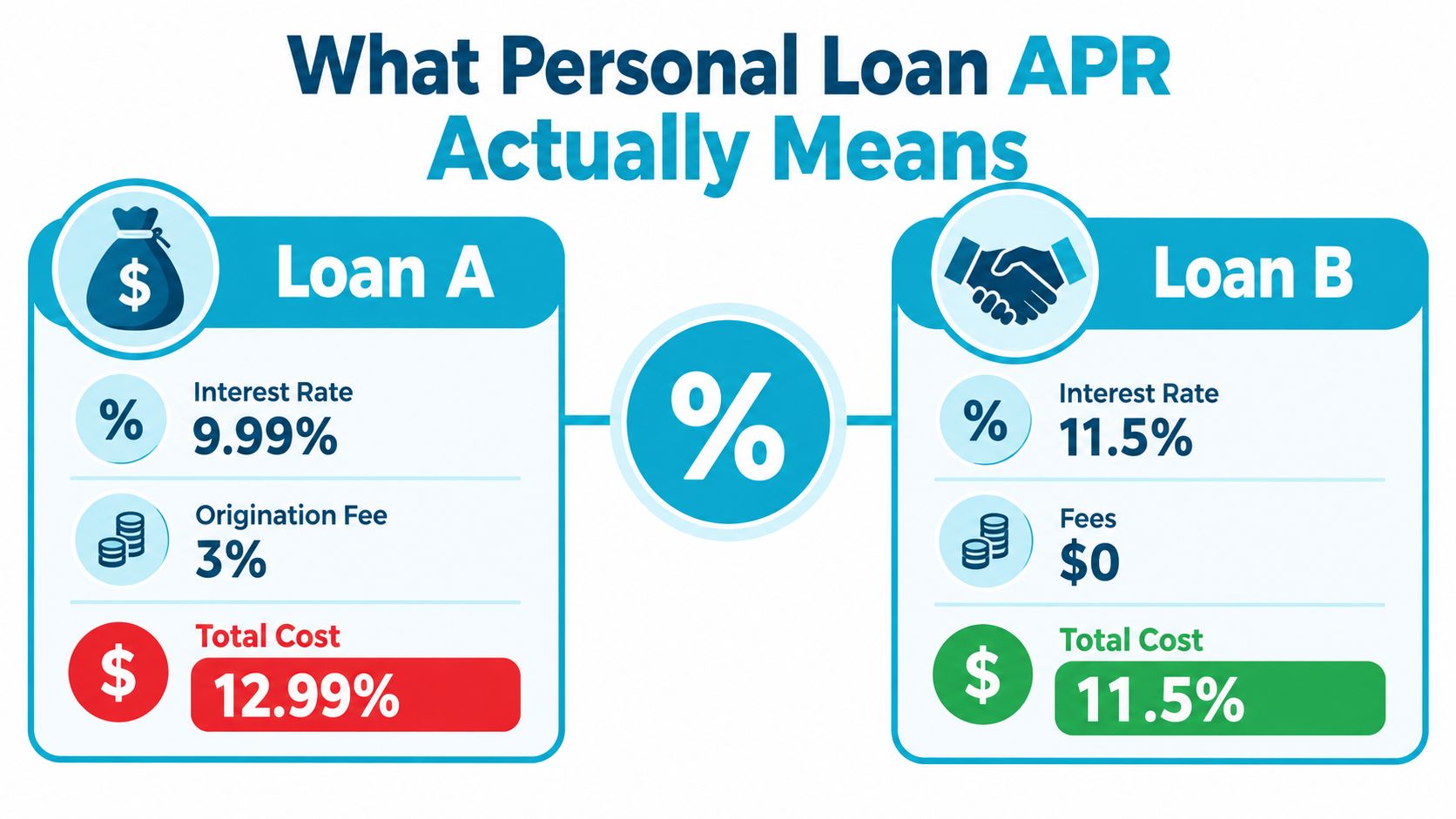
Maya needs the same amount of cash from either lender. Loan A advertises a 9.99% interest rate and charges a 3% origination fee. Loan B advertises an 11.5% interest rate with no fee. The lower headline rate makes Loan A look cheaper, but the fee reduces the money Maya receives. The better comparison depends on the loan's interest, fees, term, and repayment schedule together.
APR, or annual percentage rate, is the annualized cost of borrowing expressed as a percentage. The interest rate measures the charge applied to the borrowed balance. APR adds certain required finance charges, such as an origination fee, and expresses the combined cost in an annual format. The Federal Reserve's explanation of APR benchmarks and lending costs provides context for viewing borrowing costs as part of a broader credit market rather than as one isolated number.
Interest rate and APR answer different questions
The interest rate asks, “What percentage does the lender charge for the money borrowed?” APR asks, “What annualized cost results after eligible required fees are included?” Two loans can carry the same interest rate and still have different APRs because their fee structures differ.
For a fixed-rate, fixed-term personal loan, APR serves as a cost yardstick. It helps you compare offers for a similar purpose, amount, and repayment period. A loan with a slightly higher interest rate may still have a competitive APR if it charges fewer fees, while a lower advertised rate may become less attractive after an origination charge.
Lenders disclose APR under federal Truth in Lending requirements, giving borrowers a consistent figure to review. The disclosure does not replace the payment amount or total repayment figure. It gives you a clearer way to compare the borrowing cost before choosing an offer.
APR isn't your monthly payment
APR and the amount due each month measure different parts of the loan. The monthly payment also depends on the principal, repayment term, and the lender's amortization schedule. A longer term can lower the monthly bill while giving interest more time to accrue.
APR also does not guarantee that every borrower will receive the same offer. Market ranges commonly run from 6.24% to 35.99% APR. Your credit profile, loan size, term, lender type, and fee structure can change the rate and APR you are shown.
A practical comparison uses APR to examine borrowing cost, then checks the cash received, monthly payment, and total repayment amount separately. That process shows how changing a term, selecting another lender, or avoiding a fee can produce a meaningfully different result for the same borrower.
How APR Is Calculated Step by Step
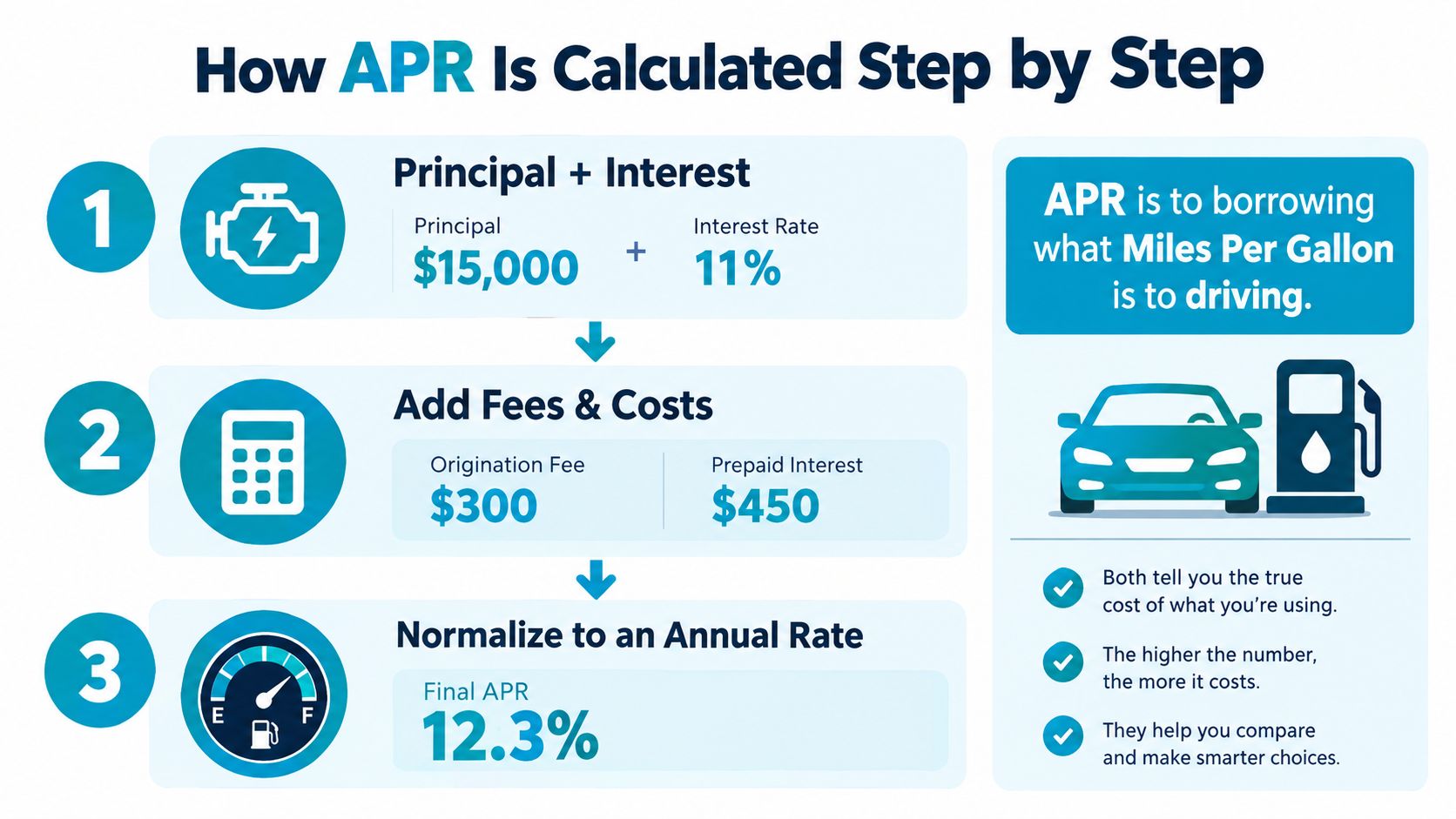
APR is easier to understand if you treat it like a measurement designed for comparison. APR is to borrowing what miles per gallon is to driving. Vehicles can have different tank sizes and fuel prices, so miles per gallon creates a common measure. APR performs a similar function for loans by normalizing interest and certain fees into an annual percentage.
Start with the loan's principal and interest. Then identify the finance charges that must be included in the disclosure. Finally, calculate the annualized rate that reflects the timing of payments and the amount the borrower receives.
A simple worked example
Consider a hypothetical $10,000 personal loan with a 36-month term, a 10% interest rate, and a 5% origination fee. The fee equals $500. If the lender deducts that fee from the proceeds, the borrower receives less than the stated principal even though repayment is based on the loan contract's balance.
The headline interest rate reflects the scheduled interest on the loan balance. APR adds eligible fees to the cost calculation, then compares the resulting finance cost with the funds made available to the borrower over the repayment schedule. Because the borrower receives less cash while still making payments under the note, the resulting APR is higher than the advertised interest rate.
The precise calculation uses an actuarial formula. That formula considers the payment amount, payment frequency, timing, principal, and finance charges. It isn't a matter of adding the fee to the interest rate. Amortization also matters because each payment changes the outstanding balance, which changes the interest portion over time.
Read the disclosure, not just the advertisement
APR captures eligible costs, but it doesn't replace a full review of the loan agreement. Check whether the rate is fixed, whether the lender charges late fees, and whether any prepayment penalty applies. A lender can present the same APR as another lender while using different policies for fees that may arise after closing.
The Consumer Financial Protection Bureau's guidance on loan cost disclosures can help you understand why the APR, finance charge, amount financed, payment schedule, and total of payments should be reviewed together. APR is the comparison tool. The contract determines what happens during the life of the loan.
Typical APR Ranges by Credit Tier and Term
A borrower can receive different APRs for the same loan amount by changing the repayment term, applying with another lender type, or choosing an offer with a different fee structure. Personal loan pricing has a broad spread because banks, credit unions, online lenders, and marketplace platforms assess risk and costs differently. Published market ranges commonly extend from 6.24% to 35.99% APR, according to Credible's personal loan marketplace information. That range describes possible pricing across borrowers, loan sizes, lenders, and terms, not a personal rate prediction.
Term length can shift pricing even for a strong borrower. Recent prequalification data showed borrowers with FICO scores of 720 or higher averaging 14.31% APR on three-year loans and 18.56% on five-year loans, according to Bankrate's market coverage. The longer term was more than 4 percentage points higher in that comparison. A smaller monthly payment can therefore come with a higher APR and more time for interest to accrue.
The verified data does not support precise ranges for every FICO band. Use the table as a comparison framework, not a rate promise.
| Credit Tier | FICO Score | 24-Month Term APR | 36-Month Term APR | 60-Month Term APR |
|---|---|---|---|---|
| Excellent | 780+ | Often among the lowest available offers | Often below broader market averages | Can rise with longer repayment |
| Good | 700 to 779 | May qualify for competitive pricing | Around the range reflected by recent market benchmarks | Usually higher than shorter terms |
| Fair | 640 to 699 | Pricing can move materially higher | Recent lender-backed data reached 27.35% for fair credit | Recent data reached 29.46% for fair credit |
| Poor or thin-file | Below 640 | May approach the upper end of lender pricing | May approach the upper end of lender pricing | Can be limited or expensive |
The fair-credit figures come from the Wall Street Journal Buy Side personal loan coverage. Its reported three-year averages ranged from 11.12% for excellent credit to 27.35% for fair credit, while five-year fair-credit rates reached 29.46%.
Personal loans sit in a mixed cost category
Personal loans generally use fixed payments, unlike revolving credit cards, but their APRs can vary widely. Auto loans use collateral, which can affect pricing differently from an unsecured personal loan. Payday products follow separate structures, so compare their total repayment obligations rather than their headline pricing with an installment loan.
A borrower researching personal loans for a 500 credit score should expect lender availability and terms to vary. One advertised APR is not a reliable approval expectation. Compare the term, lender type, and fee structure together, because changing any of them can change the APR and the cash available from the loan.
Fees vs APR and the True Cost of a Loan
The advertised interest rate can look identical across two offers while the borrower's cost differs. Consider two lenders offering a 9.99% interest rate on comparable loans. Offer A has no origination fee. Offer B charges a 5% origination fee. Offer B's APR should be higher because the borrower pays a fee in addition to interest.
| Feature | Offer A, No Fee | Offer B, 5% Origination |
|---|---|---|
| Advertised interest rate | 9.99% | 9.99% |
| Origination charge | None | 5% of the loan amount |
| Cash received | Closer to stated principal | Reduced if fee is deducted |
| APR | Closer to advertised rate | Higher than advertised rate |
| Main comparison question | What is the total repayment? | What is the total repayment after the fee? |
How lenders handle origination fees
Some lenders deduct the origination charge from the proceeds. If you request a particular principal amount, the deposit can be lower than that amount. Other lenders add the fee to the balance, which can increase the amount you repay and may increase the interest charged over time.
That's why the right question isn't “Which offer has the lowest interest rate?” Ask instead, “Which offer gives me the cash I need at the lowest total cost?” A no-fee loan with a slightly higher interest rate may leave you with more usable money and a lower overall cost than a fee-loaded loan with a lower headline rate.
Review the lender's rates and fees information before accepting an offer. Look for origination, processing, late-payment, returned-payment, and prepayment terms. APR helps incorporate certain charges, but your own comparison should also show the amount deposited, monthly payment, and total of payments.
A low advertised rate can be expensive if the fee reduces the money you receive.
How APR Shapes Your Monthly Payment
A loan's monthly payment depends on three central inputs: principal, APR or interest rate, and term. The term changes the balance between affordability today and total interest over time. A longer schedule generally produces smaller payments, but it gives interest more time to accumulate.
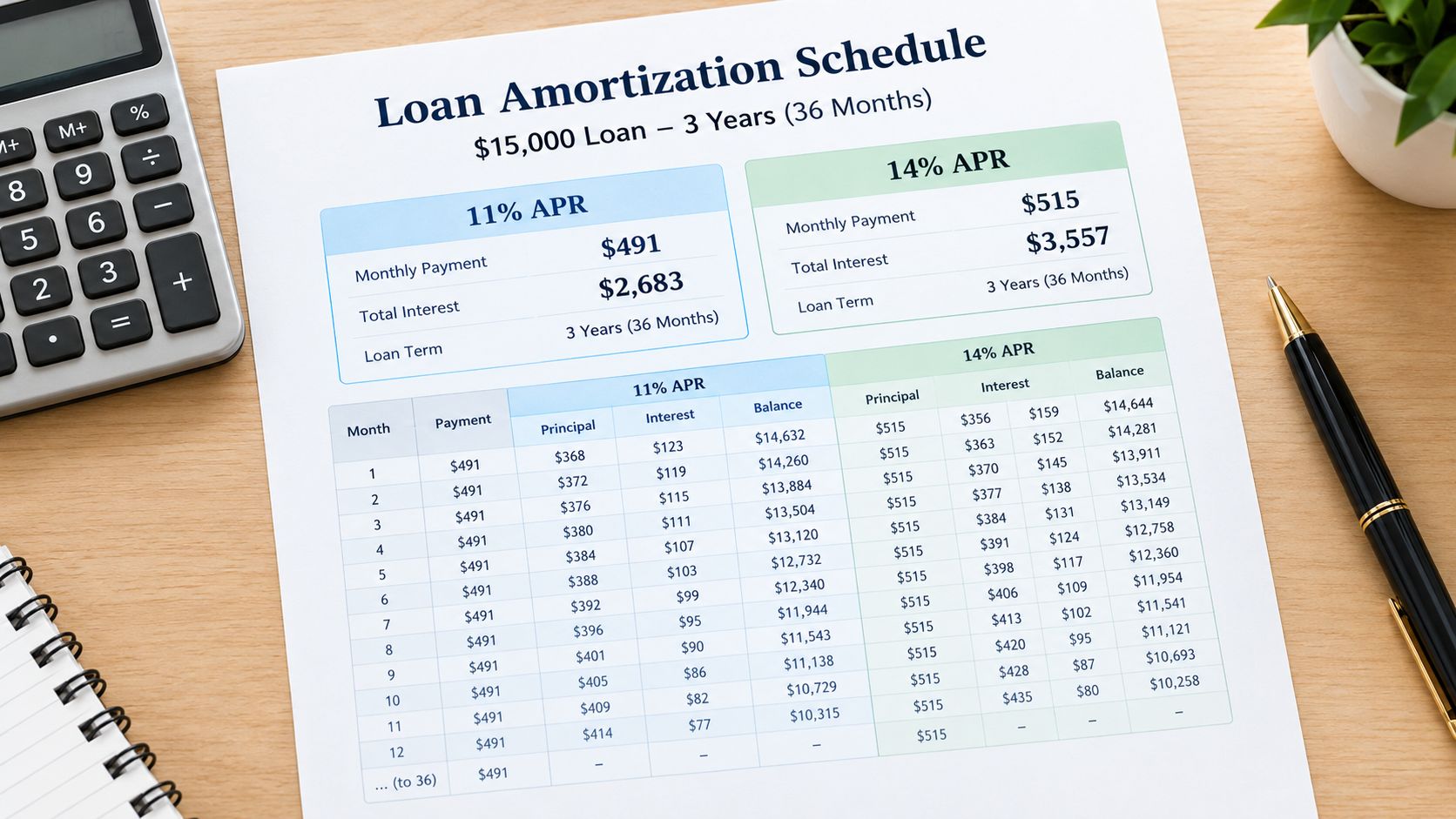
For a clean illustration, consider a $15,000 loan under two terms and two APR scenarios. These are amortization-style examples using fixed-rate payment mechanics. They're intended to show how the variables interact, not to predict a lender's exact quote.
| Loan Terms | 11% APR | 14% APR | What Changes |
|---|---|---|---|
| 36 months | Higher monthly payment, lower total interest | Higher monthly payment and higher total interest | The rate increase raises both payment and cost |
| 60 months | Lower monthly payment, more time accruing interest | Lower than the three-year payment, but more total interest | The longer term eases cash flow but extends repayment |
Moving from 11% to 14% APR raises the payment for either term because the lender charges more for the same borrowed balance. Choosing five years instead of three years lowers the required monthly amount, but the borrower makes payments for longer and generally pays more interest overall. Exact dollar totals depend on the payment calculation and whether fees are financed.
Don't let a smaller payment decide for you
A payment that fits your budget is important, but it doesn't show the full price. Ask each lender for the payment, total repayment, finance charge, APR, and net proceeds in writing. Then compare offers with the same principal and term so you aren't mistaking a longer schedule for a cheaper loan.
Shopping can change the outcome before you negotiate anything. One lender may price a three-year loan more favorably, while another may offer a better fee structure or a more competitive five-year option. The best comparison reflects the loan you can comfortably repay, not just the smallest number displayed in a payment calculator.
Why Comparing Multiple Offers Changes Your APR
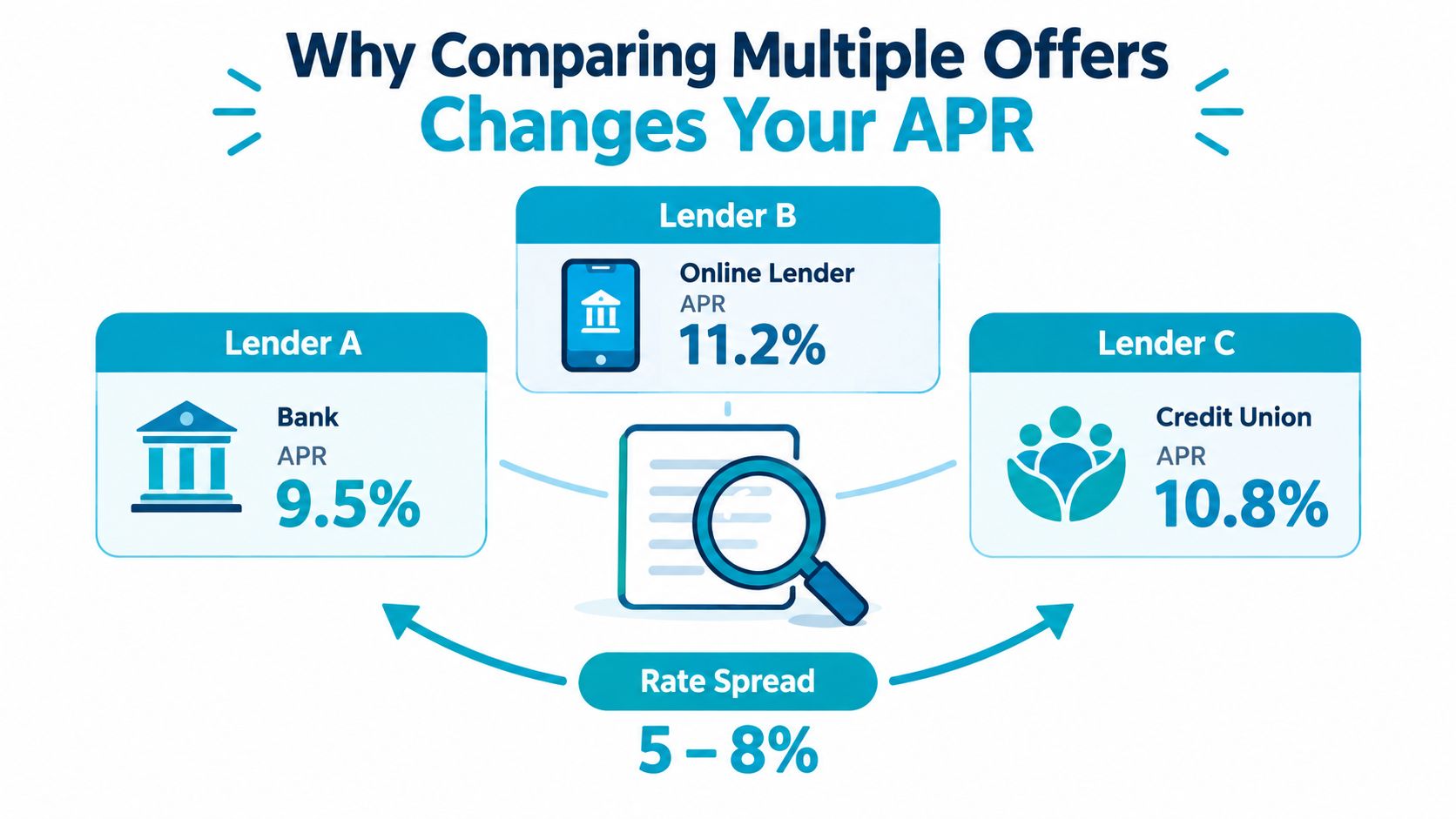
Suppose the same borrower requests one loan from a bank, one from a credit union, and one from an online lender. The borrower's income and credit history have not changed, yet the APRs may differ meaningfully. Each lender weighs credit history, income, existing debt, loan purpose, requested amount, and repayment term through its own underwriting rules.
The term and fee structure can change the result too. A lender might price a three-year loan more favorably, while another offers a lower APR for five years or charges a different origination fee. Shopping therefore changes more than the lender name. It can change the price attached to the same borrowing plan.
Every lender sees a different version of your risk
A bank may place more weight on an established relationship and verified income. A credit union may consider membership and account history. An online lender may evaluate a broader set of data points. None guarantees a lower APR, but these different methods can produce different offers for one applicant.
Before applying, review personal loan eligibility factors so you understand the information lenders may assess. Prequalification can then make comparisons easier when the lender uses a soft credit inquiry. Enter the same amount and loan purpose across several channels, record each APR and fee structure, and compare the results before deciding whether to submit a full application.
Compare the offer, not only the lender name
Hold the main variables steady by requesting the same principal and term. Then record:
- APR: Use it for the percentage comparison.
- Net proceeds: Confirm the amount deposited after fees.
- Monthly payment: Check whether the schedule fits your budget.
- Total repayment: Measure the full contractual cost.
- Flexibility: Review late fees, prepayment rules, and funding conditions.
A lower advertised rate may not produce more cash in your account if its fees are higher. A longer term may reduce the required payment while increasing the time interest accrues. Compare the complete offer, then choose the term and fee structure that fit both your budget and repayment plan. Rate shopping reveals which combination works for your circumstances, not merely which lender displays the smallest number.
A Practical APR Checklist Before You Apply
Use this checklist to turn rate shopping into a comparable process rather than a series of disconnected quotes.
Check your credit information first. Review your credit files and scores from the major bureaus for errors or unexpected balances. The useful output is a clear picture of the credit profile lenders are likely to evaluate.
Set one borrowing target. Decide the exact loan purpose and amount you need before requesting quotes. Changing the amount between lenders makes APR comparisons less reliable because loan size can affect pricing and fees.
Start with prequalification. Look for a process that clearly states whether it uses a soft inquiry. A soft inquiry generally allows you to review potential terms without treating the initial rate check like a full application, but confirm the lender's disclosure before proceeding.
Separate the headline rate from the APR. Write both figures in your comparison notes. Then add the origination fee, late-payment policy, prepayment terms, amount financed, and net proceeds.
Compare the same term. A three-year offer and a five-year offer aren't interchangeable. Compare the APR and total repayment for the same schedule first, then decide whether a different term improves affordability without creating an excessive total cost.
Calculate the cash-flow effect. Record the monthly payment and total repayment side by side. The lower monthly payment isn't automatically the less expensive option.
Review more than one lender. Banks, credit unions, online lenders, and marketplace services may assess the same application differently. A marketplace such as NextStopLoans can route one secure loan request to participating third-party lenders, while the lenders themselves make the decisions and set the terms.
Re-shop after a denial or changed offer. A denial from one lender doesn't establish your market-wide eligibility. Review the reason, correct any application issue, and compare other lenders without submitting unnecessary full applications.
The most controllable part of your APR outcome is disciplined comparison. Gather comparable offers, focus on net proceeds and total repayment, and choose a payment schedule you can maintain.
NextStopLoans lets eligible U.S. consumers submit a secure online loan request that participating third-party lenders can evaluate, with APR and fee details presented during the process. Visit NextStopLoans to review a potential lending match and compare the terms before accepting any offer.