
Payday Loans What Is It? How They Work and What They Cost
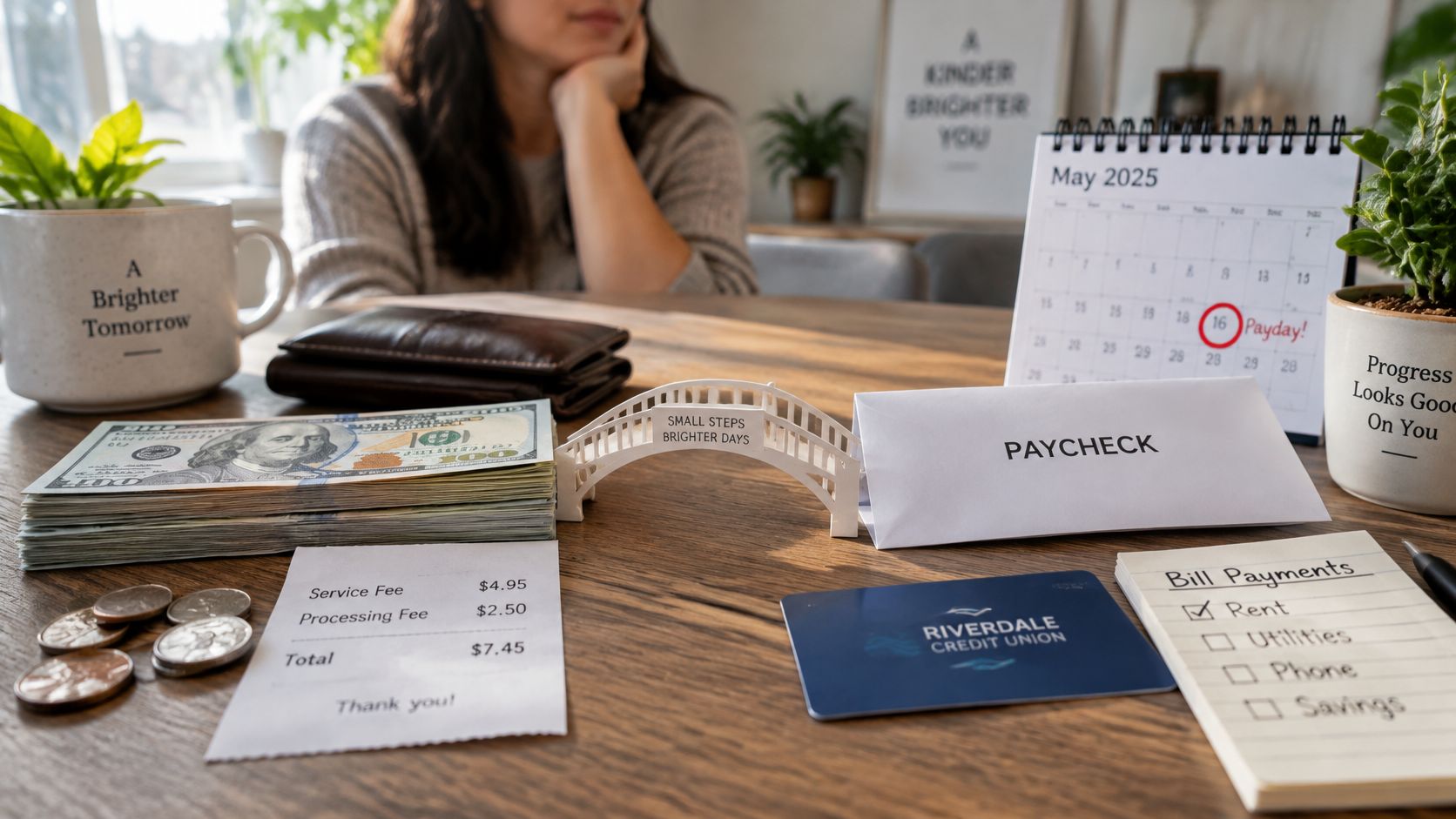
A payday loan is a small, short-term loan, usually a few hundred dollars, due on the borrower's next payday, and it typically costs about $15 for every $100 borrowed. A typical U.S. storefront loan runs a median of $350 over 14 days, and once you annualize that two-week fee, the implied rate lands near 391%.
So how can a charge of $15 per $100 be a modest sum in one sentence and a 391% loan in the next? Both numbers are accurate. They measure one cost on two different scales, and the gap between those scales explains almost everything about this product.
If you've ever searched "payday loans what is it" and waded through pages of jargon, start here: the mechanics are simple, the price is not, and the distance between the two is what follows, term by term and dollar by dollar.
Table of Contents
- What a Payday Loan Is and How It Works
- What a Payday Loan Really Costs
- What Happens When You Cannot Repay on Time
- Why Borrowers Use Them and What Lenders Require
- Cheaper Alternatives to Consider First
- Confirm the Terms Before You Borrow
What a Payday Loan Is and How It Works
Strip away the storefront sign, the neon, and the app screen, and the deal underneath keeps the same shape. You borrow a few hundred dollars, you owe the whole amount back on your next payday, and you pay a flat charge for the two weeks in between.
The Consumer Financial Protection Bureau's payday loan research describes a typical U.S. storefront loan as a median of $350 borrowed for 14 days at a median fee of $15 per $100, which annualizes to an implied rate near 391%, and counts more than 12 million borrowers using the product each year across the 26 states where it isn't prohibited.
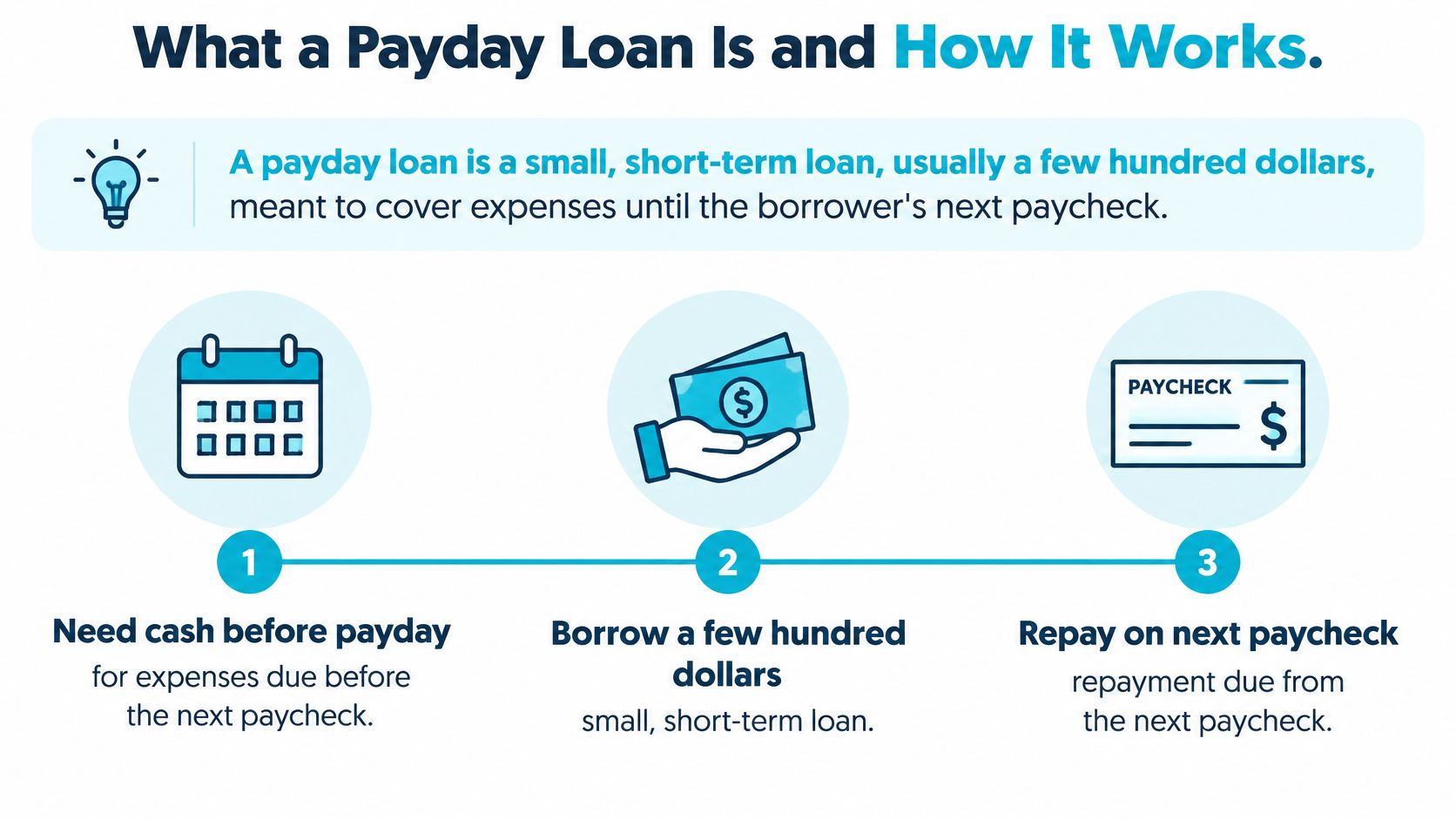
Think of the loan as a short bridge, not a long road. It spans the gap between the cash you have today and the paycheck that lands on Friday, and lenders price it by the span, which is why the cost is quoted per two weeks rather than per year. Nothing in the design carries you past the next payday.
The Five Steps of the Cycle
- Apply. You show proof of income and an active bank account, at a branch or online.
- Set the due date. The lender ties repayment to your next payday, usually about 14 days out.
- Hand over access. You write a post-dated check or authorize an automatic withdrawal from your account.
- Repay in full. On the due date, principal and fee leave your account together.
- Renew if the money isn't there. A rollover charges another fee and leaves the principal untouched.
That fifth step is where costs escape the two-week frame and start behaving like a subscription.
Availability is a state question, not a national one. Some states ban the product outright, others cap the fee, limit renewals, restrict loan amounts, or set maximum terms, so what a lender can legally offer you depends on where you live. App-based and employer-linked versions change the delivery channel, not the structure: fast access, a due date attached to the next payday, and repayment pulled from your bank account.
What a Payday Loan Really Costs
Payday lenders don't quote an interest rate. They quote a price per hundred dollars borrowed, and that habit is the reason the sticker price looks harmless.
The CFPB's breakdown of payday loan costs and fees reports that fees commonly range from $10 to $30 per $100 borrowed, with $15 per $100 the common case, so borrowing $300 at that rate requires $345 back after roughly two weeks. On a two-week term, the Federal Trade Commission's arithmetic turns that $15 fee into an annual percentage rate of approximately 391%.
Three fee levels, one $300 loan, one 14-day term:
| Fee per $100 borrowed | Fee on $300 | Total repaid after 14 days | Approximate APR (14-day term) |
|---|---|---|---|
| $10 (low end) | $30 | $330 | about 261% |
| $15 (common) | $45 | $345 | about 391% |
| $30 (high end) | $90 | $390 | about 782% |
The Arithmetic in Three Steps
- Fee as a share of the loan. Divide the fee by the amount borrowed. $15 on $100 is 15%.
- How many terms fit in a year. Divide 365 by the term length. 365 divided by 14 is about 26.
- Annualize. Multiply 15% by 26 and the answer lands near 391%.
Nothing in that math is a penalty or a hidden charge. The rate is high because the window is short: the same 15% stretched across a full year would be an ordinary price for credit, and compressed into 14 days it isn't.
Rule of thumb: multiply the fee per $100 by the number of hundreds you're borrowing and you have the real price in dollars. Do that first, then look at the annual rate, because the dollar figure is what leaves your account.
Scale it and the dollars grow with the balance. Borrow $500 at $15 per $100 and the fee is $75, still due in two weeks. That annual figure sits far above what a credit card or a personal installment loan charges, which is the comparison that matters when you're choosing between products rather than between lenders. Published payday loan rates are worth checking against this math, since a fee schedule and an APR are two views of the same number.
Each renewal starts the fee clock again on money you already owe. The flat fee and the annual rate measure the same cost on different scales, and repetition is what turns a two-week price into a year-long one.
What Happens When You Cannot Repay on Time
A missed payday-loan payment can lead to more than one fee. What happens next depends on your loan agreement and the lender's policies.
Where the Fees Land
A $400 loan at $15 per $100 costs $60 in fees. If you pay that fee and renew the loan six times, you'll have paid $420 in fees while still owing the original $400. The fees can overtake the amount borrowed even though the principal has not gone down.
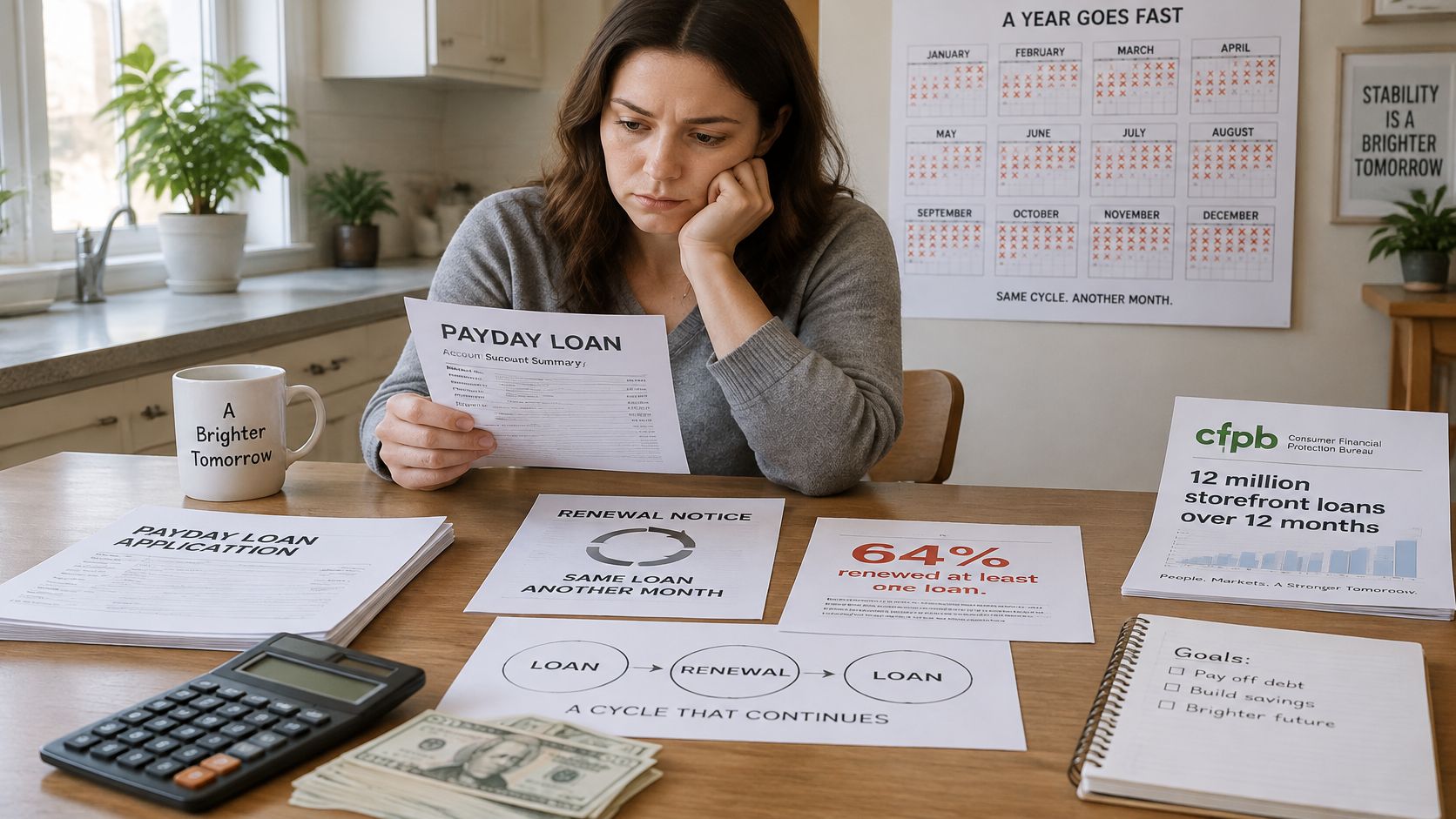
A missed payment may also lead to a late fee, referral to a collection agency, or reporting to a consumer credit agency. Some lenders may automatically renew a past-due short-term loan, adding charges set by the lender. Check your agreement for this term. If you cannot pay on the scheduled date or make an installment, contact your lender as soon as possible and ask what options are available.
App-Based Lending Repeats the Pattern
An app does not necessarily make short-term borrowing easier to repay. App-based products can follow the same repeat-borrowing pattern as storefront payday loans: a borrower repays one loan, then takes another to cover the next cash gap.
The CFPB account-debit rule generally prevents a covered lender from making more withdrawal attempts after two failed attempts unless the borrower gives new authorization. That can limit further bank fees, but it does not erase the loan balance or other charges you owe.
Why Borrowers Use Them and What Lenders Require
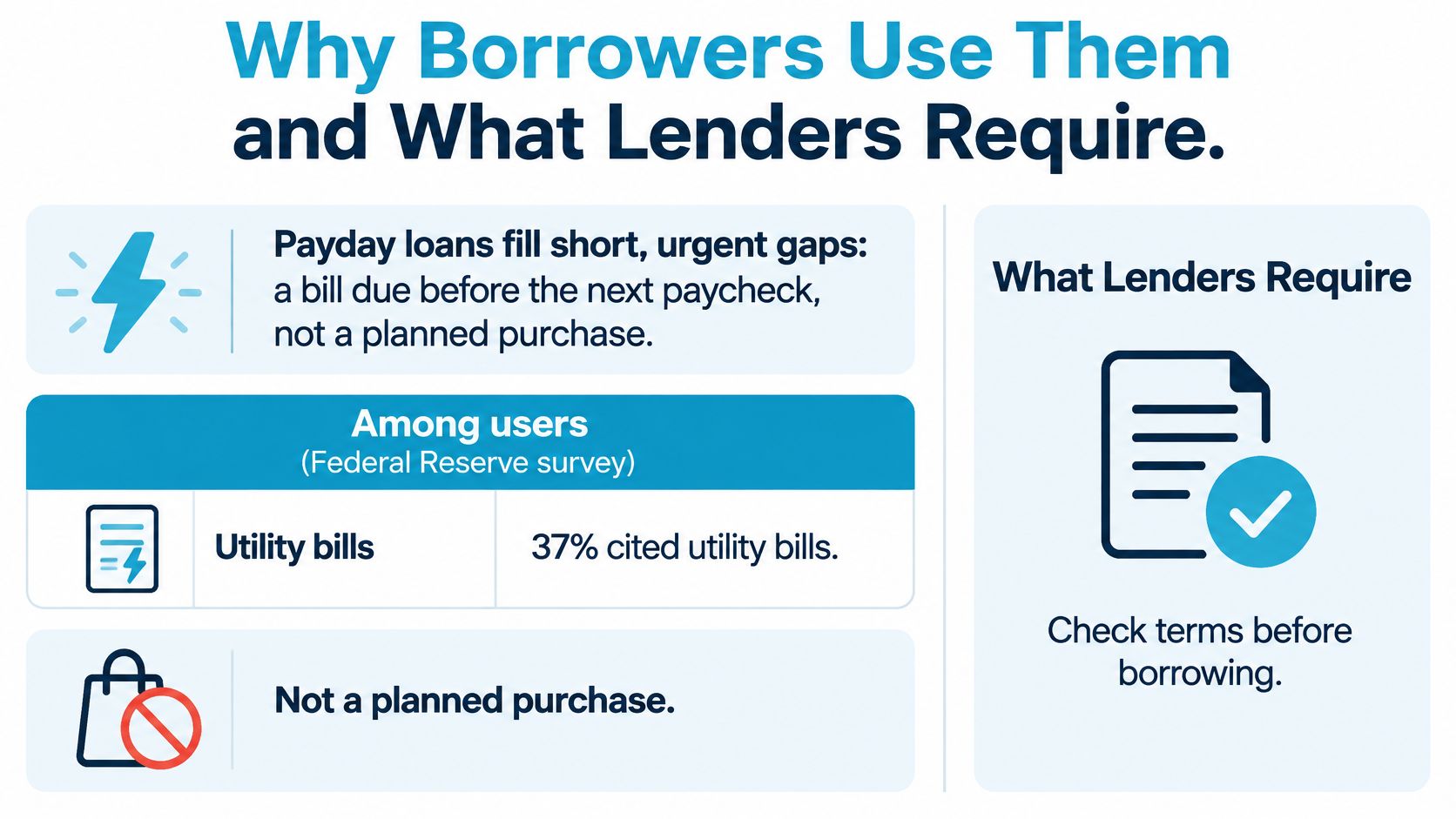
A payday loan may cover an expense that cannot wait for the next paycheck. Borrowers commonly report using the money for recurring bills, including utilities, groceries, and rent. That can signal a timing gap: the bill is due before payday, even though the borrower expects income soon.
What Lenders Ask For
Basic requirements vary by lender, but personal loan applicants generally need to be at least 18, have a checking account, and be employed with regular income and pay frequency. A lender may also ask for information to verify identity, income, and contact details.
Credit checks vary, too. NextStopLoans does not pull your credit, but lenders in its network may verify your identity and check credit history with major or alternative bureaus. See the guide to payday loan requirements for more about what lenders may ask for.
Approval requirements are only part of the decision. Compare the repayment date and total fees with the money you expect to have available. If a bill needs covering every month, relying on a new payday loan each time can add repeated fees rather than solve the shortfall.
Cheaper Alternatives to Consider First
Price every alternative the way you priced the payday loan: total dollars out of your account before the debt is gone.
| Option | Typical cost | Main limit | Best for |
|---|---|---|---|
| Payment plan with the creditor | Often no added fee | Must be requested before the due date | Utility, medical, or rent bills |
| Employer paycheck advance | Usually low or no fee | Limited to wages already earned | Workers whose employer offers it |
| Federal credit union payday alternative loan | APR capped at 28%, application fee up to $20 | Membership usually required, amounts up to $2,000 | A small emergency with a fixed repayment plan |
| Credit card cash advance | Fee plus a higher APR from day one | Cash limit and immediate interest | A short gap when the card has room |
| Nonprofit credit counseling | Usually low or no fee | Takes time to set up | Recurring cash shortfalls |
How to Work the List
Start with the phone call that costs nothing. Ask the creditor for a payment plan before the due date, because once a bill is late the advantage moves to them.
Then check the benefits you already have. An employer paycheck advance is limited to wages you've earned, which caps both the amount and the risk. If your employer doesn't offer one, move to the credit union question. A payday alternative loan from a federal credit union is the closest like-for-like replacement, with the National Credit Union Administration capping its rate and its application fee and stretching repayment over months instead of weeks. Membership is usually the gate, so check eligibility before you need the money.
A credit card cash advance fits a weekend, not a month. You pay a fee plus a higher rate, and interest starts the day the cash reaches you. Nonprofit credit counseling is the slowest option and the right one when the shortfall returns every month rather than once.
Compare totals, not rates. The question isn't which option looks cheapest per month. It's which one takes less money out of your account before the balance reaches zero.
A more expensive-looking option can still beat a payday loan that gets rolled twice, because rollover fees stack on a balance that never shrinks. If you want a wider menu, this list of payday loan alternatives covers the same ground in more detail.
Confirm the Terms Before You Borrow
Five minutes with this checklist tells you more than any advertisement will. Answer each question yes or no.
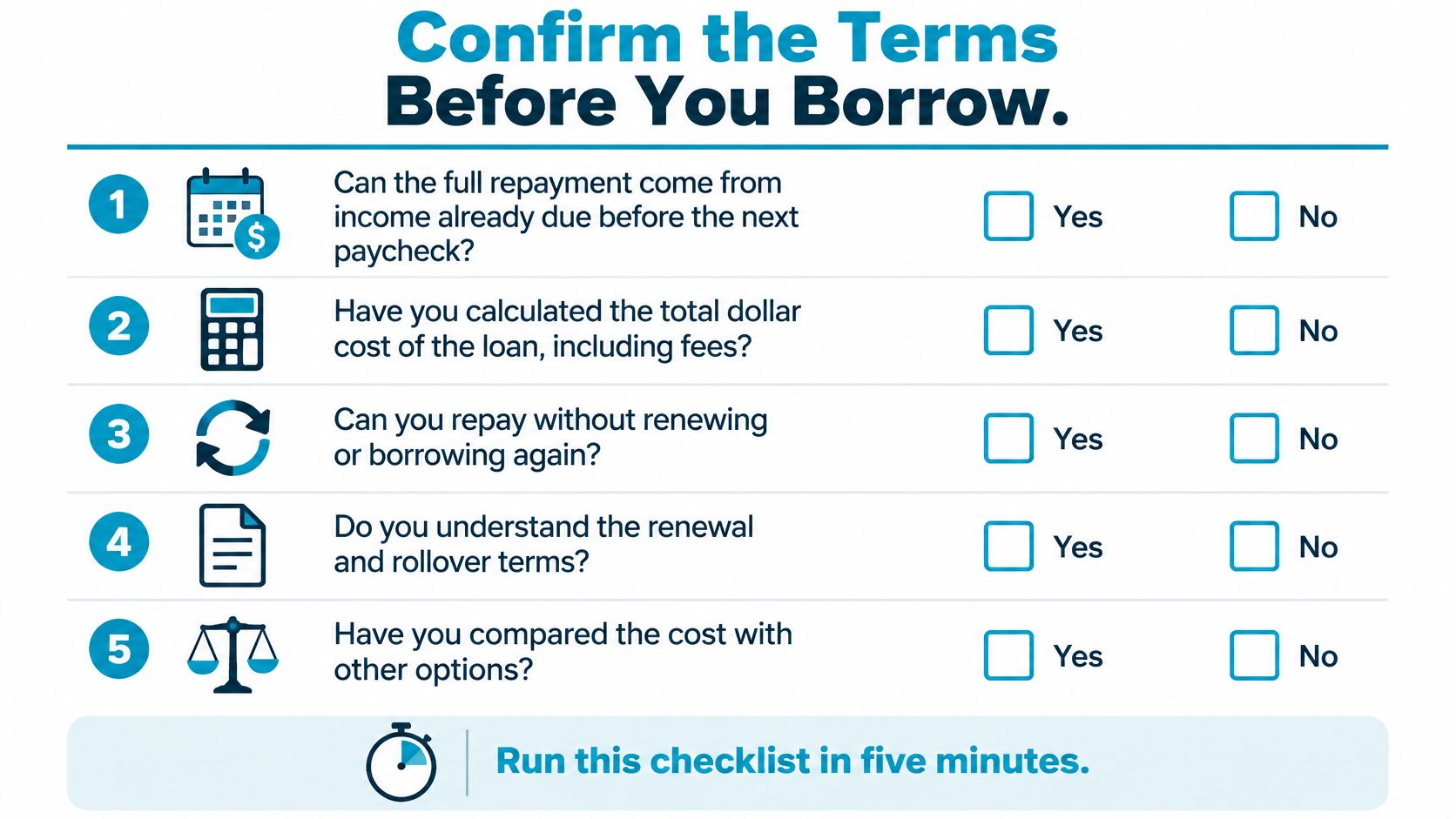
- Can the full repayment come out of income already due before the next payday? If it can't, you're planning to repay this loan with money you don't have yet.
- Have you calculated the total dollar repayment, not just the fee? The fee is the marketing number. The total is what clears your account.
- Have you asked about renewal, rollover, and extended repayment plans? Knowing the options before the due date keeps the choice yours.
- Do you know the late fee, collection, and credit reporting terms in the agreement? Read those clauses rather than the headline rate.
- Have you requested a payment plan from the creditor or priced a credit union loan? A cheaper option you never asked about costs nothing to check.
- Do you know which state's rules apply to your loan? Fee caps, renewal limits, and loan amounts are set at the state level, and an online lender may be operating under different rules than the shop down the street.
Two answers end the conversation. A no on the first question, or a loan you'd need again next month, means keep looking.
If you do borrow, take only what closes the gap and put the due date in your calendar with a reminder several days early. NextStopLoans runs an online marketplace that sends your request to independent third-party lenders, who set the terms and make the funding decision. We're paid by those lenders for referrals and don't make lending decisions ourselves, so any offer you see is theirs to make and yours to decline. Each lender has its own terms and conditions, including the repayment date, so confirm the date and time with your lender, and contact them as soon as possible if you can't repay on schedule.
Before you commit to a fee you'll pay again next month, run the checklist and price the alternatives in dollars. NextStopLoans lets you start a request in minutes and routes it to independent third-party lenders who decide the terms and the funding, so you can look at real offers instead of estimating the cost. Visit NextStopLoans to check your options before your next payday.