
Payday Loan Requirements: What You Need to Qualify
An unexpected bill can turn a routine week into a search for fast cash. Your car may need a repair, a utility payment may be due, or an essential expense may arrive before your next paycheck. A payday loan can appear straightforward because the application often asks for fewer traditional credit details, but the actual qualification question is broader than "Do I have bad credit?"
Payday loan requirements have two layers. First, an online marketplace or storefront collects information and routes a request. Then, an individual lender checks eligibility, repayment ability, disclosures, and state-law restrictions. Understanding that distinction can help you avoid submitting sensitive documents before confirming that the loan is legal, affordable, and appropriate for your situation.
Table of Contents
- When a Payday Loan Starts to Make Sense
- The Four Building Blocks of Payday Loan Requirements
- What You Actually Submit During the Application
- State Rules That Can Override the Basics
- The True Cost Behind the Fees and APR
- Income and Cash Flow Versus Your Credit Score
- Smarter Alternatives Worth Comparing First
- Preparing to Apply and Common Last Questions
When a Payday Loan Starts to Make Sense
Maria discovers on a Tuesday night that her car's alternator has failed. The repair shop needs $450 by Friday, her savings is already gone, and her next paycheck won't arrive for nine days. Without the car, she may not be able to reach work or take her child to childcare.
She runs through the choices. Asking family isn't realistic. Delaying another bill could create a late fee or put an essential service at risk. A payday loan could provide money against her next paycheck, but it would also create a single, urgent repayment obligation before her budget has had much time to recover.
A payday loan is generally a small, unsecured, short-term cash advance that's due in full on the borrower's next payday, often within two to four weeks. The loan is commonly $500 or less, although state laws and individual lender policies vary. The attraction is speed and limited paperwork. The trade-off is a premium cost and a repayment date that may arrive before other household expenses have been paid. The Federal Reserve Bank of St. Louis explains the basic structure and typical timing of payday loans.
Decision rule: Don't ask only whether you can receive the money. Ask whether you can repay the full balance on the due date without borrowing again or missing an essential bill.
Maria's first task, therefore, isn't completing an application. It's checking whether payday lending is permitted in her state, confirming the lender is licensed, and calculating the total repayment amount. The sections below walk through the documents lenders commonly request, the difference between intake and underwriting, state-specific restrictions, disclosure requirements, cash-flow review, alternatives, and a practical preparation checklist.
The Four Building Blocks of Payday Loan Requirements
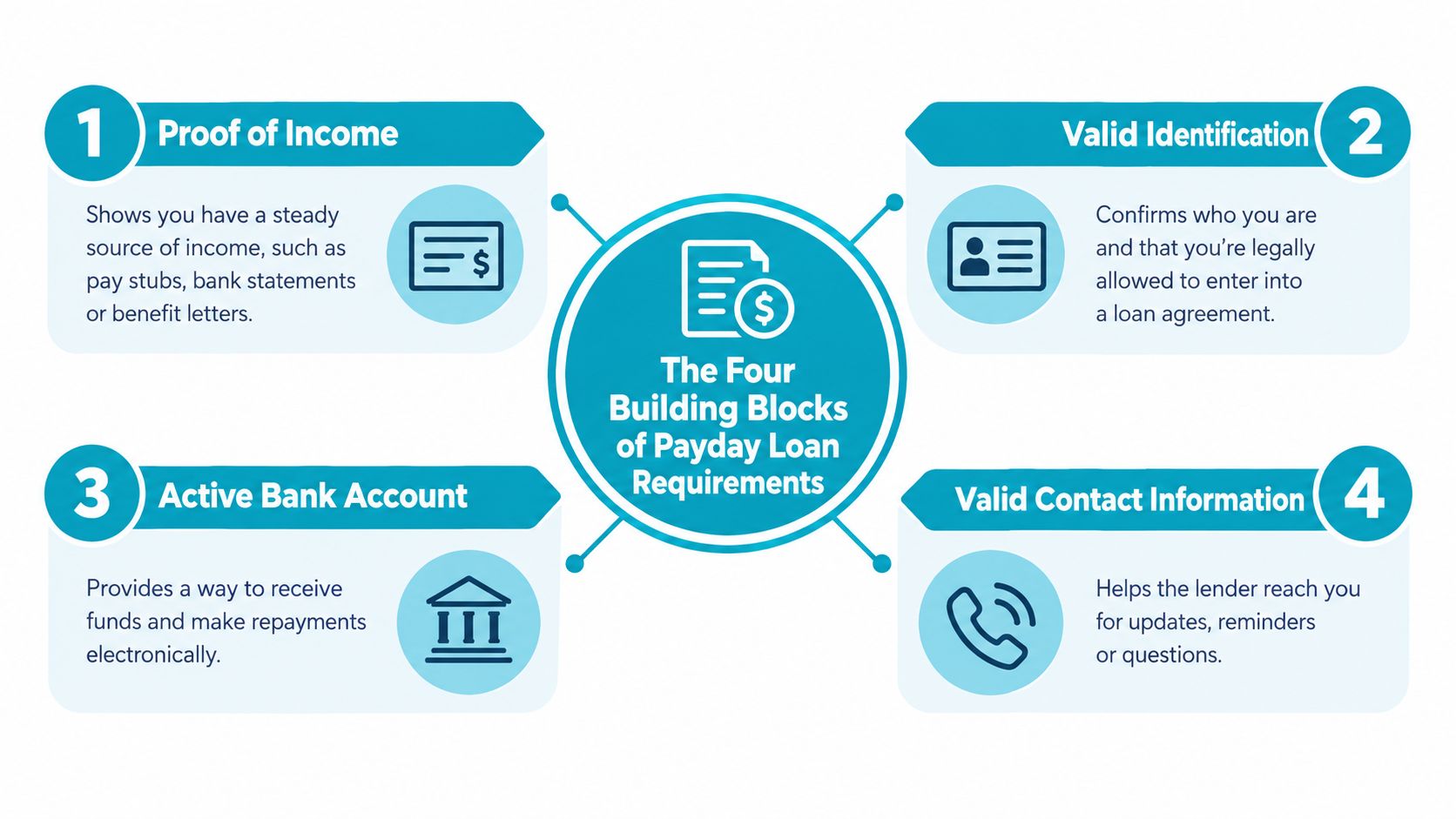
Most legitimate applications begin with four basic questions. The answers help a lender identify the applicant, establish legal capacity to borrow, verify a source of repayment, and connect the loan to a transaction account.
Age and legal eligibility. Applicants generally must be at least 18 years old. The lender uses age information to confirm that the applicant can enter a binding credit agreement. State law may impose additional eligibility rules, so meeting the age threshold alone doesn't guarantee approval.
Government-issued identification. A driver's license, state identification card, passport, or military identification may help verify your identity. The purpose is to match the application to a real person and reduce identity fraud. An ID request isn't the same as a citizenship test, but the lender may request other information to satisfy its compliance duties.
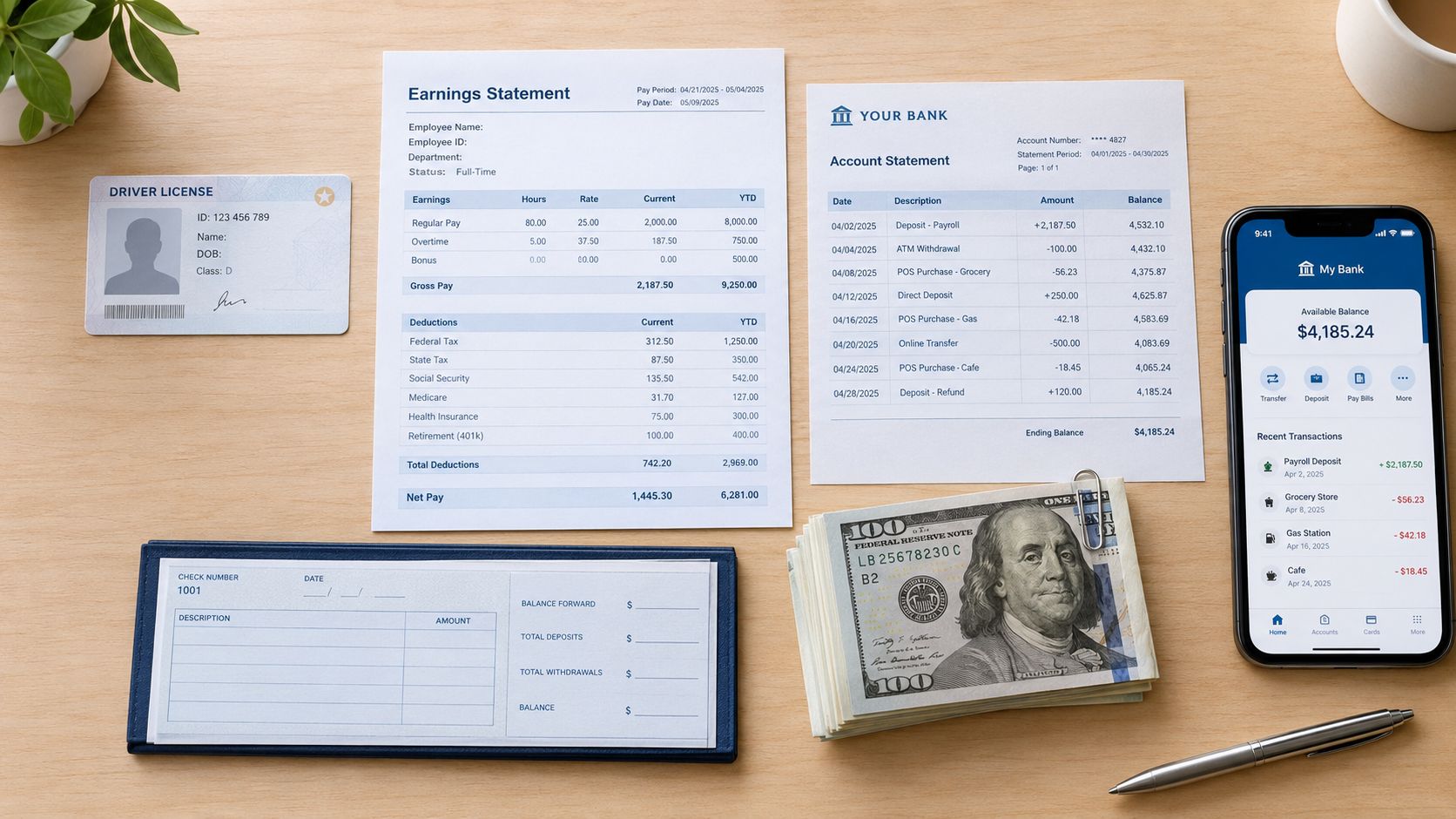
Verifiable income. The lender needs evidence that money regularly enters your budget. Depending on the applicant, that evidence can include a recent pay stub, bank activity showing direct deposits, or a benefits award letter. Employment income is common, but another reliable income source may also be considered under the lender's policy and applicable law.
An active transaction account. A checking, credit-union, or prepaid-card account may be required to receive the funds and authorize repayment. The account must generally be usable for electronic deposits or withdrawals. A lender may ask for account and routing information, but you should provide it only through a secure, verified application channel.
These building blocks don't mean every lender uses identical criteria. A marketplace may ask for additional contact information, while the lender may request documents or perform checks that weren't visible on the first screen. You can review a practical overview of online payday loan applications, but treat any general checklist as a starting point rather than proof that a loan is available in your state.
What You Actually Submit During the Application
Applicants often treat the form and the lender's decision as one process. They're different. The marketplace or storefront intake layer gathers information needed to identify, route, and contact you. The lender underwriting layer decides whether a particular lender will offer credit and on what terms.
At intake, you may enter your name, address, phone number, email address, employer or income source, requested amount, bank account details, and Social Security number. You may also be asked for references or communication preferences. Some fields help route the request, while others support identity and compliance checks.
The lender can then verify income, review account information, assess existing obligations, and request supporting documents. Depending on its policy, it may perform a credit inquiry, contact an employer, or ask for an updated pay stub or benefits letter. A marketplace can transmit a request, but it doesn't decide whether the lender will approve it.
Application Fields by Stage
| Field or Document | Intake Layer | Underwriting Layer | Required? |
|---|---|---|---|
| Full name and address | Identifies and routes the request | Confirms identity and residency | Commonly required |
| Date of birth or age | Screens for basic eligibility | Confirms legal borrowing eligibility | Commonly required |
| Government ID | May be requested as an upload | Verifies identity | Commonly required by the lender |
| Social Security number | Supports identity and compliance intake | May support lender verification and reporting | Often requested |
| Income source | Routes the request | Tests whether repayment is plausible | Commonly required |
| Pay stub or benefits letter | May be uploaded | Verifies stated income | May be requested |
| Bank account and routing details | Identifies a funding account | Confirms deposit and repayment access | Commonly required |
| Employer phone or references | Provides contact information | May support verification | Depends on lender |
| Marketing preferences | Records communication choices | Usually has no underwriting purpose | Usually optional |
A “pending” status doesn't necessarily mean something went wrong. The receiving lender may still be matching the information, checking documents, or confirming state availability. Before submitting an ID image or bank details, verify the website, read its privacy information, and make sure you understand whether you're applying with a lender or using a matching service.
State Rules That Can Override the Basics
A complete application can still be ineligible if payday lending isn't permitted under the law where you live. State rules may control the maximum loan amount, fees, repayment period, renewals, waiting periods, repeat borrowing, and lender licensing. The federal baseline doesn't replace those state restrictions.
Use this verification sequence before uploading documents:
- Confirm residency and availability. Check that the lender is licensed or authorized to serve borrowers in your state. An online form can accept information even when no legal offer is available.
- Check the state's product limits. Look for rules governing loan size, fees, repayment terms, and finance-charge disclosures.
- Review renewal and cooling-off rules. Some states restrict or prohibit rollovers, while others may permit an extension under defined conditions.
- Ask about existing-loan limits. A state database or outstanding-loan cap can prevent a new loan even when your income and ID satisfy the lender's basic intake criteria.
State Payday Loan Rules at a Glance
| State | Status | Key Cap or Restriction |
|---|---|---|
| Michigan | Payday lending is permitted under state rules | Lenders must check a state electronic database. A borrower can be denied a new loan when already carrying two outstanding payday loans. Loans are limited to $600 and repayment to no more than 31 days. |
| Maryland | Small consumer lending is regulated | Licensing and interest-rate limits apply, and the finance charge and APR must be disclosed in writing before signing. |
| States that prohibit payday lending or prevent the conventional model | Availability is restricted or effectively unavailable | Seventeen states and the District of Columbia either prohibit payday lending or impose rate limits that prevent the conventional payday-loan model. |
Michigan's rules show why existing payday debt can matter as much as income. Maryland shows a different approach, where licensing, rate limits, and written disclosures shape the transaction. The Michigan Department of Insurance and Financial Services payday-loan guidance is a useful example of the kind of state-level information applicants should seek.
A lender's online eligibility screen can't override your state's law. Verify legality before you treat a preliminary match as an available offer.
The True Cost Behind the Fees and APR
You may see a marketplace match after entering basic information, but that result is only an intake step. The lender still has to provide a state-compliant offer and disclose its cost before you sign. If payday lending is restricted where you live, no online match can make the transaction legal.
The advertisement's fee is only one part of the price. Before signing, review the disclosure for the finance charge, annual percentage rate, amount financed, and total of payments. Read the figures together rather than judging the loan by its advertised fee alone.
A common example charges $15 for every $100 borrowed on a two-week loan. Borrowing $300 creates a $45 finance charge, so you receive $300 and owe $345 at maturity. Annualized over that short period, the example produces an APR of approximately 391%. The Federal Trade Commission explains this fee example and the required cost information.
The APR appears large because it expresses a short-term charge as though the same pricing continued for a full year. It does not mean you will necessarily make payments for a year. It gives you a common measure for comparing the short repayment period and its charge with other credit options.
Read the disclosure line by line
Check these items:
- Amount financed: The principal tied to the transaction.
- Finance charge: The dollar cost of borrowing, including disclosed charges.
- Total of payments: The amount scheduled for repayment.
- APR: The standardized annualized cost.
- Payment date: When the lender expects full repayment.
- Renewal terms: Whether an extension is allowed and what it costs.
- Account consequences: Possible fees after a failed withdrawal.
State caps may reduce charges. Rollovers, origination costs, and nonsufficient-funds fees may increase what you pay. General payday loan rate information can provide context, but the lender's individualized Truth in Lending disclosure controls the offer.
Before signing: Compare the total of payments with the money you will receive. If the difference is unclear, pause the application.
Income and Cash Flow Versus Your Credit Score
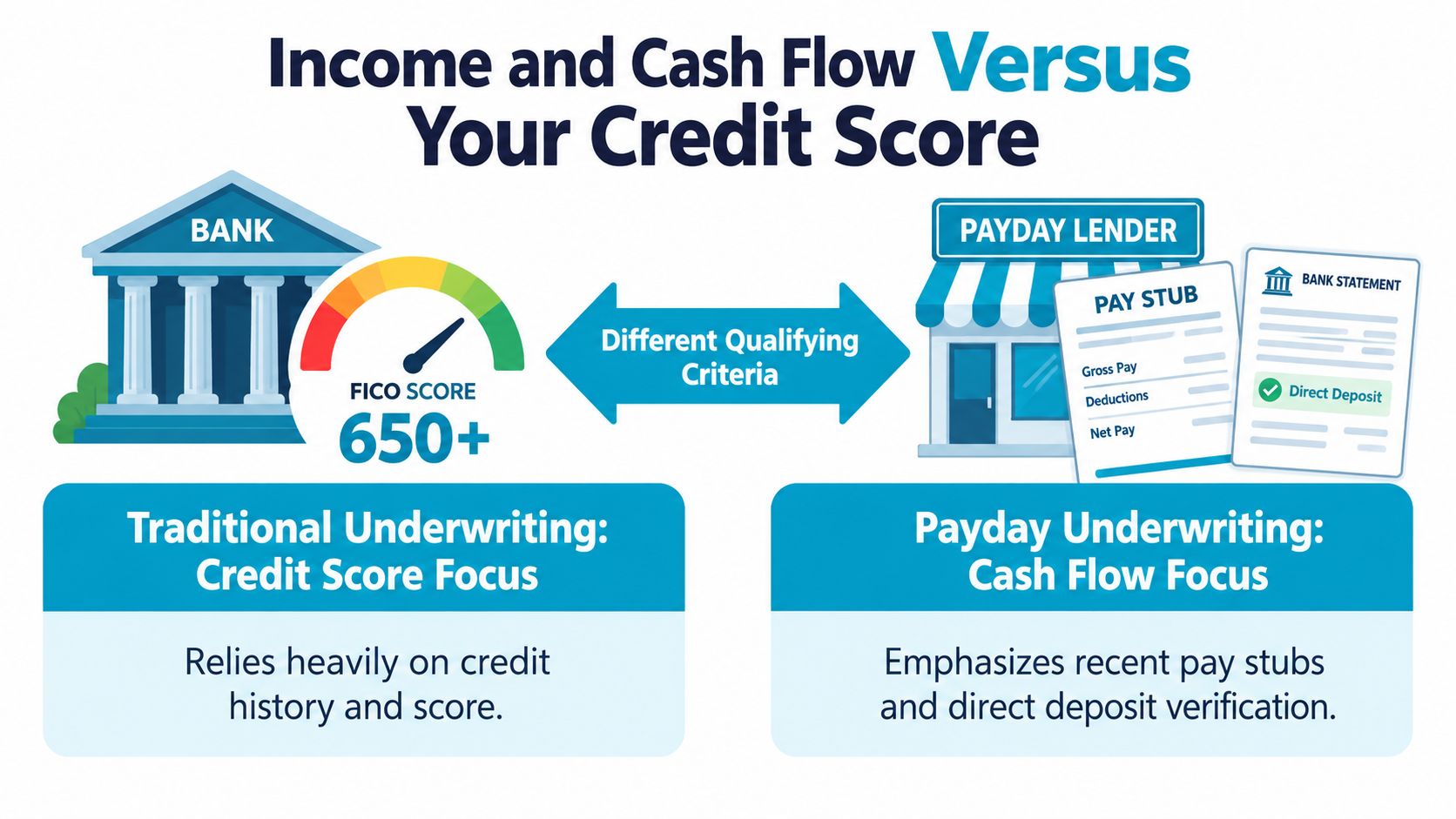
A weak credit score doesn't answer every question about qualification. A lender may focus on whether you have a dependable deposit pattern, a functioning account, and enough remaining income to meet the scheduled payment. That's a cash-flow question, not just a score question.
Traditional score-based underwriting leans heavily on credit history. Deposit-based underwriting may examine recurring deposits and account activity. An ability-to-repay assessment goes further by considering income, major debts, housing costs, basic living expenses, and the borrower's remaining income or debt-to-income position during the month with the highest scheduled payment.
Three approval models
| Model | Main evidence | What it can mean for the applicant |
|---|---|---|
| Traditional score-based review | Credit history and score | A clearer credit-related reason for approval or denial, but limited options for applicants with thin or damaged credit |
| Deposit-based review | Recent deposits and transaction-account activity | More attention to current cash flow, potentially alongside a higher-cost product |
| Ability-to-repay review | Income, major obligations, housing, basic expenses, and projected repayment capacity | A stricter check that may prevent a loan when repayment would depend on immediate reborrowing |
The Consumer Financial Protection Bureau's framework for covered short-term or balloon-payment loans requires lenders to gather and verify more than employment information. It also limits rapid repeat borrowing by preventing a sequence of more than three covered short-term or balloon-payment loans within 30 days of one another, while addressing extensions and repeated short-term debt. The CFPB executive summary describes these ability-to-repay and repeat-borrowing provisions.
You can read a broader discussion of loans with bad credit, but don't confuse “no stated minimum score” with guaranteed approval. You may be asked for pay stubs, benefit deposits, employment information, or account records, and the lender can still reject an application if the projected repayment doesn't fit your obligations.
Smarter Alternatives Worth Comparing First
A payday loan is only one response to a short cash gap. Compare the repayment structure, qualification evidence, timeline, and total cost of other products before accepting a single-payment obligation.
Installment loans from licensed lenders can spread repayment across a fixed schedule rather than requiring the entire balance on the next payday. The lender may review income, credit, existing obligations, and state limits. This option can be a better fit when the expense is larger than a short bridge or when your budget needs multiple payments, but a longer term doesn't automatically make a loan affordable.
Credit-union small-dollar products may offer lower-cost terms than conventional payday loans. They can still require membership, income verification, and an account relationship, and approval may not be immediate. Ask the credit union about its small-loan program, eligibility rules, rate, fees, and earliest funding date.
Small personal loans from banks or online lenders may provide more time to repay and a clearer amortization schedule. These lenders often place greater weight on credit history and may request stronger documentation. If your credit and income support approval, compare the APR and total repayment directly with the payday offer.
Payday Loan Alternatives Side by Side
| Option | Typical Loan Size | Typical APR Range | Repayment Term | Best For |
|---|---|---|---|---|
| Payday loan | Small, subject to state and lender limits | Can be very high and must be reviewed in the disclosure | Usually a single payment on the next payday | A narrowly defined emergency only when lawful and fully repayable |
| Licensed installment loan | Varies by lender and state | Varies by lender, state, and applicant | Multiple scheduled payments | Borrowers who need more time than one pay cycle |
| Credit-union small-dollar loan | Varies by program | Usually set by the credit union's product rules | Fixed or scheduled installments | Applicants who can meet membership and underwriting requirements |
| Small personal loan | Varies by lender | Depends heavily on credit and income | Often scheduled installments | Applicants with sufficient credit and stable repayment capacity |
A credit-union product may win on cost if you already qualify. An installment loan may fit better when repayment needs to extend beyond the next paycheck. A personal loan may be preferable when your credit profile can clear conventional underwriting. In every case, compare the written total repayment, not just the speed of funding or the advertised payment.
Preparing to Apply and Common Last Questions
A rushed application can turn a short-term cash problem into a repayment problem. Before sharing personal or bank information, check whether payday lending is legal in your state and whether the company is licensed or otherwise authorized to offer it. An online marketplace may collect your request and send it to independent lenders, but the lender, not the marketplace, decides whether you meet its underwriting requirements.
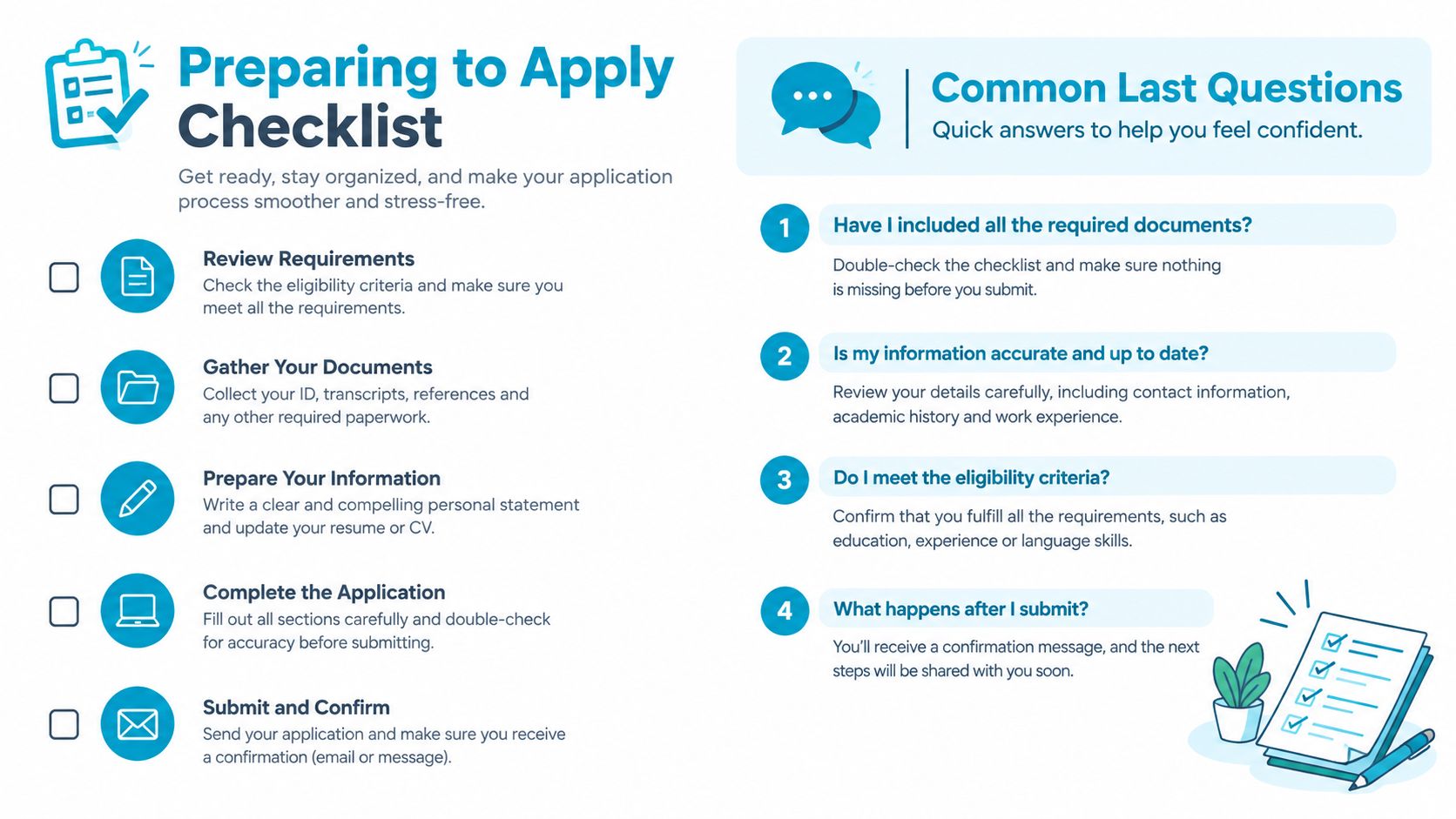
A practical application checklist
- Verify state access: Check your state regulator's rules, loan limits, renewal restrictions, and requirements for outstanding loans.
- Confirm lender identity: Review the lender's legal name, license information, privacy policy, and contact details.
- Gather identification: Keep a valid government-issued photo ID available.
- Document income: Prepare a recent pay stub, benefits letter, or other accepted proof of regular income.
- Confirm account details: Have checking, credit-union, or prepaid-account information ready. Enter it only through a secure channel.
- Review the disclosure: Check the finance charge, APR, total payments, payment date, and renewal terms before signing.
- Test repayment: Confirm that the planned withdrawal will leave enough for rent, food, utilities, transportation, and other required expenses.
The marketplace intake layer is like a front desk. It gathers details and may match a request with lenders that serve your state. The lender's underwriting layer then reviews identity, income, account information, and repayment capacity under the rules that apply where you live.
Questions borrowers commonly ask
Can I take another payday loan immediately? State databases, outstanding-loan limits, cooling-off periods, and lender policies may prevent repeat borrowing. State or federal rules may also restrict extensions and repeated short-term debt. Check the rules before submitting another request.
What protection applies to military borrowers? The Military Lending Act limits the Military Annual Percentage Rate to 36% for covered active-duty servicemembers and dependents and adds restrictions on payday and other consumer loans. The FTC's consumer guidance discusses this military-borrower protection.
What happens if the payment bounces? The lender may try the withdrawal again. Your bank or the lender may also charge a disclosed nonsufficient-funds or related fee. Contact both promptly and ask what options are available.
Will repayment build my credit? Only if the lender reports the account and payment history to a credit bureau. Ask before signing. An unpaid balance may instead lead to collection activity or other consequences.
Stop if a company withholds written terms, demands payment before explaining the loan, or presents an unlicensed tribal loan without clear legal disclosures. Verify the lender through your state regulator or attorney general complaint portal.
NextStopLoans offers an online marketplace that routes requests to independent third-party lenders, including lenders that may consider short-term, installment, or personal-loan requests. Review state availability, disclosures, terms, and total repayment cost before accepting an offer through NextStopLoans.