
8 Payday Loan Alternatives to Consider in 2026
A rent notice arrives before payday. Then the car makes a noise that needs a mechanic, or a medical bill lands when your checking account is already low. You need to deal with the expense, but a payday loan can leave you with less money for the next round of bills.
The right payday loan alternative depends on how soon you need help, what documents you can provide, your credit history, and whether you need cash or can negotiate the expense itself. A lower-cost option only helps if you understand its APR, fees, repayment schedule, and eligibility requirements before you commit.
“The safest alternative is not always the fastest one. It's the option that solves the problem without creating a second, larger debt problem.”
The options below are organized around the problem you need to solve: getting cash, qualifying with limited credit, lowering or delaying a bill, or finding help that doesn't create debt. NextStopLoans, when mentioned, is an online marketplace that connects eligible U.S. applicants with independent third-party lenders. It isn't a lender and doesn't make credit decisions.
Table of Contents
- 1. Payday Alternative Loans From Credit Unions
- 2. Earned Wage Access
- 3. Community Development Financial Institution Small-Dollar Loans and Lending Circles
- 4. Personal Installment Loans From Banks, Credit Unions, and Online Lenders
- 5. Low-Interest and 0% Intro APR Credit Cards
- 6. Bank Overdraft Lines of Credit and Overdraft Protection Transfers
- 7. Negotiated Payment Plans, Hardship Programs, and Hospital Charity Care
- 8. Community Emergency Assistance Programs
- Comparison of 8 Payday Loan Alternatives
- Choose the Option You Can Repay Without Repeating the Crisis
1. Payday Alternative Loans From Credit Unions
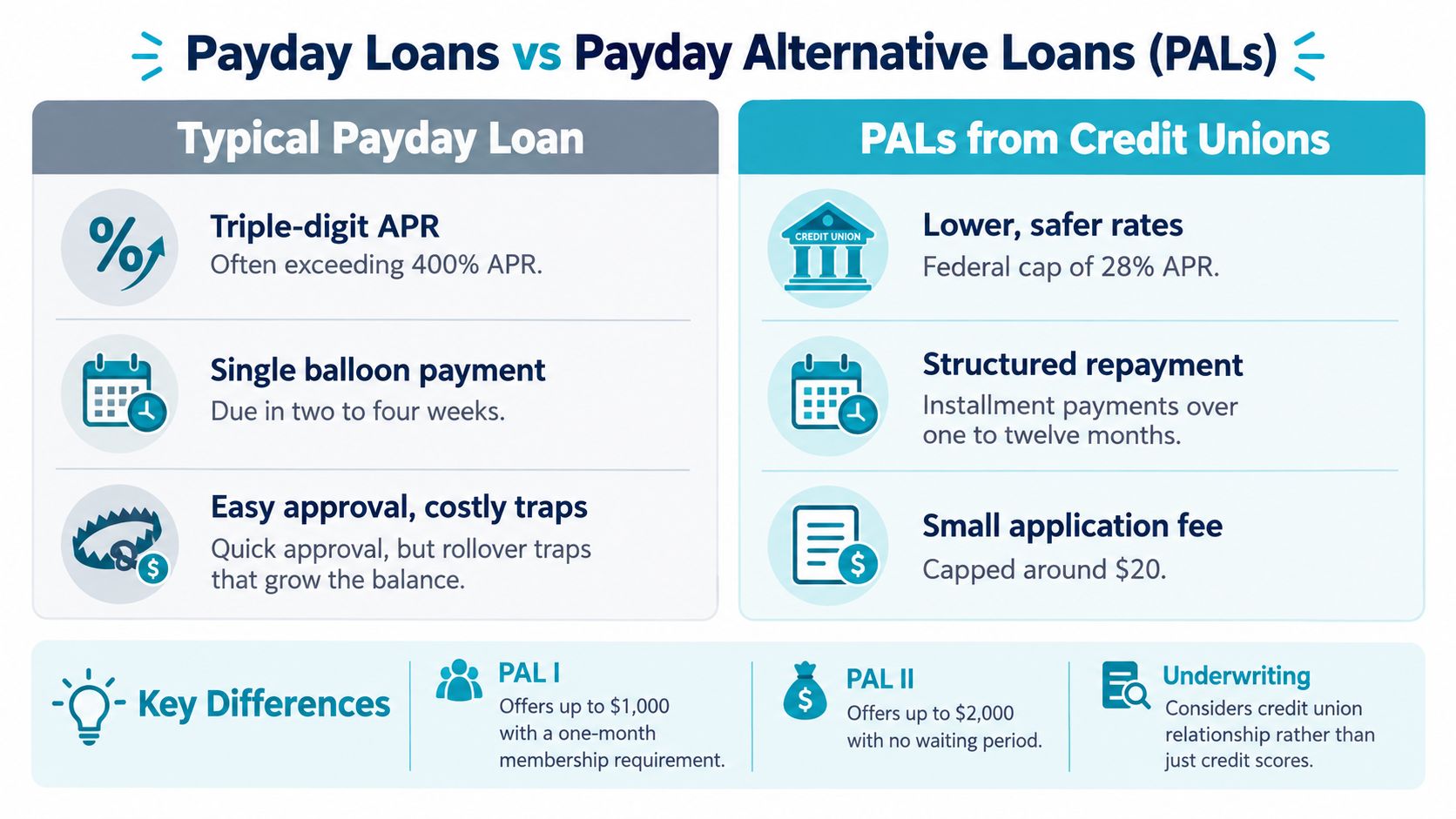
If you can qualify through a credit union, a Payday Alternative Loan (PAL) is one of the clearest direct substitutes for a payday loan. The National Credit Union Administration's PAL program began in 2010 and expanded in 2019. Under the federal framework, PAL I loans generally range from $200 to $1,000, with terms from one to six months. PAL II can go up to $2,000, with repayment terms up to 12 months. Both types have a maximum 28% annual percentage rate, and the application fee is capped at $20. Pew's explanation of credit-union small-dollar loans outlines the program and its cost structure.
The dollar-cost difference can be substantial. Pew estimates that a $500 PAL repaid over three months costs no more than $44, compared with about $450 for an equivalent payday loan. That comparison makes a useful point: check the total repayment amount, not just whether an offer arrives quickly.
Check membership before an emergency
A federal credit union can set its own eligibility and underwriting requirements. PAL I generally requires at least one month of membership, while PAL II doesn't have the same waiting period under its framework. A borrower facing a sudden car repair might not qualify for a PAL I immediately if they've never joined the credit union, so ask about membership and application timing before relying on this option.
Call a local credit union and ask whether it offers PAL I, PAL II, or another small-dollar emergency loan. Confirm the APR, fees, amount you can borrow, payment dates, and funding timing. Some credit unions list these products under “small-dollar loans” or “emergency loans.”
Borrow only what the bill requires and verify that each payment fits your budget. If you're comparing a PAL with other borrowing options, review personal loan options as well, but compare full costs and terms rather than choosing based on the advertised payment alone. The NCUA credit union locator can help you find a credit union to contact.
2. Earned Wage Access
When the problem is a short gap between work and payday, Earned Wage Access (EWA) may let you access part of the wages you've already earned. An employer may provide access through its payroll system, or a third-party app may offer advances tied to work hours or income. The amount is generally collected from a later paycheck, which means you'll have less money available on payday.
For example, an hourly worker facing a utility bill a few days before payday might use EWA to cover the bill without taking out a conventional payday loan. But “earned wages” doesn't automatically mean “free.” Some providers charge expedited-transfer fees, subscriptions, or ask for tips, and repeated advances can make the next paycheck too small to cover regular expenses.
Add every fee before deciding
Ask your employer's HR or payroll team whether EWA is available through work before signing up for a separate app. Then check what the provider charges for standard and expedited delivery, whether membership costs apply, and how repayment is deducted. Compare the total dollar cost with a credit-union loan or the offer you're considering, and make sure you can cover the next pay cycle after the deduction.
EWA also deserves a careful comparison because its cost and regulatory treatment vary. A 2025 consumer-advocacy analysis reported that some products could reach estimated APRs of 284% to 956% when treated as credit, and that some users accessed advances repeatedly; EWA advocates, by contrast, point to no-cost delivery options and the fact that workers access wages they've already earned. Texas Appleseed's analysis of EWA fees and consumer concerns discusses this disagreement and the need to compare total costs, not labels.
Use an advance only when it solves a specific timing problem and you can absorb the smaller paycheck. Keep track of each withdrawal. If you're using EWA repeatedly to pay ordinary bills, negotiate those bills or seek assistance instead of taking another advance.
3. Community Development Financial Institution Small-Dollar Loans and Lending Circles
A Community Development Financial Institution (CDFI) may be worth contacting if a bank has turned you down or your credit history is limited. CDFIs are mission-driven financial institutions that serve communities and borrowers who may not receive enough support from traditional lenders. Some offer small personal loans, credit-building products, or financial coaching, and may consider more than a conventional credit score when reviewing an application.
A lending circle takes a different approach. Members contribute to a shared pool and take turns receiving the pooled funds. The group agrees on contributions and timing, so this isn't a same-day source of cash. It can be useful when you can plan ahead and meet the commitment, but it may not fit an urgent repair due immediately.
Ask how the program works before joining
Mission Asset Fund, based in San Jose, runs lending circles designed to help participants build credit through group-based borrowing and repayment. Self-Help Federal Credit Union is another example of a CDFI offering lending and credit-building products. Availability and eligibility depend on the organization and the program, so contact providers directly rather than assuming a service is offered in your area.
Before applying, ask whether the lender reports payments to credit bureaus, what fees and interest apply, how long the process takes, and what happens if you miss a payment. For a lending circle, ask how the group handles late contributions and whether funds are available when you need them. Search the CDFI Fund's certified institution directory for organizations to contact, then verify the specific product directly with the provider.
A CDFI loan can be a better fit than a high-cost short-term loan when you have time to apply and can manage scheduled payments. Financial coaching may also help you identify whether the emergency is a one-time cash-flow problem or a recurring gap that another loan won't fix.
4. Personal Installment Loans From Banks, Credit Unions, and Online Lenders
An installment loan provides a lump sum that you repay in scheduled payments. That structure can work better than a payday loan when you need cash for an essential expense but can't repay the full amount from your next paycheck. Banks and credit unions may offer lower-cost options to qualified customers, while online lenders may provide a digital application process or serve borrowers with a wider range of credit histories.
For example, someone with a necessary car repair might compare a fixed-payment loan with a payday offer. The installment loan may spread repayment over a longer period, but a longer term can also mean paying more total interest. Don't assume a smaller monthly payment makes an offer cheaper.
Compare the amount you receive with the amount you repay
Check the APR, origination fee, payment schedule, total repayment, and whether the lender charges a prepayment penalty. An origination fee can reduce the cash deposited to you even when the principal balance stays the same. Ask whether payments are reported to credit bureaus, and read the lender's rates and fees and lending policy disclosures before accepting.
A loan marketplace can show whether participating lenders are willing to consider your request, but it can't promise approval or a particular offer. NextStopLoans, for example, routes requests to independent third-party lenders; each lender decides whether to approve an application and sets its own terms. To compare scheduled repayment options, review installment loan information, then assess any offer against your actual monthly budget.
Borrow the smallest amount that covers the expense, and choose a payment you can make without missing rent, utilities, food, or other essentials. If the monthly payment only works when nothing unexpected happens, the loan is too large or too costly for your budget.
5. Low-Interest and 0% Intro APR Credit Cards
A low-interest credit card or a card with a 0% introductory APR can help if you qualify and can repay the purchase within the offer's terms. It may work for an expense that accepts card payments, such as a medical bill or car repair. The key is to treat the promotional period as a firm repayment deadline, not as permission to carry the balance indefinitely.
For instance, if a card's introductory offer covers purchases, you could charge an urgent bill and divide the balance into planned payments. Before doing that, calculate how much you need to pay each month to clear the balance before the regular APR applies. If that amount doesn't fit your budget, the card may only defer the problem.
Purchases and cash advances aren't the same
Use the card for a direct purchase when available. Cash advances generally carry separate fees and a higher APR than purchases, and interest may start accruing immediately. A balance transfer offer can also carry a transfer fee, so compare that cost with the interest you'd otherwise pay.
Read the card's pricing disclosure before applying. Confirm the length of the introductory period, the ongoing APR, late-payment consequences, annual fees, balance-transfer fees, and whether the promotion applies to new purchases or only transferred balances. Set automatic payments for at least the required amount, then schedule extra payments to clear the balance before the promotional rate ends.
This option is most suitable when you have sufficient credit to qualify and a realistic payoff plan. Don't use a new card to cover a recurring shortfall if the balance will remain after the introductory offer expires. A payment plan with the provider may be less risky when the expense itself can be negotiated.
6. Bank Overdraft Lines of Credit and Overdraft Protection Transfers
If a bill is due before a deposit clears, ask your bank about overdraft protection before allowing a payment to trigger fees. Some banks offer a line of credit tied to a checking account. Others let you link a savings account so funds can transfer automatically when checking doesn't have enough to cover a transaction.
These arrangements can be less costly than repeated per-transaction overdraft fees, but the terms differ by bank. A line of credit charges interest on the borrowed amount, and a linked account may involve a transfer fee or other conditions. Compare those charges with your bank's standard overdraft fees and with the cost of delaying the bill.
Check which transactions are covered
Ask your bank whether protection applies to checks, automatic bill payments, debit-card purchases, or only certain transactions. Find out how much the bank may advance, when it expects repayment, and what happens if the linked savings account doesn't have enough money. If you'd rather have a debit-card purchase declined than incur a fee, ask how to opt out of overdraft coverage for those transactions.
Consider a renter whose account is short when rent is scheduled to withdraw. A credit line could cover the gap temporarily, but it won't fix a recurring mismatch between income and bill dates. Contact the landlord or bank about changing the timing, then repay any borrowed amount promptly to limit interest.
Don't assume overdraft protection is automatically cheaper. Get the fee schedule and APR in writing, and compare the total cost for the amount and repayment period you need. If the bank's terms are unclear or too expensive, try a payment extension or assistance program before borrowing.
7. Negotiated Payment Plans, Hardship Programs, and Hospital Charity Care
Before borrowing, ask the company or provider you owe whether it can change the bill's timing or amount. Utilities, landlords, medical providers, auto repair shops, and phone companies may offer payment plans, extensions, or hardship arrangements. These options address the expense directly, so you may not need to take out a separate loan at all.
Call before the due date when possible. Explain what you can pay and when, then ask specifically about a payment plan, fee waiver, extension, or hardship program. A family facing a utility shutoff, for example, could ask the utility provider to spread the overdue balance across future bills. Get any agreement in writing and confirm the new due dates.
Apply for medical assistance rather than putting the bill on a card
If you're facing a hospital bill, ask for the hospital's financial assistance policy and application. Nonprofit hospitals are required under federal tax law to maintain financial assistance policies, though eligibility and assistance vary. Submit the requested income and household information promptly, and ask the billing department to pause collections while it reviews your application.

Ask for the specific program. “Can you help?” may get a general answer. Ask for the payment plan, hardship policy, or financial assistance application by name.
Write down whom you spoke with and keep copies of applications, emails, and revised bills. If the new payment amount still won't fit your budget, explain that before agreeing. A plan that you can't maintain may create a second delinquent account instead of resolving the immediate problem.
8. Community Emergency Assistance Programs
If you can't qualify for credit or taking on debt would make the next pay cycle unworkable, look for local help with the expense itself. Community organizations may offer assistance with rent, utilities, food, transportation, or other urgent needs. Depending on the program, support may take the form of a grant, a direct payment to the provider, or donated goods and services.
Start with 211, which connects people with local support. Community Action Agencies may also help households find assistance, and local nonprofit and faith-based organizations may have programs for food, housing, or utility needs. A household facing a utility shutoff, for example, can contact 211 and ask for referrals to local energy assistance and emergency funds.
Apply early and prepare documents
Call or text 211, or search by location through 211's local resource finder. Ask what documents you need before you apply. Programs may request proof of income, household size, residence, and the bill or notice connected to the emergency. Funds and eligibility vary by area, so contact the agency to confirm that it can help with your specific expense.
A single parent who loses work unexpectedly might ask about food assistance and transportation support, not only cash for a bill. One organization may refer you to another program, so describe the full problem and ask what else is available. Apply as soon as you can because some programs have limited resources.
If a grant or direct assistance can cover the expense, it avoids adding a repayment obligation. If help won't arrive in time, ask the biller for an extension while your application is pending. For urgent cash needs that remain after you've checked assistance, compare emergency loan options carefully, including each lender's total repayment and payment schedule.

Comparison of 8 Payday Loan Alternatives
| Option | 🔄 Implementation Complexity | ⚡ Resources / Access | 📊 Expected Outcome | ⭐ Key Advantage | 💡 Ideal Use Case |
|---|---|---|---|---|---|
| Payday Alternative Loans (PALs) from Credit Unions | Moderate; requires credit union membership and application | Income and account information; PAL I requires one month of membership, PAL II has no waiting period | Small installment loan; federal credit union APR cap of 28% | Lower-cost, structured repayment than payday loans | Borrowing up to $1,000–$2,000 for a short-term emergency |
| Earned Wage Access (EWA) | Low if offered through an employer; repayment is usually automatic | Employer or app access and wages already earned; fees vary | Early access to part of the next paycheck, usually without a hard credit check | Can provide fast access without a conventional loan | Covering a small, urgent expense before payday |
| CDFI Small-Dollar Loans and Lending Circles | Moderate; lending circles require group participation and regular saving | Application and income details; availability varies by location | Affordable small loan or credit-building through shared payments | Flexible underwriting and possible financial coaching | Borrowers with thin or damaged credit seeking community-based support |
| Personal Installment Loans | Moderate; lender application, credit check, and income verification | Credit and income documentation; terms and fees vary by lender | Fixed payments over a set term, typically 6 months to 5 years | Predictable repayment and potential credit-building | Financing a larger expense that can be repaid monthly |
| Low-Interest and 0% Intro APR Credit Cards | Moderate; requires application and responsible payoff planning | Credit approval and available credit limit; introductory terms vary | Purchases may accrue no interest during the promotional period if paid on time | Flexible purchases and potentially no interest during the intro period | An eligible expense that can be fully repaid before the offer ends |
| Bank Overdraft Lines of Credit and Overdraft Protection Transfers | Low to moderate; arrange through the bank in advance | Eligible checking account; approval and fees depend on the bank | Covers account shortfalls; interest or transfer fees may apply | Can cost less than repeated overdraft fees | Brief cash-flow gaps or bills posting before funds arrive |
| Negotiated Payment Plans, Hardship Programs, and Hospital Charity Care | Low to moderate; contact the creditor or submit an assistance application | Bill and, for charity care, income and household documentation | May delay, spread, reduce, or eliminate qualifying payments | Often avoids new debt and interest | Medical, utility, rent, or repair bills that may qualify for relief |
| Community Emergency Assistance Programs | Moderate; application and eligibility review vary by program | Usually proof of income, household size, and the urgent expense | Grants or direct aid may cover part of rent, utilities, food, or transport | Assistance does not require repayment | Essential needs when household income is limited or an emergency threatens basic services |
| Emergency Assistance (211, Community Action Agencies, and Charities) | Moderate; contact 211 or local agencies and follow application steps | Local availability, eligibility documents, and program funding | May connect households to grants or direct aid; timing and amount vary | Free support and referrals to multiple local resources | Eviction risk, utility shutoff, food needs, or transportation emergencies |
Choose the Option You Can Repay Without Repeating the Crisis
No single payday loan alternative works for every emergency. Choose based on the bill in front of you, how quickly you need a solution, what you can qualify for, and what repayment will do to your next pay cycle.
Start by identifying the exact expense and amount due. Then ask whether the provider will extend the due date, accept installments, waive a fee, or review you for hardship assistance. If a biller can give you more time without adding costly debt, that may solve the immediate problem more safely than borrowing.
Next, check resources tied to your current relationships. Ask HR whether your employer offers EWA, and contact your credit union about PALs or another small-dollar loan. Confirm membership rules and application timing. If you don't have credit-union access, look for CDFIs, lending circles, and local assistance programs before assuming that a high-cost loan is your only option.
If borrowing is still necessary, compare the total repayment amount, not just the monthly payment or advertised rate. Include APR, application and origination fees, transfer or expedited-delivery charges, and any automatic deductions from your next paycheck. Ask when the money will arrive, how payments are collected, and what happens if you pay late. Verify the eligibility rules before you apply, and choose the shortest repayment schedule that leaves enough money for essential expenses.
A practical order is to contact the creditor first, check employer and credit-union resources next, and compare installment or marketplace offers only when negotiation and assistance won't solve the problem. A marketplace can help route a request to participating lenders, but each lender controls approval, funding, and terms. NextStopLoans is one example of an online marketplace that submits requests to independent third-party lenders. Review every offer's disclosures, and don't accept one unless the payment fits your budget.
Avoid rolling one short-term loan into another. If you can't comfortably make the proposed payment from your next income cycle, reduce the amount you borrow, seek additional assistance, or ask a nonprofit credit counselor to help you plan. A loan that covers today's bill but leaves you unable to cover next week's essentials hasn't solved the crisis.
If you're comparing borrowing options after checking payment plans and assistance, NextStopLoans lets eligible U.S. applicants submit a request for review by independent third-party lenders. Review each lender's APR, fees, repayment schedule, and eligibility requirements before deciding whether an offer fits your budget.