
Payday Loan Rates Explained Fees APR and State Caps
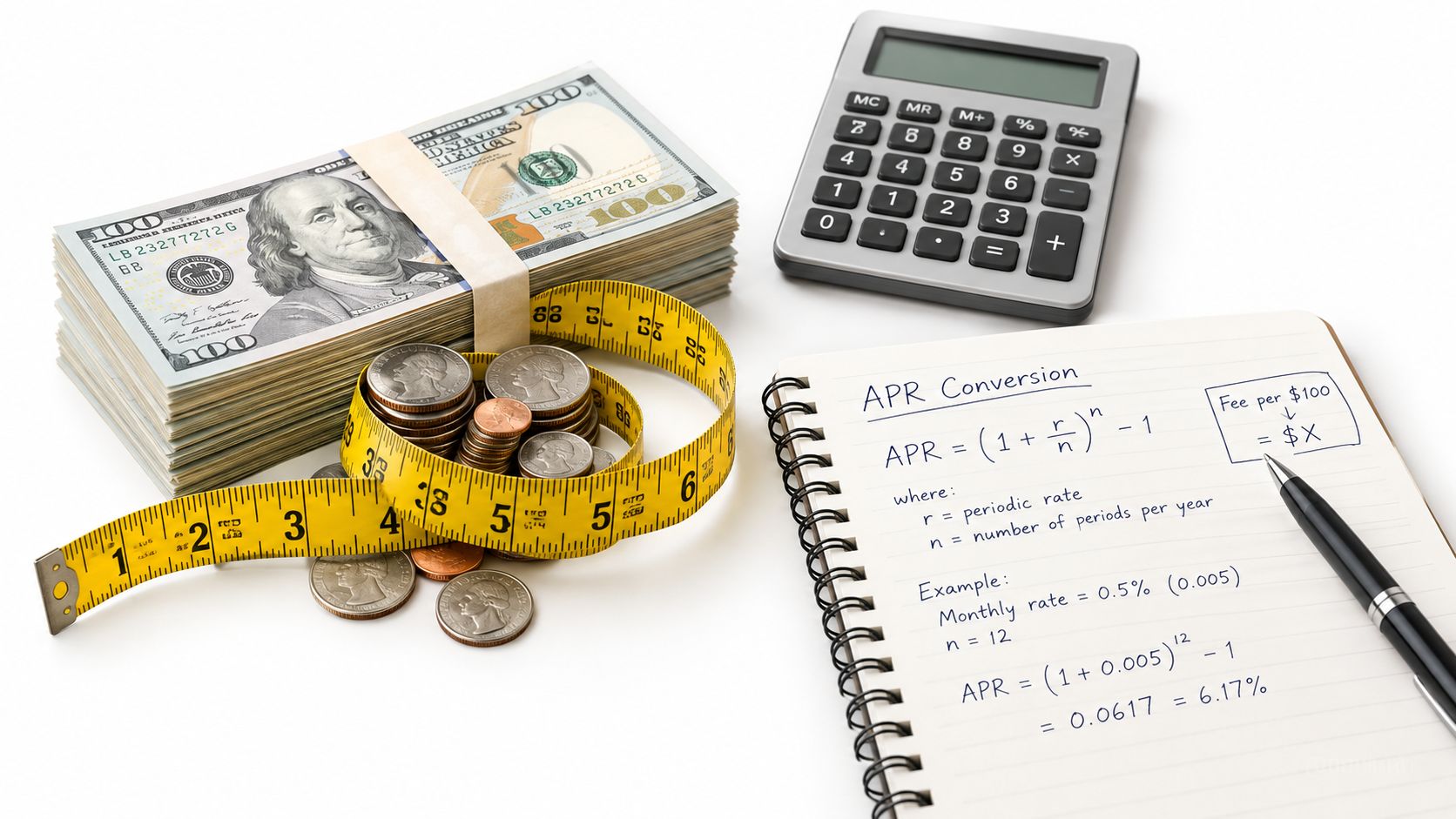
A typical payday loan in the U.S. costs about $15 per $100 borrowed for 14 days, which works out to about 391% APR. But that headline number can hide a lot, because payday loan rates often range from $10 to $20 per $100, and the cost changes sharply based on your state and how long you have the money.
If you're looking this up right now, there's a good chance you're not doing it out of curiosity. You're trying to close a cash gap before payday, and the fee on the screen might not look that bad. A charge like $15 for every $100 borrowed can feel manageable in the moment.
Then you see an APR near 400%, and suddenly the whole thing feels impossible to decode.
That confusion is normal. Payday lenders often describe price one way, in dollars per $100 borrowed, while consumer disclosures also show APR, and state laws may cap the same product differently depending on where you live. So the question usually isn't the most useful one.
The more useful question is simpler: How much money will I repay, by when, and what are my cheaper options?
Table of Contents
- Why Payday Loan Rates Feel Confusing at First
- How Payday Loan Pricing Actually Works
- Turning Fees Into APR With Simple Math
- State Caps and Regional Variations That Change Your Rate
- What Happens When You Rollover or Borrow Again
- Safer Alternatives to High Cost Payday Borrowing
- Making a Confident Choice About Payday Loan Rates
Why Payday Loan Rates Feel Confusing at First
You might be short on rent, gas, groceries, or a utility bill. You borrow because payday is close, and the fee sounds small enough to survive. That's where payday loan pricing often throws people off.
The fee looks small, but the timing changes everything
If someone says, "Borrow $300 and pay a $45 fee," many people hear that as a short-term convenience charge. It doesn't sound like a credit card rate or a car loan rate. It sounds more like paying for speed.
But payday borrowing compresses repayment into a very short window. A short term makes the annualized rate look huge, even when the dollar fee sounds limited at first glance.
Practical rule: Never judge a payday loan by the fee alone. Check the fee, the repayment date, and the total amount due together.
Two different questions get mixed together
People often blend these into one:
- What is the advertised rate? This is usually the fee per $100 borrowed.
- What is the legal limit where I live? State rules can change what lenders may charge.
- What will I personally owe? That depends on your loan amount and your exact term.
- What happens if I can't repay on time? That question matters as much as the first three.
Those are different questions, and payday loan ads don't always separate them clearly.
Why state rules matter so much
There isn't one national payday loan price. The Consumer Financial Protection Bureau explains that many state caps fall between $10 and $30 per $100, with $15 per $100 being common, and that the short term is what turns a modest-looking fee into a very high APR in annualized form (CFPB payday loan overview).
That means two borrowers can take loans that sound similar but face very different costs because of where they live or how long the loan lasts.
By the end of this guide, you should be able to look at a payday offer and answer three things with confidence: what the fee means, how the APR is calculated, and whether your state's rules change the deal in a meaningful way.
How Payday Loan Pricing Actually Works
A payday loan is usually priced as a flat dollar fee for each $100 borrowed. That is different from the monthly interest format people often see on credit cards or personal loans.
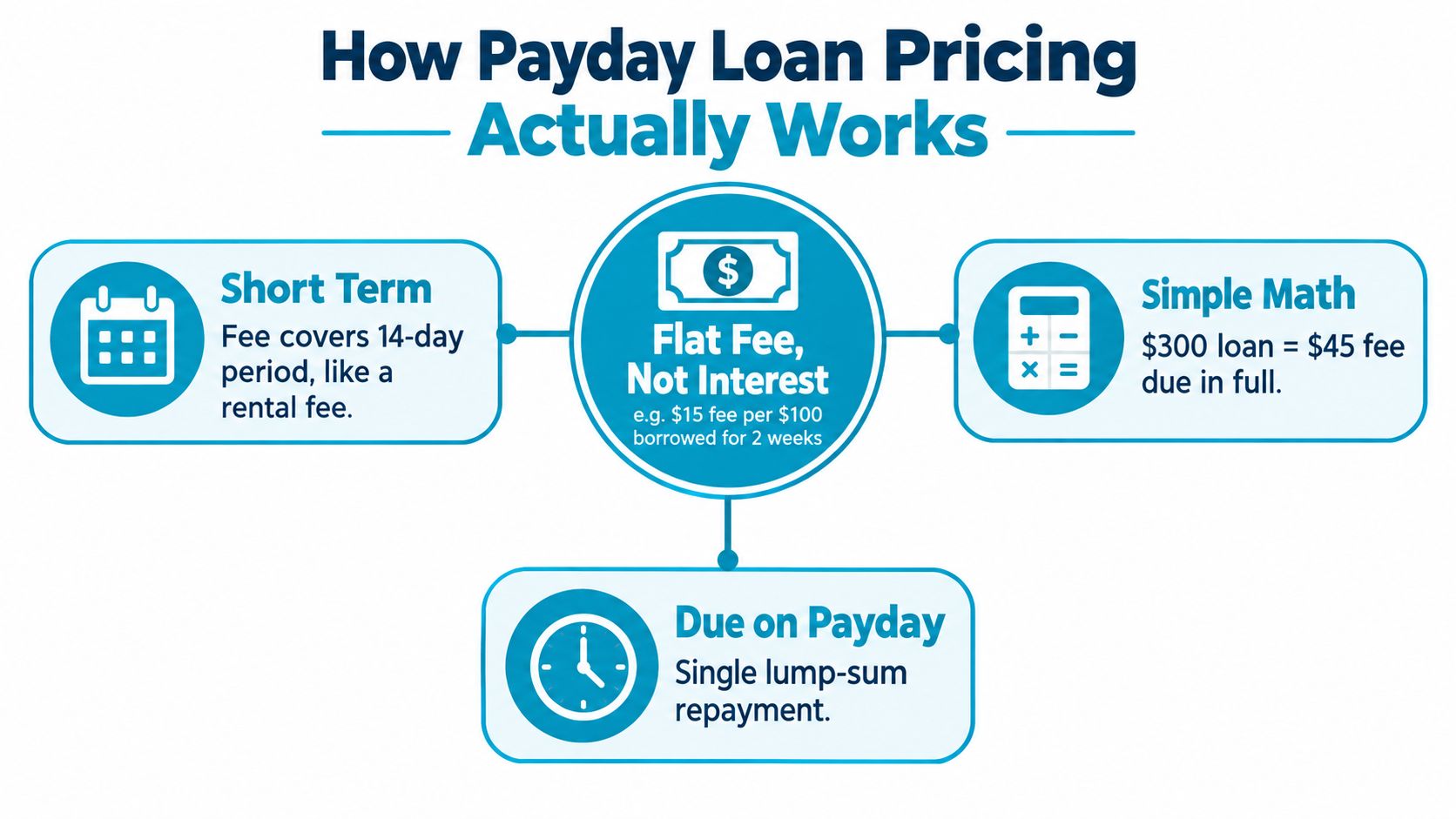
A short-term rental is a useful comparison. You pay one price for a weekend, not an annual ownership cost. Payday borrowing follows that same basic pattern. The lender gives you a short use of money, then charges a set fee for that brief period.
So if a lender says the price is $15 per $100 borrowed, the first question is simple: how many $100 blocks are you borrowing?
- $100 borrowed = $15 fee
- $300 borrowed = $45 fee
- $500 borrowed = $75 fee
That part is easy. The part that trips people up is that the fee is only one piece of the price.
Three labels often appear together, and each one answers a different question:
- Fee is the dollar amount charged for the loan.
- Finance charge is the disclosed cost of borrowing. For many payday loans, it is mostly the same charge shown as the fee.
- APR turns that short-term cost into a yearly rate so you can compare it with other credit products.
Here is where the headline numbers can mislead. A fee of $15 per $100 can produce one APR on a two-week loan and a different APR on a longer loan, even though the dollar fee itself did not change. The term length changes how that cost looks when stretched across a full year.
Repayment structure matters too. Many payday loans require one lump-sum payment on the due date. You repay the amount borrowed plus the fee in one shot. A $45 fee on a $300 loan may sound manageable when viewed by itself, but the budget question is whether you can cover $345 at once on payday.
That is why payday pricing makes more sense when you read it in one line: amount borrowed + fee + due date + total due.
If you are comparing loan formats, it helps to review how online payday loans work, especially how the repayment timing affects the total cash you need on the due date.
Turning Fees Into APR With Simple Math
A borrower takes out $300, sees a $45 fee, and wonders why the disclosure also shows an APR near 391%. The fee looks moderate. The APR looks enormous. Both numbers describe the same loan, but they answer different questions.
APR is the yearly version of a short-term cost. It works like converting a sprint pace into a full marathon pace. The short burst can make the annual number look dramatic because payday loans are usually due fast.
The benchmark example used by the Consumer Financial Protection Bureau is a payday loan priced at about $15 per $100 borrowed for 14 days, which equals 391% APR on a two-week loan (CFPB payday factsheet).
Here is the math in plain dollars.
- Borrow $100.
- Pay a $15 fee.
- Repay it in 14 days.
- Annualize that 14-day cost across a full year.
You do not need to memorize the formula to get the point. A fixed fee spread across a very short term creates a very high APR.
Now put that beside larger loan amounts using the same fee rule:
| Amount Borrowed | Fee at $15 per $100 | Total Due Before Any Other Charges |
|---|---|---|
| $100 | $15 | $115 |
| $300 | $45 | $345 |
| $500 | $75 | $575 |
That table helps with the first budget question: can you repay the full amount on the due date?
APR helps with a different question: how does this cost compare with other ways to borrow?
The part that confuses many readers is that the same fee can produce different APRs. The reason is time. If two loans both charge $15 per $100, the one due in 14 days will show a higher APR than the one due in 30 days because the same charge is being squeezed into a shorter window.
Side-by-side examples
| Fee per $100 | Loan Term | Fee on $300 | Approximate APR |
|---|---|---|---|
| $15 | 14 days | $45 | 391% |
| $15 | 30 days | $45 | lower than 391% |
| $10 | 14 days | $30 | lower than 391% |
| $20 | 14 days | $60 | higher than 391% |
This is why a single headline APR can mislead. It hides two moving parts: the fee and the length of the loan.
A simple shortcut helps. Read payday pricing in this order:
- dollars charged per $100 borrowed
- number of days until repayment
- total dollars due
- APR for comparison
That order keeps the math grounded in real cash first, then puts the APR in context. A lower APR does not automatically mean a low-cost loan. It can mean the same fee was spread over more days.
State Caps and Regional Variations That Change Your Rate
Where you live can matter as much as the amount you borrow. Payday loan rates aren't national in practice. State rules, local caps, and product availability shape what lenders can offer.
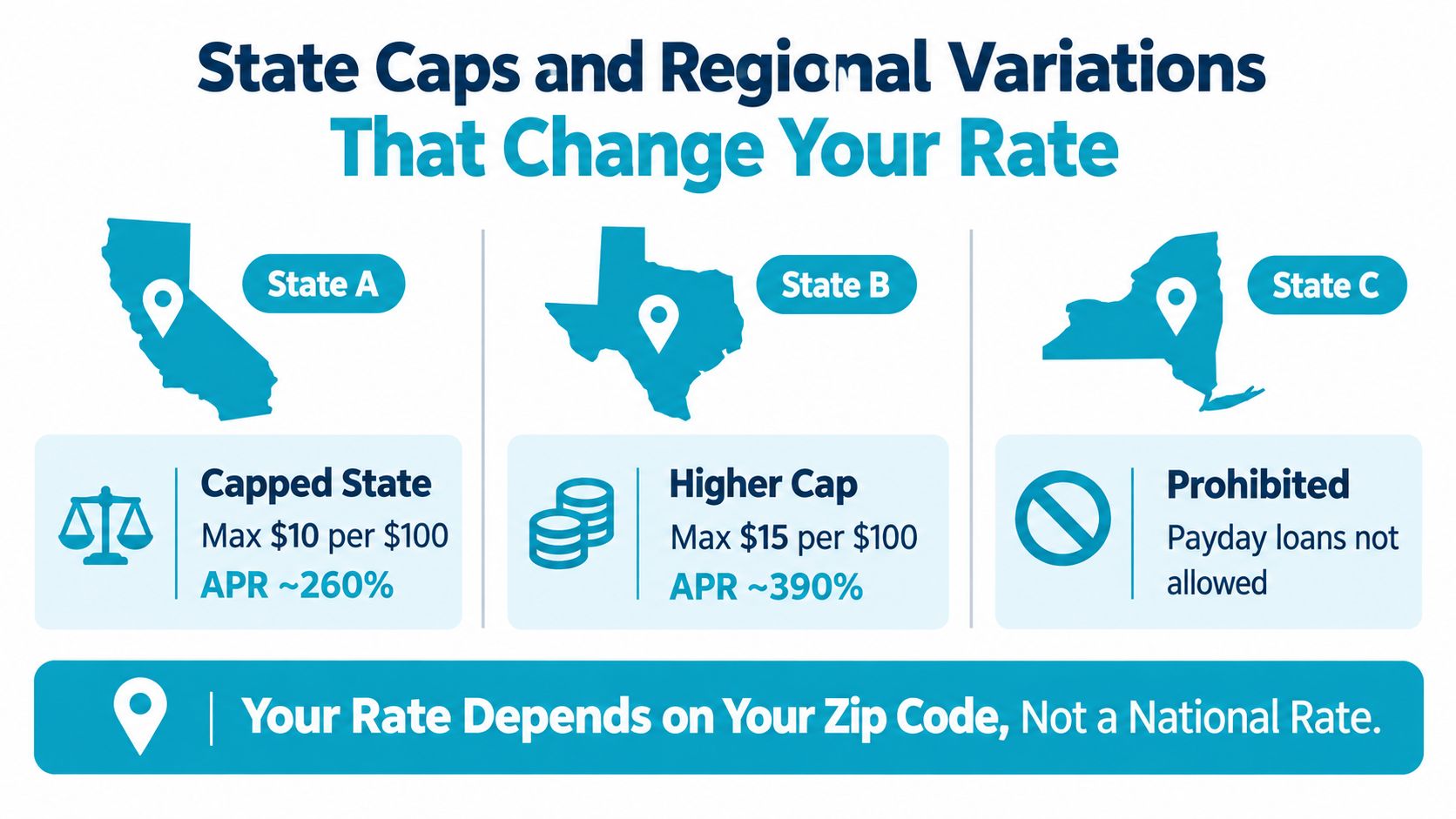
The same loan doesn't cost the same everywhere
Some markets allow higher charges than others. Some heavily restrict the product. Some don't permit payday lending at all through this marketplace model. NextStopLoans, for example, states that its service isn't offered in all states, including Arkansas, New York, Vermont, and West Virginia.
That means a borrower searching for payday loan rates in Texas may face a different practical situation than someone searching in another state. If you're comparing local availability, this overview of payday loans in Texas helps frame how location affects what you may see.
A headline APR can hide local differences
One broad benchmark doesn't tell you what your market looks like. The California Department of Financial Protection and Innovation reported an average payday loan APR of 362% in 2025, down from 364% in 2024, according to the annual report referenced in the verified data (California DFPI annual report).
That doesn't mean every California loan costs exactly that amount. It means averages shift, rules matter, and the familiar two-week benchmark isn't representative of every market.
International caps show how regulation changes the bill
Rules abroad make the contrast even clearer.
How Payday Loan Caps Compare Across Markets
| Market | Cap or Average | What Borrower Pays per $100 |
|---|---|---|
| United States benchmark | Typical fee of $15 per $100 for 14 days | About $15 per $100 |
| California | Average APR of 362% in 2025 | Varies by product and term |
| Canada | Federal payday cap cut to $14 per $100 borrowed effective January 1, 2025 | $14 per $100 |
| United Kingdom | Price cap took effect on 2 January 2015, with interest and fees capped at 0.8% per day, default fees at £15, and total repayment capped at 100% of amount borrowed | A 30-day loan repaid on time would cost no more than £24 per £100 |
The U.K. example is especially helpful because it shows several layers of protection at once. The Financial Conduct Authority's cap, described in this BBC explanation of the payday-loan price cap, limited daily charges, default fees, and total repayment.
What to check before you borrow
Use this quick filter when looking at any offer:
- Local rule first: Your state may limit fees or shape which products are offered.
- Per-$100 cost second: That's often the clearest pricing signal.
- Loan term third: The same fee can feel very different over a different timeline.
- Total repayment last: This is the number your budget has to absorb.
A national average can start the conversation. It can't finish it.
What Happens When You Rollover or Borrow Again
A payday loan can start as a two-week cash gap. The trouble starts when that gap is still there on the next payday.
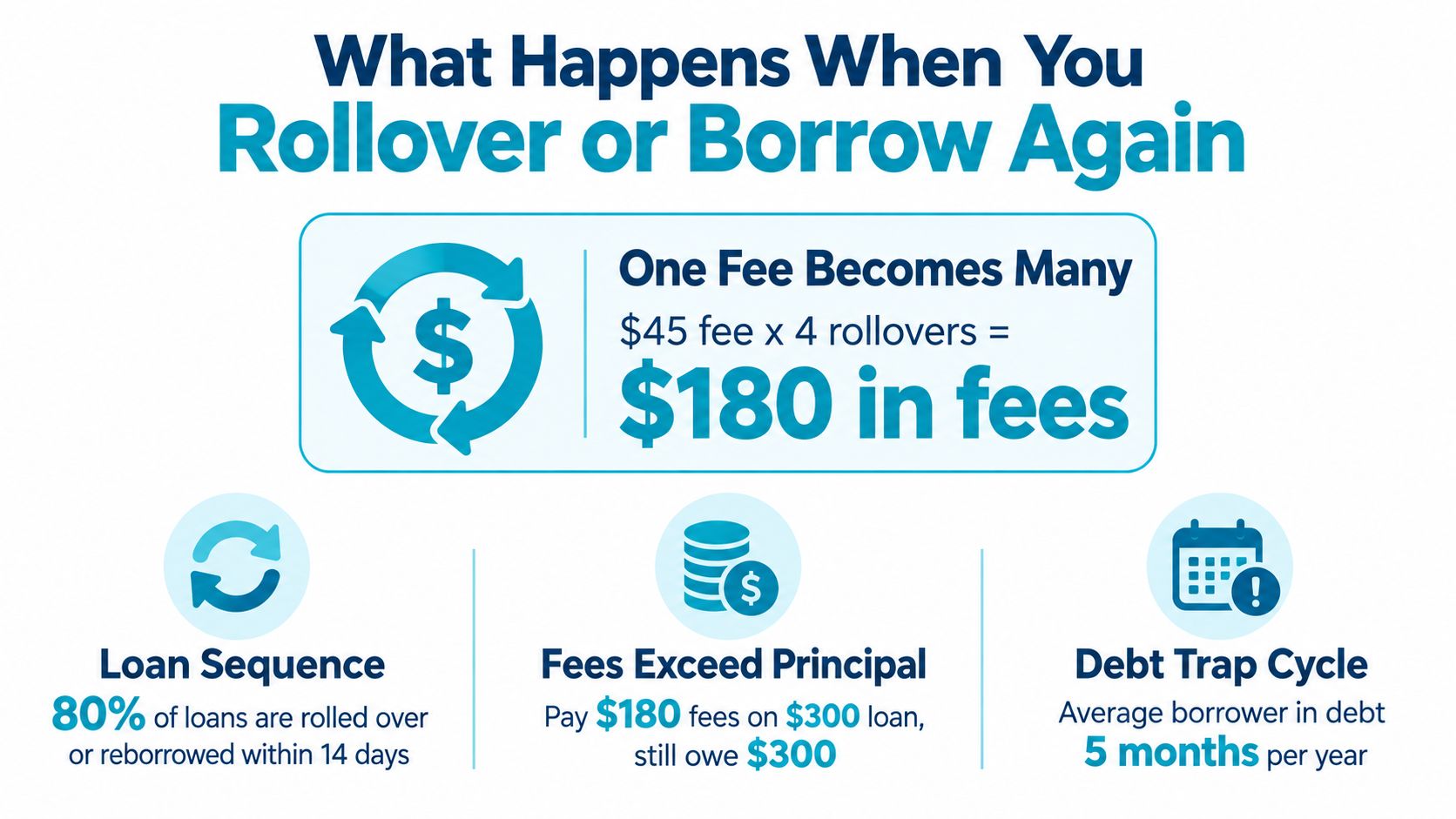
The real cost shows up across a sequence of loans
Suppose you borrow $300 and pay a common fee of $15 per $100. That first loan costs $45. If your next paycheck cannot cover the full repayment and your regular bills, borrowing again can mean another $45 fee for the same $300 gap.
After three borrowing cycles, the fees alone reach $135. After four, they reach $180. You still may not have solved the original shortfall.
That is why consumer researchers often examine loan sequences, not just one loan in isolation. The question is not only how expensive one two-week advance looks on paper. The harder question is how often the same fee repeats in real life.
Why rollover math feels worse than the first quote
The first fee can look manageable because it is quoted in dollars. Forty-five dollars on a $300 loan may sound easier to absorb than a triple-digit APR.
Repeat borrowing changes the picture. Each new cycle adds another fee, another due date, and another chance that rent, groceries, gas, or utilities will force the same choice again.
A useful way to picture it is a toll road. One toll may be irritating but manageable. Paying the same toll every few miles turns a short trip into an expensive one.
The same fee can produce very different outcomes
This is also where the article's main point matters. A headline rate does not tell the whole story.
If a lender charges $15 per $100, the fee itself does not change just because the APR headline sounds dramatic. What changes your experience is the term length and whether you must borrow again. A two-week loan repeated four times is not the same budget event as one longer loan with structured payments, even if the first quote looked smaller.
For example:
- One $300 loan for 14 days at $15 per $100: $45 fee
- The same $300 gap covered by borrowing again three more times: $180 in total fees across four cycles
- Total repaid across those four cycles: far more than the original $300 shortage that started the problem
That is one reason payday cost comparisons can mislead. A single APR headline captures annualized cost. Your bank account feels the repeated fees.
Borrowing again is often the turning point
Many borrowers do repay the first loan. The strain comes after repayment, when the paycheck that covered the loan no longer covers everything else.
That creates a common pattern. The loan solves today's shortage by pulling money from the next paycheck. Then the next paycheck arrives already spoken for.
Before accepting any offer, ask these questions:
- After repayment, what dollars are left for regular bills?
- If one surprise expense hits, do I have a backup besides another short-term loan?
- Am I fixing a one-time gap, or am I covering a budget that stays short every pay period?
Those questions are plain, but they get to the heart of rollover risk better than a headline APR alone.
Safer Alternatives to High Cost Payday Borrowing
When cash is tight, speed matters. Cost still matters too. A fast option that creates another crisis two weeks later may not be the cheapest path, even if it's the easiest to access.
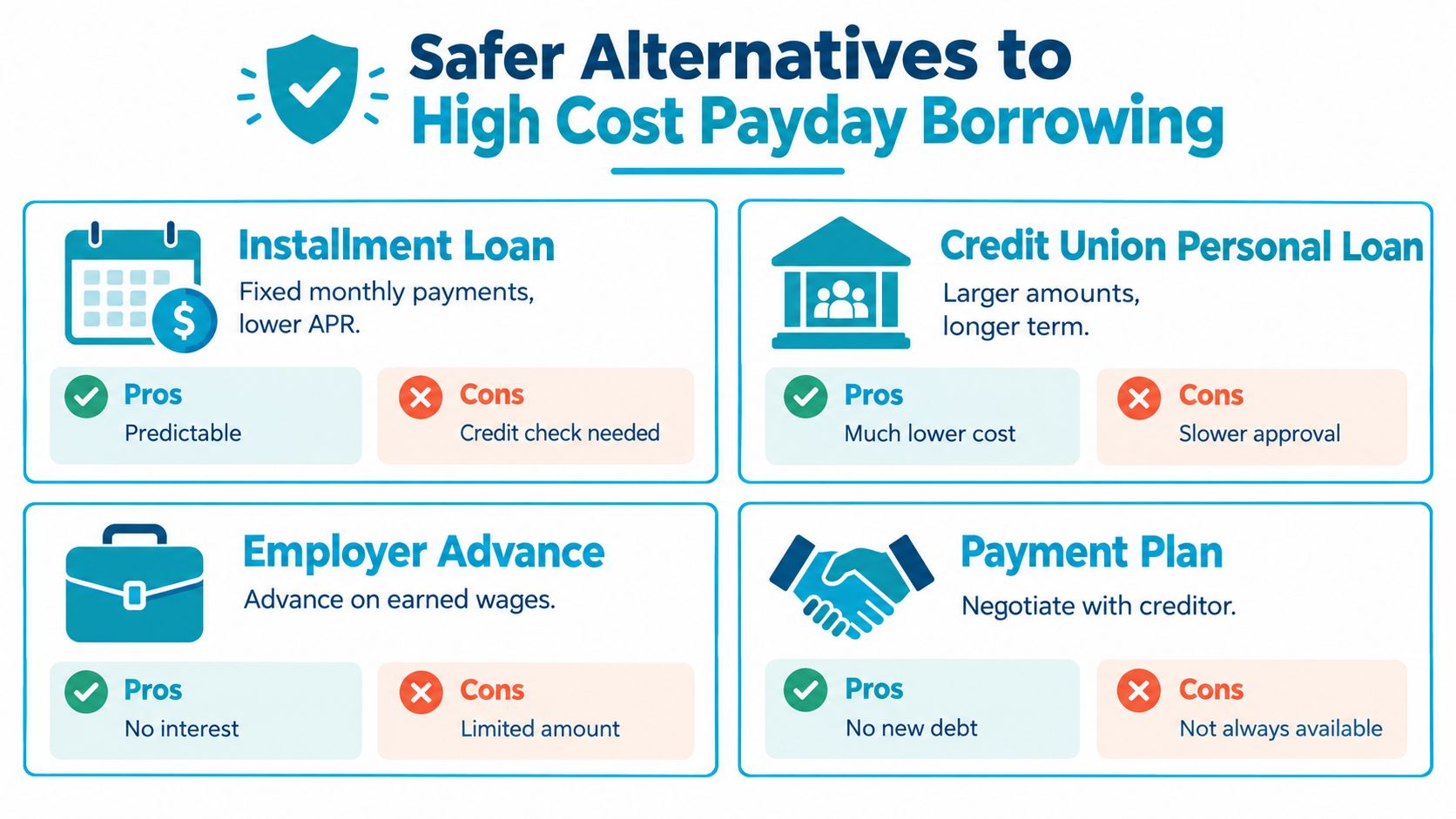
Compare the structure, not just the urgency
Different products solve different problems. A short cash gap needs a different solution than a larger expense you can't repay in one shot.
- Installment loans: These spread repayment across scheduled payments rather than one lump sum. That can make budgeting easier, even if approval standards vary.
- Personal loans: These may fit larger needs better than payday products because repayment is usually structured over more time.
- Employer paycheck advances: If available, this can reduce the need to borrow from a third party at all.
- Payment plans with billers: Medical providers, utilities, and some service companies may work with you directly.
- Credit union small-dollar loans: These can be worth checking before you accept a high-cost short-term offer.
What to compare side by side
Don't just ask, "Can I get the money?" Ask these instead:
- How is repayment structured? One lump sum is harder on many budgets than fixed installments.
- What is the total repayment? This matters more than the monthly or per-$100 framing alone.
- How quickly can funds arrive? Timing can be decisive in an emergency.
- Will a credit check be involved? Some options are more flexible than others.
- Can I decline the offer after reviewing terms? You should know this before applying.
A slower, more structured loan can be safer than a faster loan that demands full repayment all at once.
One marketplace option among many
If you want to compare pathways without filling out separate forms repeatedly, installment loans vs payday loans is a useful place to sort out which structure fits your situation.
NextStopLoans operates as a marketplace connector, not a lender. It sends a consumer's request to a network of independent lenders, while lenders handle credit decisions, terms, and funding. That setup can help if you want to review possible personal, installment, or bad-credit options in one request flow rather than shopping one lender at a time.
A practical priority list
If you can slow down for even a few minutes, start in this order:
- First, ask the biller for time: A payment extension may solve the problem without new debt.
- Next, check structured borrowing: Installment-style repayment is often easier to manage than a lump-sum payday due date.
- Then compare total cost: Look at the full repayment amount, not just whether funds may arrive quickly.
- Use payday borrowing last: If it's the only option available, go in with a clear repayment plan before accepting.
Making a Confident Choice About Payday Loan Rates
Payday loan rates make more sense once you separate the moving parts. The fee tells you the direct charge. The term changes how that charge turns into APR. State rules shape what can legally be offered where you live.
That means the most important number isn't always the headline APR by itself. The most important number for your budget is often the total amount you must repay on the due date.
A simple checklist before you accept any offer
Keep this list next to any loan screen or disclosure:
- Confirm the fee per $100 borrowed. Don't rely on a general example if your actual offer is different.
- Check the exact repayment date. A short term can make repayment much harder even when the fee seems manageable.
- Calculate the total repayment. Ask yourself whether that amount fits inside your next paycheck after regular bills.
- Review your state's limits and availability. Location affects both price and product type.
- Ask what happens if you can't repay on time. Don't wait to learn this after the due date arrives.
- Compare one non-payday option. Even one side-by-side comparison can change the decision.
Confidence comes from slowing the math down
You don't need to become a lending expert to protect yourself. You just need to translate the offer into plain dollars and plain dates.
If the loan only works in the best-case version of your next paycheck, it's probably too fragile. If a structured alternative gives you more breathing room, that may be the safer move even if it takes a bit more effort upfront.
Borrowing isn't just about getting approved. It's about whether repayment leaves you standing after the due date passes.
A good decision here often feels less dramatic than the emergency itself. That's a sign you're looking at the numbers clearly.
If you're comparing payday loan rates and want to review offers without applying separately to multiple lenders, NextStopLoans lets you submit one secure request to a network of independent third-party lenders. You can review any terms presented, compare repayment details, and decide whether an offer fits your budget before accepting.