
Payday Loans Online Same Day Deposit Guide

A same-day lender decision isn't same-day cash: usable funds are commonly available the next business day, and same-day posting depends on cutoffs, an expedited transfer, and the receiving bank. Before accepting a payday loan, judge the scheduled debit against your next paycheck and essential bills, not the speed of the approval screen.
Searches for payday loans online same day deposit often blur together several different events. A lender can review an application quickly, but approval, sending the money, and seeing spendable funds in your account aren't the same thing. A fast decision also doesn't tell you whether the repayment will leave enough for rent, food, and transportation.
Table of Contents
- What Same-Day Deposit Actually Means
- What to Have Ready Before You Apply
- Price the Offer and Apply in Order
- When the Debit Hits and You Cannot Pay
- Decline the Offer or Request One Carefully
What Same-Day Deposit Actually Means
A lender may approve an application quickly without putting spendable money in your account that day. The deposit is usable only once your bank posts it, and that timing can depend on the lender, processing cutoffs, identity checks, weekends, holidays, and your bank. The CFPB's explanation of payday loans notes that proceeds may be delivered electronically but doesn't set a universal funding deadline.
Trace the money through five handoffs. Each runs on its own clock, so the useful question is which event an advertised "same-day" promise measures.
| Stage | What it means | Typical timing | What pushes it later |
|---|---|---|---|
| Application sent | One form with identity, income, and deposit account | A few minutes | Missing fields or a state the lender doesn't serve |
| Lender decision | Approval, denial, or a request for documents | Minutes to a few hours | Income or identity verification |
| Agreement signed | Principal, fee, APR, due date, and debit authorization accepted | Same session if you accept | Stopping to read the terms |
| Funds released | Lender sends ACH or an optional expedited transfer | Same day only before the cutoff; otherwise next business day | Weekend, holiday, or after cutoff |
| Bank posts deposit | Money is available to spend | Often the next business day | Bank hold or account mismatch |
| No express fee | Standard delivery without an add-on | Slower than an expedited transfer | Optional fee that may speed delivery |
These stages work like a relay race: a fast first leg means little if the handoff after it stalls. A real-time decision can still be followed by contract review or a request to verify income, and in some circumstances a lender may require faxed application materials before proceeding. Even after the lender releases funds, your bank controls when the deposit becomes available.
Ask what the clock measures. Does "same day" mean an approval, the lender's release of funds, or a deposit your bank has posted and made available? Get the expected funding date in writing, and compare standard delivery with any paid expedited option. An express fee may speed the transfer but doesn't necessarily remove bank processing or verification delays. For a closer look at bank processing times, see this guide to when direct deposits post.
Speed also tells you nothing about cost. Before signing, compare the dollar amount of the scheduled debit against your next paycheck and the bills due before it.
An upfront request for a processing, insurance, or paperwork payment before credit is issued is a reason to stop. Don't pay to receive a promised loan. Payday loans are generally due within a short window, so even a successful deposit can leave a difficult repayment date on your calendar.
What to Have Ready Before You Apply
Prepare your information before opening an application. A complete form is easier to review than one that pauses while you look for a bank statement or pay details, but readiness doesn't guarantee approval or immediate funding.
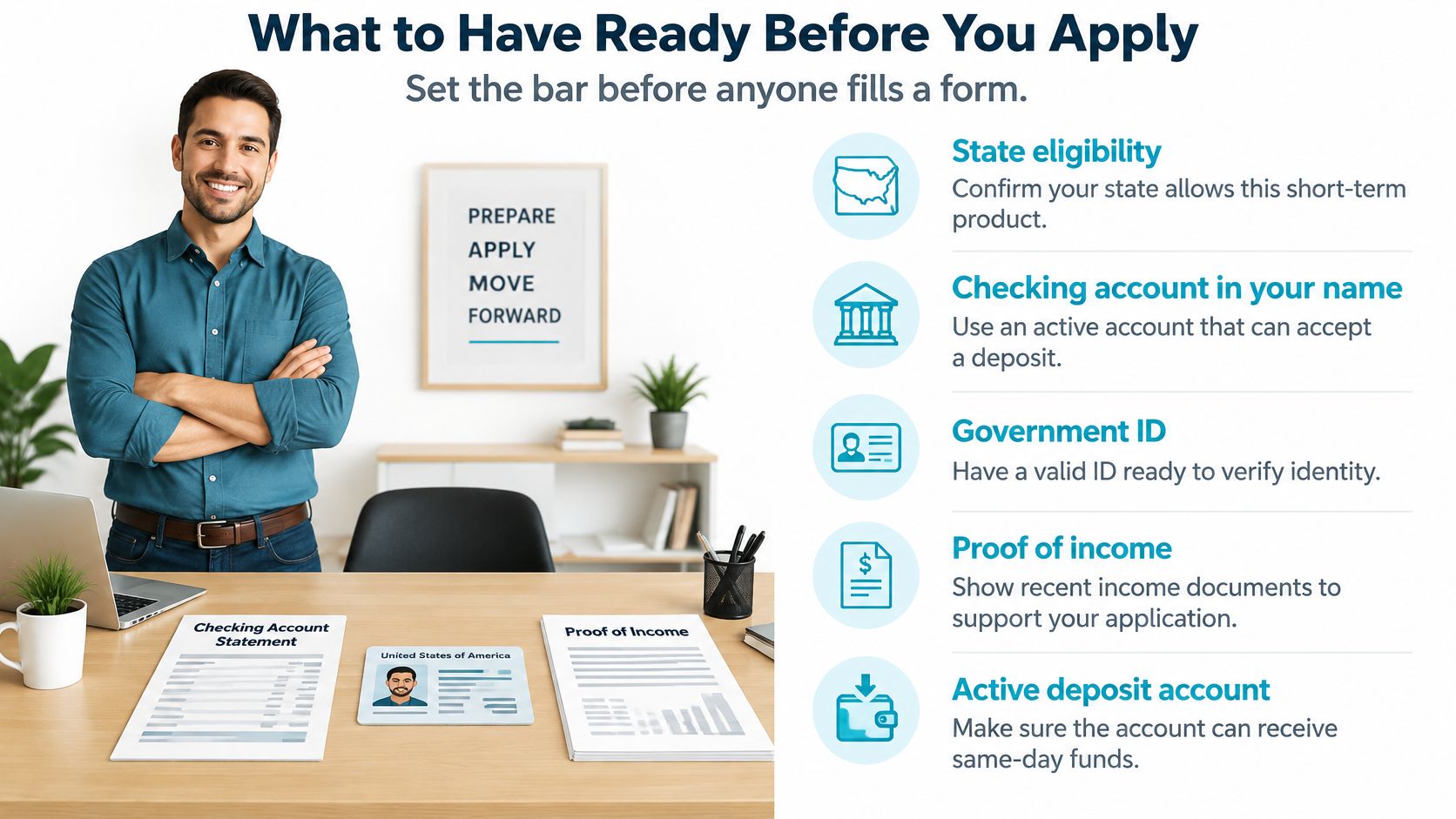
Start with state eligibility. Payday loan availability and rules differ by state. Confirm the product is offered where you live and check your state's loan limits and fee rules before submitting anything. If the product isn't available in your state, don't try to work around that restriction.
Next, gather the basic details a lender may need to identify you and assess repayment:
- A government photo ID: Have a valid document ready for identity verification.
- Income information: Know your employer or other regular income source, pay frequency, and the date you expect to be paid. A lender may ask for documents to support what you enter.
- An active checking account in your name: Confirm that it can receive a deposit and that you control it. A new account, prepaid card, or joint account you can't independently manage may create verification or payment problems.
- Contact and account details: Have a working phone and email, plus the account and routing numbers for the account receiving funds.
A request form may ask for the loan amount, personal information, and where to deposit funds. At NextStopLoans.com, submitting information gives lenders in the network permission to verify your Social Security number, driver license number, or other identification. Review what you're authorizing before you submit, and don't share account details through a link or message you can't verify.
A marketplace connects applicants with lenders; it doesn't make the lending decision. A participating lender may verify information or ask for more documents, so an application that takes minutes to complete doesn't mean funds will arrive immediately. See this guide to payday loan requirements for a checklist of common application details.
One more check matters more than a polished application: can you repay on the scheduled date without borrowing again? Payday loans are short-term borrowing, often due within a few weeks. If the next paycheck is already committed to essential bills, pause before applying.
Price the Offer and Apply in Order
Eligibility tells you whether you can borrow. The repayment total tells you whether you should. Convert every fee into dollars per $100 borrowed so offers of different sizes can be compared side by side. In states without strong rate limits, the Federal Reserve's consumer-credit discussion reports fees of roughly $10 to $30 per $100 borrowed, and it describes the rollover risks that follow when the due date arrives without the money.
Use the table as a lookup. Find the amount you need in the left column, then read across to the dollar total your next paycheck would have to cover. The on-time amount is principal plus one fee. The one-rollover column assumes a second fee of the same size is added while the original principal remains due. These figures are calculations from the listed per-$100 rates, so treat them as a comparison tool rather than a quote from any particular lender.
| Amount borrowed | Fee per $100 | Fee on time | Amount due on time | Total fees after one rollover |
|---|---|---|---|---|
| $200 | $10 | $20 | $220 | $40 |
| $200 | $15 | $30 | $230 | $60 |
| $200 | $30 | $60 | $260 | $120 |
| $400 | $10 | $40 | $440 | $80 |
| $400 | $15 | $60 | $460 | $120 |
| $400 | $30 | $120 | $520 | $240 |
The worked example: a $400 advance at $15 per $100 carries a $60 fee, so the agreement schedules one repayment of $460 on the due date. Miss that date and roll the loan over at the same fee, and another $60 is added while the $400 principal still waits to be repaid. A rollover buys time. The principal stays untouched. The number that decides the offer is the $460 debit, and what it does to the rest of that paycheck.
Decision rule: If the scheduled debit means you'll need another loan for essentials, don't accept the offer.
Once the dollar total fits, submit one complete request rather than scattering incomplete applications. The FTC's account of an online cash-advance case describes allegations involving an undisclosed express fee of $3 to $25 and customers who waited two to three business days when they didn't pay it. That case shows why application speed and funding speed are separate questions, and why the actual delivery date belongs in writing.
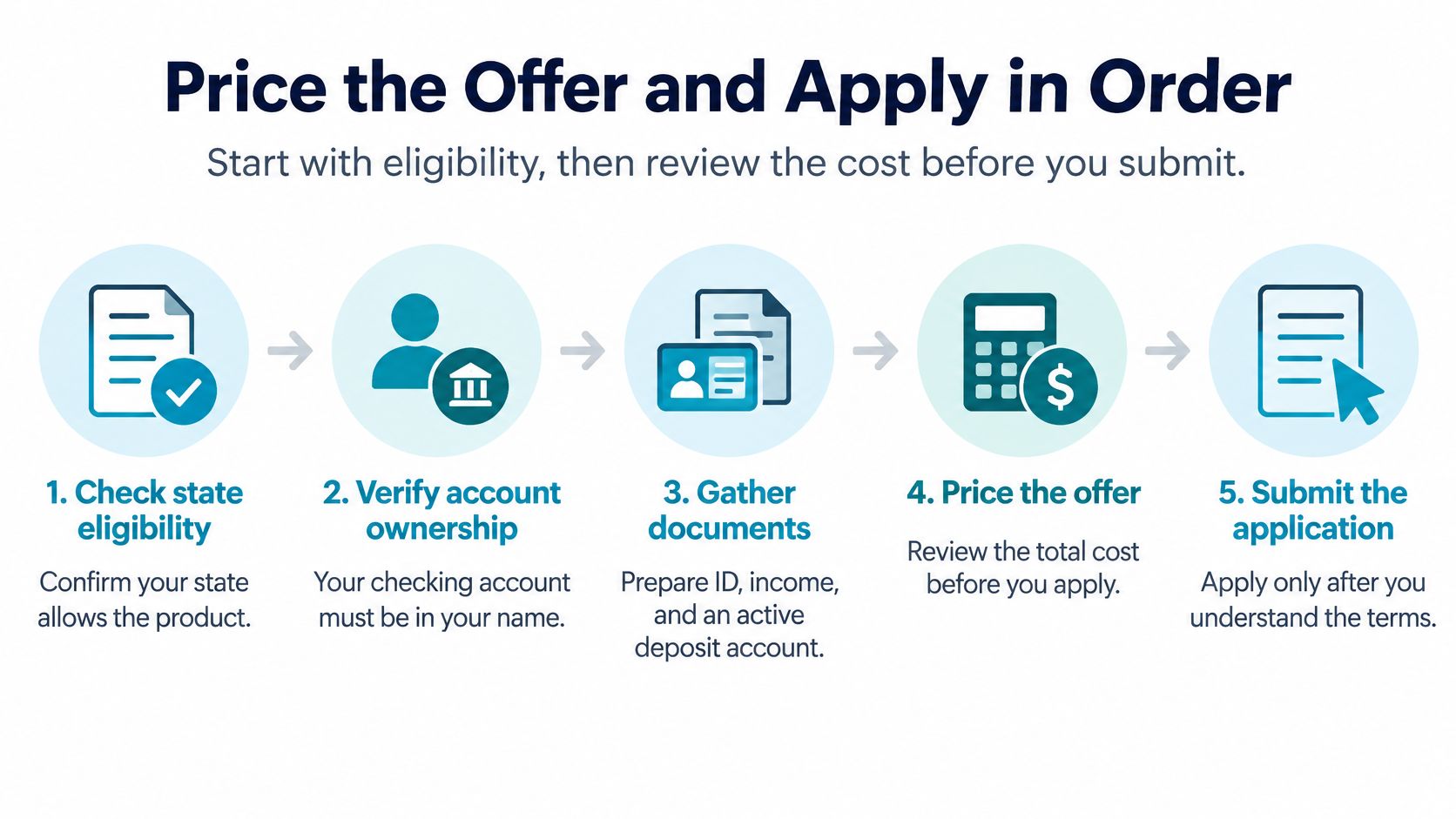
Use this order:
- Confirm eligibility. Verify that the product is available in your state and that your checking account is in your name.
- Complete one application. Enter your requested amount, identity information, income details, and deposit account carefully.
- Read the full disclosure. Write down the principal, finance charge, APR, payment date, total repayment, and whether the ACH authorization permits more than one withdrawal.
- Compare the debit with payday. Include rent, groceries, transport, and other scheduled payments. Accept only if the repayment fits without another loan.
- Confirm delivery and save the agreement. Ask whether "same day" describes approval, an expedited transfer, or money posted by your bank. Keep the electronic contract and payment schedule.
If an amount or date is missing, wait to sign until the lender clarifies it. An online request can take minutes to fill out, and submitting it doesn't guarantee approval. Funding times vary among lenders, and some may require additional documents, in certain circumstances even faxed application materials, which can push the deposit later. The payday loan rate guide walks through how lenders structure these charges, which gives you one more check before you compare costs.
When the Debit Hits and You Cannot Pay
The deposit arrived, but the scheduled debit lands before your paycheck. In the example above, the lender is set to withdraw $460 from an account that does not yet have enough money. Two charges can follow from that one failed attempt: the bank may add a nonsufficient-funds fee, and the lender may add a returned-payment fee or offer an extension for another charge. Check the agreement for the exact amounts rather than assuming a failed debit waits.
A $15-per-$100 charge on a two-week loan works out to an APR near 400%, according to CFPB guidance for borrowers considering payday loans online. That guidance also warns that extensions can carry extra fees and that failed repayment can trigger lender charges on top of the bank or credit union nonsufficient-funds fee. Read the two costs together: a missed payment can mean paying the lender and the bank for the same day.
Act before the debit is attempted. Call the lender as soon as you know the payment may fail. Ask whether a partial payment is allowed, what it costs, and whether the lender will try a second withdrawal on the same date. Each lender sets its own repayment terms, so the answer comes from the company named in your agreement, and calling early does not guarantee a change.
Then rank the account's other scheduled payments. Rent, utilities, and the loan debit may all compete for a balance that will not cover them, and a payment you can move without penalty buys room for the ones you cannot move. A second payday loan to cover the first only pushes the shortfall to a new due date and adds another repayment obligation on top of it.
Repeated borrowing is where the cost of a small loan grows fastest. Each rollover or new advance stacks another finance charge onto money already spent, and every later event in the loan's timeline, a retry, an extension, a late fee, adds a new dollar amount to the total leaving your next paycheck. A plan based only on the speed of the first deposit misses that running total.
If a debit you did not authorize goes through anyway, contact your bank and the lender promptly to dispute it and revoke the payment permission. Save the agreement, the ACH authorization, the payment schedule, and any messages about changes; those records are what a dispute rests on. Before agreeing to any extension, ask for the fee amount and the new withdrawal date, since lenders may charge late fees and nonsufficient-funds fees on a missed payment.
Decline the Offer or Request One Carefully
If the scheduled withdrawal won't fit your next paycheck after essentials, decline the loan. A fast deposit doesn't make an unaffordable debit safe, and taking another advance to cover the gap can leave you with multiple repayment dates and fees.
Try lower-cost options before borrowing. Contact the biller to ask for a new due date or payment arrangement. Ask your employer whether it offers a paycheck advance, and check whether a credit union has a small-dollar loan you qualify for. For rent or utilities, look for local nonprofit assistance. If family can help, agree on the amount and repayment date in writing.
| Option | Typical cost | Typical speed | Watch for |
|---|---|---|---|
| Ask the biller for a new due date | Usually no fee | Same day by phone | Ask before the due date |
| Employer paycheck advance | Set by employer | Ask employer for timing | Confirm whether your employer offers one |
| Credit union small-dollar loan | Set by credit union | Ask about its application process | Membership and approval required |
| Family loan with written payback date | Often no interest | Same day | Put the payback date in writing |
| Payday loan at $15 per $100 | About $15 per $100 borrowed | Next business day is typical | A rollover can double the cost |
A credit union or employer may have eligibility rules, and a biller may not grant a change, but asking can show whether a less costly option is available. Compare the actual payment date and amount, not just whether the money can arrive quickly. If you still consider a payday loan, read the lender's terms and decline any offer that leaves too little for essential expenses.
A marketplace is an optional way to request lender offers, not a lender or a promise of approval. Registration with NextStopLoans is free, and one request can be shared with participating lenders; each lender sets its own fees and repayment terms. You can review an offer and refuse it, and the service isn't available in every state.
If you've compared the upcoming debit with your essential expenses and still want to review possible offers, visit NextStopLoans to submit one online request to a network of independent lenders. Responses and funding are handled by lenders, and any offer should be checked for its total repayment, due date, and withdrawal terms before you sign.