
What Time Do Direct Deposits Post a Complete Guide

U.S. direct deposits most commonly post by around 9:00 a.m. local time on payday, but the exact hour depends on ACH settlement windows, bank cutoffs, weekends, holidays, and whether your bank offers early availability. A deposit may appear overnight, during the morning, or later on a banking day, depending on how the payment moves through the system.
You may be checking your banking app before work, waiting for payroll to appear, or watching for loan proceeds needed for an urgent expense. If the money isn't there yet, the delay can feel random. It usually isn't. The timing reflects the payer's instructions, the ACH network's processing schedule, and the receiving bank's posting policy.
The same paycheck can appear at midnight for one employee and later in the morning for another employee at the same company. Loan funding follows related rules, but the lender controls when the payment is released. Understanding the difference between settlement, posting, and availability makes the answer to what time do direct deposits post much easier to apply to your own situation.
Table of Contents
- Why Direct Deposit Timing Feels Unpredictable
- How ACH and Bank Posting Work
- The Four Factors That Decide Your Posting Time
- Weekends, Holidays, and the Three Funding Paths
- How to Check Whether Your Deposit Has Posted
- How Loan Funding Timing Compares to Payroll
- Practical Ways to Get Your Deposit Sooner
- Key Takeaways and Common Direct Deposit Questions
Why Direct Deposit Timing Feels Unpredictable
At 6 a.m. on payday, you open your banking app and still see yesterday's balance. A coworker says their pay arrived overnight, while your account shows nothing. By lunchtime, the deposit appears. The same uncertainty returns on the next payday.
The difference starts with what payday means. It is the date the payer assigns to the credit, not a guaranteed hour when every bank must display it. The payment still has to move through the ACH process, and your bank must record the incoming credit under its own posting policy.

Why two accounts can show different times
Two employees paid by the same employer can see different results. One bank may make funds available after receiving advance payment information. Another may wait for settlement, then run an overnight or morning posting cycle. Both accounts can receive the payroll correctly without their visible balances changing together.
Direct deposits commonly appear overnight or early on payday, and payroll deposits are generally available by 9:00 a.m. on the scheduled Friday payday in virtually all cases, according to Nacha's ACH payments fact sheet. That guidance describes a common outcome, not one universal posting hour for every bank or payment type.
Loan proceeds add another variable. A lender may send them through standard ACH, offer early access through its receiving bank, or use a real-time rail such as FedNow when available. Those paths do not promise the same timing, so a payroll deposit and a loan payment scheduled for the same day may appear at different times.
What you can and can't control
You can confirm your routing and account information, finish payroll or lender paperwork promptly, and ask the payer when its file was transmitted. The payer can explain submission details and the originating bank can clarify processing status. The receiving bank can explain its posting and availability policy.
A federal holiday, the receiving bank's internal schedule, and the lender's chosen payment rail are outside your control. To identify a delay, ask the payer for the transmission status and effective date, ask the originating bank whether the instruction entered processing, and ask the receiving bank when it expects to post the credit. Those answers provide more useful guidance than the payday date alone.
How ACH and Bank Posting Work
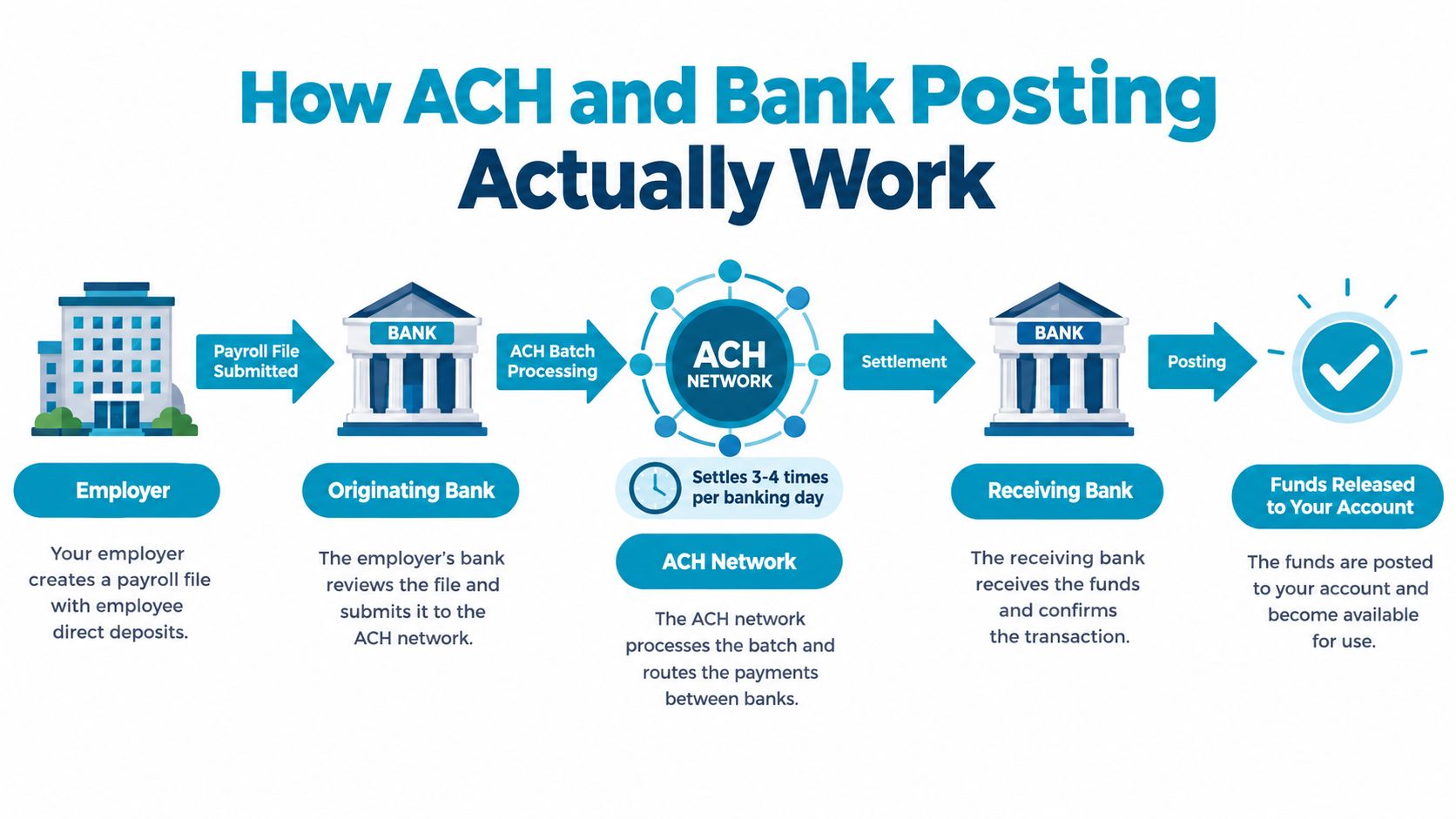
ACH, or the Automated Clearing House network, moves electronic payments between financial institutions. Employers use it for payroll, and lenders may use it for loan proceeds. Unlike a card authorization that responds in real time, ACH usually processes payment files in batches during banking-day windows.
The process resembles overnight mail. A payroll department prepares a file and sends it to the originating bank. That bank places the instructions into a processing batch. The ACH network routes and settles the batch, and the receiving bank accepts the credit before recording it in your account.
Nacha says ACH payments are processed for approximately 23¼ hours on each banking day and settle four times per banking day. Weekends and federal holidays do not provide ordinary ACH settlement. The network's operating framework appears in Nacha's ACH payments fact sheet.
Four terms that explain the timing
- Business day: A day when the relevant banking and settlement systems operate. Weekends and federal holidays generally fall outside ordinary ACH settlement.
- Cutoff: The latest time a payer or originating bank can submit an instruction for a particular processing window.
- Effective entry date: The date the sender assigns for the credit to reach the recipient.
- Posting: The moment the receiving bank records the credit in your account and makes it visible under its own policy.
These terms separate events that can occur hours apart. Settlement describes the movement and completion of funds between institutions. Posting describes the receiving bank's decision to credit your account. The bank may also show funds earlier by advancing its own money before interbank settlement. That practice helps explain why some payroll recipients see a deposit before the stated payday.
Why ACH is reliable but not always immediate
A standard ACH credit can follow a predictable path without appearing instantly. If the file reaches the appropriate processing window and carries the correct effective date, the network can settle it on a banking day. A missed cutoff, late submission, or holiday-adjusted date can move the transaction to the next available processing opportunity.
Loan proceeds can follow a different path. A lender may use standard ACH, provide early access through the receiving bank, or send funds over a real-time rail such as FedNow when available. These options do not promise the same arrival time, so a loan payment and payroll deposit scheduled for the same day may post at different times.
The receiving bank then applies its own workflow. One institution may post settled credits during an overnight cycle, while another updates accounts in a morning batch. The answer to “what time do direct deposits post” is therefore a range shaped by the payer, ACH processing, the payment rail, and the receiving bank's posting policy.
The Four Factors That Decide Your Posting Time
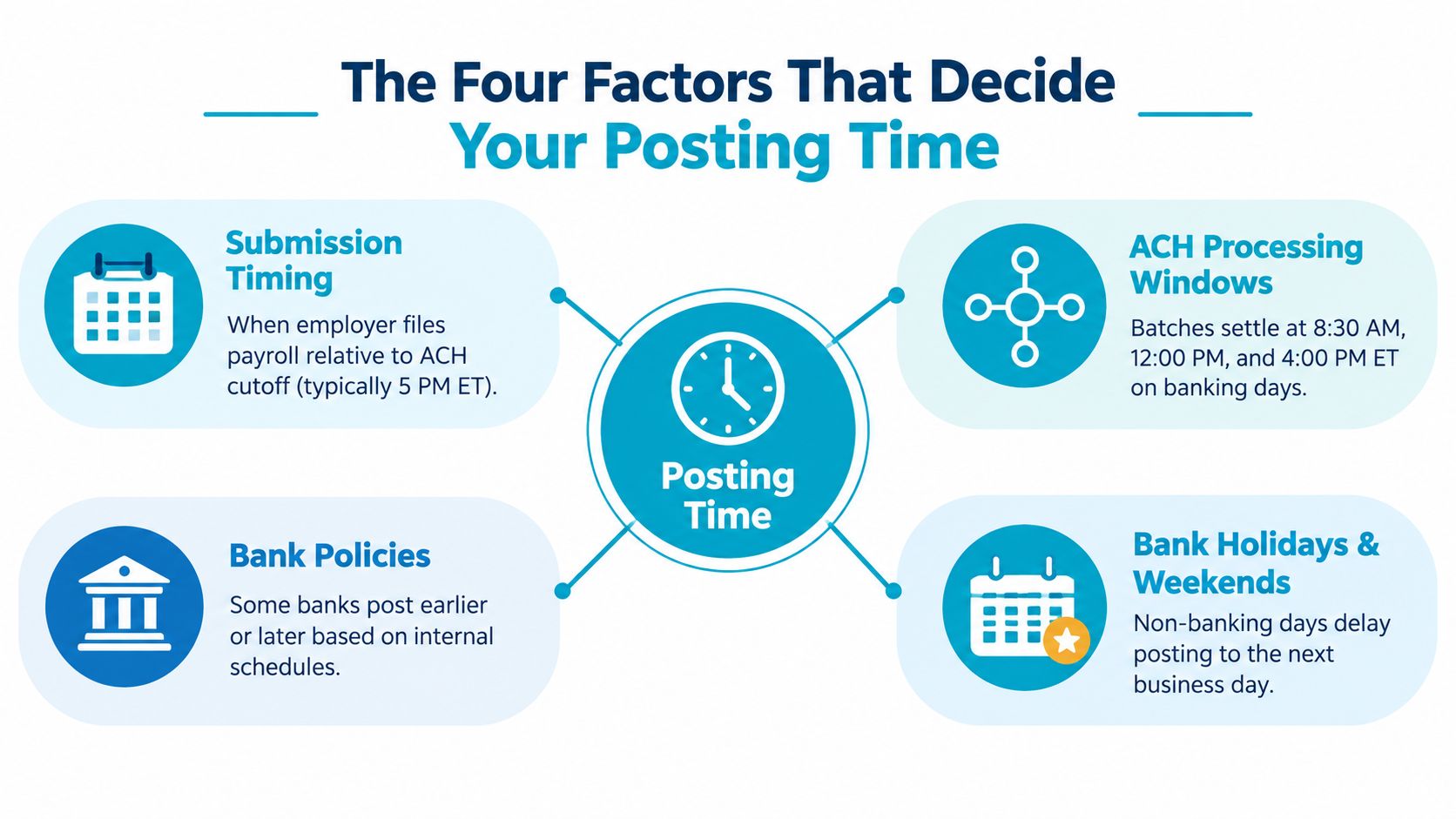
Two employees can have the same payday and still see their money at different hours. The difference usually comes from four points in the payment chain: submission timing, settlement, the receiving bank's posting policy, and early availability.
1. Submission timing and the effective date
An employer, lender, or payroll processor sends payment instructions through an originating bank. A file submitted before a processing cutoff may enter an earlier ACH window. A late file may wait for a later window or the next banking day.
The effective entry date adds another layer. A sender can submit instructions before payday while telling the receiving bank to credit the account on the scheduled date. Early submission therefore does not automatically create early access. The bank may follow the effective date instead of releasing the money ahead of it.
2. Settlement and internal bank processing
Nacha guidance describes ACH settlement occurring four times during each banking day. Same Day ACH can allow an incoming credit to arrive during the day. Under the framework described by the Consumer Financial Protection Bureau, qualifying same-day ACH credits were required to be available by 5:00 p.m. in the receiving institution's local time when the relevant submission and settlement requirements were met.
That deadline does not make 5 p.m. a universal posting hour. A credit sent early enough for same-day processing may appear in the afternoon. A standard or late-submitted credit may instead wait for an overnight cycle or the next business day.
3. The receiving bank's policy
Once the receiving institution gets the credit, its systems decide when to display it. One bank may post settled credits during an overnight batch. Another may update accounts later in the morning. Account controls and funds-availability practices can also affect when the balance changes.
4. Early availability
Some banks offer an early-payday program that makes qualifying payroll visible up to two days before the official payday after receiving advance payment information. The bank is advancing its own funds or applying its own availability policy. The ACH network's settlement calendar remains unchanged.
For example, an employee enrolled in an early-paycheck feature might see Friday payroll on Wednesday or Thursday, depending on when the employer's file reaches the bank. Another employee at a bank without that feature may wait for the normal settlement and posting cycle.
Early access changes when the money can be used. It does not necessarily mean the underlying ACH payment settled earlier. That distinction helps explain why one payroll recipient sees funds ahead of payday while another waits, even when both work for the same employer.
Weekends, Holidays, and the Three Funding Paths
A weekend or federal holiday can change the posting day because standard ACH settlement occurs on banking days. A payment scheduled for Monday may appear during the bank's overnight or early-morning processing cycle, but a payment submitted after a cutoff, during a weekend, or before a federal holiday may not post until the next banking day.
Consider the calendar rather than just the clock:
- Friday payday: The deposit may appear overnight or early Friday if the employer submitted it with the correct effective date.
- Monday holiday: A payment that would normally settle on Monday may wait until the next banking day.
- Saturday payday: Standard ACH generally won't settle on Saturday, so the payment may need to be handled through the preceding or following banking-day schedule, depending on the sender's instructions.
The payment method also matters. Guides often use “direct deposit” to describe three different paths.
| Funding Path | Typical Posting Window | Operates on Weekends and Holidays | Common Lender Use |
|---|---|---|---|
| Standard ACH | Overnight, early morning, or another banking-day posting cycle | No ordinary ACH settlement on those days | Common for payroll and electronic loan disbursements |
| Early-access ACH | Before the official settlement date when the bank receives advance information | The bank may display funds early, but the underlying settlement calendar still matters | Offered by some banks and fintech providers for payroll |
| Real-time rails such as FedNow | Immediate availability when both institutions support the rail and the sender uses it | FedNow operates continuously, 24 hours a day, seven days a week, and 365 days a year, according to the Federal Reserve information cited in this direct-deposit timing reference | Possible in some payment arrangements, but not universal for lenders |
For borrowers, a lender's electronic transfer may still be ordinary ACH even if the application was completed online. The lender decides the transmission method, and the recipient bank must support the relevant rail for real-time delivery. Before comparing loan options that may not require a traditional direct-deposit setup, confirm how the lender sends approved funds.
How to Check Whether Your Deposit Has Posted
Start by separating three labels that often appear together in a mobile banking app.
A posted transaction has been credited to the account and is included in the available balance under the bank's rules. A pending transaction has been received or identified but hasn't completed the bank's posting process. A held transaction may be subject to an account review or another restriction, so the money may not be usable even if the transaction appears on screen.
Your statement may show the deposit on its effective or posting date rather than the moment you first noticed it. The app's transaction details can provide more context, including the payer name, amount, and status.
A repeatable verification routine
- Check the status: Look for posted, pending, or held language rather than relying only on the displayed balance.
- Review the date: Compare the transaction date with the expected effective entry date.
- Confirm the payer: Make sure the employer, lender, or payroll processor name appears correctly.
- Check alerts: Review push notifications, email alerts, and account activity for a delayed update.
- Call the bank if needed: Have the ACH trace number, originating company name, expected effective entry date, and dollar amount ready.
A bank representative can tell you whether an incoming credit is visible in the institution's system, whether it has posted, and whether an account-specific restriction is affecting availability. If the bank can't locate the payment, contact the employer or lender.
Ask the sender three direct questions: Was the file submitted? Which cutoff did it meet or miss? What effective entry date was assigned? For a loan, also ask whether the payment was transmitted already or is still waiting for identity, account, or contract verification.
A missing deposit needs a traceable answer, not another round of app refreshing.
How Loan Funding Timing Compares to Payroll
If payroll is due on a Friday, an employee may already know their bank's usual posting pattern. A loan payment follows a different path. The lender may first complete identity checks, review the application, collect electronic signatures, verify the bank account, and finish underwriting before sending any ACH credit.
Three funding paths can produce different expectations:
- Standard ACH: The lender sends the payment through the regular network. The effective entry date and banking-day schedule determine when it can settle, while the recipient bank decides when to post it.
- Early-access ACH: Some banks or fintech accounts show eligible deposits after receiving advance payment information. This can make payroll appear earlier, but it does not guarantee early access to loan proceeds.
- Real-time rails: A lender using a real-time payment service may transmit funds outside the standard ACH timetable, if both the sender and recipient institutions support that rail. Availability can still depend on the lender's release process and the account's receiving rules.
“As soon as the next business day” therefore describes a possible settlement day, not a guaranteed hour. A payroll deposit may be available under the account's funds-availability policy, while a loan payment may still be waiting for approval, transmission, or posting. The eCFR rule for electronic payments explains the next-business-day availability framework for covered electronic payments, but it does not promise a specific posting time for every loan disbursement.
Where a borrower can lose time
An approval shown in an application is not necessarily the moment money was transmitted. A completed e-signature, extra identity information, bank-account verification, final underwriting, or an internal cutoff can delay submission.
NextStopLoans routes requests to independent lenders, and its loan processing timeline guide explains why approval and funding may occur at different stages.
Ask the lender: “Was the payment sent by standard ACH or a real-time rail, and what date and time did you transmit it?” For standard ACH, request the expected effective entry date and any available trace information.
Practical Ways to Get Your Deposit Sooner
You can't make standard ACH settle on a weekend, but you can reduce avoidable delays and learn your bank's normal pattern.
- Enroll in early availability: If your bank offers early direct deposit, eligibility may let it release payroll after receiving advance information from the payer.
- Verify account details: Check your routing and account numbers with payroll or the lender. Incorrect information can cause a rejected or misdirected payment.
- Finish loan steps promptly: Complete identity checks, e-signatures, and bank verification early enough for the lender's review and transmission cutoff.
- Check the calendar: Review federal holidays before planning around a payment due near a long weekend.
- Use account alerts: Turn on deposit notifications so you know when the credit posts without repeatedly refreshing the app.
- Track your pattern: Record the posting date and approximate time across several pay cycles. Your own transaction history often reveals whether your bank posts overnight or later in the day.
If you use a bank or fintech account with an early-access policy, read its terms carefully. Early visibility depends on receiving payment information and doesn't mean every ACH credit, including loan proceeds, qualifies. Borrowers comparing account compatibility can also review information about payday loans that work with Chime, then confirm the specific lender's funding requirements.
Key Takeaways and Common Direct Deposit Questions
Direct deposits commonly post overnight or by about 9:00 a.m. local time on payday, but the exact hour depends on submission timing, ACH settlement, bank processing, and the calendar. Loan funding uses related rails, while the lender controls approval and transmission.
What does pending mean? The bank has identified the transaction but hasn't completed its posting or availability process. Check the transaction details or contact the bank if the status remains unchanged.
Can a bank hold a direct deposit? Electronic payroll deposits generally must be available no later than the next business day after the business day of receipt, although institutions often release them sooner. A specific account restriction can affect access.
What if the deposit never appears? Ask the employer or lender whether the file was sent, which effective date was used, and whether a trace number is available. Then give those details to your bank.
NextStopLoans connects eligible U.S. consumers with independent third-party lenders through an online request process, while lenders make the decisions and handle funding. Visit NextStopLoans to submit a secure request and confirm the lender's expected funding method and timing before accepting an offer.