
Payday Loan vs Cash Advance: Costs and Risks in 2026
The usual advice says skip the payday loan and take the cash advance, because the second option looks cheaper. That ranking collapses as soon as you read the contract. Payday loan vs cash advance is not a matchup between two products with two prices. One side is a single short loan due on the next paycheck. The other is a label that banks, card issuers, apps, and storefront lenders put on deals with different triggers, fees, and debit rights.
A screen that says no interest can still produce a triple-digit annualized cost once an express transfer, a membership, and a tip are counted. A small dollar fee does not tell you whether the next paycheck can absorb the pull. The decision sits in the post-repayment budget, not in the headline.
Table of Contents
- Payday Loan vs Cash Advance at a Glance
- What the Cash Advance Label Can Cover
- What One Loan Costs in Dollars
- How Repeat Borrowing and Debits Multiply Costs
- Cheaper Options to Check Before Either Product
- Which Option Fits Your Situation
- Confirm the Post-Repayment Budget Before You Sign
Payday Loan vs Cash Advance at a Glance
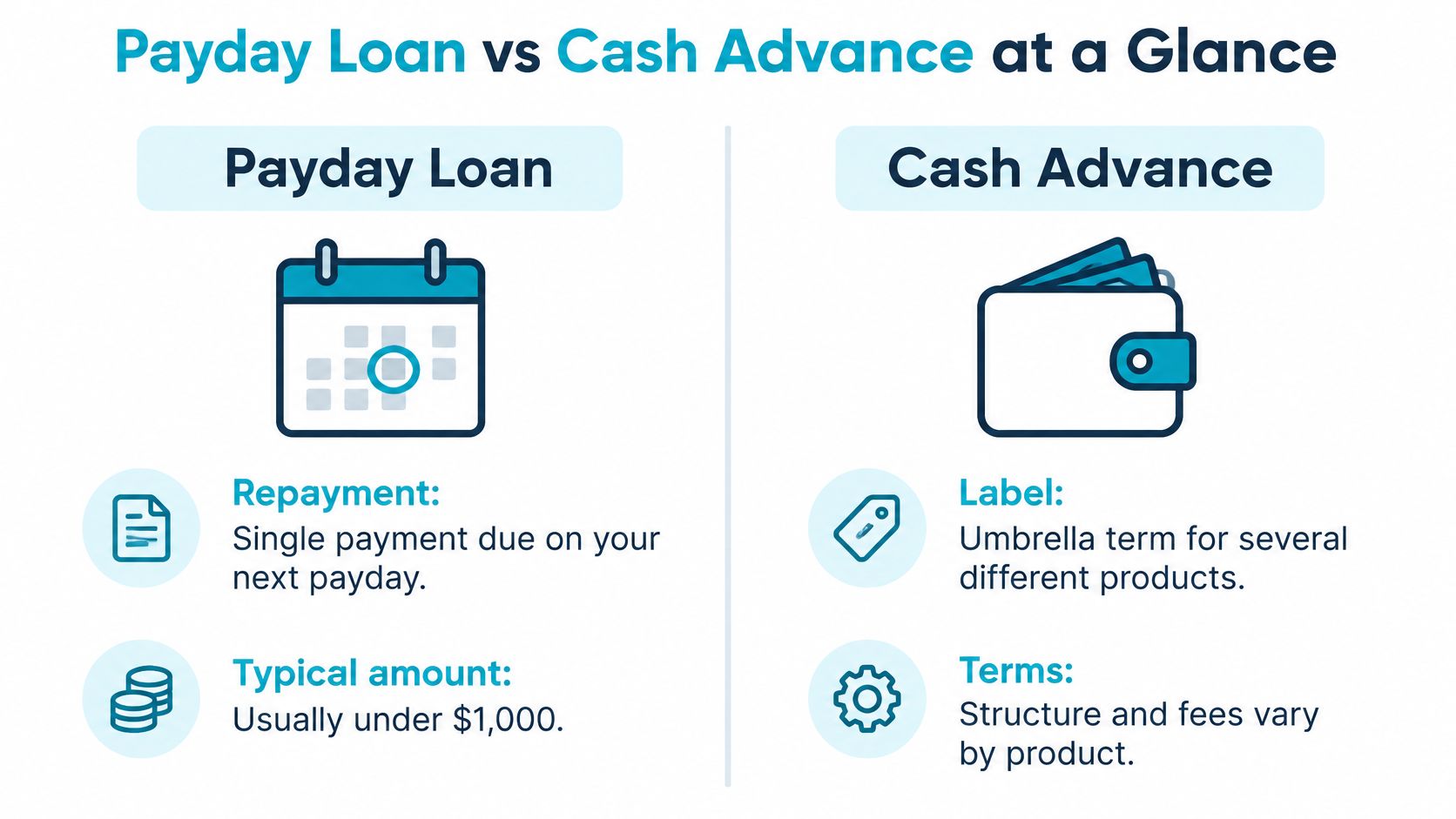
The headline fee can understate the cost of either option. A payday loan is a closed, single-payment advance: you receive a lump sum, then owe the principal and fee on your next payday, often within two to four weeks. Payday loans are typically below $1,000, with fees of approximately $15 to $30 per $100 borrowed, according to the Federal Reserve. Over two weeks, that fee range annualizes to roughly 390% to 780%.
A dollar example makes the charge clearer. The Consumer Financial Protection Bureau says a $350 payday loan with a fee of $15 per $100 costs $52.50. The borrower owes more than $400 after about 14 days, and the fee corresponds to an APR of approximately 391% (CFPB payday-loan cost example).
Cash advance is a label, not one contract. It can refer to a bank deposit advance, a credit-card withdrawal, an earned-wage draw, or a short-term loan marketed as an advance. Those products can have different fees, repayment triggers, and debit arrangements, so the label alone does not reveal what will be owed or when.
Side by side on the terms that change the bill
| Factor | Payday loan | Cash advance (common forms) |
|---|---|---|
| Typical amount | Under $1,000 | Set by the product or credit line |
| Typical fee | $15 to $30 per $100 borrowed | Credit card: about 3% to 5% of the amount plus APR; other products vary |
| Repayment | One payment on the next payday, usually 2 to 4 weeks | Credit card: monthly bill; bank advance: deposit-linked due date; earned-wage app: often automatic debit on payday |
| Annualized cost | Roughly 390% to 780% APR on a two-week term | Credit card APR applies from day one; earned-wage apps averaged about 232% annualized in one analysis |
| Eligibility | Income proof, active checking account, ID, age 18 or older | Credit-card account, bank deposit history, or employer enrollment |
| Credit check | Often limited; income and bank account matter most | Credit card: credit history; bank advance and wage apps: account or payroll history |
| Renewal risk | Rollover adds a new fee while principal remains due | Repeat advances, subscriptions, and tips can recur |
Practical rule: Compare the repayment date, dollar cost, and permission to debit your account. Those terms matter more than the product label.
Eligibility and repayment risk also differ by product. A payday contract commonly depends on income, an open checking account, and identification. A card advance requires an existing card, while bank and wage products may depend on deposits or payroll. Repeat borrowing, recurring subscriptions, and tips can turn a one-time charge into a repeated cost. The useful comparison is what remains in your budget after repayment, not whether the screen calls the advance interest-free.
What the Cash Advance Label Can Cover
Four products usually sit under the cash advance sign. They do not share a trigger, a fee, or a due date, so a side-by-side of "the cash advance" against a payday loan mixes unlike contracts.
Credit-card cash advance. You pull cash at an ATM, a branch, or with a convenience check, against a limit that is often lower than your purchase limit. A percentage fee hits immediately, then a higher APR than your purchase rate starts on day one. There is no grace period. The balance rides on the monthly statement until you pay the cash portion off.
Bank deposit advance. The bank opens a short line because your pay already lands there. Repayment is a sweep of the next deposit on a short clock, priced as a per-hundred charge rather than a revolving card rate. If that deposit also has to cover rent, the advance and the rent compete for the same dollars.
Earned-wage access. You draw wages the employer says you have already earned. The cost shows up as an express-transfer fee, a subscription, a tip, or some mix of the three. Repayment is usually an automatic debit on the next payday, not a bill you choose to send.
A payday loan wearing a new name. The trigger is a fresh application, the charge is a finance fee, and the full sum is due on the next payday. If the contract is a single balloon payment, you are looking at payday credit regardless of the banner.
When no interest still prices like credit
A checkout screen can make an app look cheaper than a storefront loan. Fortune's reporting on a Center for Responsible Lending analysis of 10,000 consumers found that 96% of direct-to-consumer advances involved fees or tips, averaging nearly $208 a year, with an estimated average annualized cost of 232%. A mandatory express fee and an optional tip are different lines. Stack memberships on top, and the annualized cost can sit near short-term credit even when the app never prints an interest rate.
APR is a clumsy ruler for a two-week gap, yet it still helps when the principal and the number of days are similar. The dollars owed on the due date are what you can actually budget. A plain walk-through of how fast cash advances are structured is a useful cross-check while you ask the provider four questions.
- What triggers repayment: the next payday, the next deposit, or the card statement?
- What is mandatory: an express fee, a finance charge, or a subscription?
- What is optional: a tip you can set to zero without losing the advance?
- What if the account is short: a retry, a late fee, an overdraft, or a lost advance limit?
Rate caps, rollover limits, and outright bans differ by state, and the same label can fall under different rules. Read your state's current rules before you rank two offers that happen to use the same word.
What One Loan Costs in Dollars
Price one advance in cash, not in a slogan. The Consumer Financial Protection Bureau reports typical payday finance charges of $10 to $30 per $100 borrowed, with $15 per $100 common. A $300 loan at that common fee requires $345 back, which implies an annual percentage rate of nearly 400% when the charge is annualized over 14 days.
Two steps, then the total due
- Divide the amount by 100.
- Multiply by the fee per $100.
On that $300 loan, 300 divided by 100 is 3, and 3 times $15 is a $45 finance charge. You owe $345 in about 14 days. Annualizing the same fee, 15 divided by 100, times 365 divided by 14, lands near that nearly 400% figure. The annualized rate overstates what a single two-week loan costs in your account. Use it to rank products with similar amounts and similar terms. Use the total due to decide whether you can pay.
The Federal Trade Commission warns that extending a payday loan usually adds a new fee while the original principal stays outstanding, so the cost compounds across rollovers. That is a second bill, not a discount for needing more time. A closer look at how payday loan rates are built helps when a lender quotes only the fee per hundred.
| Product | Amount and fee basis | Fee or finance charge | Repayment window |
|---|---|---|---|
| Payday loan | $300 at $15 per $100 | $45 | About 14 days, total $345 |
| Payday loan | $350 at $15 per $100 | $52.50 | About 14 days |
| Payday loan | $500 at $15 per $100 | $75 | About 14 days |
| Bank deposit advance | $500 at $10 per $100 | $50 | Next direct deposit or within 35 days |
| Credit card cash advance | $500 at 5% fee, 30% APR assumed | $25 fee plus about $12 interest | 30 days, billed monthly |
| Earned-wage app | $500 with express fee and optional tip | The express fee plus any tip you confirm in the app | Next payday |
The card row is an illustration, not a quoted offer. Say you assume a 5% fee and a 30% APR held for 30 days. The fee is $25. Interest is about $12, because $500 times 0.30 times 30/365 is roughly that. About $537 would be tied to the card if nothing else changed. A real cardholder agreement can price the cash APR and the fee differently, and a faster payoff shrinks the interest piece only.
The earned-wage row stays blank on purpose until you open the provider's terms. One app's standard delivery can be a membership. Another's instant delivery can be a flat express charge plus a prompted tip. Add those dollars to the $500 and you have the only figure that belongs in the budget.
Compare total dollar repayment, any membership, late or returned-payment charges, and whether the provider can debit the account again. The advertised advance amount is the smallest number on the page.
How Repeat Borrowing and Debits Multiply Costs
A short-term loan can cost far more than its first fee when repayment leads to repeat borrowing or failed debits. In a CFPB analysis covering more than 15 million payday loans over 12 months, the median borrower took out 10 transactions, remained indebted for a median of 199 days, and paid $458 in fees. That is several times a single two-week charge: repeated fees buy more time without reducing the original principal.
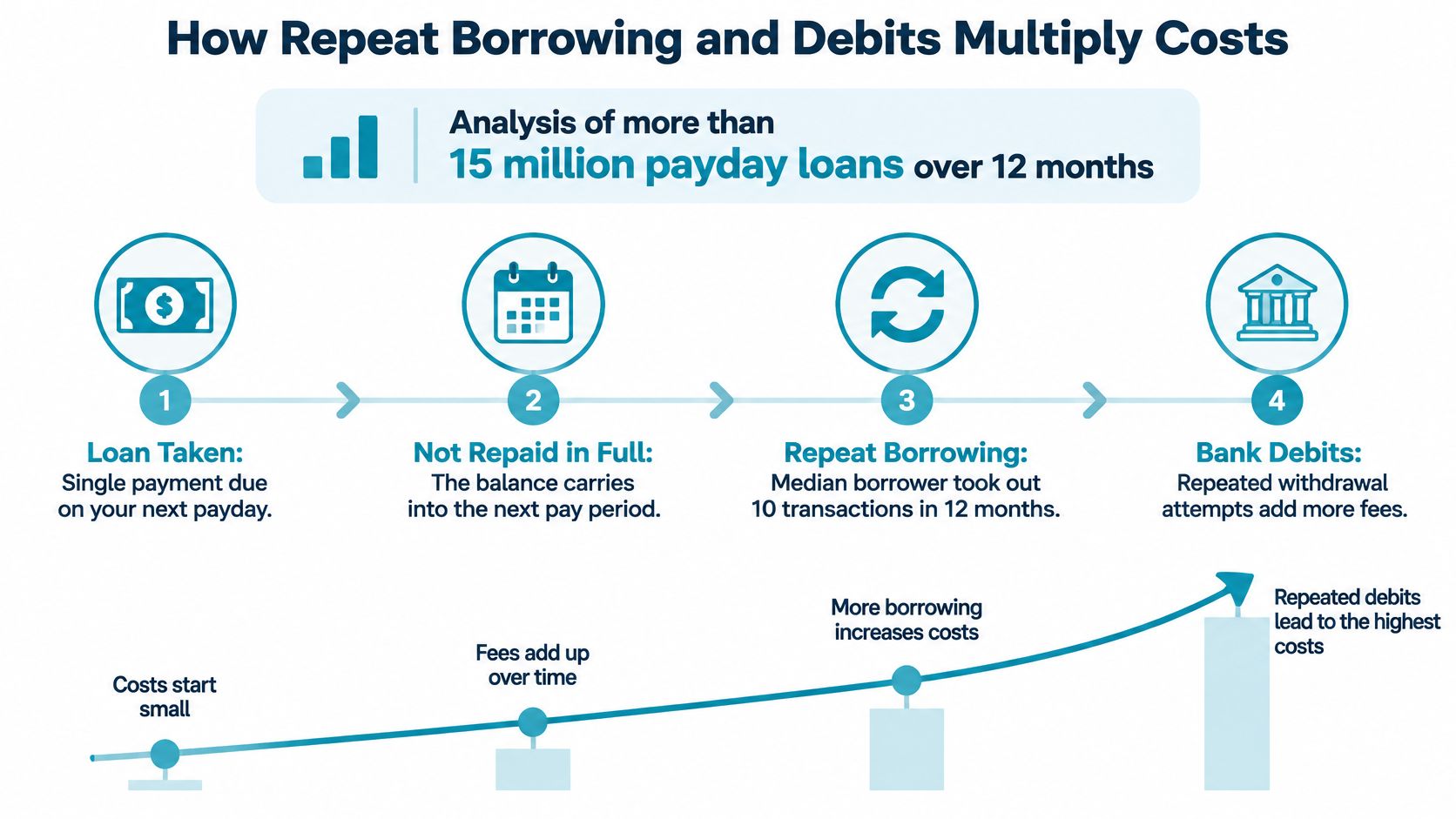
With a rollover, the due date moves, a new fee is charged, and the principal remains unpaid. Each renewal adds a charge to the balance that still needs repayment. The median of 10 transactions in the CFPB loan file shows that repeat borrowing was common in that group, not merely a worst-case scenario.
What a failed debit does next
A failed payment can set off costs on both sides of the transaction:
- The payment comes due on payday.
- The paycheck cannot cover the debit and other bills.
- A rollover fee moves the due date.
- A partial debit is still attempted.
- The debit fails for insufficient funds.
- The bank may charge an overdraft or insufficient-funds fee, and the lender may try again.
Every retry creates another opportunity for a bank fee, while the lender may also charge for the returned payment. With online repayment, an authorized debit can hit the account when a deposit posts or before it arrives. That timing can leave less money available for other bills.
Employer-sponsored paycheck advances use different terms, but repeated use can still add up. The CFPB reported in 2024 that workers using these products averaged 27 advances a year, with an average transaction of $106 and a typical calculated APR of 109.5%. More than 7 million workers accessed approximately $22 billion through these providers in 2022, while transaction volume grew by more than 90% from 2021 to 2022.
The label “cash advance” does not tell you the full cost. Even an advance described as interest-free can carry fees or tips that raise its annualized cost; the relevant question is how much remains in the budget after repayment. A single draw may seem small, but recurring draws, subscriptions, and tips can turn it into a costly pattern. Add those charges across the year before judging the price by one advance.
Cheaper Options to Check Before Either Product
Rank replacements by what they take out of the next paycheck, starting with the ones that add no new creditor.
Ask the biller first. Utility, medical, and telecom offices often move a due date or split a bill at no charge if you call before the payment fails. A shifted due date beats a new debit that lands on payday.
Ask the employer. Some payroll teams already run a paycheck advance, sometimes with a small fee and sometimes with none. You are drawing wages you are about to earn, and repayment is a payroll deduction rather than a lender's repeated bank attempt.
Check a credit union small-dollar loan. Many credit unions offer a payday-alternative style loan with a capped rate, a short application, and months to repay instead of a single balloon date. Read that credit union's current cap, term, and application fee before you assume last year's brochure still applies.
Put the purchase on a card you already have. A purchase uses the purchase APR and, on many cards, a grace period if you pay the statement. A cash withdrawal does not. If the expense is a bill the merchant will take on a card, you skip the cash-advance fee entirely.
Compare a small installment loan from a bank or credit union. A longer schedule can carry a lower APR and still cost more interest in total, because you pay for more months. The number to line up is total dollars repaid, not the APR sticker alone.
Use one request to see several offers. Payday loan alternatives are worth pricing before you sign a balloon note. NextStopLoans is one marketplace option: it sends a single secure request to independent lenders in real time, does not lend, and does not set the APR or the payment. You can decline every offer. It is not offered in Arkansas, New York, Vermont, or West Virginia, so confirm availability against the provider's current terms. If an offer leaves the next payday short after rent and regular bills, turn it down.
Which Option Fits Your Situation
Match the gap to the contract, then ignore the product name. The better fit is the one whose total due still leaves the next paycheck able to cover rent and the bills that cannot slip.
| Situation | Usually the better fit | Why | Watch for |
|---|---|---|---|
| Gap under $300 with a known paycheck date | Employer paycheck advance or bank advance with a low fee | Smaller total due and no new loan structure | Repayment on the next deposit can drain the account |
| Two-week gap of $300 to $500 and no other source | Payday loan, only if the total due fits the next paycheck | Fast, with a fixed total due that is known upfront | Rollover adds a new fee; repay in full on the due date |
| Cash needed at an ATM with a card already open | Credit-card cash advance, repaid quickly | Immediate cash with no new loan application | Fee of about 3% to 5% plus APR from day one, no grace period |
| Repeated gaps every month | Neither; fix the budget or use an installment or credit union loan | Repeat use drives most of the cost | Rollovers and repeat advances compound quickly |
| Amount above $1,000 or repayment over months | Installment loan or credit union loan | Longer schedule and often a lower APR | Total interest can still be high; compare total repaid |
| Income below regular expenses | Income-side fix, such as a bill renegotiation or budget reset | Advances only postpone the shortfall | Recurring subscriptions, tips and fees |
The rows people actually match
A shortfall under a few hundred dollars, with a paycheck date you can name, rarely needs a new balloon loan. An employer draw or a bank line priced as a modest per-hundred fee keeps the structure smaller, as long as that next deposit is not already spoken for.
A two-week gap of a few hundred dollars, with no biller who will wait and no card that can take the purchase, is the narrow case where a payday loan's fixed total can be the honest number. It only works if that total, written down, fits after rent and the bills due the same week. If it fits only because you plan to extend, it does not fit.
Cash at an ATM is fast because the card account already exists. It is also the option that starts charging on day one and keeps charging until that slice of the balance is gone. Repay it on the next statement if you use it at all.
When neither product is the fix
A gap that returns every month is not a funding problem. It is a budget that is short by roughly the size of the advance. An installment loan or a credit union loan spreads the cost and can cut the annualized rate, but only after you stop reborrowing the same hole. Above $1,000, or any need that takes months to resolve, a single payday due date is the wrong shape of debt. Compare total repaid, including every fee, across the installment offers in front of you.
If income sits below regular expenses even in a normal month, another advance postpones the shortfall and adds a debit. Renegotiate a bill, cut a subscription, or change the paycheck's timing. Recurring tips and memberships will not close a structural gap. They invoice it.
Confirm the Post-Repayment Budget Before You Sign
The key comparison is what remains after repayment, not just the fee shown upfront. Before accepting an offer, subtract the full amount due on its scheduled date. Then check whether the bills arriving next can still be paid.
The Federal Reserve found that 63% of U.S. adults said they could cover a hypothetical $400 emergency with cash, savings, or a credit card paid off at the next statement. 2% said they would use a payday loan, deposit advance, or overdraft. Those responses describe one hypothetical expense, not repeat borrowing or the number of people who might combine several sources. They show how respondents said they would handle that scenario, not how often short-term borrowing occurs in real months.
Digital repayment can turn a missed payment into an automated debit problem. If a debit fails, another attempt may trigger a fee before you speak with anyone. Check the repayment terms and possible bank charges alongside the stated loan cost.

Write down these details before signing:
- Total due and date: principal, mandatory fees, and the calendar day of the debit.
- Repayment structure: whether you owe one lump sum or have installments with visible due dates.
- Retry rights: whether the lender or app can try another debit after a failed payment.
- Failed-payment cost: the provider's charge and any possible bank overdraft fee.
- Extension cost: the fee for moving the due date, with the principal still outstanding.
- State rules: any applicable cap, rollover limit, or ban where you live.
If repayment leaves too little for the bills that follow, decline the offer and return to options such as asking a biller for flexibility, an employer advance, or a credit union loan. A lower headline fee does not make an advance affordable if the scheduled debit leaves the account short.
NextStopLoans routes a single request to independent lenders, including lenders offering short-term and installment loans. It does not set rates, and you are not required to accept an offer. Compare the amount due and repayment date with your next paycheck before deciding whether to submit a request through NextStopLoans.