
Fast Cash Advance Guide: Options, Risks, and Next Steps

An unexpected $400 car repair can turn an ordinary week into a financial emergency, especially when payday is still several days away. You may need the vehicle for work, have little savings available, and feel pressure to accept the first offer that promises money quickly.
A fast cash advance can provide short-term access to funds, but speed doesn't tell you what the borrowing will ultimately cost. The important questions are how the product works, when repayment is due, what fees apply, and whether you can repay without borrowing again.
Table of Contents
- Understanding What Fast Cash Advances Are
- Comparing the Main Types of Fast Cash Advances
- What Lenders Require and How Approval Works
- The Hidden Reality of Repeat Borrowing and Fees
- How Loan Marketplaces Change the Shopping Process
- Making Smart Decisions When You Need Cash Fast
Understanding What Fast Cash Advances Are
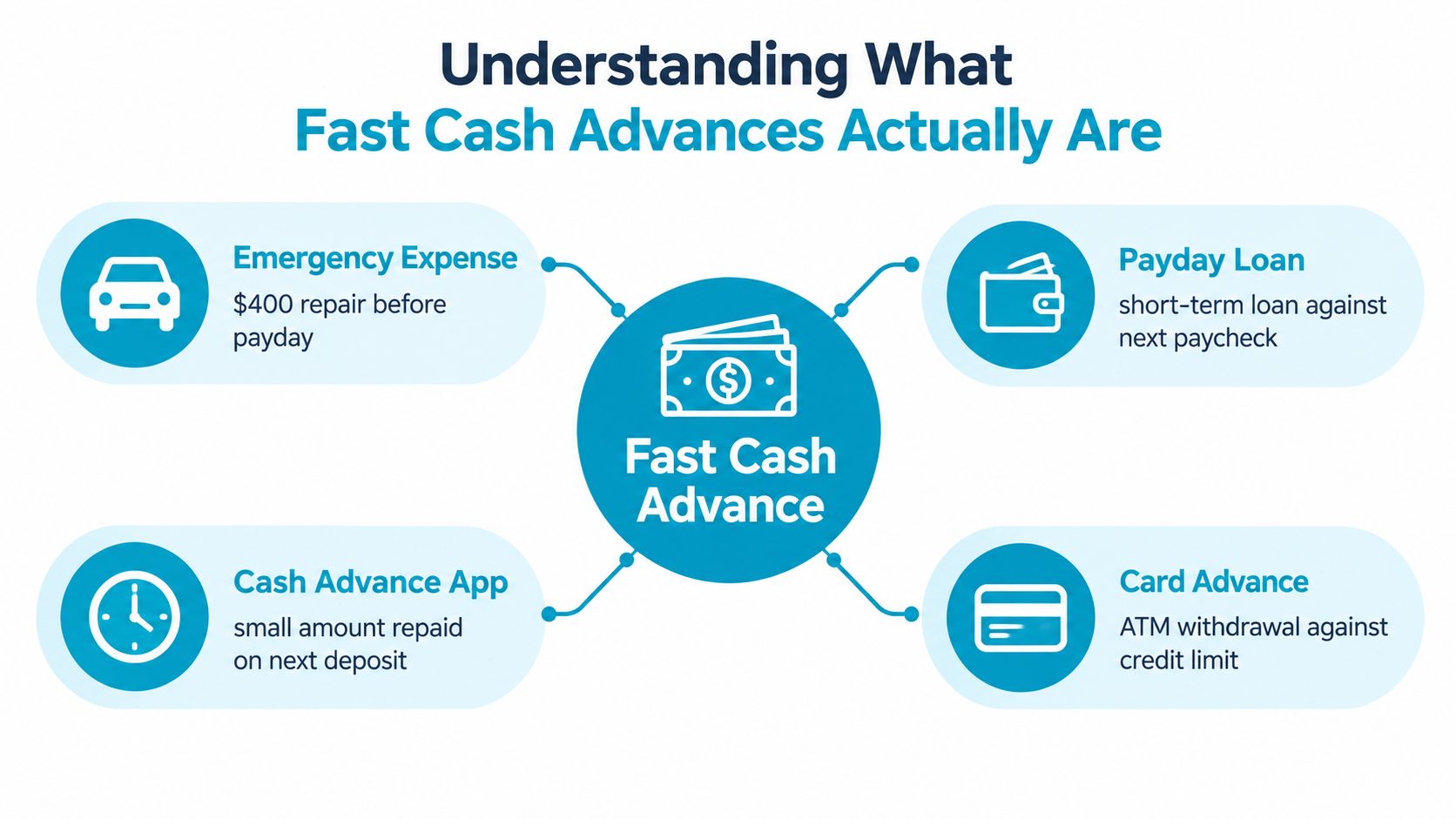
A fast cash advance is a broad term for short-term borrowing designed to place money in your hands quickly. It may mean a payday loan, a credit-card cash advance, a small advance linked to a bank account, or another emergency loan with rapid processing. These products differ in their mechanics and costs, but they address the same immediate gap between an expense and the money currently available.
Your mechanic may quote a $400 repair while your paycheck arrives after the deadline. A traditional personal loan can involve a detailed application, income review, and underwriting. A fast advance usually follows a shorter path. You provide basic information, the lender or platform checks its requirements, and approved funds may travel through a debit-card or bank-transfer rail.
The speed comes from a simpler process, not from removing risk. The lender still evaluates your identity, income, bank account, and ability to repay. A shorter timeline may also bring a shorter repayment window, automatic withdrawals, and fees that cost a great deal compared with the amount borrowed.
What makes an advance different from a personal loan
A personal loan generally uses a structured repayment schedule spread over a longer period. A fast advance prioritizes quick access and short repayment, so the payment can come due before your budget has recovered. The speed helps with timing, while the compressed schedule can create another shortage.
The product name can also blur important distinctions. A credit-card cash advance draws from an existing credit line. A payday loan is commonly tied to your next paycheck. An installment loan divides repayment into scheduled payments, while a title loan uses vehicle equity as security.
Compare the payment structure, not only the funding speed. Ask whether the scheduled payment fits after housing, food, utilities, transportation, and other bills. A product that deposits money today may still leave too little for the next pay cycle, leading to another application and another round of fees.
Practical rule: Treat speed as one feature, not proof that a loan is affordable.
Before applying, write down the amount you need, the total repayment amount, the due date, and the money that must remain available for essentials. This quick check can show whether the advance covers a temporary timing problem or shifts the same shortfall into the next paycheck. It also gives you a clearer basis for comparing alternatives before accepting fast funding.
Comparing the Main Types of Fast Cash Advances
A fast cash advance can solve a timing gap, but the repayment design determines what happens next. A payday loan may provide a lump sum against an upcoming paycheck. A short-term installment loan may offer a similar amount with several scheduled payments. A card advance uses existing credit, while a title loan uses vehicle equity as security.
| Product Type | Typical Term | Funding Speed | Average APR Range | Repayment Structure |
|---|---|---|---|---|
| Payday loan | Often very short term | Storefront can be same-day, online funding can take 1–2 business days | Can be roughly 391% to 521% for some two-week products, according to CFPB materials on payday and deposit advances | Usually one payment tied to the next qualifying deposit |
| Debit-card advance | Short term | Can be near-instant after approval | Varies by provider and agreement | Automatic repayment from a linked account or deposit |
| Short-term installment loan | Set schedule determined by lender | Online funding can take 1–2 business days | Varies by lender, state, and borrower | Several scheduled payments over the agreed term |
| Credit-card cash advance | Determined by card agreement | ATM or bank access can be immediate | Usually higher than the card's purchase APR | Added to the card balance, with interest and fees under card terms |
| Auto title loan | Short term or scheduled payments | Often rapid after title and vehicle review | Varies widely and can be high | Repayment secured by vehicle equity, with repossession risk if the borrower defaults |
Payday loans
A payday loan generally provides money now in exchange for one large repayment from a future paycheck or qualifying deposit. For instance, a lender might advertise $300 today and require a larger payment soon afterward. The practical question is whether that payment leaves enough for rent, food, utilities, transportation, and other bills.
If it does not, the advance can move the same shortage into the next pay cycle. The initial speed may feel like a bridge, but a bridge with a steep toll can become expensive when you must cross it repeatedly.
Debit-card and credit-card advances
A debit-card disbursement can arrive close to instantly. An ACH transfer usually adds about one business day after final approval, according to Finder's overview of payday-loan funding timelines. A credit-card cash advance draws against an existing credit line, so the card agreement determines the fee, interest rate, and available limit.
These products also differ in how repayment reaches the lender. Automatic withdrawal can make repayment convenient, yet it can also reduce the balance available for essentials if the withdrawal arrives before your income does.
Installment and title loans
Installment loans spread repayment across scheduled payments, which can make the calendar easier to follow. A smaller payment does not necessarily mean a lower total cost, so compare the full repayment amount, fees, and term. A side-by-side guide to installment loans versus payday loans can help clarify how the schedules differ.
A title loan may be available when other credit is limited, but the vehicle secures the debt. Missing payments can therefore threaten transportation, not just your credit or checking account.
Before choosing, write down the amount received, total repayment, due dates, and money needed for essentials. Then ask one repeat-borrowing question: after this payment leaves, will the next pay cycle cover your normal bills? The fastest deposit is not always the safest solution, and the smallest scheduled payment is not always the least expensive.
What Lenders Require and How Approval Works
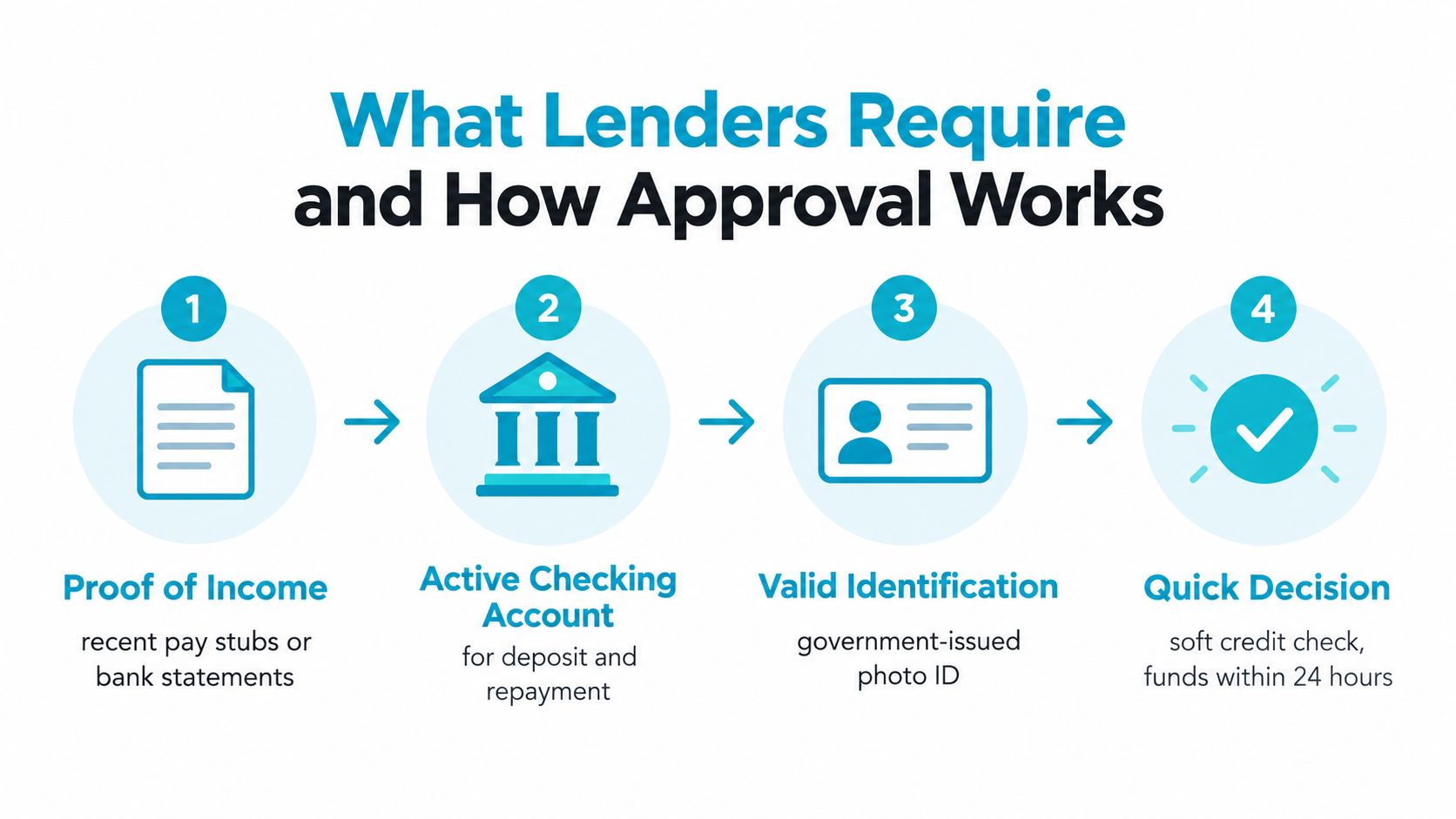
A fast cash advance application usually starts with four items: proof of income, an active checking account, valid identification, and contact or residence information. Each serves a practical purpose. Income helps the lender assess repayment capacity, the account supports electronic deposit and repayment, identification helps prevent fraud, and residence details may establish eligibility under state rules.
Gather these materials before applying. Recent pay stubs or bank statements can document income. Keep a government-issued photo ID available, and confirm that your checking account is active and can receive electronic deposits. Missing or inconsistent information can slow a decision.
The usual review sequence
Submit the request. You provide personal, employment, income, and banking details. Use a secure application, then read the privacy and consent language before sending it.
Verify identity and income. The lender may confirm your identity, review account deposits, and compare the stated income with your account history.
Review credit and eligibility. Some lenders use traditional credit reports, while others consider alternative information. An application may be declined because of unstable income, an inactive account, an existing obligation, state restrictions, or information the lender cannot verify.
Receive a decision and review terms. Approval does not require acceptance. Before signing, check the annual percentage rate, finance charge, repayment date, automatic-payment authorization, late-payment consequences, and total repayment amount. These details show the actual cost behind a quick deposit.
The process may move quickly when your information matches and the payment system is available. Identity mismatches, incomplete documents, bank-verification issues, weekends, holidays, or a final lender review can create delays. Funding speed is only one part of the decision. A faster option can still leave too little money for the next set of bills.
For a clearer idea of the information requested, review this loan application form guide. Compare each offer on total repayment and payment timing, not just the advertised speed, and avoid submitting multiple applications without checking their fees and repayment rules.
The Hidden Reality of Repeat Borrowing and Fees
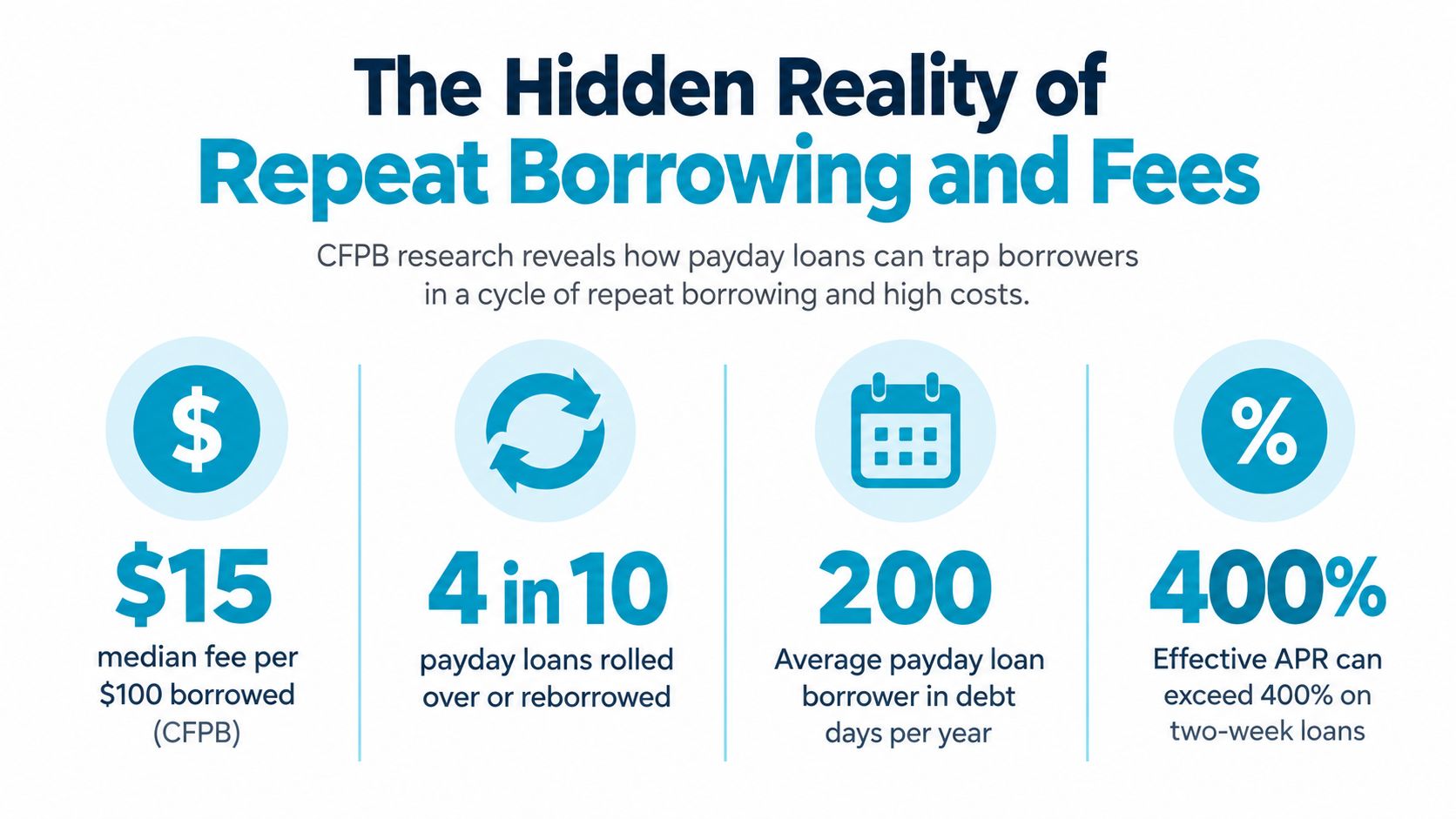
The largest danger with a fast cash advance often isn't the first transaction. It's the possibility that the repayment amount arrives before your budget has recovered, forcing you to borrow again. Research from the Consumer Financial Protection Bureau on payday loans found a median storefront payday-loan fee of $15 per $100 borrowed for a 14-day term. On a typical $350 loan, that translated to a median APR of 391%.
An APR converts borrowing costs into an annualized measure. That doesn't mean you keep a two-week loan for a full year, but it does show how a fixed fee becomes extremely expensive when applied to a very short term. A fee that looks manageable in isolation can become costly when the borrower renews or replaces the loan.
The same CFPB material reported 15,766 payday-loan stores across 36 states in 2015, illustrating how widespread the storefront model had become by the mid-2010s. Consumer advocates and Pew estimated that about 12 million Americans used payday loans each year and paid roughly $9 billion in fees, as reported in the same CFPB summary.
Why a short loan can become a long problem
Pew estimated that the average borrower spent five months of the year in debt and paid about $520 in fees while repeatedly borrowing $375, based on the figures summarized by the CFPB. The repayment pressure helps explain the pattern. Pew noted that the average repayment required $430 on the next payday, equal to 36% of an average borrower's gross paycheck.
A borrower who loses more than a third of gross pay to repayment may still need to cover housing, groceries, utilities, fuel, and existing bills. Reborrowing can then feel less like a choice and more like a way to restore the cash removed by the previous payment.
CFPB data found that more than 80% of payday loans were rolled over or renewed within two weeks, and 64% of borrowers renewed at least one loan during the year, according to the CFPB report on payday-loan rollovers and renewals. The detailed CFPB study also found that 15% of new loans were followed by sequences lasting at least 10 loans, while half of all loans were in a sequence of at least 10 loans.
The useful question isn't “Can I get approved?” It's “Can I repay the full amount and still cover necessities without taking another advance?”
A 2024 report from the Center for Responsible Lending found that advances repaid in 7 to 14 days carried an average APR of 367%, compared with typical payday loans at around 400%. The report also found that 75% of consumers took another advance on the same day or the day after repayment. The lesson is straightforward: “fast” doesn't mean “cheap,” and repeated use can matter more than the first advertised fee.
How Loan Marketplaces Change the Shopping Process
A borrower comparing several lenders can face the same form repeatedly, like filling out the same intake sheet at different counters. A loan marketplace consolidates that first step by sending one request to a network of independent lenders. The marketplace is not the lender, does not make the credit decision, and does not set the final terms. Each participating lender decides whether to offer credit, which fees and repayment schedule apply, and how the funds will be delivered.
With NextStopLoans, a borrower submits one secure request and may receive offers from participating lenders to review. A match is not an obligation. The borrower can accept or decline an offer after checking its terms. The service supports online processing from a phone or computer and describes 256-bit SSL encryption for its application workflow. For broader context on online lending options, see this guide to instant loans online.
Speed depends on the funding path
A marketplace can shorten the search, much like one directory replacing several separate searches. It cannot remove underwriting steps or the time banks need to transfer funds. Debit-card disbursement may be near-instant, while ACH commonly adds about one business day after final approval, according to the Finder explanation of transfer timing. Online payday-style lending can take 1–2 business days, and each lender may follow its own funding schedule.
That difference matters if a repair shop, landlord, or medical provider has given you a firm deadline. “Decision in minutes” refers to the lender's response, not necessarily the arrival of money in your account. Before accepting, confirm the funding method, cutoff times, weekend and holiday handling, and whether an instant-transfer fee applies.
What to compare after a match
Treat the marketplace as a way to collect options, not as evidence that an offer fits your budget. Read the lender's offer and check:
- Total repayment: Compare the amount deposited with the full amount you must return, including listed charges.
- Payment date: Check that the scheduled withdrawal will not collide with rent, utilities, or other bills.
- Automatic debit terms: Find out whether the lender may attempt another withdrawal after an unsuccessful payment.
- State availability: Marketplace services and lender products may not be available to every U.S. resident or in every state.
- Credit review: The marketplace may not pull credit, while an individual lender may use major or alternative credit bureaus.
A marketplace reduces repeated form-filling, but it does not make a costly offer affordable. Compare the time saved with the repayment burden, then choose based on total cost and your ability to repay without another advance.
Making Smart Decisions When You Need Cash Fast
A repair bill is due Friday, your account is short today, and an application promises a quick answer. Before applying, write down the amount you need, the payment deadline, the total repayment, and what will remain afterward. If that final amount cannot cover food, housing, utilities, transportation, and other scheduled bills, the advance is shifting the shortage into the next pay cycle.
Start with options that change the bill or timing rather than adding another mandatory payment. Ask a mechanic, medical provider, utility company, landlord, or service provider about a payment arrangement. Check whether your employer offers a salary advance, whether a credit union has a small-dollar loan, or whether an emergency fund or trusted person can help. A side job may take longer, but it does not automatically withdraw money from your next deposit.
Use this checklist before accepting an offer:
- Measure the full cost: Compare the amount deposited with the full repayment. Include origination, transfer, finance, membership, and service charges.
- Protect the next paycheck: Confirm that repayment leaves enough for necessities and existing commitments.
- Test the due date: Ask whether you can pay on time without borrowing again. Uncertainty is a reason to pause.
- Compare alternatives: Review at least three available choices, including a payment arrangement or lower-cost credit where possible.
- Read the authorization: Check automatic-debit permissions, late fees, renewal terms, and what happens after a failed payment.

Speed answers the immediate question, but repayment shows the true cost. Research on renewals and repeat borrowing is a reminder to examine what happens after the first withdrawal, especially if the budget already has no room. Considering short-term credit is not a personal failure. The responsible decision is the one you can repay without needing another advance.
NextStopLoans lets you submit one secure online request to participating independent lenders and review any offers received. Funding timing depends on the lender and payment method. To compare potential short-term borrowing options, visit NextStopLoans and review each lender's complete terms before accepting.