
Can I Get a Loan with Bad Credit? What Actually Works

Yes, you can get a loan with bad credit. But if your FICO score is below 580, the prequalification rate can fall to 0.5%, and fewer than 1% of bad-credit borrowers prequalified at all, so your job isn't just finding more lenders. It's understanding how expensive the offers get and what improves your odds.
Most articles answer “can I get a loan with bad credit” with a cheerful yes and a list of lenders. That's not useful. If you're sitting in the subprime range, shopping harder usually doesn't fix the underlying problem.
What helps is getting honest about the approval math, then tightening the parts of your file lenders still care about: income stability, bank activity, debt load, and whether your requested payment looks manageable. That's where approvals happen or die.
Table of Contents
- What the Approval Odds Actually Look Like
- Why Lenders Treat Bad Credit as a Risk Signal
- Loan Options That Work With Poor Credit
- What a Typical Bad-Credit Request Looks Like
- What Lenders Actually Need From You
- How to Improve Your Odds Before You Apply
- How NextStopLoans Routes Your Request
- When Borrowing Makes Sense and When to Wait
What the Approval Odds Actually Look Like
How hard is it to get approved with bad credit? Hard enough that you should start with the numbers, not lender lists.
The clearest snapshot comes from Credible's personal loan marketplace data. Borrowers with credit scores below 580 had a prequalification rate of just 0.5%, while borrowers with scores from 800 to 850 had an 81.4% prequalification rate. In the same dataset, fewer than 1% of bad-credit borrowers prequalified at all, and the average funded borrower had a 702 credit score compared with 588 for users who tried to prequalify, a 114-point gap.
Those numbers should reset your expectations. If your score is deep in subprime territory, the problem usually is not finding one more website to try. The problem is that very few lenders want the file in the first place.
What those numbers mean in practice
A score under 580 usually means sparse options, tougher screening, and offers that get expensive fast. A score in the low 600s is still a difficult file, but lenders start paying more attention to the rest of the application, especially steady income, cleaner bank activity, and a payment that fits your budget. Stronger score bands get more competition from lenders, which usually means more approvals and less painful pricing.
That is the gap most bad-credit guides skip.
Even when approval happens, terms often get worse before they get better. Poor-credit borrowers in Credible's data saw average rates near 29.74%, versus 10.00% for excellent-credit borrowers, as noted earlier. Lenders also cut risk by trimming the amount they will fund, which is why bad-credit applicants often get approved for less than they requested.
| FICO Score Band | Approx. Prequalification Rate | Typical APR Range | Typical Loan Amount Range |
|---|---|---|---|
| Below 580 | 0.5% prequalification rate; fewer than 1% prequalified | Near 29.74% on average for poor credit | Often reduced or partial approvals |
| 800 to 850 | 81.4% prequalification rate | Around 10.00% on average for excellent credit | Usually broader approval amounts |
| Overall applicant pool vs funded borrowers | 588 average for applicants vs 702 average for funded borrowers | Varies by lender | Funded borrowers tend to qualify for stronger terms |
Ask a tougher question than “can I get a loan with bad credit?” Ask whether the payment, fees, and loan size still make sense after the lender prices in the risk.
Why Lenders Treat Bad Credit as a Risk Signal
Why does one late-payment history change the whole loan conversation? Because lenders are not judging intent. They are pricing the odds that they will not get paid back on time, or at all.
The Federal Reserve has long treated credit scores as a summary of default risk, and the CFPB credit score report shows how wide that risk gap can be. Accounts opened for borrowers with FICO scores below 520 had about a 40% serious-delinquency rate, versus less than 1% for borrowers with scores of 760 or higher. That spread drives underwriting far more than marketing promises about “bad-credit approvals.”
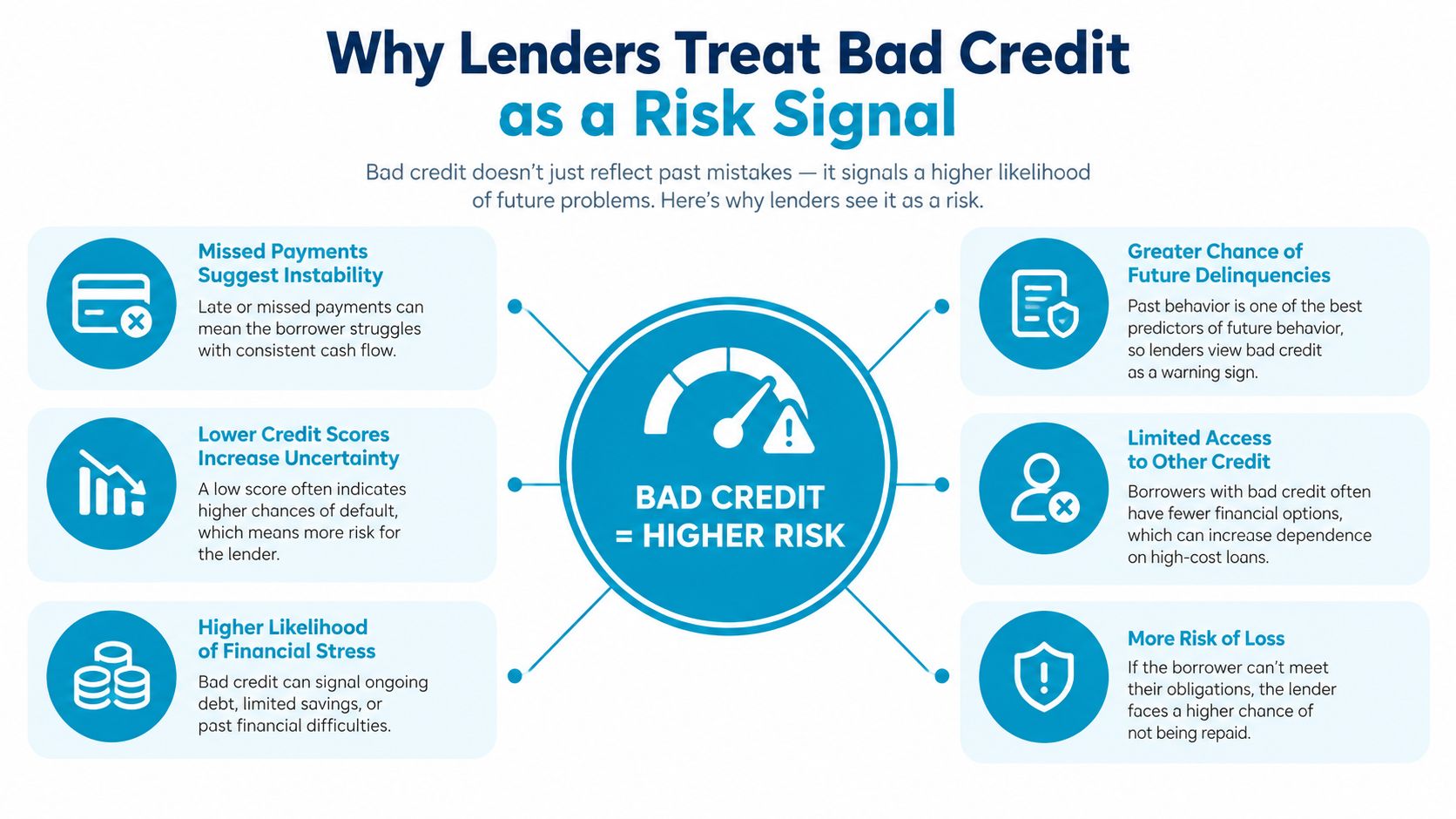
What the lender sees when your score is low
A low score usually signals one of four problems. Recent missed payments, high revolving balances, thin reserves, or unstable repayment behavior. The lender does not need all four to worry. One can be enough.
That concern shows up in the offer, not just the decision:
- Higher APRs: The lender builds expected losses into the price.
- Lower loan amounts: The lender caps exposure instead of giving you the full request.
- More conditions: Pay stub checks, bank-statement reviews, and identity verification become more common.
- Collateral or stronger file support: Some lenders want a secured structure or a co-borrower before they will proceed.
If you are trying to separate a thin file from a damaged one, this guide on no credit vs bad credit explains why lenders react differently to each.
Alternative data can help, but only if it solves the lender's concern
Some lenders look beyond the score. The Oliver Wyman summary on alternative data explains why rent, utility, telecom, and deposit-account data can improve risk assessment. That matters for bad-credit borrowers because a weak score can be partly offset by clean bank activity and provable income.
Here is the blunt version. A low score gets you flagged. Consistent payroll deposits, manageable expenses, and few overdrafts can help clear that flag. Chaotic bank activity usually confirms it.
A low score is the warning. Your recent cash-flow behavior is the rebuttal.
That is why shopping harder is rarely enough by itself. If the file still shows missed payments, frequent overdrafts, or too little income left after bills, more applications just create more denials. The borrowers who improve approval odds give lenders a cleaner story to underwrite.
Loan Options That Work With Poor Credit
Bad-credit borrowers don't have one market. They have several, and the differences matter. Some options are expensive but manageable. Others are expensive and dangerous.
The loans worth checking first
Unsecured personal loans from subprime specialists are usually the least bad option when your credit is damaged but your income is real. Underwriting can be stricter than people expect. Lenders may ask for bank statements, pay stubs, or additional verification. In return, you can get a fixed payment and a defined payoff schedule.
Secured and credit-builder loans matter for a different reason. They're not always the best answer for immediate large cash needs, but they can help rebuild a file when your current profile isn't getting traction.
A marketplace like loan options for borrowers without strong credit history can also help you compare pathways without filling out separate forms everywhere. That saves time, but it doesn't change your credit profile by itself.
The options that deserve skepticism
Payday loans and cash advances are fast. That's the main advantage. They also tend to be the first products people regret because the repayment pressure hits immediately.
Title loans can open the door when nothing else does, but you're putting your vehicle on the line. If losing the car would threaten your job, that risk is bigger than most borrowers admit upfront.
My rule: If the loan solves this week's problem by creating next month's disaster, it's not a solution.
| Loan Type | Typical APR Range | Typical Loan Size | Funding Speed | Main Downside |
|---|---|---|---|---|
| Unsecured personal loan from a bad-credit lender | Often high, sometimes near the upper end of bad-credit personal loan pricing | Small to moderate | Often slower than payday options | Harder underwriting, frequent partial approvals |
| Payday or cash advance loan | Very expensive | Usually small | Very fast | Short repayment cycle and high rollover risk |
| Title loan | Can vary widely | Based on vehicle equity | Fast in many cases | Repossession risk |
| Secured loan | Often more accessible than unsecured credit | Depends on collateral or deposit | Varies | You must pledge cash or an asset |
| Credit-builder loan | Usually small | Small | Slower, more structured | Not ideal for urgent large expenses |
| Credit union small-dollar loan | Usually more consumer-friendly if available | Usually small | Varies by institution | Availability is limited and membership may be required |
My opinion is simple. If you can qualify for a true installment-style personal loan, start there. Payday and title loans should sit at the back of the shelf, not the front.
What a Typical Bad-Credit Request Looks Like
Take a borrower with a 565 FICO, steady full-time income, and a debt load that already feels tight. They submit a personal loan request for an amount that would solve the immediate problem in one shot.
The first response is often silence from prime lenders. That's normal. Those lenders aren't built for subprime files, and they screen fast.
What usually comes back
A more realistic response pattern looks like this:
- One hard no from a mainstream lender: The score band alone knocks the file out.
- A couple of soft-pull prequalification-style responses from subprime partners: These may show a broad APR window and require document upload before anything becomes firm.
- A partial approval: The lender may approve less than requested, shorten the term, or ask for added verification.
That partial approval is common because the lender is trying to make the payment fit the risk. If the requested amount looks too aggressive relative to income and bank activity, the lender cuts exposure instead of approving the full ask.
Why the offers feel disappointing
Bad-credit borrowers often assume stable income should fix everything. It doesn't. Stable income helps, but lenders still look at what's left after rent, existing debt, and recent account behavior.
Funding speed also varies more than people expect. Some lenders move quickly after verification. Others take longer because manual review kicks in, especially when the score is weak and the file needs more scrutiny.
A partial approval is not random. It usually means the lender likes the borrower more than the original loan structure.
That's why borrowers should judge the actual monthly payment and total cost, not just whether an offer showed up.
What Lenders Actually Need From You
What does a bad-credit file need to look approvable? Clean, consistent, and easy to verify.
Bad credit forces lenders to rely less on your score and more on proof. They want to confirm three things fast: you are who you say you are, money comes in regularly, and your account is not already under strain. If any of those pieces are unclear, the file slows down or dies.
Standard documents you should prepare
Have these ready before you submit anything:
- Recent income documents: Current pay stubs, benefit statements, or other recent proof of income. Old documents do not help.
- Bank statements: Lenders review deposit timing, average balance, bill patterns, and signs of stress such as frequent overdrafts or bounced payments.
- Government-issued ID: Your name and date of birth must match the application.
- Proof of address: A utility bill, lease, or similar document is often required, especially if your ID has an old address.
Messy paperwork gets weak files declined. I see this constantly.
What subprime lenders check after the basics
Subprime lenders often underwrite from the bank account outward. They still care about credit, but they also study cash flow, recurring obligations, and whether there is room for another payment. Rent, utilities, phone bills, and account history can all help or hurt the file, especially if the score is already low.
These signals usually matter most:
- Recurring payroll deposits: Steady deposits beat one unusually large recent deposit.
- Low overdraft activity: Repeated negative balances are one of the clearest warning signs in a bad-credit file.
- Room after fixed bills: If income is real but disappears immediately into rent, debt, and subscriptions, approval gets harder.
- Job stability: Longer time with the same employer can offset some score weakness.
If you want a clearer baseline for personal loan eligibility requirements, start there before you apply.
| Signal | Prime Lenders | Subprime / Bad-Credit Lenders |
|---|---|---|
| Credit score | Heavy first filter | Important, but weighed alongside cash flow and verification |
| Income verification | Required | Required and reviewed closely |
| Bank statements | Sometimes secondary | Often central to the decision |
| Rent and utility history | Less commonly emphasized | More likely to influence the file |
| Overdraft activity | Can matter | Often treated as a major risk flag |
| Employment tenure | Helpful | Can help support a weaker score |
Prequalification often starts with a soft pull. A hard pull usually comes later, once the lender sees enough in the file to justify a full review.
How to Improve Your Odds Before You Apply
If your score is weak, the best move is often to wait a bit and repair the file before you submit anything serious. I'd rather see someone spend a short stretch cleaning up the application than rush into bad terms because they're tired of searching.
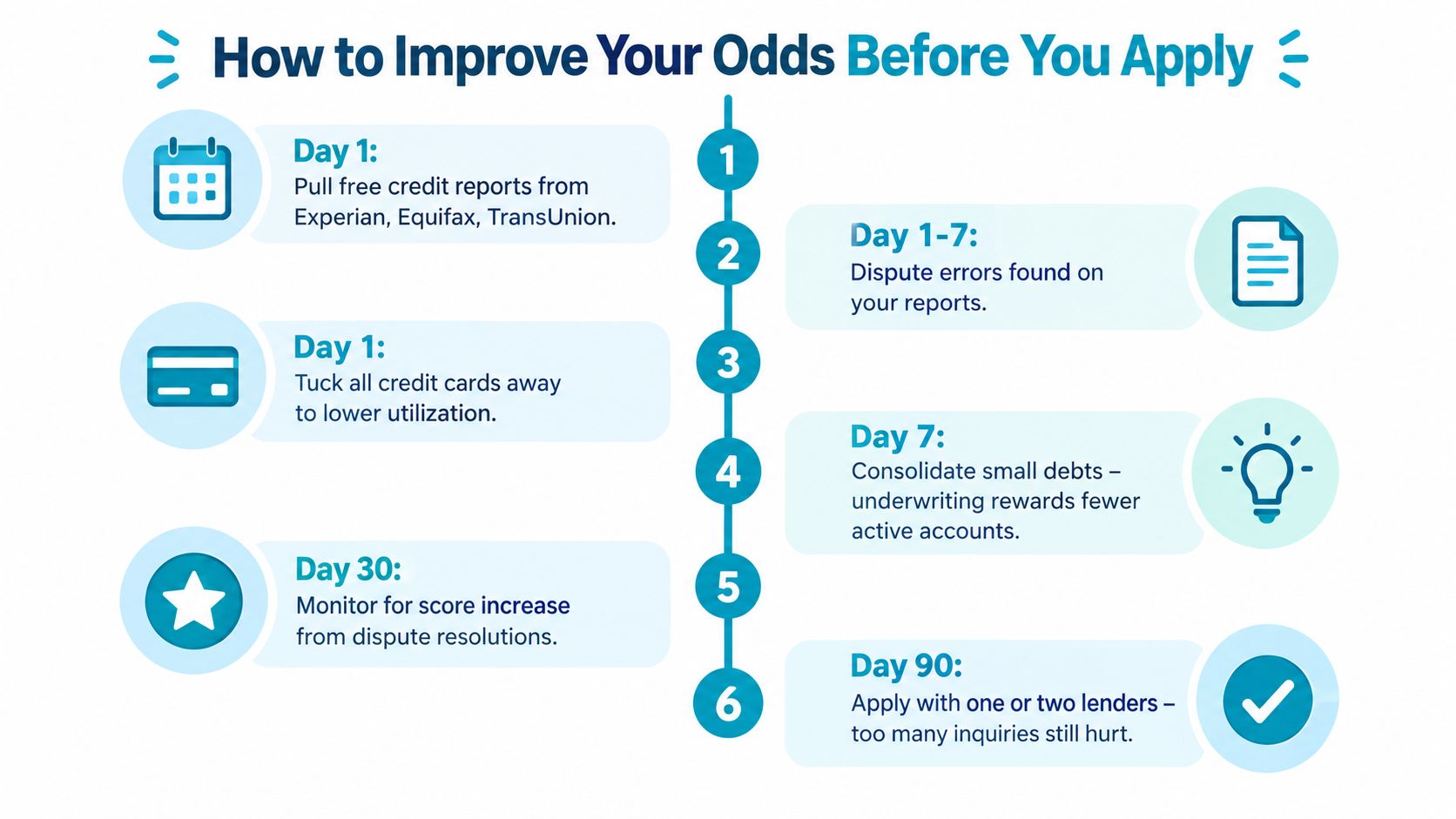
Start with what you can control fastest
Pull your credit reports from all three bureaus and read them line by line. You're looking for reporting errors, old items that should be updated, and balances that don't match reality. If something is verifiably wrong, dispute it.
Then look at your revolving balances. If your cards are crowded near their limits, paying them down can help your profile look less stressed. You don't need a perfect file. You need one that looks safer than it did last month.
Stop making the file worse
A lot of borrowers sabotage themselves right before applying. They add a new card, finance a phone, or stack multiple applications in a short window. That tells lenders the borrower is under pressure.
Instead:
- Pause new applications: Let your existing file settle.
- Make every payment on time: Recent misses hurt more than people think.
- Keep cash in the account when possible: A small cushion looks better than repeated near-zero balances.
Practical rule: Don't submit a loan request during the same stretch that your credit report looks most chaotic.
Build proof outside the score
If your bureau score is lagging behind your real financial behavior, build a stronger alternative-data footprint. Reportable rent, utilities, and steady deposit activity can help some lenders see what the score alone misses.
You can also consider a secured card or a credit-builder loan if your profile needs fresh positive activity. The point isn't speed for its own sake. The point is showing a pattern of controlled borrowing and on-time repayment.
Be careful with credit-repair companies that promise dramatic score jumps. No one can legally remove accurate negative information just because you paid them. Real improvement usually comes from cleaner utilization, fewer recent issues, and time.
How NextStopLoans Routes Your Request
NextStopLoans isn't a lender. It's a marketplace that routes your request to independent lenders whose underwriting may fit your profile more closely.
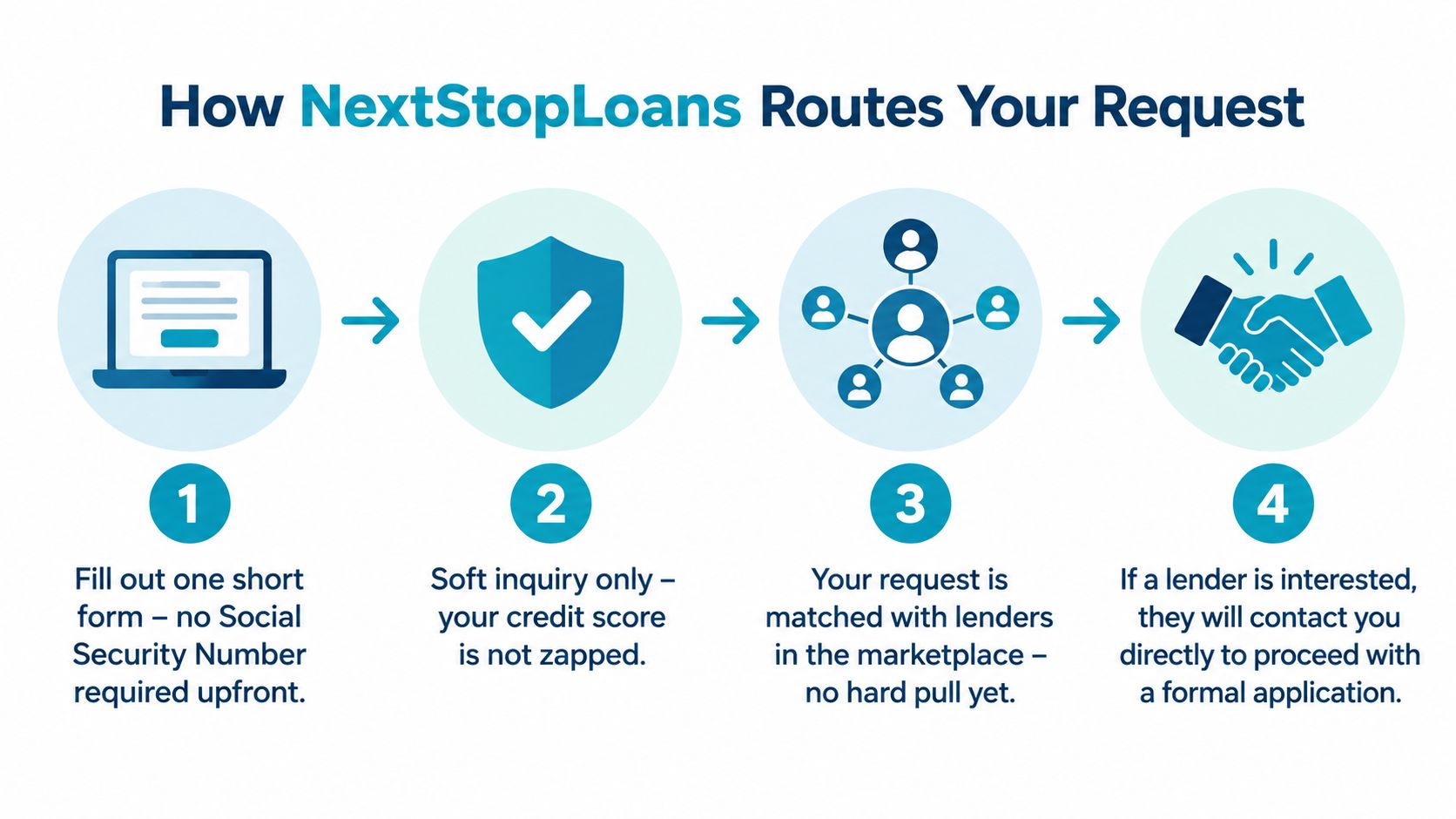
What happens after you submit
You fill out one short request form. The marketplace itself doesn't make the credit decision, set terms, or fund the loan. Instead, it routes the request across a network of third-party lenders in real time.
The key practical detail is this: the marketplace doesn't pull your credit. Participating lenders may check credit and may use both traditional and alternative bureau data if they decide to take the file further.
What bad-credit borrowers should expect
Don't expect a flood of offers if your credit is rough. Most bad-credit borrowers get a small number of responses, and the first offer isn't always the best one. Sometimes it's just the lender most willing to price the risk aggressively.
Returned offers usually spell out a few core items:
- Loan amount or amount range
- APR or APR window
- Repayment term
- Any added conditions, such as collateral or extra verification
Use the form carefully. Complete every field accurately, choose the loan purpose, and read the returned terms with a calculator in hand. The offer is a starting point, not a command.
When Borrowing Makes Sense and When to Wait
Borrowing with bad credit makes sense when the expense is necessary and the alternative is worse. Emergency medical needs, avoiding a utility shutoff, or paying for essential car repair so you can keep working can justify an expensive loan if the payment still fits your budget.
It also makes sense when you already have a realistic plan to improve your file and refinance later. That second part matters. A high-rate loan without an exit plan can trap you longer than expected.
Situations where I'd tell you to wait
I'd wait if the loan is for a discretionary purchase, if the structure looks abusive, or if the new payment would leave no room for error in your monthly budget. I'd also wait if your recent bank history looks unstable, because weak cash flow plus bad credit is where costly mistakes pile up.
Use this short readiness check:
- You can cover at least one new payment from cash on hand
- Your income is documented and recent
- You've already started at least one concrete credit-improvement step
- The loan solves a real problem, not a want
The cheapest loan is often the one you don't take. If the offer fixes today but wrecks the next few months, passing is the smarter financial move.
If you want to see what the market returns for your profile, NextStopLoans lets you submit one secure request that can be routed to a network of independent lenders. That can be useful if your credit is rough and you want to compare realistic options without filling out separate applications everywhere.