
Online Payday Loan Guide to Fees Eligibility Timing
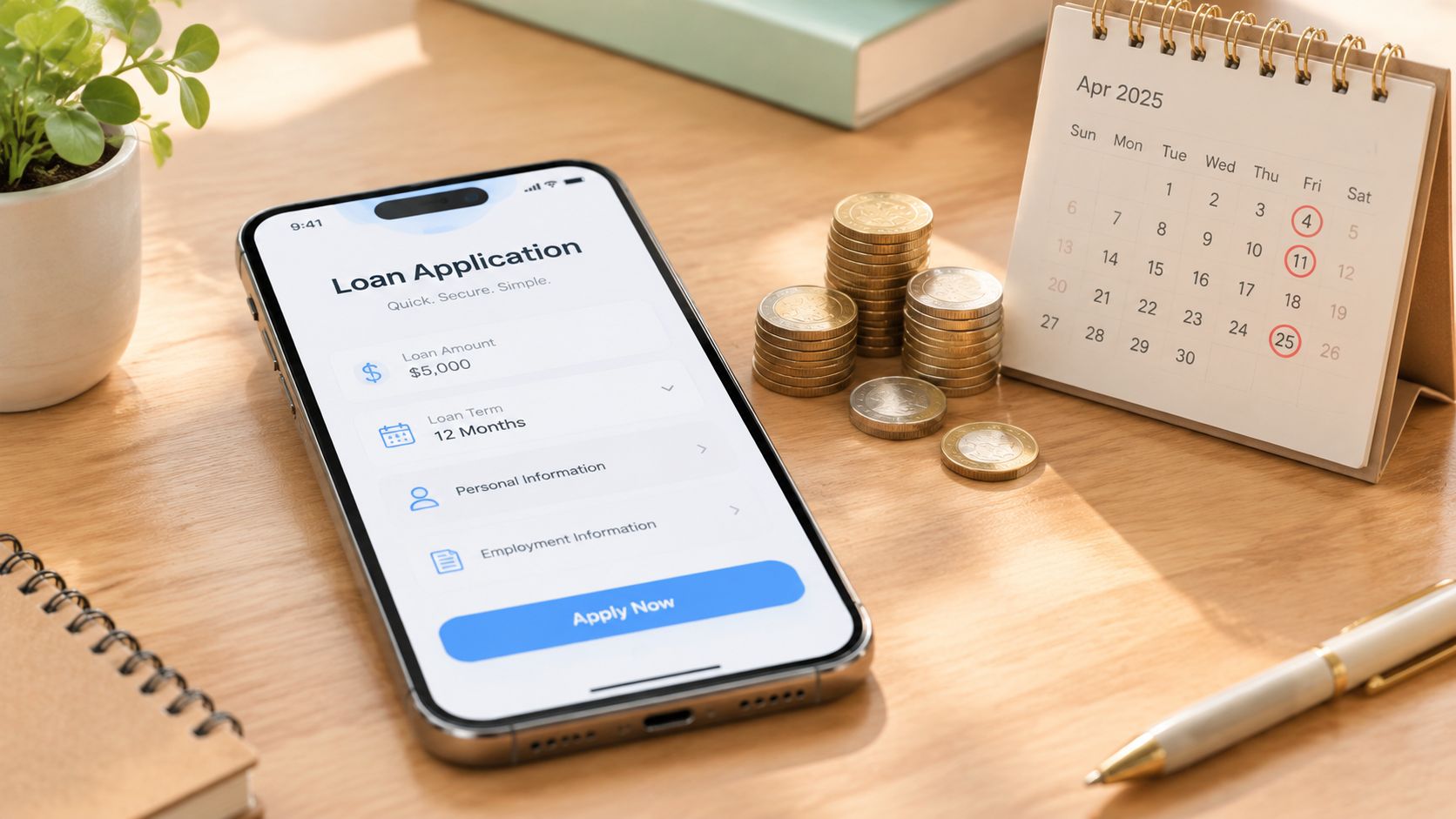
Your car breaks down two days before payday. The repair shop needs payment now, your savings are already gone, and a search for emergency cash produces offers promising fast applications and deposits. The short form makes an online payday loan look like a simple bridge to your next paycheck.
That bridge can become expensive when the repayment date arrives before your budget has recovered. A fee that looks small, an automatic bank withdrawal, or a decision to renew the loan can change the total cost quickly. The Consumer Financial Protection Bureau's guidance on online payday loans specifically encourages borrowers to ask about the full cost, repayment method, missed-payment consequences, and whether a website is a lead generator rather than a direct lender.
This guide explains how an online payday loan works, what eligibility and application steps may involve, how funding timing is handled, and why the annual percentage rate can look dramatically higher than the advertised fee. It also examines ACH authorization, rollover cycles, state restrictions, and alternatives that may reduce the risk of turning a short-term cash shortage into lasting debt.
Table of Contents
- Understanding online payday loan basics
- Application journey and funding timeline
- Cost breakdown fees APR and repayment mechanics
- State rules and restrictions for online payday lending
- Borrower scenarios illustrating rollovers and true costs
- Safer alternatives and smarter borrowing strategies
- Conclusion making informed decisions
Understanding online payday loan basics
An online payday loan is a short-term, high-cost loan designed to provide a small amount of cash before a borrower's next paycheck. The basic idea resembles a temporary bridge. You receive money on one side of a cash shortage, cross the gap with the loan, and repay the balance when income arrives.
The problem is that the bridge has a narrow repayment window. If the paycheck is already committed to rent, utilities, food, or another bill, the borrower may not have enough available money to clear the loan. A renewal or new loan can then become the next bridge, adding another charge instead of reducing the original pressure.

How the money moves
The process usually follows a straightforward path:
- You submit personal, income, employment, and banking details through an online form.
- A lender or lending network reviews the request.
- If a lender approves the request, you review the offered terms and provide electronic consent.
- Funds are sent to your bank account according to the lender's process.
- Repayment may occur through an electronic withdrawal from that account on the agreed date.
That last step deserves careful attention. An ACH authorization can allow the lender to request payment electronically, which may be convenient when the account has enough money. If the withdrawal reaches the account before your paycheck or competes with other transactions, it can create overdraft or returned-payment problems.
How it differs from other credit
An installment loan normally spreads repayment across scheduled payments over a longer period. A credit card provides revolving access to a credit line, allowing the balance to change as you borrow and repay. A payday loan generally focuses on a short period and a single upcoming income event, so the repayment date matters as much as the amount borrowed.
Online access removes the need to visit a branch, but it doesn't remove the need to check the lender's identity, licensing, cost disclosures, and payment terms. California's 2021 annual report recorded more than 4.5 million payday loans worth over $1.26 billion, and 52.7% of customers used online channels, according to the CFPB payday-lending data point. Digital delivery is therefore not a minor convenience. It's a central way borrowers encounter this product.
Application journey and funding timeline
An online application can feel almost frictionless, which is useful during an emergency but risky if speed discourages careful reading. Treat each stage as a checkpoint rather than a formality. Approval doesn't mean the offer is affordable, and a fast response doesn't prove that the provider is a direct lender.
Before you submit
Start by checking the basic requirements shown on the application page. Providers commonly ask applicants to be eligible U.S. residents with regular income, an active bank account, and the legal ability to enter a loan agreement. Exact requirements vary by provider and state, so don't assume that meeting one website's criteria guarantees approval elsewhere.
Next, confirm who will receive your information. Some websites connect applicants with independent lenders instead of making loans themselves. The How It Works information can help you understand whether the service is a lender or a marketplace, but you should still read the final lender's disclosure before accepting an offer.
What happens after the form
A secure application typically asks for identity, income, employment, contact, and banking information. The request may then be reviewed by one lender or routed through a lender network. A lender may use credit-bureau information or other underwriting data, and the effect of any inquiry depends on that lender's process.
An approval message should be treated as an invitation to inspect terms, not as a reason to sign immediately. Look for the amount you'll repay, the due date, the fee, the annual percentage rate, the ACH authorization, and the consequences of a failed payment.
Timing and possible delays
Some decisions arrive quickly, while funding depends on the lender, bank processing, verification, and the time of day you accept the agreement. A direct deposit may arrive as soon as the next business day in some circumstances, but that timing isn't guaranteed for every application.
Before counting on the money for a same-day repair or bill, ask when the lender sends the deposit and whether your bank can make the funds available. Keep a copy of the application, offer, consent record, and repayment schedule. Those records can help you identify the responsible party if the payment amount or date later differs from what you expected.
Cost breakdown fees APR and repayment mechanics
The advertised fee is only the first layer of the cost. A borrower needs to connect three pieces, the amount received, the charge for using it, and the time allowed for repayment. A short term can make a modest dollar fee look extremely expensive when converted into an annual rate.
The CFPB explanation of payday-loan APR gives a clear example. A $15 fee per $100 borrowed over a 14-day term translates to an APR of almost 400% when annualized. APR doesn't mean the borrower necessarily keeps the loan for a full year. It standardizes the cost so consumers can compare short-term credit with products using different terms.
A simple cost example
| Fee per $100 | Term in days | APR |
|---|---|---|
| $15 | 14 | Almost 400% |
The table shows why comparing only the fee can mislead you. A fee of $15 might sound manageable in isolation, but the repayment period is only 14 days in this example. The annualized figure exposes how rapidly the cost scales when the same short-term charge is expressed over a year.
Use the lender's actual agreement for the final calculation. Check whether the stated fee is the entire finance charge or whether the contract adds origination charges, processing fees, late charges, or other costs. The rates and fees information can help you locate disclosure details, but the lender's offer controls the terms you must evaluate.
What an ACH authorization can do
ACH means an electronic request to move money from a bank account. During an application, you may be asked to authorize a lender to debit the account on the repayment date. That can make repayment automatic, but it also creates a timing risk.
Think of the authorization as giving the lender a scheduled route to your account. If the account contains enough money, the route may work as planned. If the balance is too low, the request can be returned or create an overdraft, depending on your bank's policies and the account's settings.
Before consenting, identify:
- Withdrawal date: Confirm the exact date and whether the lender can retry after a failed debit.
- Withdrawal amount: Check whether the debit includes only principal and the stated fee or includes additional charges.
- Account impact: Consider whether rent, utilities, payroll deposits, and other scheduled payments use the same account.
- Cancellation process: Read the agreement for instructions on stopping or revoking an authorization, and remember that canceling a debit doesn't erase the debt.
Missed payments and fee spirals
A missed payment can produce more than one consequence. The lender may charge a contractual fee, attempt another debit, report the account according to applicable rules, or send the balance to collections. Your bank may also impose its own penalty when an electronic debit fails.
CFPB research reported that one-half of online payday and payday-installment borrowers had at least one failed debit attempt that produced average bank penalty fees of $185 over 18 months. The same CFPB research summary reported that 36% of accounts with a failed debit attempt from an online lender were eventually closed by the depository institution. These figures illustrate why repayment mechanics matter as much as the initial price.
A rollover or extension can conceal the actual cost. Instead of paying down the principal, you may pay a new charge to postpone the due date. Ask for a written payoff amount, not just the next required payment, and calculate how much money will leave your account if the loan remains open through another cycle.
State rules and restrictions for online payday lending
Payday-lending rules depend heavily on where the borrower lives. A website may advertise nationwide access, but state law can restrict whether the product is available, how much a lender can charge, the loan amount, repayment practices, or the lender's authority to operate.
That creates an important distinction between online availability and legal availability. A web form may accept your information even when the final lender can't legally offer the advertised product in your state. The lender's license, state disclosures, and final agreement matter more than a general marketing statement.
Why state comparisons can mislead
Some jurisdictions prohibit payday lending, while others permit it under fee, amount, or term limits. Certain states also apply broad cost limits that can make a typical payday model unavailable. A stated 36% APR limit in a jurisdiction, for example, can be entirely different from a product priced at almost 400% APR in the CFPB's 14-day example, because the cap changes the economics of the loan.
You may encounter excluded areas such as Arkansas, New York, Vermont, and West Virginia on some marketplace applications. That doesn't mean every provider follows the same availability map. It means you should verify the applicable rule and the provider's status rather than relying on a search result.
For a state-specific example, consult the payday-loan information for Texas, then confirm the current requirements with the relevant state regulator or licensing authority.
Questions to ask before accepting
- Can this lender legally serve my state? Look for a license or regulator reference in the disclosure.
- What is the total repayment amount? Don't stop at the fee or the amount deposited.
- Does the contract allow a renewal or extension? Identify the charge and whether principal decreases.
- Who is the actual lender? A lead generator may collect your request and share it with independent lenders.
- What happens after a failed debit? Read the contract, then check your bank's separate fee policies.
If the provider won't clearly identify the lender, explain the repayment schedule, or show the total cost before consent, pause the application. A legitimate disclosure should make the obligations understandable without requiring you to guess.
Borrower scenarios illustrating rollovers and true costs
Consider Maya, who borrows to cover an urgent repair and receives a repayment date shortly before her next paycheck. Her paycheck arrives as expected, and she has enough money after essential bills to repay the full balance. In that situation, the loan may end after the agreed payment, although the fee still represents a high cost for a short period.
Jordan has a different outcome. He receives the same kind of short-term advance, but an unexpected utility bill consumes the money he planned to use for repayment. Rather than clearing the balance, he extends the loan or takes another loan when the first one becomes due. The new charge buys time, but it doesn't solve the original cash shortage.
How the cycle changes the math
The CFPB report on payday lending defines a loan sequence as an initial payday loan followed by subsequent loans renewed within 14 days. Independent summaries of that research report that over 80% of payday loans are rolled over or followed by another loan within 14 days.
The practical lesson is simple. Each cycle should be evaluated as a new cost event, not as a harmless extension. If the principal remains largely unpaid, repeated fees can consume money that could otherwise reduce the balance.
Failed debit scenario
Elena authorizes an electronic withdrawal, but her paycheck posts later than expected. The lender's debit fails, and the bank also assesses a penalty under its account rules. If the lender retries the withdrawal while other bills are pending, Elena may face several competing demands on the same balance.
She now needs to ask for the exact payoff amount, review the contract's retry and late-payment provisions, and contact her bank about account protections. The key issue isn't only whether she missed one payment. It's whether the payment system can keep generating charges while the principal stays open.
Practical rule: Before accepting an extension, write down the amount already owed, the new fee, the next due date, and the total payoff amount. If you can't explain how the extension reduces the balance, treat it as added cost rather than progress.
Safer alternatives and smarter borrowing strategies
A payday loan, despite having the shortest application, shouldn't be the first option. Start with alternatives that may give you more time, a lower cost, or greater control over repayment.
- Short-term personal installment loan: Fixed payments can make budgeting easier, but compare the APR and total repayment amount rather than assuming every installment product is affordable.
- Community credit union product: A credit union may offer member-focused underwriting, structured payments, or financial counseling. Membership and eligibility rules apply.
- Employer cash or payroll advance: An employer program may provide access to earned wages or a payroll advance, but review any participation charge and the effect on your next paycheck.
- Creditor negotiation: Ask a landlord, utility provider, medical office, or service company whether it can offer a payment arrangement before borrowing.
- Emergency savings: Even a small reserve can reduce the need to authorize an electronic withdrawal against your next paycheck.
Questions that protect your budget
Ask every provider for the total cost, repayment method, missed-payment consequences, and rollover or extension charges. Confirm whether the website is a direct lender or a lead generator, and identify the company that will make the credit decision.
If you compare offers through a marketplace such as NextStopLoans, remember that it connects requests with independent third-party lenders. The participating lender, not the marketplace, makes the decision and sets the offered terms, so read that lender's disclosure before accepting.
Conclusion making informed decisions
An online payday loan can deliver quick access to money, but speed doesn't reveal affordability. The important questions are practical: How much will you repay? When will the withdrawal occur? What happens if the account is short? Can you repay the balance without borrowing again?
The fee and APR must be read together. A small fee over a very short term can produce a very high annualized cost, while an ACH authorization can expose your bank account to failed withdrawals, retry attempts, and separate bank penalties. A rollover may postpone the deadline without meaningfully reducing principal.
Use this checklist before you apply:
- Verify eligibility and legality: Confirm that the lender can serve your state and identify its license or regulatory information.
- Calculate the full cost: Include the fee, APR, late charges, failed-payment charges, and any extension cost.
- Inspect the payment method: Know the withdrawal date, amount, retry policy, and process for disputing an unauthorized debit.
- Read the lender agreement: Make sure the actual lender's name and disclosures match the offer.
- Compare alternatives: Contact creditors, check credit unions, review employer programs, and consider installment options before choosing a high-cost bridge.
- Plan the payoff: Don't accept a loan unless your expected income can cover the balance while leaving essential expenses funded.
A fast approval solves a timing problem only if the repayment plan also fits your budget.
NextStopLoans provides a secure online marketplace where eligible U.S. consumers can submit one loan request for review by independent third-party lenders, including providers offering short-term, installment, and emergency loan options. Visit NextStopLoans to compare available responses, then review each lender's total cost, repayment schedule, and ACH terms before accepting an offer.