
How to Get Payday Loan with Bad Credit in 2026
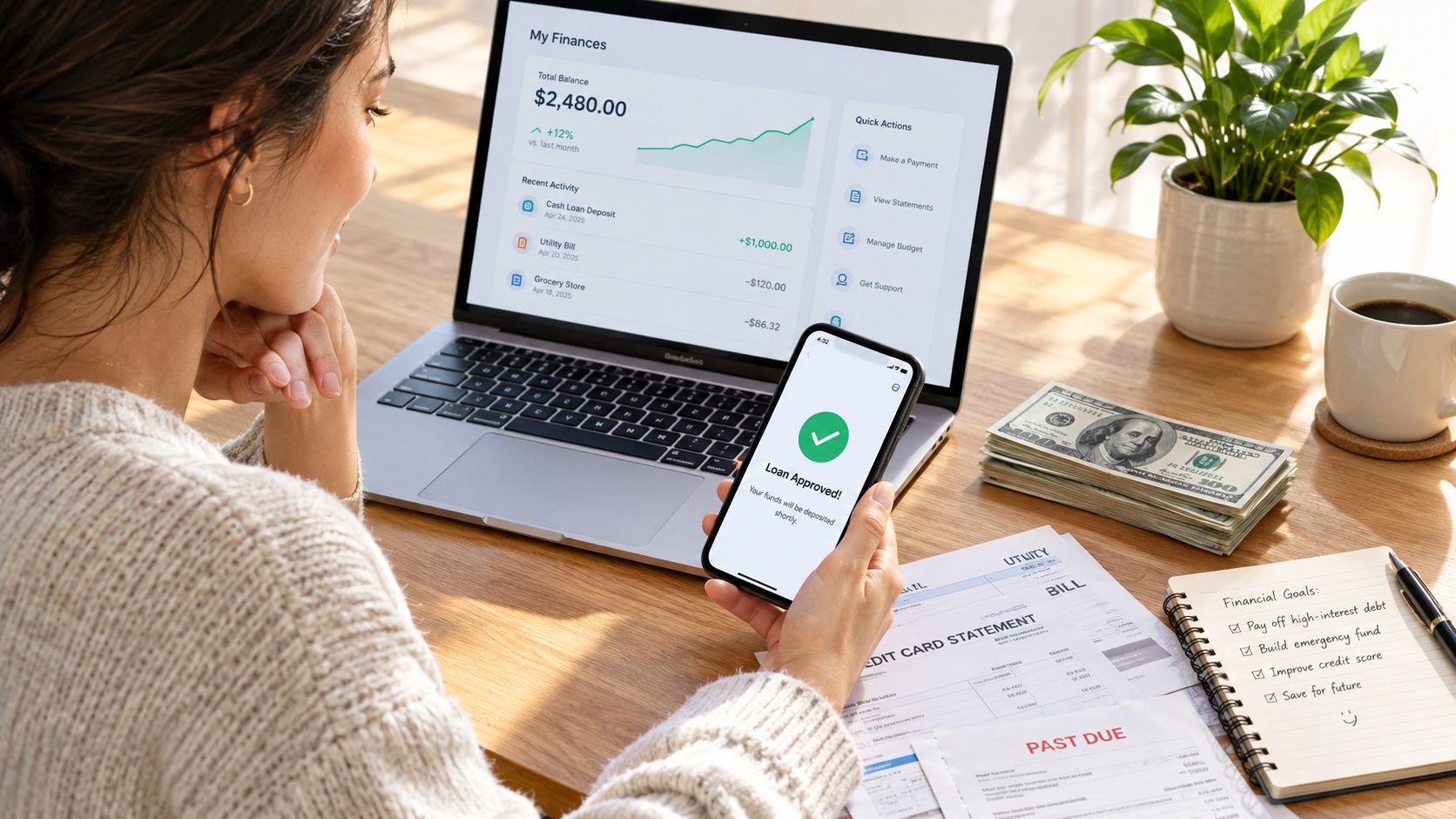
You're staring at an overdue bill, your credit history is rough, and payday is still several days away. A payday loan may look like the fastest answer, especially when traditional lenders have already rejected you. But getting approved and being able to repay the loan safely are separate questions.
A payday lender may look more closely at your current income, active bank account, identity, and ability to repay than at a conventional credit score. That can make approval possible with bad credit, but it doesn't make the loan affordable. The practical question isn't only “Can I get a payday loan with bad credit?” It's “Can I repay it on the exact due date without borrowing again?”
Table of Contents
- When Bad Credit Meets a Short-Term Cash Need
- What Lenders Actually Check Beyond the Credit Score
- Preparing and Submitting a Loan Request Online
- Reading the Offer Like a Pro Before You Sign
- Lower-Cost Alternatives Worth Checking First
- Spotting Advance-Fee Scams and Unlicensed Lenders
- Your Decision Checklist Before You Accept Any Offer
When Bad Credit Meets a Short-Term Cash Need
A bad credit history doesn't automatically prevent you from seeking a payday loan. Payday lenders traditionally place more weight on current income, an active bank account, identity, and repayment ability than on a high conventional credit score. Availability still depends on your state's law and the lender's own requirements.
The price is the issue. The Consumer Financial Protection Bureau's payday loan factsheet reports that a typical storefront payday loan carries a median fee of $15 for every $100 borrowed and usually lasts 14 days. Expressed as an annual percentage rate, that pricing equals about 391% APR.
Approval can therefore create a dangerous illusion of progress. The lender has decided that your application meets its criteria. It hasn't decided that the payment will fit comfortably beside rent, food, utilities, transportation, and your next financial obligation.
The real approval test: If repayment requires another loan immediately after this one, the offer doesn't solve the emergency. It extends it.
Before applying, write down the amount you need, the total amount due, and the date your income will arrive. Confirm that the lender serves your state, check its license, and compare the offer with a credit-union small-dollar loan, employer advance, negotiated bill extension, or longer-term installment product.
Services such as NextStopLoans use a marketplace connector model. A single intake can be evaluated by multiple independent lenders in real time, but those lenders make the decisions, set the terms, and handle funding. A marketplace can help you find an offer. It can't make an expensive loan affordable.
What Lenders Actually Check Beyond the Credit Score
A low credit score is only one part of a payday lender's review. The lender needs evidence that money regularly enters your account and that it can identify you and legally serve you. That's why a borrower with damaged credit may receive an offer while another applicant with a cleaner file is rejected because income or banking information can't be verified.
Expect the application to focus on:
- Verifiable recurring income: Paychecks, benefits, or another accepted income source must show that repayment is plausible.
- Active checking account: The account generally needs to receive deposits and support the lender's repayment method.
- Identity details: A valid government-issued identification document helps the lender confirm who is applying.
- Age and residency: You must meet the lender's age requirement and be eligible in the state where you live.
- Working contact information: A functioning phone number or email lets the lender communicate with you about verification and terms.
- Repayment capacity: The lender may consider whether your income and banking activity support the proposed payment.
What bad credit changes
Traditional lenders often rely heavily on conventional credit reports and scores. Payday lenders may use broader information, but broader underwriting doesn't mean they ignore repayment risk. A low score can still affect whether you qualify, the amount offered, the fee, the payment schedule, or the lender's decision to decline you.
The most useful way to approach the process is to treat your income and bank account as evidence, not as permission to borrow. Gather accurate information before submitting anything, and don't inflate your income or hide existing obligations. A lender may verify what you provide, and inaccurate details can lead to a denial or create a repayment problem later.
For more context on the difference between credit history and loan eligibility, see this guide to getting a loan with bad credit. The key distinction remains simple: a lender's willingness to offer credit isn't proof that the payment fits your budget.
Preparing and Submitting a Loan Request Online
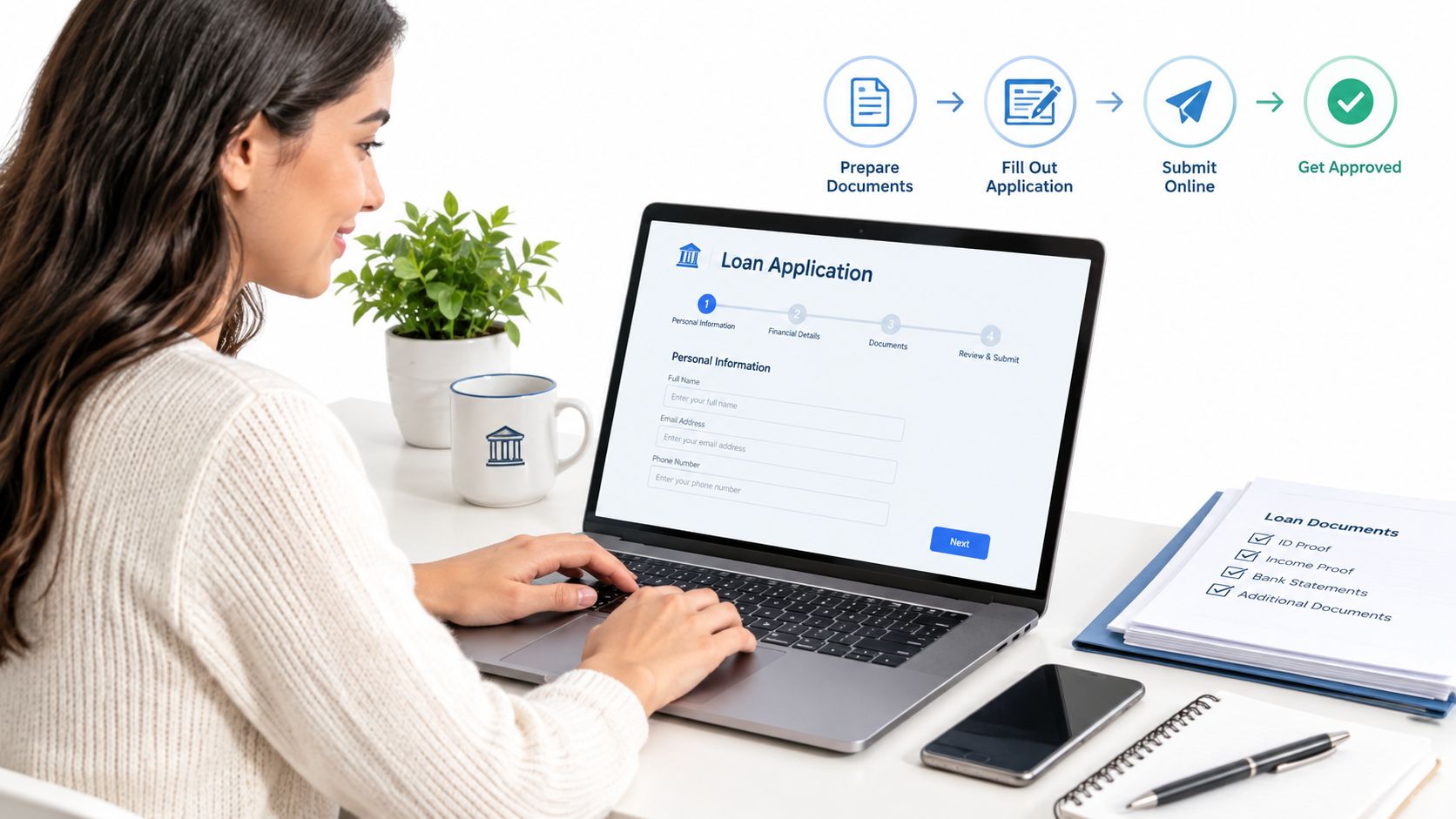
An online request moves quickly when you have the necessary information in front of you. Before opening a form, collect recent pay stubs or other proof of income, your bank account and routing numbers, employer details, government ID information, and any references the lender may request. Decide how much you need, not how much the form allows you to request.
A smaller request can reduce the amount due, but it won't fix an unaffordable payment schedule. Write down the repayment date and identify the income deposit that will cover it. If you can't name the deposit and show what remains after essential bills, pause before submitting.
A secure marketplace form typically asks for personal, employment, and banking information, then routes the request to participating lenders. Look for 256-bit SSL encryption, clear electronic-consent language, a privacy policy, and disclosures explaining that independent lenders make the final decision. Review the permission you're granting before clicking submit.
What happens after submission
A marketplace can send one request to multiple lenders, reducing the need to repeat the same application. Responses may arrive within minutes, but that response is only an indication that a lender is interested. You still need to open the lender's agreement and inspect the cost, due date, withdrawal authorization, and consequences of late or returned payments.
Direct-deposit funding may arrive as soon as the next business day, subject to the lender's review, approval, and banking process. Don't schedule a bill payment based on a promised timing until the lender confirms when funds will be available.
The online loan application form guide can help you understand the information typically requested. Keep your approach disciplined: provide truthful details, submit only when you're ready to evaluate an actual offer, and remember that you can decline after reviewing the terms.
Reading the Offer Like a Pro Before You Sign
Approval feels like relief. It is not the decision point. The decision is whether the repayment works on the exact date the lender will come for the money.
Start with the dollars, not the marketing. A typical fee of $15 per $100 borrowed means a $300 loan would cost $45 in fees, so the total repayment would be $345 if it is due in 14 days and no other charges apply. That same price works out to about 391% APR. The APR is not there to predict that you will carry the loan for a year. It shows how expensive a very short borrowing period becomes when expressed as an annual rate. For a plain-language breakdown of fee structure and annualized cost, read this payday loan rates guide.
Then move to the part many borrowers skip. The due date.
A lender can approve you in minutes and still set up a payment you cannot survive. Write down the exact repayment date in the agreement, then line it up against your next paycheck or benefit deposit. After that, subtract rent, food, utilities, transportation, child care, minimum debt payments, and any other charge that will hit before or on that same date. If the payment does not fit cleanly, the offer is bad, even if approval was easy.
The CFPB figures cited earlier in this article show why this matters. Analysts reviewed more than 15 million payday loans over a 12-month period and found that the median borrower completed 10 transactions, stayed in debt for a median of 199 days, and paid $458 in fees excluding principal. One-quarter of borrowers paid at least $781 in fees. The same CFPB research found that more than 80% of payday loans were rolled over or reborrowed within 30 days, with a new charge attached each time. That is the trap. Approval is the small event. Repayment pressure is the actual risk.
Use a side-by-side check before you sign:
| Item | Single-Payroll Loan | 4-Payroll Installment |
|---|---|---|
| Amount borrowed | $300 due in one payment | $300 split across four payments |
| Payment timing | Usually one short-term due date | Several scheduled payments |
| Cost to compare | Fee, APR, total repayment, and returned-payment charges | APR, total repayment, installment amount, and all fees |
| Main pressure point | One large payment can collide with essential bills | Multiple deductions can reduce future paychecks |
| Safe test | The full payment must fit after essential expenses | Every installment must fit after essential expenses |
Now stress-test the offer using the contract, not a sales summary and not a text message from a loan matcher.
- Total due: Add the principal, fee, interest, and any other charges listed in the agreement.
- Deposit timing: Identify the exact paycheck or deposit that would cover the payment.
- Essential bills: Calculate what is left after housing, food, utilities, transportation, and required obligations.
- Account access: Check whether the lender can debit your bank account automatically, and on what date.
- Failed payment cost: Read the terms for returned payments, overdrafts, or collection activity.
- Renewal terms: Confirm whether your state allows rollovers or extensions, and what they cost.
Read every authorization line before you click accept. If the lender can pull funds electronically, one mistimed debit can trigger bank fees and leave you short on basics. If the payment leaves no cushion, if one missed deposit would break the plan, or if you already know you will need another loan to get through the due date, walk away. Declining a bad offer is cheaper than surviving it.
Lower-Cost Alternatives Worth Checking First
A payday loan shouldn't be your first stop just because your credit score is damaged. Start with options that address the bill directly or spread repayment over a schedule your income can support.
A credit-union small-dollar loan may suit someone who can wait for membership and underwriting. Ask about the total cost, application charges, repayment period, and whether the credit union offers a payday alternative product. A longer schedule can reduce immediate pressure, but compare the full repayment rather than judging by the payment alone.
An employer paycheck advance may fit a worker with predictable wages and an employer-provided benefit. Check whether the advance carries a fee, how it affects the next paycheck, and whether repayment is automatic. If the deduction leaves the next paycheck short for essentials, it only moves the problem forward.
For a medical, utility, or rent bill, call the provider before borrowing. Request a payment plan, due-date change, hardship arrangement, or short extension. This route can be slower than clicking an application, but it may prevent you from paying a high fee just to delay an existing obligation.
Match the alternative to the emergency
- Nonprofit or community assistance: Best when the expense involves food, housing, utilities, transportation, or medical needs and you may qualify for local support.
- Installment financing: More suitable when you need credit but can repay only through several pay periods. Read the APR and total repayment carefully.
- Bill negotiation: The right first move when the creditor controls the due date or payment schedule.
- Credit-union borrowing: Worth checking when you have an active account and can complete a formal review.
- Employer advance: Useful only when the deduction won't damage the next pay cycle.
A practical rule: Ask who gets paid if you solve the emergency. If the answer is a lender charging a high short-term fee, first ask whether the original provider will accept a smaller or delayed payment.
Some marketplaces can route one request to lenders offering payday-style and installment structures, but that convenience doesn't replace comparison. Review each offer independently, and don't accept a longer product merely because the payment looks smaller. The total cost, withdrawal schedule, and effect on future income still control the decision.
Spotting Advance-Fee Scams and Unlicensed Lenders
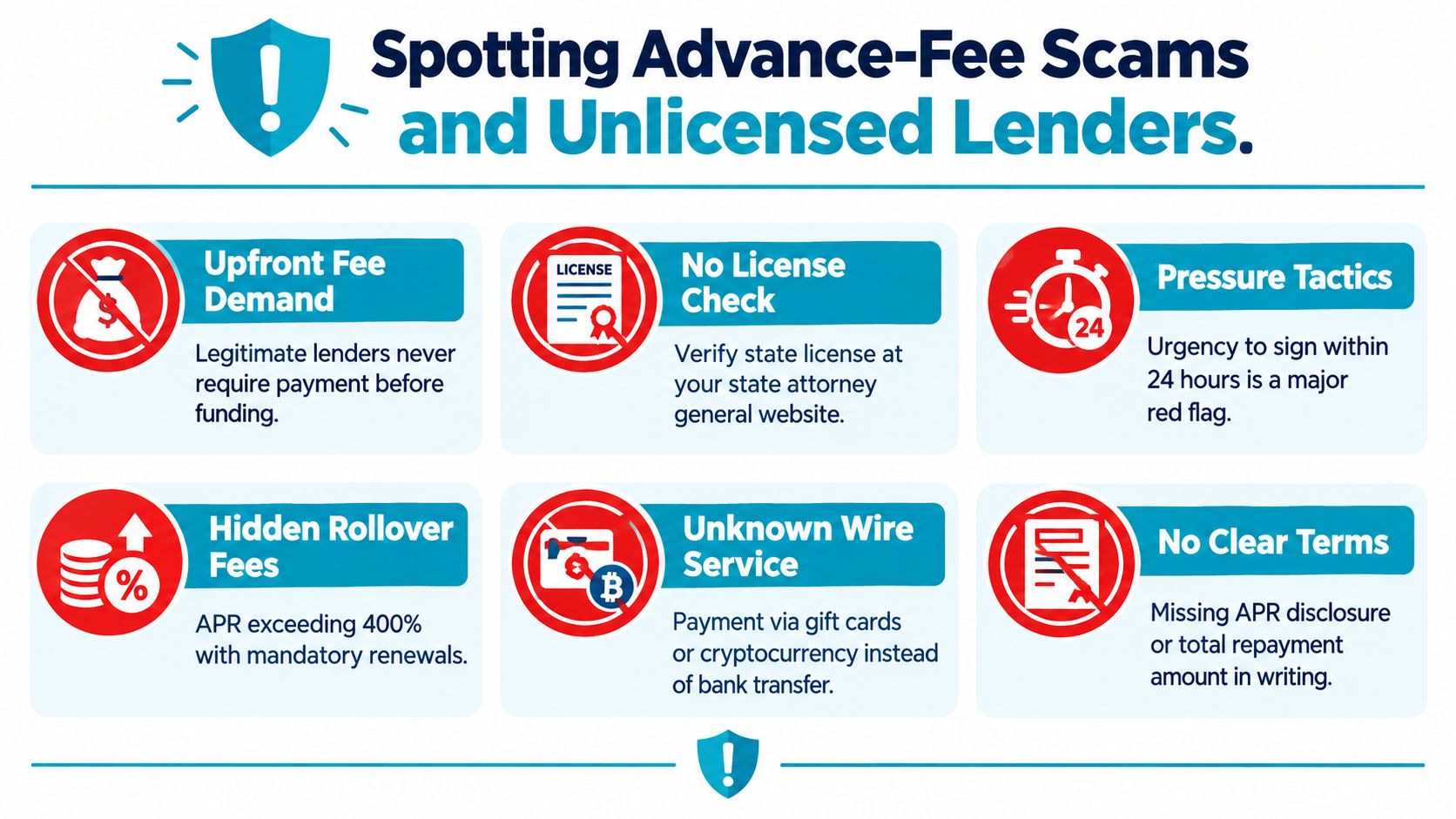
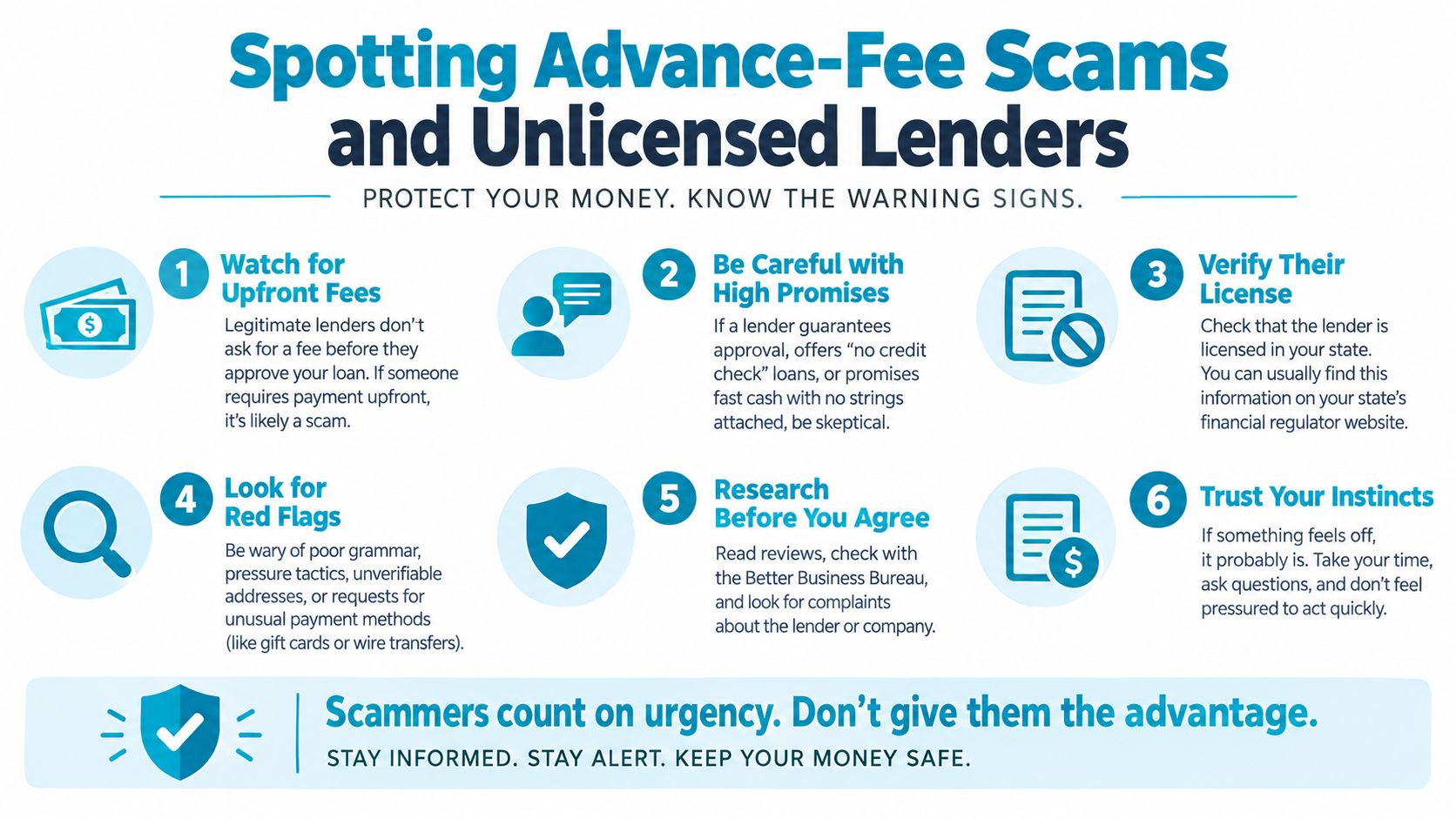
Bad credit makes people vulnerable to offers that promise certainty. A message claiming guaranteed approval regardless of credit history deserves suspicion, especially when the sender asks for insurance, processing, or application money before funding.
The Federal Trade Commission's advance-fee loan guidance says consumers shouldn't pay for a promise of credit. A legitimate lender may disclose fees in a loan agreement, but a demand for payment before the promised funds arrive is a serious warning sign. New York's financial regulator also warns about guaranteed-loan advance-fee schemes and says requesting an upfront payment for a loan or credit card is unlawful.
Use this verification routine before sharing banking information:
- Confirm the legal lender: Identify the company that will make the loan and verify its license through your state regulator or attorney general.
- Read the written terms: Find the APR, total repayment, due dates, late charges, returned-payment fees, and renewal rules.
- Inspect account permissions: Understand whether the lender may make electronic withdrawals, how often, and for what amount.
- Reject pressure: Don't let a text, email, or phone call force an immediate signature.
- Protect credentials: Never provide online banking passwords or one-time security codes through an unsolicited message.
- Stop at an upfront demand: Don't send money by gift card, wire, cryptocurrency, or another hard-to-recover method to qualify for a loan.
A marketplace connector isn't the same as the lender funding your loan. Treat every offer as coming from an independent lender, verify that lender's identity and state availability, and read the agreement before consenting to electronic withdrawals. Bad credit is not a reason to skip fraud checks. It's a reason to make them stricter.
Your Decision Checklist Before You Accept Any Offer
An offer is not a debt until you accept it. Use that control.
- Affordability: Can you repay the full required amount from income you already expect, without another loan?
- Timing: Is the due date after the deposit you'll use, and before essential bills consume the account?
- Total cost: Do you know the APR, fees, principal, and total repayment in writing?
- Account access: Do you understand every automatic debit and the charge for a failed payment?
- Legitimacy: Have you identified the actual lender and confirmed state licensing and availability?
- Alternatives: Have you asked the bill provider, employer, credit union, or local assistance program for a lower-cost solution?
- Exit option: Are you comfortable declining if one answer doesn't work?
State restrictions matter. Online services aren't available to every U.S. resident or in every state, and a lender's eligibility rules may differ from the marketplace's intake process. Confirm local availability before sending sensitive information.
If the math works and the lender passes the verification check, submit through a secure intake and review the final agreement carefully. If the payment depends on a rollover, overdraft risk, or another loan, walk away and pursue a bill arrangement, employer advance, nonprofit support, credit-union product, or installment option instead. The strongest tool in this process is your ability to decline.
NextStopLoans provides a secure online request process that can route your information to independent lenders, including lenders that consider applicants with damaged credit. Visit NextStopLoans to submit a request, review any available offer, and decline it if the repayment math doesn't work.