
Loan Application Form: How to Get Approved
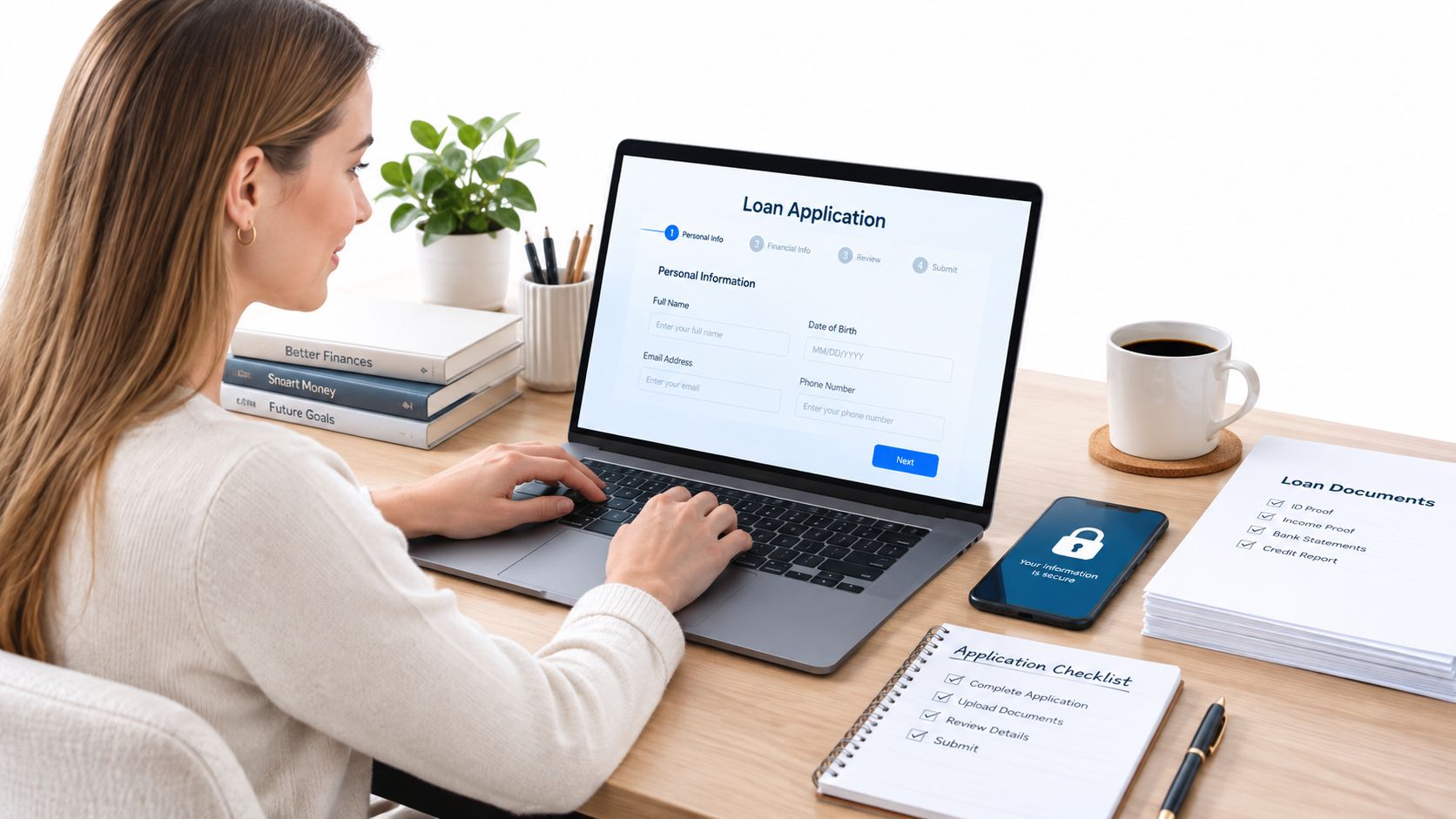
You're staring at a loan application form, one hand on your phone and the other reaching for a pay stub you can't immediately find. The expense is urgent, the questions feel invasive, and you're worried that one wrong answer will cost you an approval. That pressure is understandable, but rushing blindly is the wrong move.
The most important distinction is this: a marketplace intake form is not the same as final lender underwriting. The first form helps route your request to potentially suitable lenders. A lender may later verify income, review documents, check credit, and set the actual terms. Enter accurate, complete information at the start, but don't volunteer documents or details before they're requested.
Table of Contents
- How Modern Digital Lending Actually Works
- Gathering Your Documents Before You Start
- Navigating Common Fields and Strategic Entry
- Verifying Security and Electronic Consent
- The Submission and Lender Matching Process
- Evaluating Offers and Protecting Your Rights
How Modern Digital Lending Actually Works
You submit a loan application form from your phone, receive potential offers, and may assume the form itself decides whether you qualify. It does not. Modern digital lending separates marketplace intake from final lender underwriting, and understanding that distinction helps you provide useful information without creating unnecessary risk.
An online intake form gathers a defined set of identity, employment, income, loan, and banking details. The marketplace uses those details to identify independent lenders that may review your request. Complete the fields accurately and consistently, but keep the first submission focused. Do not upload sensitive documents or provide extra financial details unless a verified lender requests them.
The scale of automated lending is clear in the CFPB's loan application packet guidance, which reported about 66 million applications for buy now, pay later loans in 2022, with roughly 69% resulting in originations. The same reporting described more than 1 million loan applications per day that year. Those figures apply to a specific credit product, but they show how widely form-based decisions operate in digital finance.
Borrowing conditions also affect results. The European Central Bank's summary of Federal Reserve consumer credit findings reports that 33% of U.S. adults applied for some type of credit in 2025, the lowest annual rate since the survey began in 2015. Among applicants, about one-third were denied or received less than requested, an increase of 5 percentage points from 2021. Accurate entries and a realistic loan request matter when lenders are selective.
Practical rule: Use the first submission to present a controlled, accurate profile, not to complete the final loan file.
A marketplace does not approve your loan, set its interest rate, guarantee funding, or replace underwriting. A lender may later verify your income, review documents, check credit, and establish the actual terms. One careful intake can therefore create multiple potential paths while reducing repeated data entry. Before submitting, confirm every field and understand whether the next step may involve a soft inquiry or a hard credit pull.
Gathering Your Documents Before You Start
A loan application can stall before you reach the first decision. You may need to search for an account number, estimate income from memory, or stop when a verification screen requests information you could have prepared. Build a small, accurate file before opening the form.
Prepare the facts for the initial marketplace intake, but hold back sensitive documents until a legitimate lender or secure portal requests them. The goal is clean data entry that can produce multiple lender matches without unnecessary exposure or premature hard inquiries.
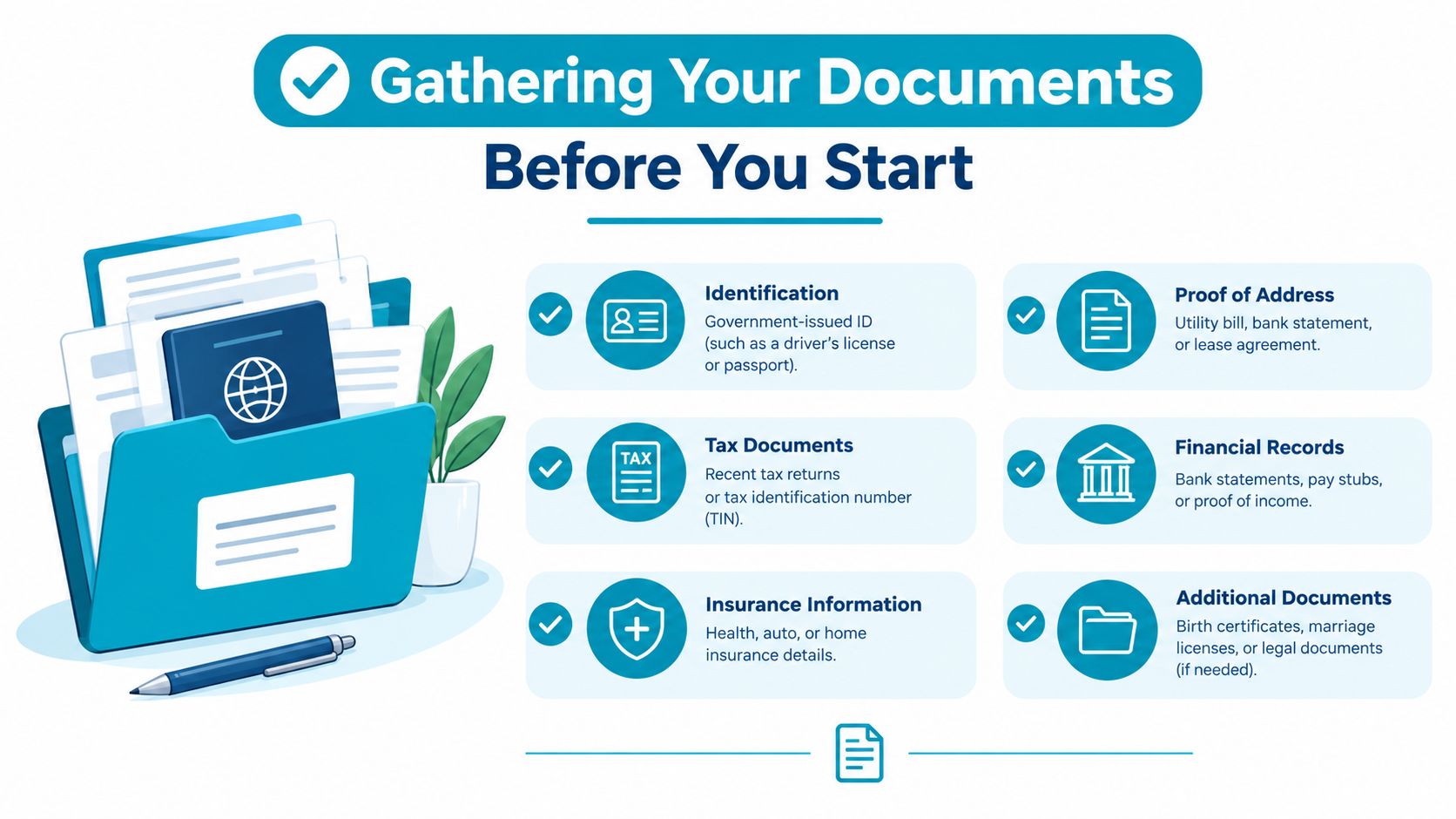
Prepare the intake information
Have these details ready:
- Identity details: Enter your legal name, current address, date of birth, and contact information exactly as shown in your records.
- Employment information: Record your employer's name, work status, occupation, and length of employment. If you are self-employed or work through several platforms, organize the details so your description stays consistent.
- Income figures: Identify the figure the form requests. Gross income means income before deductions, not the amount deposited into your account.
- Loan request: Choose the amount you need and the most accurate purpose listed. A larger request can reduce the quality of potential matches.
- Banking details: Keep your bank name and account information available if verification or deposit details require them. Enter these details only through the legitimate, secure form you selected.
Review this guide to applying for a personal loan online if you are unsure which information belongs in the first request.
Separate matching from underwriting
A marketplace intake gathers enough information to understand your request and identify possible lender fits. It is not the lender's final file. An intake may ask only for your employer name and monthly income figure. A lender may later request two recent pay stubs and 60 days of bank statements.
That distinction should control what you submit. Keep supporting records available, including pay documentation, bank statements, tax records, identity documents, and details about existing obligations. Send them only when a specific lender requests them through a secure channel.
The CFPB loan application packet guidance cited earlier helps explain common document categories, but its mortgage-oriented checklist does not mean every personal loan applicant must upload a complete packet at the marketplace stage. Use it to understand what a lender may eventually verify, not as a reason to disclose everything immediately.
Follow this rule: minimum necessary disclosure upfront, prompt verification later. Accurate initial information gives matching systems a usable profile, while delayed document sharing limits unnecessary exposure of sensitive data. Before submitting, review each field and check whether the next step involves a soft inquiry or a hard credit pull.
Navigating Common Fields and Strategic Entry
Your answers do more than fill empty boxes. They help determine how a marketplace and its participating lenders interpret your request. Accuracy gives you the widest legitimate matching opportunity. Guessing, rounding aggressively, or choosing an inaccurate purpose can send your application down the wrong path.
Complete personal and employment fields precisely
Use your legal identity information and a current address. A mismatch between your name, address, and verification records can create avoidable delays. If you recently moved, follow the form's instructions rather than substituting an old address just because it appears on a document.
Employment questions require the same discipline. Select the status that describes you. Full-time employment, part-time work, self-employment, contract work, retirement income, and benefits can be treated differently by lenders, so don't choose a more favorable category that isn't true.
Gig workers and self-employed applicants should report stable, documentable income rather than a particularly strong month. If your income comes from several sources, keep a simple record of each source and the period it covers. A lender may later verify the figure, and consistency between your application and supporting records is more useful than an optimistic estimate.
Report income in the requested format
Read the label carefully. Gross income generally means income before taxes and other deductions. Net income is what remains after deductions. If the form doesn't make the distinction clear, look for an explanation or contact the provider instead of entering a number based on guesswork.
Include only income you're permitted to report and can reasonably verify. Don't count borrowed money as income, and don't treat a one-time payment as recurring earnings unless the form specifically asks for it. The objective isn't to make your profile look impressive. It's to present a profile lenders can evaluate without finding contradictions later.
Make the request realistic
Choose the amount tied to a defined need. If you're consolidating debt, calculate the balances you intend to address. If the need is an auto repair or medical bill, use the actual expected cost where you know it. A larger request can change affordability and lender fit, while a smaller, well-supported request may be easier to evaluate.
The purpose field also matters. Select the closest truthful category rather than choosing an option because it sounds more acceptable. Lenders use purpose, amount, income, and other information together. Applicants with limited or damaged credit shouldn't disqualify themselves through careless entries. A marketplace may route requests to lenders that consider broader information than a traditional score alone, but it still needs clear, truthful data to do that.
The winning application isn't the one that says the most. It's the one that says exactly what the lender needs to assess the request.
Verifying Security and Electronic Consent
You shouldn't submit personal or banking information until you know who will receive it and how the platform handles it. A polished design proves very little. Check the web address, confirm that the connection is encrypted, and read the privacy and consent disclosures before entering sensitive details.
256-bit SSL encryption protects information while it travels between your browser and the website. In practical terms, it helps prevent outsiders from easily reading data in transit. It doesn't guarantee that a company is legitimate, and it doesn't mean every lender in a network will use identical practices. Encryption is one verification point, not a substitute for reviewing the company's identity and policies.

Inspect the page before submitting
Look for the browser's secure connection indicator and confirm that the address is spelled correctly. Be cautious if a page redirects unexpectedly, pressures you to pay an upfront fee to receive an offer, or asks for information unrelated to the request. A legitimate marketplace should explain whether it's a lender or a connector, identify the role of third-party lenders, and provide accessible privacy and advertising disclosures.
Electronic consent is normal in digital lending, but it's still a legal decision. By agreeing, you may authorize electronic delivery of notices, communications, disclosures, or signatures. Read the consent terms so you know what you're accepting, how to withdraw consent, and whether paper alternatives are available.
Review the electronic consent information before you click the final button. You should understand what communications may arrive electronically and what actions may be recorded as your approval.
Understand information sharing
The central privacy question is not only whether the form is encrypted. It's which parties may receive your information and for what purpose. Read the disclosure describing the lender network, marketing partners, verification providers, and communication permissions. If the disclosure is vague or impossible to find, stop and reassess.
A secure process should let you make an informed choice without hiding the material terms in dense, inaccessible pages. Save or download the disclosures you accept, note the date of submission, and retain copies of any offers. That record becomes valuable if the terms you later see differ from what you expected.
The Submission and Lender Matching Process
Clicking submit starts a sequence of checks, not a final approval. The marketplace receives the intake, validates whether the information is complete enough to process, and may evaluate the profile against criteria supplied by participating lenders. Potential matches can then contact you or present offers for your review.
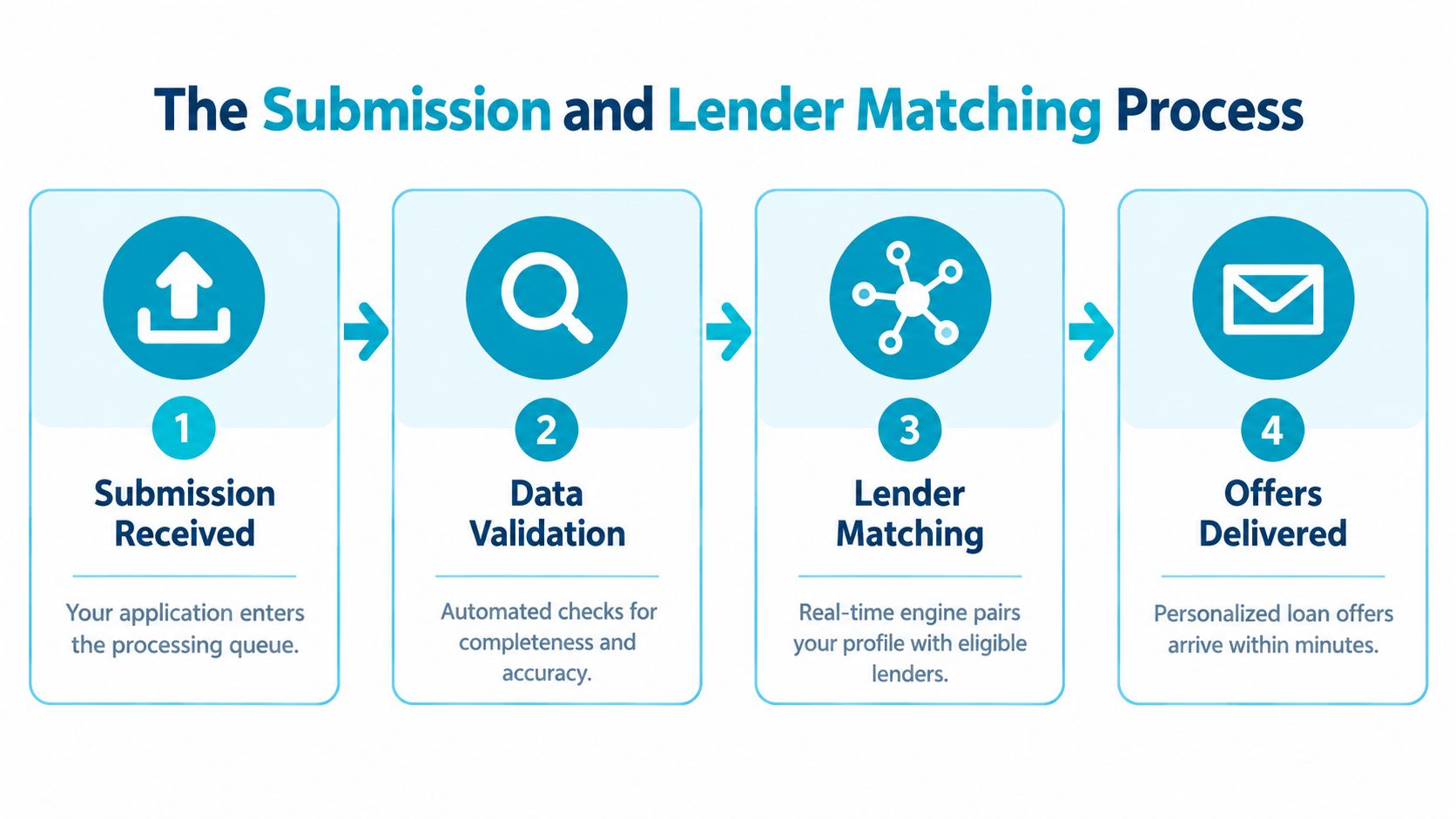
That model changes how you should shop. Instead of completing several near-identical forms, you submit one consistent request and assess the responses that appear. The quick credit connection process can help explain the distinction between submitting a request and receiving a lender's decision.
Know who makes the decision
The marketplace is a connector. Independent lenders decide whether to approve, what amount to offer, which fees apply, and how repayment will work. A match means a lender may be willing to consider your profile. It doesn't mean you're obligated to proceed, and it doesn't mean the marketplace has guaranteed a particular rate or funding date.
Credit inquiries deserve careful attention. A marketplace may not pull your credit itself, while a participating lender may check credit through a major or alternative bureau. Ask whether the initial review uses a soft inquiry and whether accepting a particular offer could lead to a hard inquiry. Don't assume every lender uses the same process.
Funding also depends on lender procedures, verification, approval, and your bank's processing. Direct deposit may be available as soon as the next business day in some circumstances, but you should treat that as a possibility, not a promise. Read the lender's funding disclosure and confirm the actual timing before relying on the money for a deadline.
Read the first response carefully
When an offer arrives, don't focus only on the approved amount. Check whether the lender is asking you to complete a separate application, upload documents, or authorize a credit check. The lender's terms become the relevant terms once you move beyond the marketplace introduction.
Keep your expectations practical. A clean submission can remove administrative delays, but it can't override affordability standards, verification results, credit history, or state-specific availability. Submit once with care, then let each lender explain the next required step.
Evaluating Offers and Protecting Your Rights
A submitted form doesn't lock you into the first lender response. It doesn't even require you to accept an offer. You remain responsible for deciding whether the proposed loan fits your budget and whether the cost is justified by the need.
Compare offers using the full terms, not the headline amount:
- Annual percentage rate: Review the APR, not only the nominal interest rate, because the APR can reflect certain borrowing costs.
- Repayment schedule: Confirm the payment amount, frequency, number of payments, and total repayment obligation.
- Fees: Look for origination charges, late fees, returned-payment fees, and any other listed cost.
- Funding conditions: Check what verification or documentation must be completed before money is sent.
- Consequences: Understand what happens if you pay late, refinance, or repay early.
If the payment would force you to miss rent, utilities, food, insurance, or existing debt payments, decline the offer. A lender's willingness to approve you doesn't establish that the loan is affordable. It only establishes that the lender has chosen to offer terms under its own standards.
You can decline an offer that doesn't fit. No approval is a command to borrow.
Be especially cautious when a short-term product solves today's problem by creating a larger repayment problem. Ask for the total cost in writing, verify the lender's identity, and don't sign electronic documents until every material term is clear. The marketplace introduces options, but you choose whether any option belongs in your financial plan.
NextStopLoans provides a secure online loan request form that sends consumer requests to a network of independent third-party lenders for potential matching. If you're ready to compare possible lender responses, visit NextStopLoans and review the disclosures before submitting accurate, prepared information.