
How to Get Debt Consolidation Loan: Steps and Costs

Search for how to get a debt consolidation loan and nearly every guide leads with the same advice: find a rate below your credit card rates, then enjoy the smaller monthly payment. The rate half is right. The payment half is where borrowers get hurt.
A monthly payment can be shrunk in two ways. One is a cheaper loan. The other is a longer one, and the second method works even when the rate is identical. Lenders quote the number people ask about, and that number can fall sharply while the total you hand over climbs.
So the order that protects you runs like this: inventory every debt, price the loan on total cost, screen the lender before sharing data, apply once, then close out the old accounts cleanly. Two things get tested before you sign anything, the arithmetic and your cash flow. Everything below is those two tests.
Table of Contents
- Check Whether Consolidation Fits Your Debt
- Compare Offers by Total Cost, Not Monthly Payment
- Spot Lenders and Scams Before You Share Data
- How to Apply for a Debt Consolidation Loan
- Pay Off Old Accounts Without Missing a Payment
- Decide Whether to Apply This Week
Check Whether Consolidation Fits Your Debt
A debt consolidation loan replaces several balances with one new installment loan, repaid on a fixed schedule. The process is straightforward; deciding whether it helps takes a little arithmetic. Start by listing what you owe and what each debt costs.
Household debt and credit-card balances are substantial, but that alone does not make consolidation a good fit. The CFPB guidance on consolidation offers explains why a new loan does not automatically lower costs. Approval, APR, fees, collateral, and repayment length all affect the outcome.
Start with the weighted-average APR
For each account, record the balance, APR, minimum payment, and remaining payoff period from your latest statement. Then calculate a weighted-average APR. It gives you a single benchmark for comparing the rates on your current debts with a possible new loan.
Suppose you owe $6,000 on a card at 22% and $3,000 on another at 15%. Multiply each balance by its rate, add the results, then divide by the total balance: ($6,000 × 22) + ($3,000 × 15) = 177,000; 177,000 ÷ $9,000 = 19.67%. That is the weighted-average APR.
Next, add the minimum payments. If one card requires $150 and the other $60, your current debts use $210 of your monthly cash flow. Compare that amount with a potential new payment to see whether consolidation would ease your monthly budget. A payment that fits is important, but it does not by itself show that the loan costs less overall.
Classify the balances too. Credit cards, medical bills, and personal loans are common consolidation candidates. A mortgage or auto loan is secured by property you may want to keep, so consider refinancing those debts separately rather than folding them into an unsecured loan.
| Item | Where to find it | Why it matters |
|---|---|---|
| Outstanding balance | Latest statement | Sets the total the new loan must cover |
| APR | Interest line on the statement | Drives the weighted-average APR calculation |
| Minimum payment | Payment due section | Shows how much monthly cash current debts use |
| Remaining payoff period | Statement or creditor app | Reveals whether the new loan extends repayment |
| Late fees and penalty history | Account history | Helps you identify account costs and payment issues |
Test the alternatives before you shop
A nonprofit credit counselor may help you consider a debt management plan based on the terms of your existing debts. A counselor can negotiate rates and fixed payments with creditors while you make one monthly deposit to the agency. This option adds no new credit, hard inquiry, or collateral. It may suit a household that regularly comes up short more than someone with one expensive balance and room in the budget.
The basic test is whether the new loan's APR is clearly below your weighted-average APR and whether its payment fits your budget on time, every time. Check both. If the rate is not lower, or the payment strains your cash flow, consolidation may rearrange the debt without making it easier to repay.
If your credit file is thin or includes recent late payments, review debt consolidation loan qualifications before applying. That can help you understand what lenders may consider as you assess whether a loan is a realistic option.
Compare Offers by Total Cost, Not Monthly Payment
A smaller monthly payment can make a loan cost more overall. For example, a hypothetical $10,000 balance at 12% APR over 36 months has a monthly payment of $332.14 and a total repayment of $11,957. Extend the same loan to 60 months and the payment falls to $222.44, but the total rises to $13,346. That is $110 less due each month in exchange for $1,389 more over the life of the loan.
| Option | Term | Extra cost |
|---|---|---|
| Shorter term at 12% APR | 36 months | Baseline ($332.14 a month, $11,957 total) |
| Longer term at 12% APR | 60 months | $1,389 more ($222.44 a month, $13,346 total) |
These figures are arithmetic for a hypothetical loan, not a lender quote. The principal and rate stay the same; only the repayment schedule changes. A lower payment may ease this month's budget, but a longer term can keep you in debt longer and increase the final bill. For a closer look at how loan terms affect repayment, read about debt consolidation loan terms.
Five checks in the order that matters
- Compare APR, not the advertised rate. APR includes origination fees and certain finance charges. A 9% loan with a 5% fee can cost more than a 10.5% loan with no fee, so ask for the APR in writing.
- Compare offers at the same term. A 36-month offer and a 60-month offer do not show which lender is cheaper on equal terms.
- Check the net proceeds. If you borrow $10,000 and pay $600 in fees, only $9,400 reaches your creditors while you repay $10,000. Confirm how much will be deposited or paid out.
- Confirm whether the rate is fixed for the full term, and check whether the contract allows it to reset.
- Review late fees and prepayment penalties. A fee for paying early can reduce the value of consolidating if you plan to clear the balance ahead of schedule.
Card rates make the comparison relevant, but the numbers need context. Average general-purpose credit-card purchase APRs were near 24.1% in 2025, and private-label APRs were around 31.3%, according to Federal Reserve data published by the Philadelphia Fed. The share of card balances at least 90 days delinquent reached 12.4% in Q3 2025, the highest since 2011. A 19% consolidation loan may reduce interest against a card at 24%, but a longer repayment term can give back part of that saving.
Before applying, test the proposed payment against your actual monthly cash flow. Keep room for essential bills and an emergency cushion; if the payment leaves no margin, a lower monthly figure may still be too costly for your budget.
The rule: consolidate only if the new loan's scheduled payments plus fees total less than the cost of keeping your current balances, and the payment fits your budget.
Spot Lenders and Scams Before You Share Data
Consolidation attracts fraud for a reason unrelated to the loan itself. It reaches people who are behind, motivated, and used to sending documents fast. The common opening is a promise that you're already approved, followed by a request for a few hundred dollars to access the money.
The moment to slow down is while you're still reading the offer.

The Federal Trade Commission's guide to getting out of debt draws the line in a useful place. Legitimate lenders disclose their fees clearly and generally deduct approved charges from the loan proceeds, or collect them after approval. Money demanded before approval, whatever it's called, is the signal.
Say a caller offers a $12,000 consolidation loan and wants a $600 insurance fee first. No version of that transaction needs your $600. Real charges come out of the loan or appear on the disclosure, and a legitimate lender can state the APR, the term and the total repayment before you send anything.
Checks to run before you share anything
- Verify the license with your state regulator. Look up the legal entity name in your state's licensing database, not the name in the text message.
- Read the privacy notice. It tells you who receives your information and what they can do with it.
- Get the APR, fees, repayment schedule and funding conditions in writing. If those four items stay vague while the questions get personal, end the conversation.
- Send the sensitive data last. Social Security, bank and income details come after the terms, never before.
One more distinction trips people up. Some consolidation loans are secured: a home equity loan or a title-backed product pledges your house or vehicle, and a stretch of missed payments can cost you the asset rather than a fee. An unsecured personal loan relies on your credit instead, which is why its rate leans so heavily on your file. On our side, one screen is geographic: customers must not be residents of any state where the loan they're applying for is illegal, so availability depends on where you live.
How to Apply for a Debt Consolidation Loan
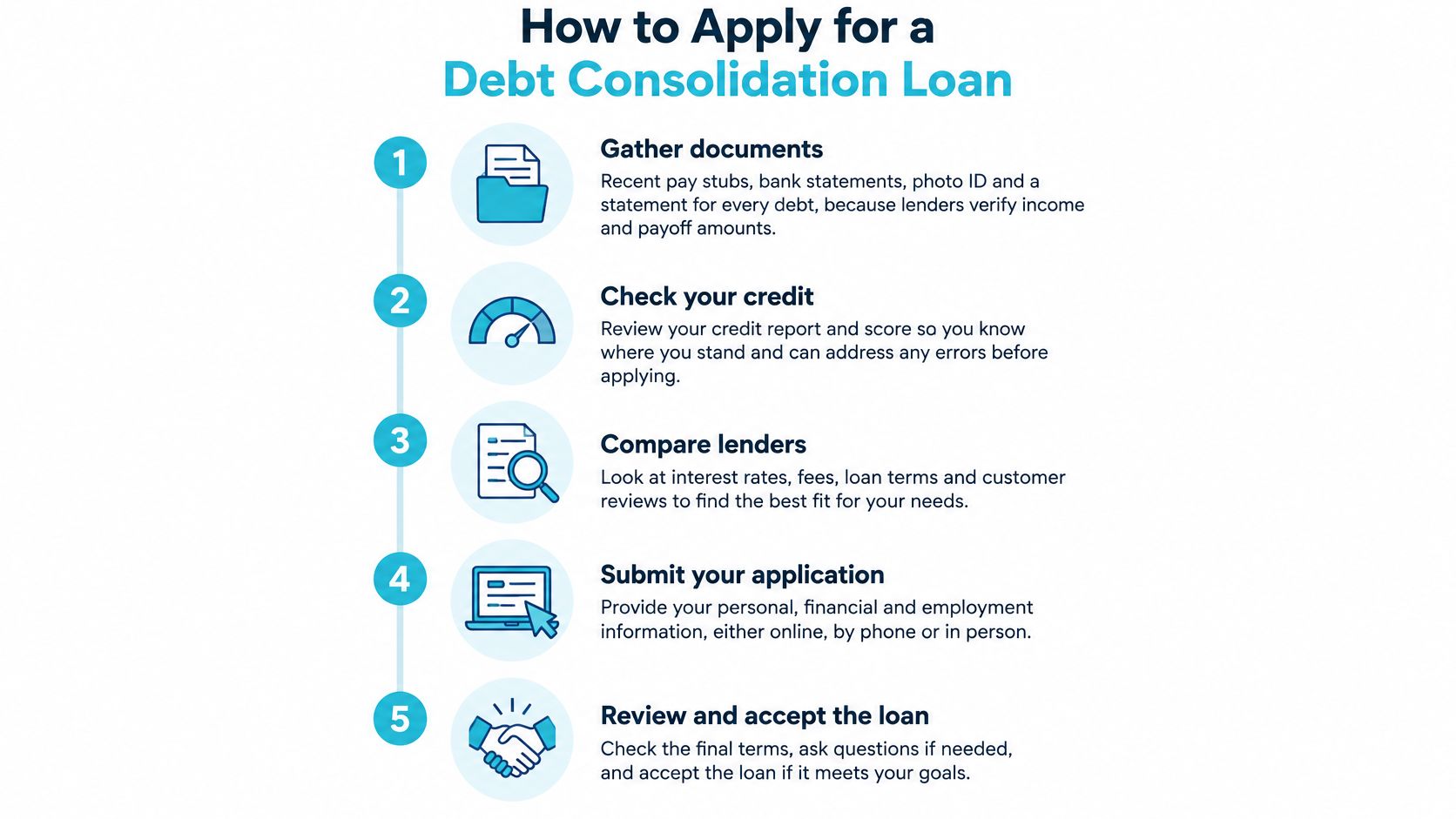
A lower payment does not automatically make a loan a better deal. Follow the steps in order, and pause to check that the terms fit both your debt and your budget.
- Gather relevant information. Have your income, employment, housing payment and debts in mind before you begin. A current statement for each debt helps you compare the payoff amount with a lender's offer.
- Check the basic requirements. To qualify for a personal loan through NextStopLoans, you must be at least 18, have a checking account, and be employed with regular income and a pay frequency. Other requirements can depend on the lender.
- Request a loan. The online form takes minutes and asks for the amount, some personal information, and where the funds should be deposited. Submitting a request does not guarantee approval.
- Compare the terms. Check the APR, fees, repayment schedule and total repayment, not just the monthly bill. A longer term can lower the payment while increasing the amount of interest paid, so test whether the payment fits your cash flow and whether the total cost makes sense.
- Submit one request at a time. Multiple inquiries to the Big 3 credit bureaus, Experian, Equifax and TransUnion, may lower your credit score. Registering for one loan at a time can help limit repeated inquiries.
- Agree to the terms by signing. Read the lender's offer and repayment schedule before you accept. A loan is accepted when you electronically sign the offer and send it back to the lender.
The process has three stages: request a loan, agree to terms, and get your money. The lender makes the decision and handles funding. For more detail on what to expect during an application, see this guide to the personal loan application process.
What underwriting looks at
Lenders can assess applicants differently. At year-end 2022, more than 31 million U.S. adults held personal loans totaling about $356 billion across 36.2 million accounts, and roughly 40% of those borrowers were nonprime, defined in the cited research as an Equifax Risk Score below 720, according to Federal Reserve research on the personal loan market. This range of borrowers helps explain why a lender may consider more than one factor when reviewing a request.
Prepare to answer questions about income, employment, housing payments and existing debt. Review the proposed payment against your monthly cash flow before signing. If a lower monthly payment comes with a longer repayment period, compare the total repayment with what you owe now before deciding whether consolidation will save you money.
Pay Off Old Accounts Without Missing a Payment
Approval is the midpoint. What decides whether consolidation worked is the two weeks after the money moves, and the first question is who pays your creditors.
The Consumer Financial Protection Bureau's guidance on consolidating credit card debt says to settle this before you accept: some lenders send funds directly to each creditor, while others deposit the money with you and leave the payoff in your hands. The two paths need different work, and only one of them removes the risk of the money going somewhere else first.
- Get written payoff figures with a good-through date. A balance printed three weeks ago isn't a payoff. Ask each creditor for the current payoff amount and the date it expires, then add a few dollars for daily interest.
- Pay the exact figure the day funds arrive if the money lands in your account, and save the confirmation number for each creditor.
- Keep paying every old account until it reports zero. This is the step people drop. One missed minimum in the gap damages the credit profile the loan was meant to protect.
- Set autopay on the new loan for a day or two after your pay date rather than on the due date, so a weekend or a payroll delay doesn't turn into a late fee.
- Check your credit reports 30 to 60 days later to confirm the old accounts show as paid or closed.
Read the rate clause, not just the payment. Some quoted rates are temporary pricing that lasts a limited period and rises afterward, so the fixed-rate question belongs in the contract rather than the sales call. A payment built on a rate that expires isn't a payment you can budget.
Miss a payment and the consequences are ordinary and expensive: late fees, referral to a collection agency, reporting to a consumer credit agency, and in some cases an offer to renew the loan with additional fees or interest. If you can't pay on time, call the lender before the due date rather than after. Early contact keeps options open, and silence closes them.
Decide Whether to Apply This Week
The deciding question isn't whether you can get approved. It's whether your budget can carry the new payment without reaching for a card in month three.
The trend suggests plenty of households can't. Aggregate U.S. credit-card balances reached about $1.2 trillion in Q3 2025 and had risen 14% over two years, according to the Federal Reserve's household credit and well-being report. Balances climbing that steadily point to budgets that don't balance every month rather than one-off emergencies. A consolidation loan simplifies the payment. It doesn't add income.
So run the subtraction. Monthly take-home pay, minus essentials like housing, food, transport, utilities and insurance, minus the new loan payment. If the remainder is thin or negative, consolidation relocates the debt and leaves you in the same place. Nonprofit credit counseling costs less than a loan and attacks the same problem from the other end.
Three actions if the surplus is positive
- Write the before-and-after budget and reserve the new payment before you sign, not after the first one clears.
- Decide what happens to the cards. Freeze them, lower the limits, or delete saved card details from your browser and phone. Reusing a paid-off card leaves you holding the installment loan plus a fresh revolving balance.
- Submit one request instead of five. NextStopLoans routes a single form to multiple independent lenders and works with lenders who handle every type of borrower, which beats repeating the same application across separate sites.
Submitting information online doesn't guarantee approval, and you're under no obligation to accept any offer that comes back. That's the whole point of comparing before you commit.
What evidence shows that my budget can support the new payment without borrowing again?
Answer that in writing, with the surplus number attached, and the decision makes itself.
NextStopLoans runs an online marketplace for borrowers who want to see consolidation offers without filling out the same form at five different lenders. Registering is free, and one secure request goes out to independent lenders who set their own terms, so you can weigh an offer against the arithmetic you've already done. Bring your debt inventory and your post-payment surplus, then visit NextStopLoans to see what comes back.