
Debt Consolidation Loan Qualifications Guide

Most advice about debt consolidation loan qualifications starts with the wrong question: “What credit score do I need?” A score matters, but it doesn't guarantee approval, a requested loan amount, or an affordable offer. Lenders care about whether your documented income can support every existing obligation plus the proposed payment, and whether the new loan actually improves your overall position.
A strong application is built on repayment capacity, accurate documentation, and sensible loan economics. A borrower with a higher score can still be declined because the requested amount pushes monthly obligations too high. Another borrower with damaged credit may receive an offer because the lender weighs income, liabilities, loan size, and other risk factors differently.
The practical objective is simple: calculate the math before applying, document the facts a lender will verify, and reject any offer that lowers the payment only by making the debt more expensive.
Table of Contents
- The Myth of the Universal Minimum Credit Score
- Core Underwriting Metrics Lenders Actually Evaluate
- Calculating and Optimizing Your Debt to Income Ratio
- Income Verification and Documentation Requirements
- Why Identical Applicants Get Different Approval Outcomes
- Navigating Options for Borrowers with Weaker Profiles
- Final Preparation Steps Before Submitting Your Request
The Myth of the Universal Minimum Credit Score
A credit-score cutoff can keep an application out of review, but it cannot prove that the loan will work. For debt consolidation loan qualifications, lenders assess whether your documented income can support the proposed payment alongside your existing obligations. They may review your credit reports, income, monthly debts, requested principal, repayment term, and applicable state requirements. See this CFPB guidance on how lenders evaluate loan applications for context on the underwriting process.
Published score thresholds are filters, not promises. Each lender sets its own approval rules and prices risk differently, so there is no universal minimum credit score, income level, or DTI limit for every unsecured personal loan. The same applicant can receive different results from different lender networks because their policies, verification methods, and acceptable risk levels differ.
What your score can and can't tell you
Your credit score condenses information from your credit file, including payment history, balances, account age, and recent credit activity. It does not show the full state of your cash flow. A strong score cannot offset a proposed payment that strains your income, unstable earnings, or liabilities reported inaccurately.
A lower score does not make approval impossible. It can produce a smaller offer, higher pricing, added documentation, or a request for a co-borrower or collateral. The lender still needs evidence that repayment is reasonable.
Practical rule: Treat a credit-score minimum as an entry condition, not an approval promise.
Stop applying by score alone
Review the information an underwriter will assess:
- Credit profile: Check payment history, outstanding balances, recent applications, and reporting errors.
- Income: Use stable, documentable gross income instead of an optimistic estimate.
- Liabilities: Include every recurring debt payment that may appear during credit or income verification.
- Loan request: Ask only for the amount needed to pay eligible debts and cover permitted fees.
- Repayment structure: Compare the monthly payment and total repayment, not only the advertised rate.
The math determines whether consolidation improves your position. A lower monthly payment may result from a longer term and a higher total cost, so compare both before accepting an offer.
If you have limited credit history rather than damaged credit, identify that difference before applying. This guide to no credit versus bad credit can help you choose an application strategy that matches the problem a lender must evaluate.
Core Underwriting Metrics Lenders Actually Evaluate
Lenders do not approve a debt consolidation loan because a score reaches an arbitrary threshold. They assess whether the proposed loan leaves enough income to cover every required payment. Debt-to-income ratio (DTI) is central because it connects recurring obligations with gross monthly income.
Calculate post-loan DTI by adding total recurring monthly debt payments, including the proposed consolidation payment, then dividing that sum by gross monthly income. Include obligations a lender is likely to verify, not only the balances you intend to consolidate.
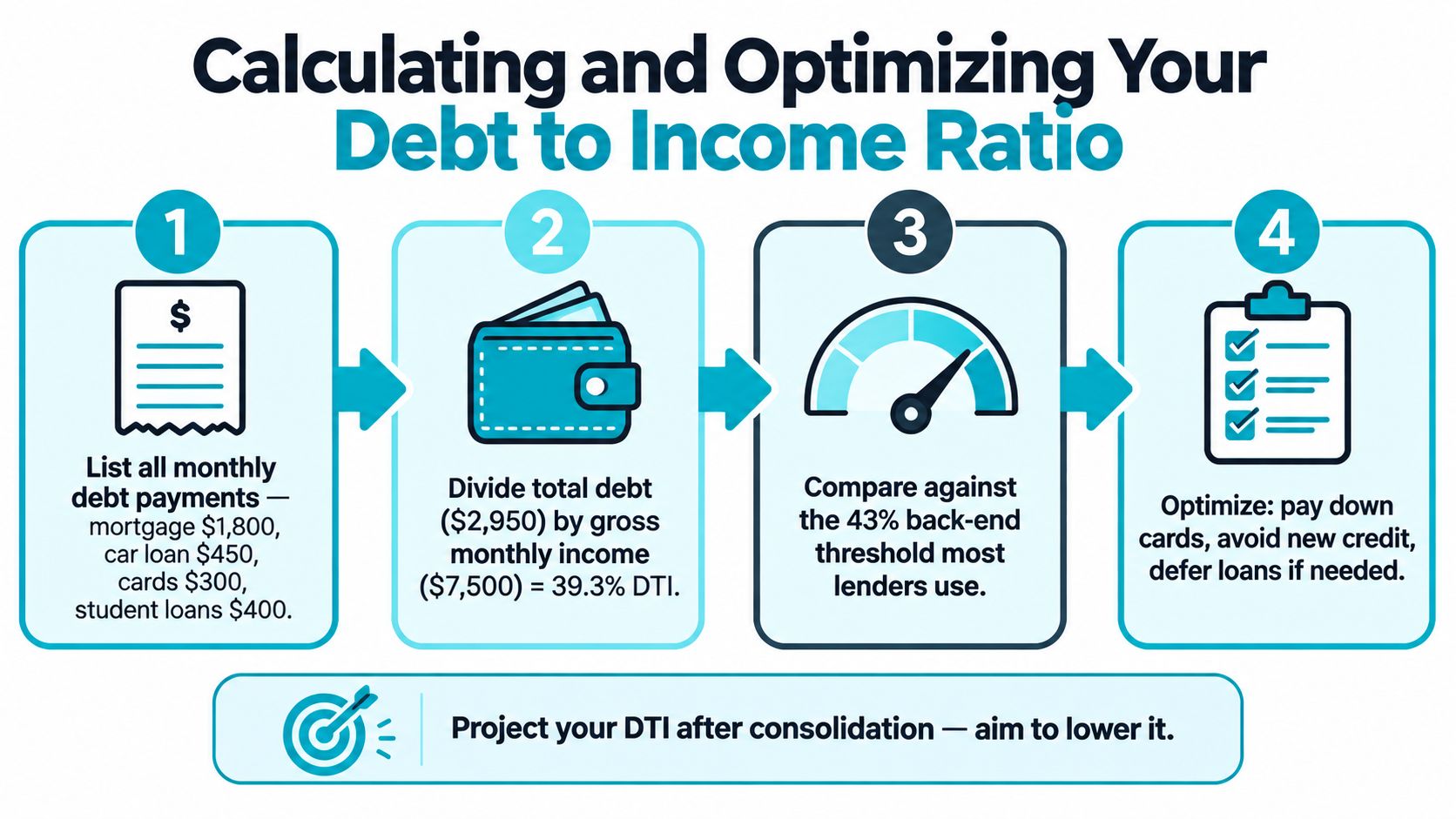
The numbers behind the decision
A clean credit history cannot compensate for a payment burden that leaves too little room in the budget. If current obligations already consume a large share of stable gross income, adding the consolidation payment can lead to a denial, a smaller approved principal, or higher pricing.
Income quality matters as much as income volume. Lenders may separate regular employment income from variable earnings, self-employment income, benefits, and deposits that do not clearly qualify. They can also verify employment continuity and request supporting documents before issuing final approval.
The requested principal and repayment term change the underwriting result. A larger balance generally produces a larger payment. A longer term can lower that payment while increasing total interest. Compare the monthly obligation with the total repayment, because the lender is evaluating the full transaction rather than your credit score alone.
Industry benchmarks provide context, not rules
Fannie Mae's mortgage underwriting framework sets a manual-underwriting benchmark of 36% DTI, rising to 45% when specified credit-score and reserve requirements are met. Its automated underwriting process can permit up to 50%, according to Fannie Mae's underwriting factors and documentation guidance. These are mortgage benchmarks, not personal-loan rules.
The practical lesson applies across loan types: strong income, reserves, credit history, and a smaller request can offset weakness in another area. A high DTI still limits approval and pricing options. Use these benchmarks as context, then calculate your own post-loan DTI and total borrowing cost before applying.
Calculating and Optimizing Your Debt to Income Ratio
Calculate your DTI before a lender does. You'll make better decisions when you know whether consolidation lowers the monthly burden or rearranges the balances.
Begin with a complete liability list. Include mortgage or rent-related obligations that the lender counts, auto loans, installment debts, minimum credit-card payments, student-loan payments, co-signed accounts, and personally guaranteed business debt. Then add the estimated consolidation payment based on a real offer or a conservative payment range.
Run the calculation twice
Use this sequence:
- Add recurring monthly debt payments. Don't omit a payment because it's small, shared, or tied to a business. If you're personally responsible, assume the lender may count it.
- Divide by gross monthly income. Use income that you can document and that the lender is likely to recognize.
- Add the proposed consolidation payment. Calculate the post-loan figure, not only your current DTI.
- Compare the result with your budget. A lender's approval doesn't make a payment affordable. Leave room for housing, food, insurance, utilities, and irregular costs.
- Test the loan's total economics. Compare APR, fees, monthly payment, and total repayment amount.
A consolidation loan improves qualification only when it replaces debts with equal or higher monthly payments. If the new payment is lower solely because the repayment term is extended, your DTI may improve while your total interest cost rises. If the old balances remain open and you continue borrowing, the loan may worsen your financial position.
A lower payment is useful only when it creates sustainable cash-flow relief without hiding a more expensive repayment plan.
Build a repayment comparison
Create a simple side-by-side worksheet:
| Measure | Existing debts | Proposed consolidation |
|---|---|---|
| Monthly payments | Add every recurring obligation being replaced | Add the new required payment |
| Interest cost | Review each account's current pricing | Calculate interest across the full term |
| Fees | Identify any account or payoff costs | Include origination and other lender fees |
| Balance behavior | Revolving balances may remain available | Installment balance follows a fixed schedule |
| Risk after closing | New charges can recreate the problem | Spending must stay below available cash flow |
Your personal loan eligibility checklist should support this process, but don't outsource the calculation. You know your complete household budget better than any application form.
Income Verification and Documentation Requirements
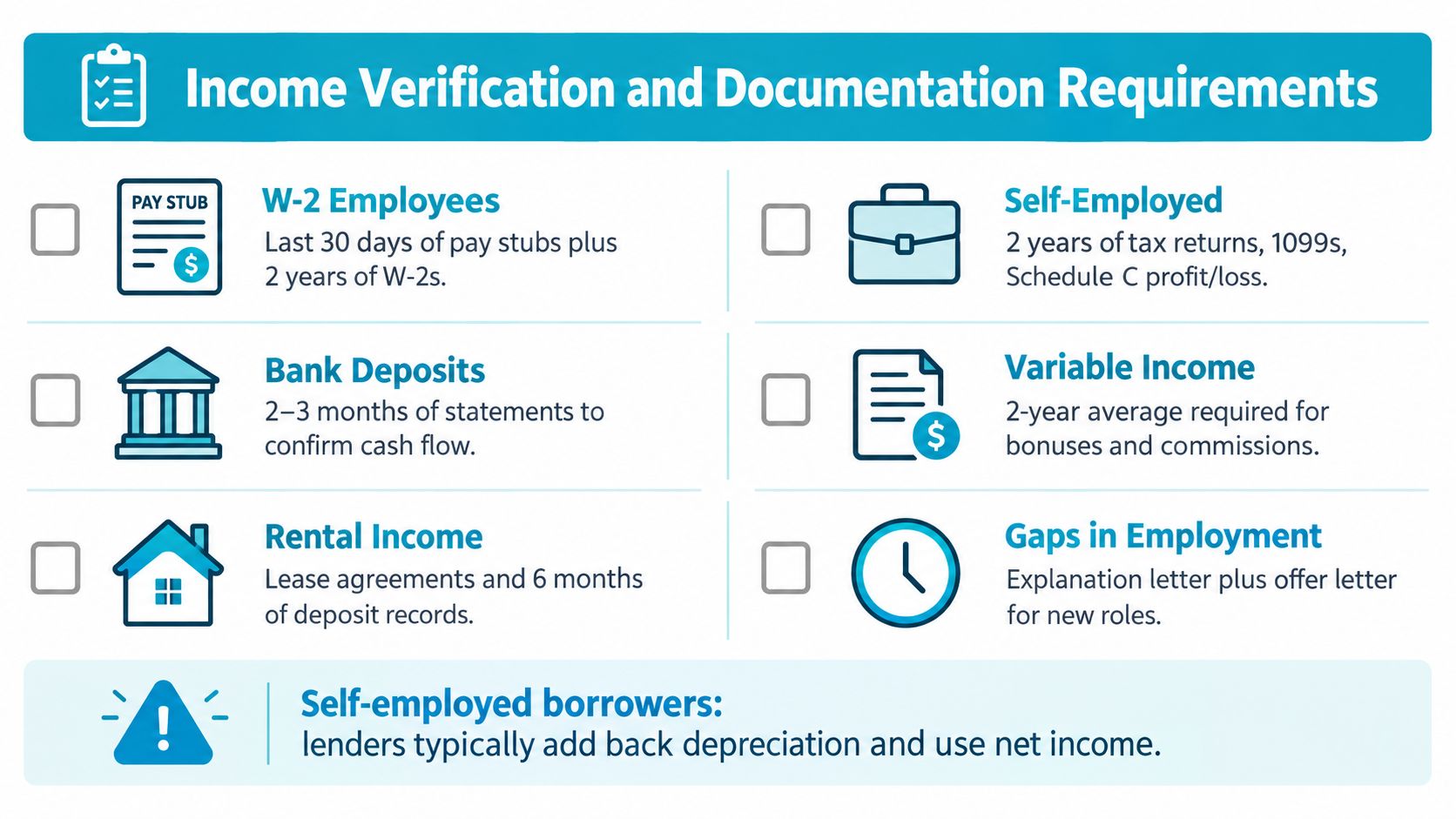
A low DTI won't help if the lender can't verify the income behind it. Underwriting depends on evidence, and the evidence must show both the amount and the reliability of your earnings.
Employees usually have a clearer paper trail, but lenders can still request additional information when deposits, employment dates, or stated income don't line up. Self-employed applicants and gig workers face a more detailed review because gross deposits may not equal qualifying income after business expenses and deductions.
Document the entire financial picture
Prepare these records before you apply:
- Income proof: Gather recent pay records, tax returns, benefit statements, or other documents that establish regular income.
- Self-employment records: Keep business tax filings, profit-and-loss information, and evidence that earnings are continuing.
- Bank statements: Use them to explain recurring deposits and distinguish personal income from transfers or business revenue.
- Debt statements: Record current balances, payoff amounts, minimum payments, and account numbers for every debt under consideration.
- Co-borrower information: Expect the lender to review the co-borrower's income and liabilities, not just their credit score.
Don't hide obligations by accident
Fannie Mae's guidance on underwriting self-employed borrowers requires business debt for which a borrower is personally obligated to be included in total monthly obligations when calculating DTI. The same analytical principle applies to consolidation applications.
Personally guaranteed business loans, installment debts, minimum card payments, and co-signed obligations can all affect the lender's calculation. Excluding them may understate your DTI and lead to re-verification, a reduced approval amount, or denial.
Variable income needs an explanation
Multiple jobs, gig work, commissions, and benefits may be usable, but the lender decides how to define and verify them. Irregular deposits don't automatically prove stable income. The underwriter may examine continuity, tax records, bank statements, and the relationship between reported income and recurring obligations.
Answer income questions consistently across the application and supporting documents. A mismatch between stated income and verified income is more damaging than a conservative, accurate estimate. If a lender permits a co-borrower, ask how it treats both applicants' income, debts, and responsibility for existing accounts before submitting.
Why Identical Applicants Get Different Approval Outcomes
Two applicants can have similar scores, income, and debt balances and still receive different decisions. The reason is that lenders don't use one shared underwriting formula. Each lender decides how to weigh risk, what documentation it accepts, which loan purposes it supports, and how much it's willing to lend.
One lender may place heavy weight on income stability. Another may focus more on DTI, payment history, recent applications, employment, loan purpose, or the requested amount. A lender may also calculate qualifying income or recurring obligations differently from its competitors.
The same profile can produce different offers
Consider two outcomes for the same applicant. Lender A might decline because the requested principal creates too much monthly exposure. Lender B might approve a smaller amount because its policy handles the applicant's income type differently. Neither decision proves that the borrower is generally creditworthy or uncreditworthy. It shows that the transaction fits one lender's model better than another's.
Federal Reserve survey data show that among U.S. adults who applied for credit in 2025, one-third were denied or approved for less credit than requested, which was five percentage points higher than in 2021, according to the Federal Reserve's household credit report. That context makes a partial approval important to interpret. The lender may be limiting exposure rather than rejecting your entire financial profile.
Eligibility isn't affordability
An approval is only an invitation to review terms. It doesn't prove the loan will lower your interest cost, improve your cash flow, or help you eliminate debt.
Compare offers using these tests:
- Payment test: Does the new required payment fit your budget after all recurring obligations?
- APR test: Is the rate appropriate relative to the debts being replaced?
- Total-cost test: How much will you repay after interest and fees?
- Behavior test: Can you keep paid-off revolving accounts from creating new balances?
- Purpose test: Will every dollar pay eligible debt, or will some funds disappear into general spending?
Shopping across compatible lenders is therefore a mathematical necessity. It lets you compare how different underwriting policies treat your actual profile, but you should avoid submitting unnecessary full applications until you understand whether the inquiry will be hard or soft and what documentation the lender requires.
Navigating Options for Borrowers with Weaker Profiles
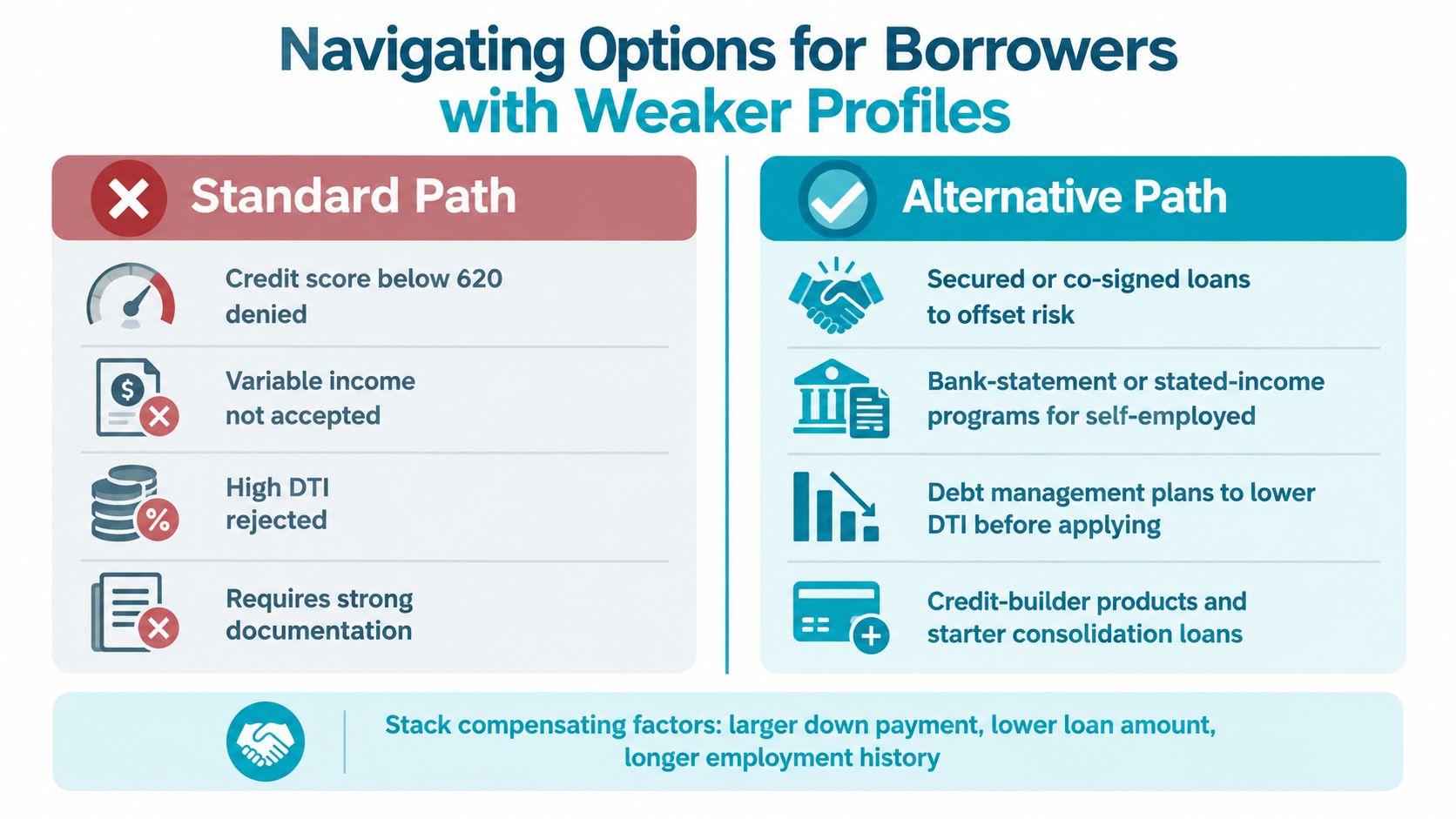
Borrowers with low or damaged credit need more than a score threshold. They need a lender that can evaluate documented income, recurring obligations, requested amount, and compensating factors without assuming that a weaker score tells the whole story.
In the first quarter of 2025, 23.9% of U.S. adults with a credit record had a score below 660. In low-income areas of the Federal Reserve's Eighth District, the share reached 53.2%, according to the St. Louis Fed's discussion of lower-income households' credit journeys. Those figures describe a broad borrower population, not an automatic approval path.
Ask the questions standard forms skip
Gig income, benefits, and multiple jobs may count, but each lender sets its own verification rules. Ask how the lender defines qualifying income, whether it requires a history of receiving that income, and which documents it accepts.
A new inquiry or account can affect an application, depending on the lender's process and the applicant's broader credit profile. Don't assume that a prequalification result and a final underwriting decision use identical checks.
Debt type matters too. Unsecured revolving debt may fit a consolidation plan more naturally than secured debt, where the collateral and existing contract create separate risks. Delinquent student loans, medical balances, buy-now-pay-later accounts, and secured obligations should be reviewed individually. Consolidating a balance is not automatically beneficial if the new loan costs more or fails to address the reason the account became delinquent.
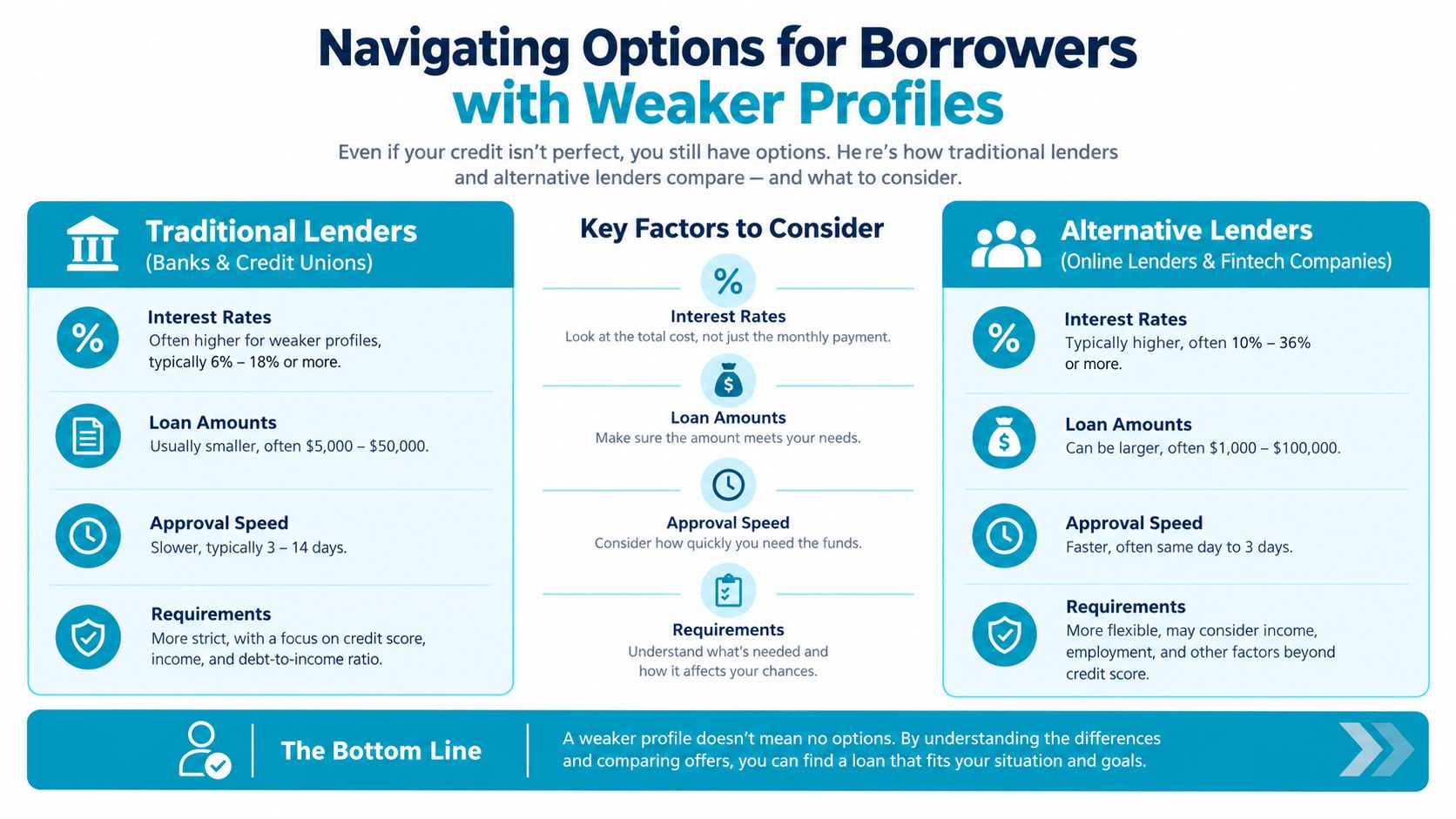
Use marketplace routing carefully
A marketplace can reduce repetitive searching by collecting one secure request and routing it to independent third-party lenders. That can be useful when a single-lender search would miss lenders with different policies for non-prime credit, variable income, or smaller loan amounts.
NextStopLoans operates as a connector rather than a lender. Its online request process submits consumer information to a network of independent lenders, while those lenders make the decisions, set the terms, and handle funding. Review each offer's APR, fees, payment, term, and total repayment before accepting anything. The debt consolidation loans for bad credit guidance can help you frame the comparison, but it shouldn't replace your own budget analysis.
Final Preparation Steps Before Submitting Your Request
Treat the application like an underwriting file, not a quick form. Accuracy gives the lender a clear risk picture and prevents avoidable delays.
Use this final checklist:
- Recalculate post-loan DTI. Include every recurring debt and the proposed payment, using documentable gross income.
- Gather verification records. Prepare income documents, tax records where relevant, bank statements, creditor statements, balances, and minimum payments.
- Confirm the requested amount. Borrow only what's needed for eligible payoffs and permitted costs.
- Compare total economics. Review APR, fees, monthly payment, repayment term, and total repayment amount.
- Ask about payoff mechanics. Confirm whether the lender pays creditors directly or sends funds to you.
- Check the debt list. Decide whether each balance is efficient to consolidate, especially delinquent, secured, or contract-specific debt.
- Review the offer calmly. Approval is not a reason to accept unfavorable terms.
A complete file can't guarantee approval, but an incomplete or inconsistent file can create problems that have nothing to do with your underlying ability to repay. Submit only after the numbers work under your actual monthly budget.
NextStopLoans provides a secure online request process that can route a debt-consolidation request to independent third-party lenders for consideration. Visit NextStopLoans to submit your information, then compare any available offers by payment, APR, fees, term, and total repayment before accepting.