
Debt Consolidation Loan Terms: A Complete Guide

You're at the kitchen table with several balances, several due dates, and two consolidation offers that appear to tell opposite stories. One promises a lower monthly payment. The other advertises a lower APR. Both sound helpful, yet either one could cost more over time if the debt consolidation loan terms are wrong for your situation.
Debt consolidation isn't debt forgiveness. It's a mathematical restructuring, usually through a fixed-term personal loan that pays off multiple revolving or unsecured balances. The new payment may be easier to manage, but the question is whether the loan lowers your total cost after fees, interest, and the full repayment period.
Table of Contents
- Understanding Debt Consolidation Loan Terms
- Decoding Interest Rates and Hidden Fees
- Choosing the Right Repayment Term Length
- Evaluating Collateral Requirements and Credit Impact
- Calculating the Break-Even Math
- Navigating Loan Marketplaces and Comparing Offers
- Final Verification Before Accepting an Offer
Understanding Debt Consolidation Loan Terms

A debt consolidation loan replaces several debts with one installment account. Instead of sending separate payments to credit-card issuers or other creditors, you borrow enough to pay those balances and then repay the new lender under one fixed schedule. The structure creates a clear end date, but it doesn't automatically produce savings.
Most consolidation loans in major markets use fixed-term personal-loan structures. Common repayment windows range from 12 to 84 months, or 1 to 7 years, with frequently offered bands of 24, 36, 60, and 84 months, as described in this overview of debt consolidation loan structures. A shorter term generally raises the required monthly payment while reducing the time interest accrues. A longer term usually reduces the monthly bill but keeps the balance outstanding for more years.
The payment is only one part of the offer
Suppose one lender offers a smaller payment because the loan runs for many years. That may solve an immediate cash-flow problem, but it can also increase the total interest you pay. Another lender may offer a larger payment with a shorter payoff period and a lower overall cost.
The right comparison includes:
- APR: The annualized cost of borrowing, including qualifying charges.
- Loan term: The number of months until the scheduled final payment.
- Net proceeds: The amount you receive after any upfront fee.
- Total repayment: The sum of all scheduled payments over the loan's life.
- Payment risk: Whether the required payment fits your budget in an ordinary month, not just an unusually good one.
Practical rule: A lower monthly payment is a cash-flow result, not proof of a financial benefit.
Read the agreement before comparing offers. Look for the amount financed, the APR, the payment schedule, the first due date, late charges, insufficient-funds fees, and any prepayment language. Marketing copy highlights the attractive number. The disclosure tells you what the loan costs.
Decoding Interest Rates and Hidden Fees
The interest rate and APR answer different questions. The interest rate describes the rate used to calculate interest on the outstanding balance. The APR is designed to express the yearly borrowing cost more completely by incorporating certain finance charges, such as an origination fee.
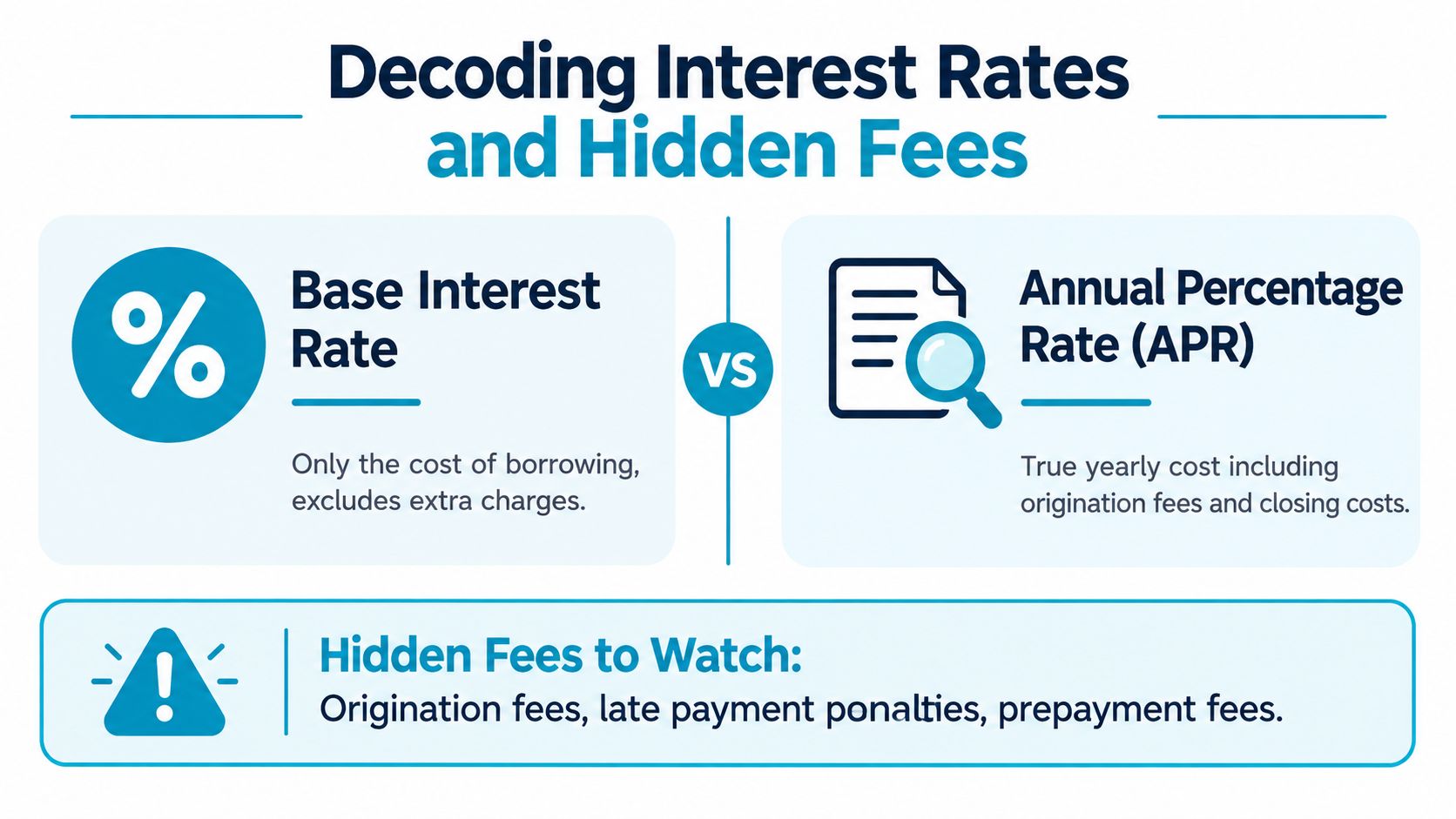
A lender might advertise a rate that looks competitive, while an origination fee reduces the money available to pay your creditors. For example, if the contract states that the loan amount is $15,000 and the lender deducts a fee before disbursement, you may receive less than $15,000 while still owing according to the full repayment schedule. The exact deduction must come from the offer disclosure, not from an assumption.
APR varies sharply by credit tier
Debt consolidation pricing is highly credit-sensitive. LendingTree's 2026 user-data snapshot reports average APRs of 14.95% for excellent credit, 17.08% for very good credit, 22.56% for good credit, 27.35% for fair credit, and 30.45% for poor credit, based on typical loan amounts from $5,000 to $54,999 and repayment terms from 36 to 83 months. You can review the underlying LendingTree consolidation-loan rate data.
That spread matters because the same loan purpose can produce very different economics. A borrower with excellent credit may qualify for a rate that makes a shorter term attractive. A borrower with fair or poor credit may face a payment that looks manageable only after extending the term, while total interest continues to grow.
Product-level offers can range from roughly 5.96% to 35.99% APR, with terms commonly spanning 2 to 7 years and origination fees reaching about 1% to 9.99% on some offers, according to LendingTree's debt-consolidation marketplace analysis. Those are broad market ranges, not a promise of what you'll receive.
Fees can erase a rate advantage
Check every charge that affects the net cost:
- Origination fee: Often deducted from the proceeds before funding.
- Late fee: Charged when a payment arrives after the lender's permitted window.
- Insufficient-funds fee: Applied when an automatic payment fails.
- Prepayment penalty: A charge for paying the balance early, if the contract permits one.
- Optional discounts: A lower rate may depend on automatic payments or another condition.
Before applying, review the rates and fees information and then compare it with the final lender disclosure. Don't evaluate a loan using the advertised interest rate alone. Evaluate the cash you receive, the payments you'll make, and the total amount required to close the account.
Choosing the Right Repayment Term Length
The loan term controls the tension between monthly affordability and total cost. A 24-month loan attacks principal quickly but demands more room in the monthly budget. A 60-month loan spreads the same balance across more payments, which may protect cash flow but gives interest more time to accumulate.
The table below uses the requested illustration of a $15,000 loan at 18% APR. The figures are amortization estimates based on monthly payments and exclude fees, so the lender's disclosure remains authoritative.
| Loan Term | Monthly Payment | Total Interest Paid | Total Repayment Amount |
|---|---|---|---|
| 24 months | $749.10 | $2,978.40 | $17,978.40 |
| 36 months | $542.30 | $4,522.80 | $19,522.80 |
| 60 months | $380.96 | $7,857.60 | $22,857.60 |
| 84 months | $321.11 | $11,973.24 | $26,973.24 |
The payment drops as the term lengthens, but the total repayment rises substantially. That's the long-tail problem. A payment that feels comfortable today can remain in your budget long after the immediate crisis has passed.
Use affordability as a guardrail, not an excuse
Choose the shortest term you can sustain without missing payments or sacrificing essential expenses. A shorter term is not automatically wise if it forces you to rely on credit cards again. Replacing one debt with a new loan while creating fresh revolving balances defeats the purpose.
A sensible decision process looks like this:
- Set the maximum reliable payment. Use ordinary income and ordinary expenses.
- Compare the shortest affordable term. Don't begin with the lowest advertised payment.
- Check total repayment. Include interest and every disclosed fee.
- Stress-test the budget. Ask whether the payment still works after a routine repair, bill increase, or income disruption.
- Reject artificial comfort. If the only affordable option is a very long term at a high APR, consolidation may not save money.
For strong-credit borrowers, shorter terms often carry the most attractive pricing, while weaker-credit borrowers may need to balance total interest against payment stability. The best term is the one that you can pay consistently and that produces a clear cost advantage.
Evaluating Collateral Requirements and Credit Impact
Most personal debt consolidation loans are unsecured, which means the lender approves the loan based on your credit profile, income, existing obligations, and other underwriting factors. You don't pledge a home or vehicle directly to support the balance.
A secured loan works differently. Home-equity borrowing, auto-secured lending, and title loans attach the debt to an asset. The lender may offer different pricing because collateral provides a recovery path, but the borrower accepts a more serious consequence if payments stop. Failure to repay can place the pledged asset at risk.
Apply with a clear credit-pull plan
The application process usually has two distinct stages:
- Initial shopping: A marketplace or lender may use a soft inquiry to assess potential eligibility. A soft inquiry generally isn't treated like a full application for scoring purposes.
- Final underwriting: The lender you choose may conduct a hard inquiry before approving and pricing the loan.
Ask which type of inquiry applies before submitting personal information. A final hard pull can create a short-term score impact, and opening a new account can change the age and composition of your credit profile.
After funding, the credit effect depends heavily on account management. Paying off revolving balances can reduce utilization, while on-time installments can build a positive payment record. Those benefits only materialize if you keep the new loan current and avoid rebuilding the balances you just paid off.
Don't pledge an asset casually
An unsecured loan may carry a higher rate than a secured alternative because the lender has no collateral. That doesn't make a secured loan automatically better. Losing a vehicle needed for work or putting housing at risk can be far more damaging than accepting a higher unsecured borrowing cost.
Before choosing collateral-backed borrowing, compare the rate reduction with the asset risk, the repayment term, and your ability to handle income disruption. The secured-loan information from NextStopLoans can help you understand the basic structure, but the matched lender's agreement determines the actual collateral and default provisions.
Calculating the Break-Even Math
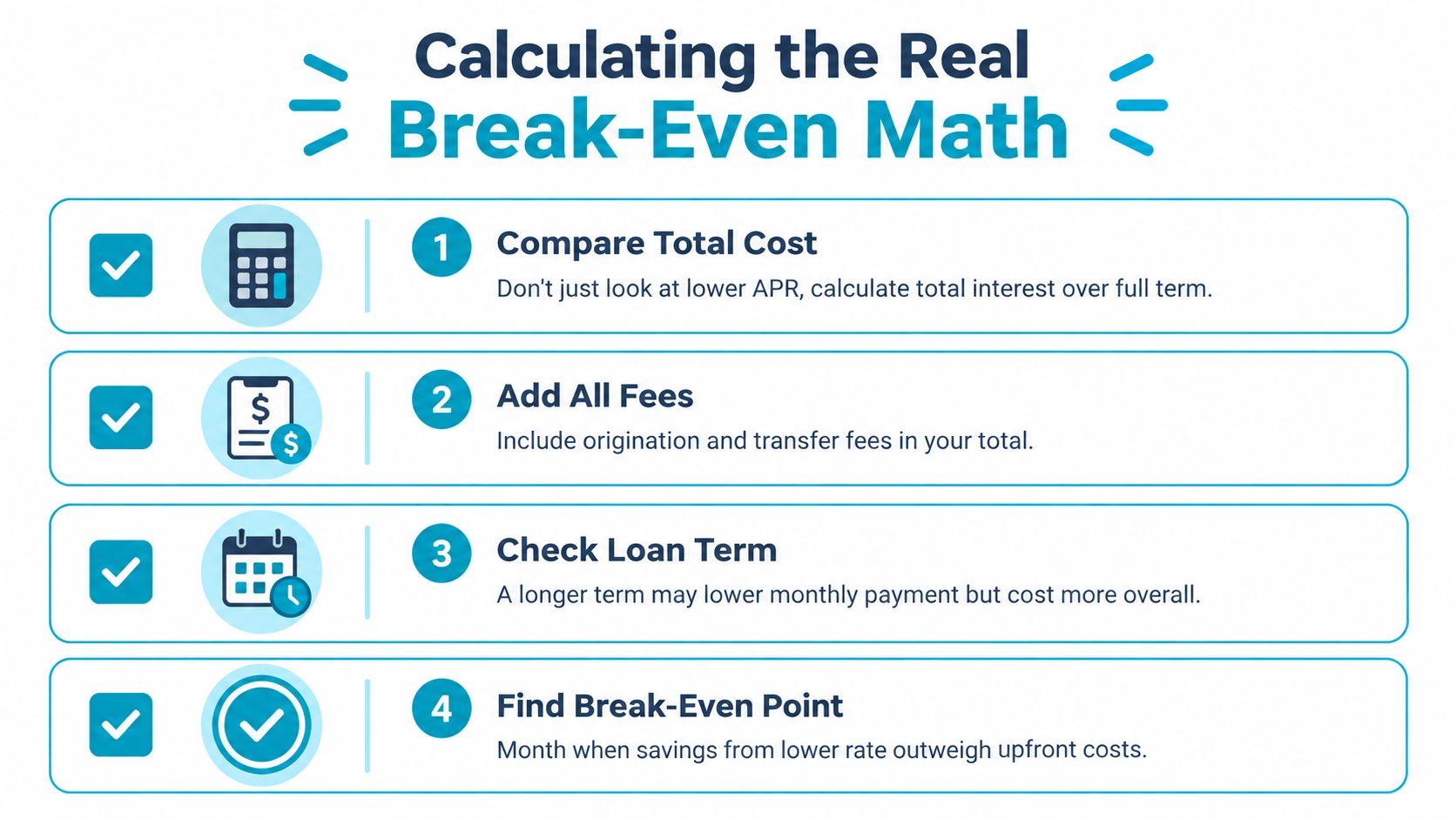
A lower APR does not automatically reduce your cost. Consolidation helps only when the new loan costs less than keeping the existing debts, after origination fees and across the repayment periods you will use.
List every debt you plan to consolidate. Record its balance, APR, minimum payment, and current payoff method. Then calculate a weighted average APR, giving each rate weight according to its balance. A high-rate balance should affect the comparison more than a small balance carrying a lower rate.
Use four figures, not one
Compare these four totals:
- Current debt cost: Estimate the total interest and charges under your present repayment plan. If you are using minimum payments, rely on lender statements and stated payment assumptions instead of assuming the balances will disappear quickly.
- New loan payments: Multiply the scheduled payment by the number of payments, then add charges that the stated payment does not already include.
- Origination adjustment: Subtract the upfront fee from the funds available to pay creditors. If the net proceeds do not cover the balances, you may need additional borrowing.
- Net savings: Subtract the new loan's total repayment and fees from the cost of keeping the old debts.
A modestly lower APR can still produce no savings. A fee taken at closing reduces the amount applied to your balances, and a longer term gives interest more months to accumulate. You may receive a lower monthly payment while paying nearly as much, or more, over the full schedule.
Find the break-even point
If the upfront fee exceeds the monthly interest savings, calculate the month when those accumulated savings recover the fee. A break-even month close to the end of the repayment schedule leaves little margin for error. Refinancing, a missed payment, or paying off the loan early could erase the projected benefit.
The offer earns its place only when the lower cost survives the fee, term, and payment test together.
Credit-tier pricing makes this review especially important for borrowers who fall between preferred categories. LendingTree's published averages place good-credit borrowers at 22.56% APR and very-good-credit borrowers at 17.08% APR, so either label can still produce a costly offer. Compare the actual disclosure with your weighted current rate, not with the lender's headline range.
Navigating Loan Marketplaces and Comparing Offers
A lending marketplace can reduce the work of collecting potential offers. Instead of completing a separate request with every lender, you submit one secure intake form that may route your information to participating independent lenders. The marketplace connects the request. It doesn't make the final credit decision or set the loan terms.
Follow a controlled shopping process
Begin by gathering the information every lender will need, including the amount required to clear the existing balances, income details, housing costs, and creditor information. Enter it consistently so that differences between offers reflect underwriting and pricing rather than conflicting application data.
Then inspect each result for:
- APR and interest rate: Use APR for the broad cost comparison.
- Term and payment: Confirm the number of payments and the scheduled due date.
- Net funding: Check whether fees reduce the proceeds.
- Lender identity: Read the actual agreement from the lender making the offer.
- Funding conditions: Confirm whether verification, electronic signatures, or bank-account requirements apply.
The marketplace itself may not pull credit, but participating lenders can review credit through major or alternative bureaus. Ask whether a result is a preliminary indication or a firm offer requiring a hard inquiry.
NextStopLoans operates as an online connector that routes consumer loan requests to independent third-party lenders. Its quick credit request process can present potential options, but the lender's disclosure controls the APR, fees, term, approval, and funding decision.
You're not obligated to accept an offer. If none passes the break-even test, decline them and keep working on the existing balances or consult a qualified credit counselor.
Final Verification Before Accepting an Offer
A consolidation loan deserves a final review before you sign, even if the payment looks comfortable. The last disclosure is where you confirm whether the offer solves the problem or rearranges it.
Run this acceptance checklist
- Confirm the net amount: Verify the exact funds you'll receive after origination fees and other deductions. Make sure that amount is enough to pay the balances you intend to close.
- Recalculate the total: Multiply the scheduled payment by the full number of payments and add charges that aren't already included. Compare that figure with the cost of keeping the current debts.
- Read the APR definition: Confirm the APR, not just the base interest rate, and check whether an automatic-payment discount can disappear.
- Check the first due date: Make sure the first payment fits your income cycle and that automatic payments will draw from the correct account.
- Review early payoff language: Look for a prepayment penalty or any charge that would discourage you from paying ahead.
- Verify creditor payments: If the lender pays creditors directly, confirm which accounts receive funds and when. If you receive the money, send payments promptly and retain confirmations.
A low payment is acceptable only when you know what it costs, when it ends, and what happens if your circumstances change.
Consolidation also creates a behavioral test. Paying off credit cards doesn't remove the spending problem if you immediately use those cards again. Keep paid accounts under control, remove them from routine purchases, and direct the former debt payments toward the new installment balance.
Reject the offer if the APR is too close to your current weighted rate, fees consume the expected savings, or the term stretches repayment without a defensible cash-flow reason. Accept only when the payment is sustainable, the net funding is accurate, and the full-cost comparison shows a meaningful advantage.
NextStopLoans lets you submit one secure loan request that may be evaluated by independent lenders offering personal loans for debt consolidation, subject to their approval and terms. Visit NextStopLoans to compare potential options, then apply the break-even checklist before accepting anything.