
How Do I Get a Cash Advance? Steps, Costs and Options

The alternator dies on a Tuesday. The shop quotes $400 to replace it, the car is already on the lift, and your checking account won't see another deposit until Friday. You have a credit card in your wallet, a lender's app on your phone, and about ten minutes to decide.
The search how do I get a cash advance usually ends on an application page. The application is the easy part. The decision that matters is which route gets you to Friday without turning $400 into $700 over the next two months.
Start with the amount you need, not the amount a lender will let you borrow. A $400 repair is a $400 problem. Rounding up to $600 because the form offers it adds fees to money you didn't need.
Table of Contents
- Cash Advance Options and Cheaper Fixes First
- What a Cash Advance Really Costs
- Avoiding the Rollover Trap When Repayment Is Due
- Check the Terms Before You Sign an Advance
- How to Apply for a Cash Advance Step by Step
Cash Advance Options and Cheaper Fixes First
Say the repair bill is $400 and payday is nine days away. The fastest route is rarely the cheapest one, and the cheapest route is rarely advertised. The six options below cover most of what's available before your next paycheck. None is free. The differences are speed, the credit check, and what happens when the due date arrives.
| Option | Typical cost | Speed | Credit check | Main risk |
|---|---|---|---|---|
| Credit card cash advance | Cash advance fee plus a higher APR than purchases | Same day at an ATM or bank branch | None beyond your existing card limit | Interest starts immediately, with no grace period |
| Payday loan | Fee charged per $100 borrowed on a two-week term | Often next business day | Set by each lender | Rollovers and repeat borrowing |
| Credit union PAL | Lower APR set by the credit union, plus a membership requirement | Often within days | Credit union review | Membership required and a repayment plan you must meet |
| Employer earned wage access | Set by your employer, often low or no fee | Usually same or next day | Usually none | Limited to wages you have already earned |
| Personal loan from a bank or online lender | APR set by your credit profile | Days to about a week | Full credit check | Longer commitment and interest over several months |
| Payment plan or bill extension | Often no fee | Days | Usually none | Late fees apply if not arranged before the due date |
The table makes one thing clear: speed and price run in opposite directions. A same-day cash advance is priced for urgency, and you pay for that urgency in fees.
Cheaper fixes, in order
1. Ask for a due-date change first. Call the creditor's billing line, not the collections line, before the bill is late. Ask for the due date to move past your payday, and get the new date in an email. An arrangement made before the due date usually costs nothing. One made after it often carries a late fee.
2. Check your credit union for a PAL. A payday alternative loan is small, short, and priced for members. You need a membership, and funding often takes a few days, so it fits a bill due next week rather than one due in two hours. Ask the loan officer for the total repayment, not the monthly figure.
3. Ask payroll about earned wage access. Some employers let you draw wages you've already worked. The cost is set by your employer and is often low or zero. The ceiling is the catch: you can only draw money you've already earned, so it won't cover a gap bigger than your next paycheck.
4. Call a nonprofit credit counselor if the gap repeats. A one-time repair bill is an emergency. A gap that opens every month is a budget problem, and a loan only moves the shortage to a later date with interest attached.
5. Request only the bill gap. If the bill is $400 and you have $120, ask for $280. Every $100 you add carries the same fee structure, and you repay it with money you'll need for something else.
The bind is common. The Federal Reserve's household economic well-being survey found that 63% of adults could cover a hypothetical $400 emergency with cash, savings, or a credit card paid at the next statement, while 12% could not pay it immediately. Only 2% reported using a payday loan, deposit advance, or overdraft for that scenario. Nearly half of adults, 48%, reported adjusting bill-payment timing or another cash-flow strategy during financial hardship. That is the same move as the due-date call, and it's cheaper than any loan on the table.
The full menu of cash and cash alternatives is longer than six rows, but the ranking holds: use savings first, then a payment arrangement, then a low-cost membership loan, and put high-cost credit last.
One-time emergency or recurring gap
One-time gap, one-time fix. If the repair is a genuine one-off, solve it once and rebuild the buffer. If the same gap appears every month, a loan adds a payment to a budget that already doesn't balance.
A title-backed advance puts your vehicle at risk. Miss the payment and the lender can take the car you use to get to work. Treat it as a last resort, not a shortcut.
If you have a credit union membership and need less than $2,000, check a PAL before a payday lender. If you can repay the full balance on your next payday, a credit card cash advance may cost less than a payday loan, even with its fee and higher APR. If neither is true, the $400 problem is really an income-timing problem, and a loan will make it worse.
What a Cash Advance Really Costs
The quoted fee sounds manageable because it's quoted per $100 for two weeks. Run the arithmetic on the whole balance before you agree to anything. The Consumer Financial Protection Bureau's explanation of the payday debt trap reports that payday fees commonly range from $10 to $30 for every $100 borrowed, and a typical two-week loan at $15 per $100 carries an annual percentage rate of nearly 400%.
On a $350 loan, $15 per $100 adds $52.50, so you repay $402.50 two weeks later. The money arrived fast. The repair is paid. The cost of borrowing $350 for 14 days is $52.50, before any late fee or renewal.
The scale of the fee is easier to see in one view.
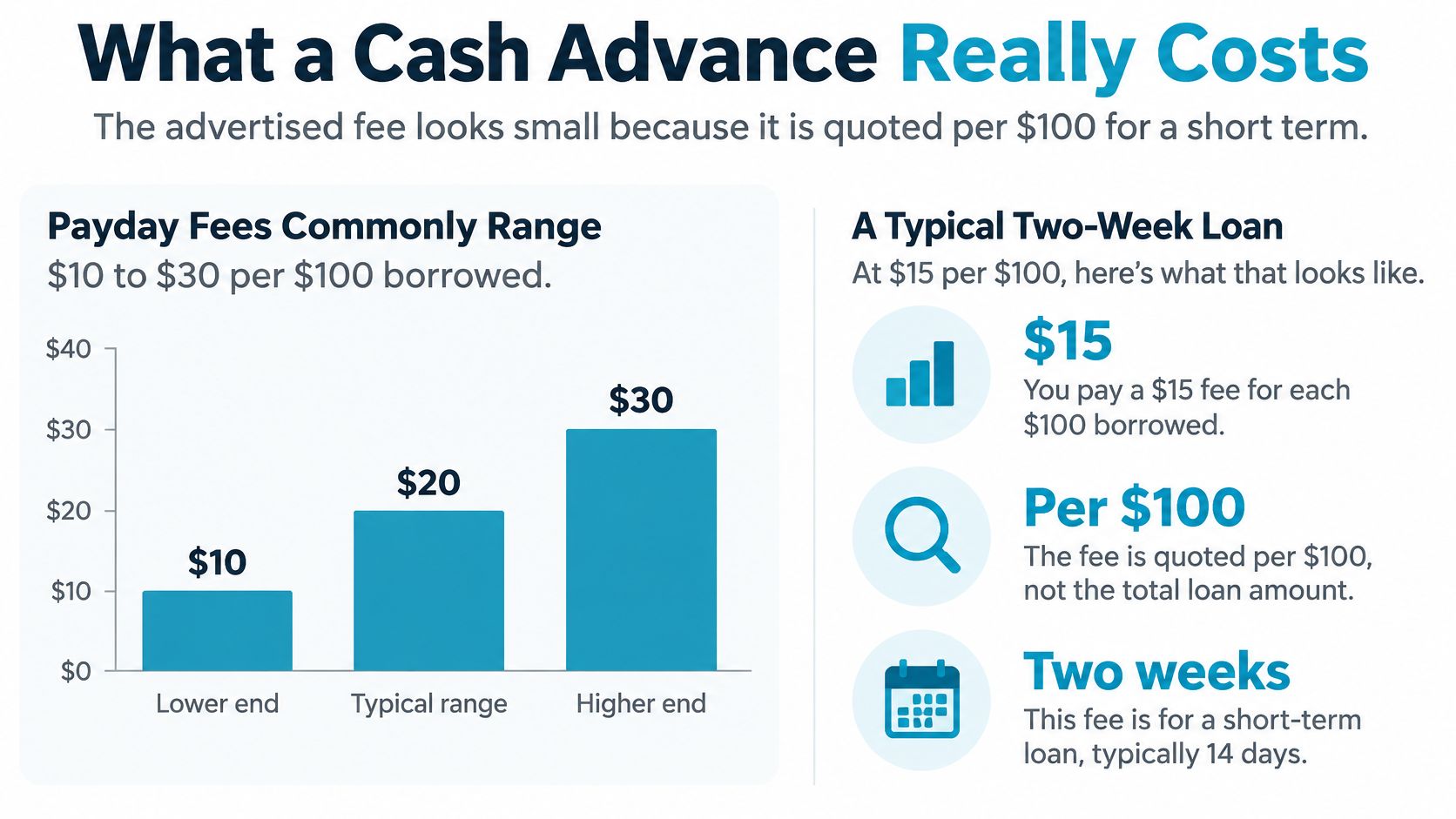
The same structure on a $300 advance shows why the per-$100 quote is a poor comparison tool.
| Fee per $100 | Fee on $300 | Total repaid in two weeks | Approximate APR |
|---|---|---|---|
| $10 | $30 | $330 | 260% |
| $15 | $45 | $345 | 391% |
| $30 | $90 | $390 | 783% |
Charges that sit outside the quoted fee
The per-$100 fee is rarely the only charge. Late payment fees, non-payment fees, and returned-payment charges may apply to both short-term and online personal loans. Some online personal loans also carry origination or documentation fees, which are deducted or added before you see the money.
Where you live matters. Some states cap the APR and the amount of charges on an online personal loan. A loan from a state with no limiting law, or from a bank not governed by state law, may carry an even higher APR. That is why two offers for the same $300 can have different total costs. The payday loan rates comparison explains why the same $15 per $100 quote produces different annual rates across products.
Write down two numbers before you sign. The total dollars you will repay, and the date the payment leaves your account. If you can't state both without checking the app, you don't have the full cost yet.
Compare that total with the cheapest option from the first section, not with the loan amount. A $402.50 repayment is the price of the $350 advance.
Avoiding the Rollover Trap When Repayment Is Due
A rollover is where a shortfall turns into a cycle. The Consumer Financial Protection Bureau's analysis of more than 12 million storefront payday loans found that over 80% were rolled over or renewed within 14 days. More than 60% occurred in sequences of seven or more loans, and 22% of new loans were renewed at least six times. Each renewal resets the due date without touching the principal.
The signature line looks simple. The renewal clause is the expensive part.
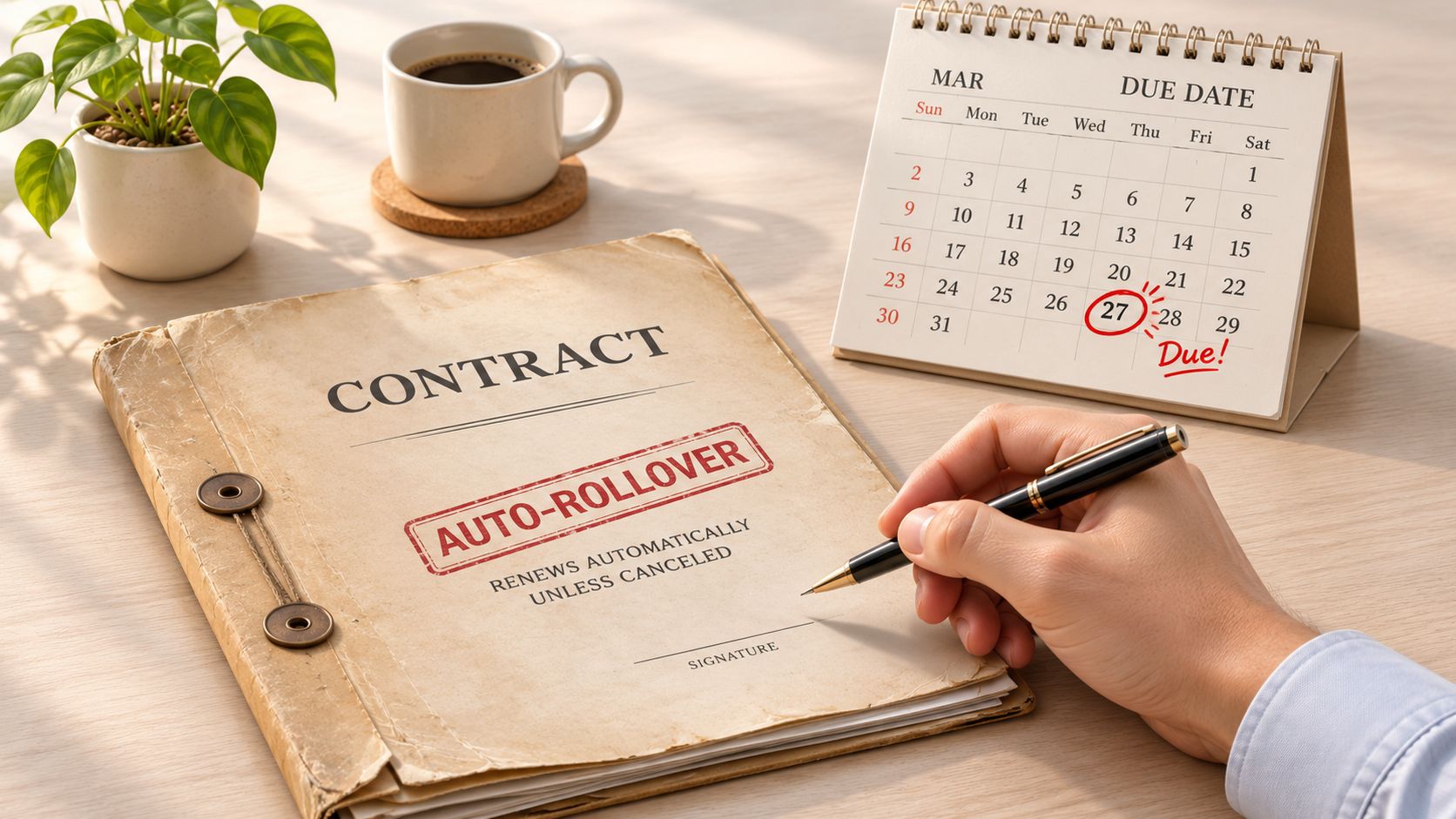
A rollover extends the loan for another fee instead of collecting the principal. You pay to keep the debt alive. The original balance stays, and the new fee is added to what you owe. Nothing is repaid. The same balance comes due again on the next payday, which is how a single shortfall stretches across months.
Run the stress test before the due date
- Add the principal and every mandatory fee. Include the finance charge, any origination or documentation fee, and any charge labeled convenience or processing. That total is your repayment, not the amount you borrowed.
- Test it against the paycheck after the due date. Subtract housing, utilities, food, transportation, and existing debt payments. If the advance doesn't fit, the loan is already in trouble.
- Model one missed payday. Add the late fee, the returned-payment charge, and the cost of one extension. That is the likely downside, not the best case.
Consider a $300 loan with a $45 fee every two weeks. After four months of renewals, the borrower would pay $360 in rollover fees and still owe the original $300. Four months of payments buy nothing but time, and the debt sits where it started.
Never renew a loan just to buy two weeks. A renewal clears nothing. It buys time at the same price and leaves the balance where it started.
If repayment looks uncertain, call the lender before the due date. Ask for a documented hardship or extended-payment arrangement, and get the new schedule in writing. That conversation costs less than a renewal, and it keeps the balance from growing while you wait for the next paycheck.
Check the Terms Before You Sign an Advance
The second cost after the fee is the debit. The Consumer Financial Protection Bureau's research on online payday borrowers found that nearly 70% of payday borrowers take out a second payday loan within one month, and one in five new borrowers takes out at least 10 loans consecutively. Among online borrowers, half had at least one debit attempt that overdrafted or failed over an 18-month period, and those borrowers paid an average of $185 in bank penalty fees, separate from lender charges.
Failed debits repeat. The agency also reported that 70% of second payment attempts failed after an initial failed attempt, and 73% of third attempts failed. A due date that lands two days before payday is a failed debit waiting to happen.
The checklist below is the one I'd keep open while reading an offer.
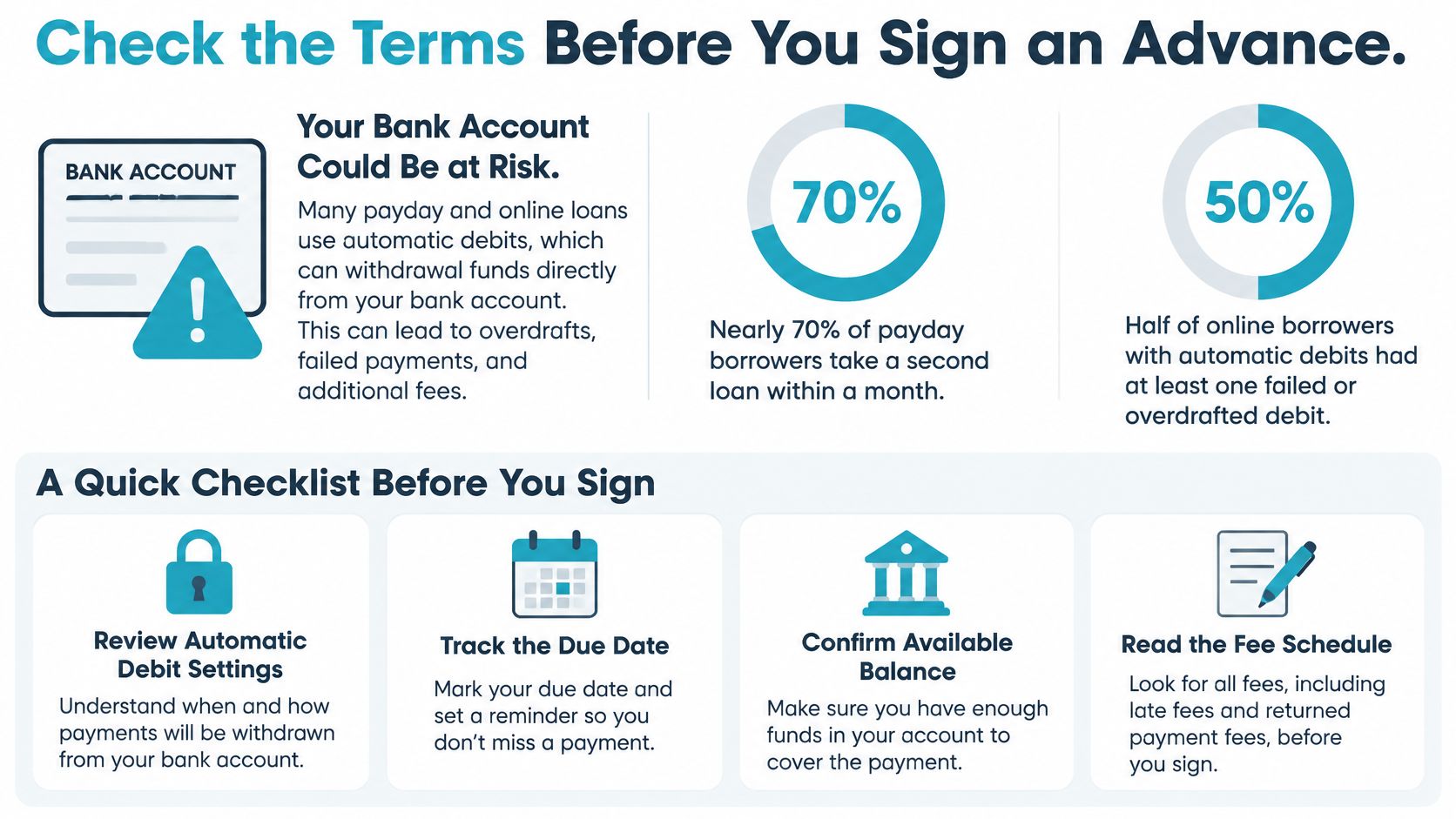
Seven terms to read before you sign
- Total repayment and APR. The APR lets you compare offers. The total repayment tells you what leaves your account.
- Origination or documentation fees. Ask whether the fee is deducted from the deposit, because that changes the amount you can use.
- The due date against your pay date. Move the date before you sign if the payment would post before your paycheck clears.
- The automatic-debit authorization. Ask how to revoke it and what notice the lender must give before a debit.
- Late, non-payment, and returned-payment fees. These stack on top of bank charges when a payment fails.
- The extension policy. Ask how payments split between fees and principal, so you know whether a renewal reduces the balance at all.
- Your state's APR cap. Some states cap the APR and the amount of charges on an online personal loan. Confirm the lender is licensed where you live.
An online request form takes minutes and asks for the amount, some personal information, and where the funds should be deposited. That speed is not the same as approval. The process has three steps: request a loan, agree to terms, and get your money. There is no guarantee of approval by one of the participating lenders, and the lender, not the form, sets the price.
Accept only when the total repayment fits your next paycheck with room for other bills. If it doesn't, go back to the first section and pick a cheaper route. The terms don't improve after you sign.
How to Apply for a Cash Advance Step by Step
Once you decide an advance is the least bad option, the application is short. The work is in the amount and the comparison. A larger request adds fees you do not need.
The seven steps
- Calculate the exact shortfall. Subtract the cash you have from the bill. Borrow only the gap, then check whether total repayment leaves room for other bills before payday.
- Gather matching documents. Identity, income, employment, bank account, and contact details must match across documents. Incomplete or inconsistent data commonly causes verification delays or declines, so check every figure before you submit.
- Submit one complete application. Several partial applications create a mess for lender checks and can look like a burst of credit seeking. One clean request is easier to verify.
- Compare each offer against the terms checklist. The advertised fee hides the total. Compare APR, finance charge, repayment schedule, and late fees side by side. If the offer only works because you plan to renew it, it does not work.
- Accept electronically only after the comparison. Signing the lender's offer creates the loan. Do not pay an upfront fee to receive an offer, and do not hand over online-banking credentials unless the authorization terms are clear.
- Confirm the funding date, repayment amount, and due date in writing. Screenshot the offer or save the email. Verbal details do not help when the debit posts early.
- Keep enough in the account for the authorized debit. A failed debit triggers its own charges, and a second attempt is more likely to fail than the first.
A marketplace request is not an approval. Each lender decides approval, pricing, funding speed, and state availability. Funds are typically deposited directly into your bank account, often by the next business day, but the lender controls the timeline. The personal loan application process follows the same logic: one clean request, a clear comparison, then a decision.
The one-sentence test
Before you sign, say the total repayment and the due date in one sentence. "I will repay $402.50 on the 28th." If you cannot, you are not ready to sign. Name the paycheck that will cover it, not a hoped-for renewal.
Set a reminder two days before the due date and confirm the balance. That reminder is cheaper than a late fee and gives you time to call the lender before a failed debit adds a charge. A rollover can keep the account current while leaving the principal untouched, which is how a small shortfall becomes a debt cycle.
NextStopLoans runs an online marketplace that sends one request to a network of independent lenders. The form asks for the amount, a few personal details, and where to deposit funds. Lenders respond in minutes, and approved funds are usually deposited by the next business day. Visit NextStopLoans to start a request and read the rates and fees first.