
Cash and Cash Alternatives: Costs and When to Use Each

Nearly two-thirds of cash payments were made by people who preferred another payment method, according to the Federal Reserve's 2025 Diary of Consumer Payment Choice. That reframes cash as a backup, not just a way to pay. The personal finance question is whether your backup is money you already own or money you'll have to borrow.
Comparing cash and cash alternatives means looking at both sides: where to keep accessible money and what it costs to borrow when that money runs short. My recommendation is straightforward: protect immediate access to a modest reserve, try to move the bill before borrowing, and compare total repayment rather than the advertised payment.
Table of Contents
- Cash and Cash Alternatives Side by Side
- What Cash Borrowing Means and Who Uses It
- What Cash Loans Really Cost
- What Happens If You Cannot Repay on Time
- Cheaper Alternatives and Which Option Fits Your Situation
- Building a Cash Buffer So You Borrow Less
- Where to Hold Cash Until You Need It
- Confirm the Total Cost Before You Borrow
Cash and Cash Alternatives Side by Side
Cash loans and alternatives compared on cost, term, speed and risk
| Option | Typical cost | Typical term | Funding speed | Main risk |
|---|---|---|---|---|
| Payday loan | Finance charge stated in the lender's offer | Short term, with the due date set by the agreement | Confirm deposit availability before accepting | Renewals that add fees without clearing the balance |
| Title loan | Interest and fees stated in the secured loan agreement | Due date and renewal rules set by the lender | Approval and vehicle documentation must be completed | Loss of the vehicle if repayment fails |
| Installment or personal loan | Our network's APR range is 5.99% to 35.99%, set by the lender | Our network offers terms from 61 days to 84 months | Next-business-day funding may be possible | Large total interest over a long term |
| Credit card cash advance | Cash advance fee plus the card's applicable interest charges | Minimum payments follow the card agreement | ATM access may be available within the cash advance limit | Carrying an expensive revolving balance |
| Credit union payday alternative loan | Interest and application charges disclosed by the credit union | Scheduled repayment under the credit union's program | Membership and approval must be completed | Eligibility requirements and unavailable funding |
| Employer paycheck advance | Any service, subscription or expedited-transfer charge | Recovery from future pay under the program | Employer and provider processing determine availability | Less take-home pay when the advance is recovered |
| Savings or emergency fund | No borrowing interest | No repayment obligation | Immediate when held in a transaction account | A smaller reserve for the next emergency |
A payday loan's dollar cost is the amount you must pay above the cash received, even if the lender describes it as a fee rather than interest. A title loan adds a different exposure: your vehicle secures the debt, so a low-looking payment isn't the whole risk.
An installment loan spreads repayment, but you must compare the full scheduled cost, not just the monthly amount. A credit card cash advance needs its own price check because purchase terms don't necessarily apply to cash withdrawals.
A credit union loan is worth checking before an urgent deadline becomes a crisis. An employer advance can solve a timing problem, but only if the reduced paycheck still covers essentials.
Savings avoid a lender's bill entirely. Using them for a genuine emergency is usually more sensible than protecting an account balance while taking expensive debt.
Practical rule: Choose the lowest total-cost option that delivers usable money before the expense is due and leaves an affordable repayment schedule.
Treat this table as a starting point, not a quote. Write down the amount needed, the payment deadline and the date your income arrives before choosing a row.
What Cash Borrowing Means and Who Uses It
A cash loan is a short bridge with a toll. It gives you money in hand or in your bank account, then requires repayment on a stated date or through scheduled payments. Extending the crossing can mean paying more without making much progress toward the other side.
Payday loans are designed to bridge the gap between paychecks. Alternatives address the same shortage through a different route, such as delaying the bill, drawing on savings or arranging more manageable repayment.

Consider a worker whose rent arrives before wages clear. Borrowing might cover the deadline, but the useful question is whether the next paycheck can cover both repayment and ordinary living costs.
A household with limited credit faces another problem: the cheapest advertised bank loan may not be available. A vehicle owner facing an unexpected expense may consider title-backed funding, but that changes the decision from borrowing against income to borrowing against an essential asset.
Match the product to the problem
Medical bills and car repairs can require urgent action, but they don't always require an urgent loan. Debt consolidation is different again: the objective should be replacing existing debt with a better repayment arrangement.
Through our marketplace, consumers can request title, emergency, payday, installment, personal, cash, signature and bad credit loan options from independent lenders. Those categories describe possible products, not a recommendation or a promise of approval.
The right comparison answers what the money costs, how long repayment lasts and what you could lose if repayment slips.
What Cash Loans Really Cost
A payday fee can look small beside the amount borrowed. Compare it with the cash received and the repayment deadline, and the cost is clearer: the fee comes due from a paycheck that still has to cover food, housing and transportation.
A personal loan can spread repayment over time, but that does not guarantee a lower total cost. A long schedule, origination fee or high rate can make the final amount paid much larger than the money received. Compare the dollars, the repayment timing and any collateral at risk.
Compare dollars before annual rates
APR, or annual percentage rate, puts borrowing costs on an annual basis for comparison. Total repayment shows how many dollars you must pay under the agreement. Check both, and remember that a short-term loan's APR can look especially high because it annualizes a charge for a brief borrowing period.
The figures below are hypothetical examples, not offers. They show how repayment terms affect cost. The payday and title examples use illustrative charges because the actual fees and terms depend on the lender's offer. A title loan also puts the vehicle used as collateral at risk if you cannot repay.
Worked cost examples for common cash loans
| Loan example | Illustrative cost and repayment |
|---|---|
| Hypothetical $500 payday loan | At a $75 fee for 14 days, repay $575 on the due date. The equivalent simple annualized rate is about 391%. |
| Hypothetical $1,000 title loan | At an illustrative 25% APR for 12 months, monthly payments would be about $95, for roughly $1,140 total. The vehicle secures the loan. |
| Hypothetical $5,000 personal loan | At an illustrative 18% APR over 36 months, payments would be about $181 monthly, or roughly $6,509 total. |
| Hypothetical $2,500 credit card cash advance | At an illustrative 30% APR, repaid in full after one month with a 5% advance fee, the cost would be about $187.50, for roughly $2,687.50 total. |
These examples use simplified calculations and exclude fees beyond those specified. Your actual cost depends on the lender's rate, fees, repayment schedule and how payments are applied. A lump-sum loan requires you to have the full balance available by its due date. With installments, add every scheduled payment and any separate upfront charges.
An origination fee may be deducted before funds reach you. That can leave you with less spendable cash than the loan balance you must repay.
Compare cash received against total dollars repaid. If the amount deposited does not cover the expense, the loan does not solve the full problem.
Price the agreement you'll actually sign
The lenders and lending partners NextStopLoans works with offer terms of 61 days to 84 months, with an APR range of 5.99% to 35.99%. These are network ranges, not a personal quote or a guarantee that every product is available on those terms.
Origination, documentation and other additional fees may apply to an online personal loan. Late-payment, non-payment fees and other penalties may apply to both short-term and online personal loans.
NextStopLoans cannot provide the exact APR you'll be charged if approved. Review the lender's offer before signing, including its fees and repayment schedule. The guide to payday loan rates explains why a quoted fee alone does not show the complete repayment obligation.
Reject comparisons that show only the amount deposited or a low-looking payment. Check the payment count, final due date and total repayment, then weigh those dollars against the timing and any collateral the loan puts at risk.
What Happens If You Cannot Repay on Time
A missed payment doesn't follow a universal calendar. Your agreement, the lender's actions and applicable law determine the consequences, so don't assume you have a guaranteed period before fees, collections or other action can begin.
Lenders may offer full repayment at a later date, installments over time or renewal. Renewal isn't the same as paying down the balance. It may extend the obligation while adding fees or interest.
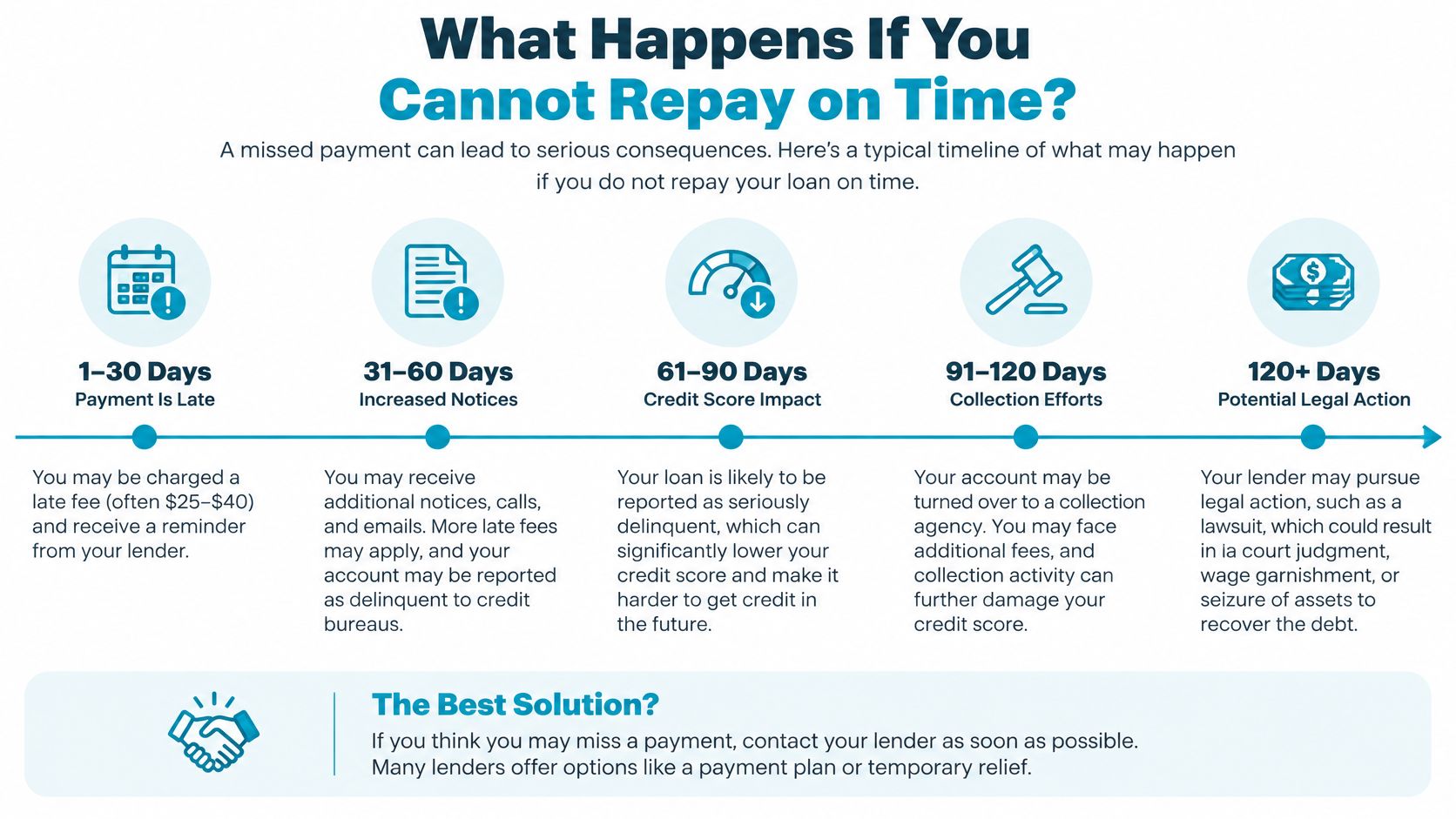
A possible missed-payment sequence
The graphic is illustrative, not a deadline schedule. These events may occur in a different order, and not every lender takes every step.
- The due date passes. A late fee may apply under the agreement.
- A payment is rejected. Non-sufficient-funds charges may follow, creating another expense while the loan remains unpaid.
- The lender offers renewal. Additional fees or interest may increase what you owe.
- The account moves to collections. A collection agency may seek payment, subject to applicable debt collection law.
- Non-payment is reported. The lender may report the account to a consumer credit agency.
Contact the lender before the payment fails if you know the funds won't be available. Request the proposed arrangement in writing, including what changes, what it costs and whether the balance will decrease.
You're under no obligation to accept a renewal offer. You can also leave our request process without accepting a loan, but declining a new offer doesn't cancel an existing signed debt.
Keep the agreement, payment confirmations and written communications together. If the lender proposes a replacement schedule, compare its full cost with the original obligation rather than relying on a verbal promise of relief.
Before signing, resolve the renewal, late-fee and failed-payment questions in the final checklist. Those terms matter most when your budget has the least room for surprises.
Cheaper Alternatives and Which Option Fits Your Situation
Can you repay the full amount on the due date? Would a longer term lower the total cost, or merely shrink the payment? Is property at risk if your plan fails?
Answer those questions before shopping for approval. A loan that arrives quickly but requires unaffordable repayment has solved the deadline, not the financial problem.
Try the route that avoids a new expensive balance
- Provider payment plan. Ask a medical provider or utility whether it can divide the bill or move the deadline without interest. Confirm the arrangement in writing, including any administrative charges and whether service or collections will be affected.
- Employer paycheck advance. This fits a temporary mismatch between a bill and earned income. Check every program charge and build the next budget around the smaller paycheck.
- Credit union payday alternative loan. Ask whether your credit union offers a small-dollar program and request its complete fee schedule. Membership, underwriting and processing requirements can make it unsuitable for an immediate deadline.
- Bank or credit union installment loan. Fixed payments can make an unavoidable expense easier to budget. Compare net proceeds and total repayment, and avoid stretching the term to make an unnecessary purchase feel affordable.
- Promotional card offer. This can work for an eligible purchase when you have a clear payoff plan before the promotion ends. Confirm that the offer covers the transaction you need, because a purchase promotion may not cover cash advances.
Best cash option for each common borrowing situation
These are hypothetical situations, not product quotes.
| Situation | Better fit | Why | Avoid |
|---|---|---|---|
| Car repair with payday approaching | Employer advance or credit union loan | Can address a timing gap without securing the debt against the car | Title-backed borrowing before checking unsecured options |
| Planned wedding or home expense | Save first, then compare a personal installment loan if necessary | Allows time to adjust the budget and compare scheduled repayment | Repeated short-term borrowing for a planned purchase |
| Medical bill from a provider | Interest-free provider plan, if available | May eliminate lending charges and collateral | Borrowing before checking the provider's billing options |
| Cash needed with a vehicle owned outright | Compare an unsecured personal loan first | Keeps the vehicle outside the loan's collateral agreement | Treating vehicle ownership as a reason to pledge it |
Use a deliberate order
Start by requesting a payment plan or due-date change. Then check employer assistance and credit union options before comparing a personal installment loan. Reserve high-cost borrowing for a necessary expense when the alternatives won't work.
Our guide to payday loan alternatives can help you identify routes to investigate before submitting a request. For a planned celebration or discretionary upgrade, postponing the purchase is usually better than financing it under pressure.
Check the lender's licensing, identity and complete fee schedule before accepting any offer. Tribal lenders may be offered through our marketplace in some cases, and their rates and fees may be higher than those of state-licensed lenders.
Put a title loan last. If losing the vehicle would threaten your job, childcare or medical access, its practical cost extends far beyond the repayment amount.
Building a Cash Buffer So You Borrow Less
In 2025, 63% of U.S. adults said they could cover a hypothetical $400 emergency using cash, savings or a credit card paid off by the next statement, according to the Federal Reserve's report on household economic well-being. That measure includes promptly repaid credit, so it shouldn't be read as a claim that everyone in that group had emergency savings.
The useful question isn't whether you can build a large fund immediately. It's what amount would stop your next routine setback from becoming a borrowing decision.

Build in stages, not all at once
- Start with an accessible cushion. Choose an amount you can reach soon that would cover a plausible disruption, such as essential transportation or a modest urgent bill.
- Build toward a month of essentials. Base the target on housing, utilities, groceries, necessary transport, insurance and minimum debt obligations, not your ideal lifestyle.
- Expand for your actual exposure. Variable income, dependents and essential equipment can justify a larger reserve than predictable pay and fewer obligations.
Don't drain every available dollar into debt if it leaves you unable to handle the next unavoidable expense. But once you have a workable starter cushion, paying down expensive debt can be more valuable than adding money to a low-yield account.
Compare the interest you avoid with the return you earn. Keep enough access to avoid immediately borrowing again, then direct additional money where it most improves your position.
Make the system fit irregular income
For irregular earners, test the budget against a low-income month rather than an optimistic average. Use stronger months to replenish the reserve and set aside money for predictable costs that don't arrive with every paycheck.
Budget test: After saving or making an extra debt payment, can you still cover essentials until the next dependable income arrives?
Holding excessive idle cash has a cost too: rising prices can reduce its purchasing power. Give emergency money a clear job, then evaluate longer-term money separately rather than keeping everything in a transaction account.
Set a fixed automatic transfer on each payday at an amount your lowest-income budget can support. Raise it when your finances improve, rather than choosing an ambitious transfer you'll repeatedly reverse.
Where to Hold Cash Until You Need It
Access, principal stability, yield and protection are separate features. An account can provide convenient access without a competitive return, while an investment can offer income without guaranteeing that you can spend its full value immediately.
Where to hold cash compared on access, principal and protection
| Vehicle | Access | Principal stability | Protection |
|---|---|---|---|
| Checking account | Immediate for supported transactions | Stable deposit balance, not an investment price | Deposit insurance within applicable limits at an insured bank |
| High-yield savings account | Transfers subject to bank processing | Stable deposit balance; interest rate can change | Deposit insurance within applicable limits at an insured bank |
| Government money market fund | Rapid redemptions, with processing and settlement requirements | Stable target price may apply, but losses are possible | Not FDIC-insured |
| Short-term Treasury bill | Hold to maturity or arrange an early sale | Market price can change before maturity | U.S. government obligation, not an FDIC-insured deposit |
Keep daily spending money in checking. A high-yield savings account is a sensible home for the core emergency reserve when its transfer arrangements match your needs; test access before depending on it.
Separate deposits from investments
Government money market funds must invest at least 99.5% of total assets in qualifying liquid investments, but fund shares aren't FDIC-insured and investors can lose principal, as the SEC's money market fund investor bulletin explains. Check redemption cutoffs and transfer arrangements rather than assuming brokerage cash is immediately spendable.
Treasury bills fit money with a known future use. The U.S. Treasury's published rate tables cover maturities including 4, 6, 8, 13, 17, 26 and 52 weeks, allowing comparison across holding periods.
A bill is generally purchased at a discount and redeemed at face value. Holding to maturity avoids having to accept an interim market price, while selling early exposes you to price changes and transaction logistics.
Match access to the expense date. Don't put money you may need unexpectedly into a vehicle that requires an early sale or an uncertain transfer. For a predictable bill, choose a maturity that releases the money before payment is due.
Confirm the Total Cost Before You Borrow
Don't accept an offer because the deposit would solve today's problem. Accept it only after you've checked what happens to your budget on every repayment date.
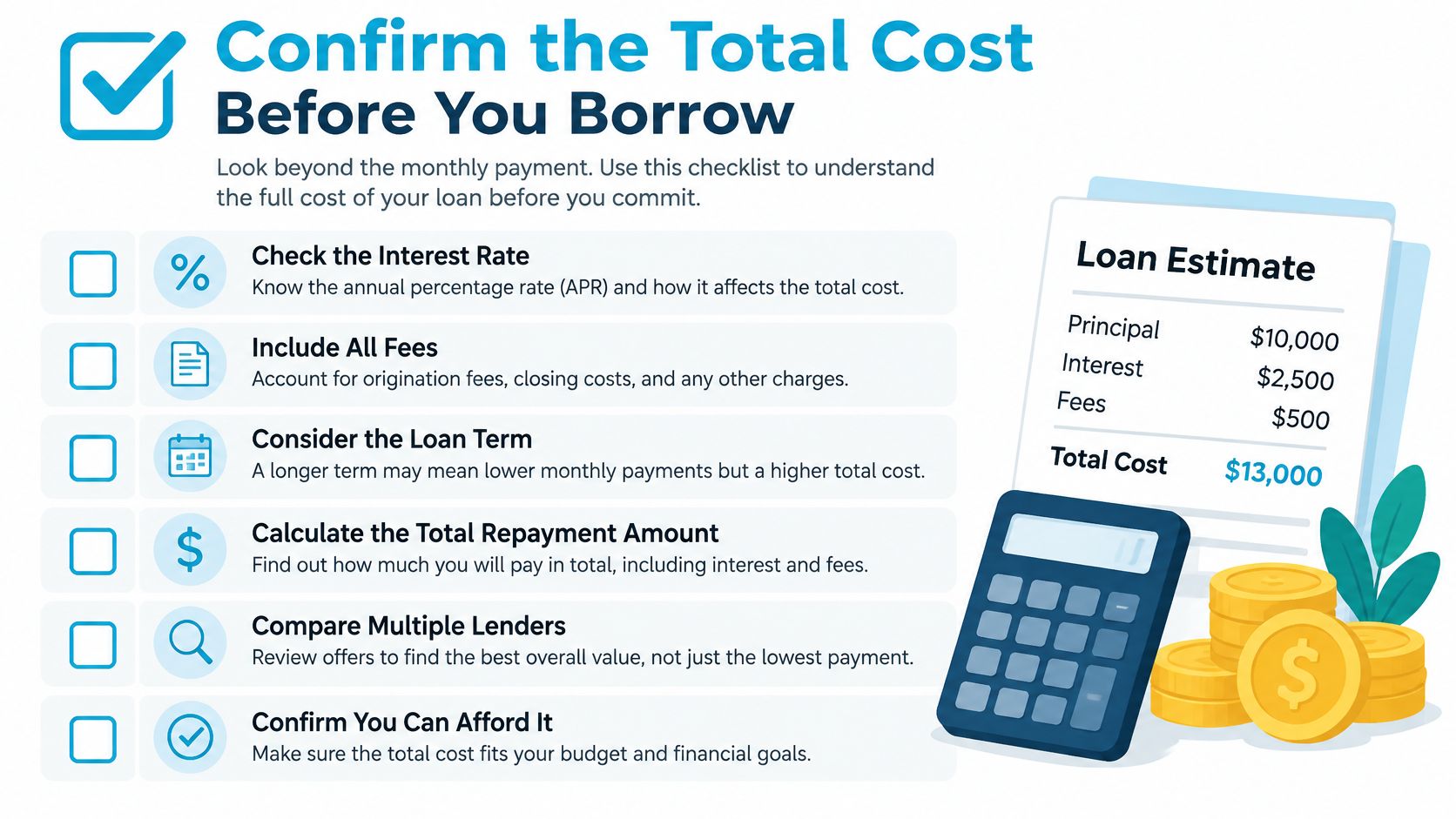
Complete this checklist with the actual agreement open. Save a copy of the disclosures and your calculations, not just the application confirmation.
Complete the checks before signing
Write the exact need and deadline. Separate the unavoidable expense from optional additions. Borrowing extra for breathing room creates another obligation unless your budget can support it.
Calculate total repayment. Include every required payment, upfront fee and mandatory charge. Our loan calculator can help you test repayment amounts, but the lender's agreement controls and may contain charges you must add separately.
Obtain the final APR. Use the personalized lender disclosure rather than a marketplace range or promotional starting rate. Check that the quote matches the amount you'll receive and the schedule you intend to follow.
Confirm the repayment structure. Identify whether the agreement requires a lump sum or installments, and ask what renewal would cost. Don't treat renewal as your planned method of making the original loan affordable.
Find the late and failed-payment charges. Read when each charge applies and how payments will be collected. Leave enough in the payment account for essential bills as well as the loan debit.
Confirm your right to decline. You may exit our request process at any step and aren't obligated to accept the loan presented. Distinguish reviewing an offer from electronically signing and returning the lender's agreement, which constitutes acceptance.
Read the policy disclosures. Review rates, fees, payment authorization, collateral provisions and collection terms. If a term remains unclear, pause acceptance until the lender provides a clear written answer.
Understand the marketplace's role
NextStopLoans is an online marketplace that submits a request to a network of independent lenders. We don't make credit decisions or set loan terms; lenders handle approval and funding.
Our request form offers amounts of $500, $1,000, $2,500, $5,000, $7,500, $10,000 and $20,000. Those selections aren't approval promises, and selecting a larger amount doesn't make it the right amount for your situation.
Lenders provide fees and charges at the time of an offer, and you're under no obligation to accept them. Your decision now is to compare the total cost of competing offers or compare an offer against a workable non-loan alternative, then choose only if the repayment fits.
NextStopLoans connects consumers with independent lenders offering cash borrowing options through an online request process. If borrowing still makes sense after checking your savings and lower-cost alternatives, visit NextStopLoans to request an offer and review the lender's total cost, repayment dates and terms before deciding.