
Does Debt Consolidation Hurt Your Credit? It Depends

For most borrowers, debt consolidation causes a small, temporary score dip of about five points or less from the hard inquiry and the new account, and it often improves the score within months if payments stay on time and card balances fall.
The most popular advice treats consolidation as one switch, either a rescue or a mistake. That advice skips the part that truly decides the score. A personal loan, a balance-transfer card, a counseling plan, a settlement, and closing paid-off cards are different actions, and credit reports record them differently. The loan or the card is only the setup. What you do with the freed-up cards afterward usually matters more than the consolidation itself.
Think of the report as a running logbook. The consolidation does not stamp the word "consolidated" on your score. It writes a few new lines, and then your payment habits write the rest.
Table of Contents
- Short Answer and Why Your Score Dips
- The Five Factors That Decide the Net Effect
- How Long the Dip Lasts and When Scores Recover
- How to Consolidate Without Lasting Damage
- When Consolidation Makes Your Credit Worse
- Decide If Consolidation Is Right for You
Short Answer and Why Your Score Dips
Does debt consolidation hurt your credit? Yes, usually by a few points and usually for a short stretch. Experian reports that a hard inquiry typically reduces a score by five points or less and remains a FICO scoring factor for 12 months. A brand-new installment account can also pull down the average age of your accounts and register as recently opened credit. Both effects are modest. Both hit harder when your history is short or you already carry several recent inquiries.
The method you pick decides which entries appear, so these five paths deserve to be read as five different products.
| Method | Hard inquiry? | Short-term effect | Long-term effect | Main risk |
|---|---|---|---|---|
| Personal consolidation loan | Yes, at formal application (soft pull at prequalification) | Small dip, usually five points or less, plus a new account | Can improve if card utilization falls and payments stay on time | Reusing the paid-off cards |
| Balance-transfer card | Yes, when the card is opened | Dip from the inquiry and new account; utilization can jump if the new limit is low | Improves if the transferred balance is paid down before the promo ends | Transfer fee and a higher rate when the promo expires |
| Debt management plan | Usually no new loan application; enrolled cards are often closed | Possible dip because closed cards shrink available credit | Gradual improvement as balances are repaid on schedule | Smaller limits after accounts close |
| Debt settlement | No new loan; a creditor accepts less than the full balance | Large drop from missed payments and settled accounts | Settled accounts can remain on reports for years | Creditor lawsuits and settlement fees |
| Closing paid-off cards only | No | Utilization rises if balances remain elsewhere, and available credit shrinks | Recovers if the cards stay open and unused | Lost limit and a shorter credit history |
Read any row from left to right. The inquiry column tells you whether shopping itself can touch the score. The short-term column covers roughly the first one to three months. The long-term column is what on-time payments and lower card balances can do after that, and the last column names the behavior that undoes the plan.
Two entries in the logbook
A personal consolidation loan writes two entries at once. The first is the hard inquiry, a lender's formal request to see your report. The New York Fed defines hard inquiries as voluntary lender requests for a consumer report, which means applying for a consolidation loan produces one even when the money goes straight toward paying off other debt.
The second entry is the new installment account itself. It is young, so it pulls down the average age of everything else on the report. That is a smaller effect than a late payment, but it is real on day one.
Practical rule: Compare offers before anyone runs a formal application. A soft-pull prequalification is the look that does not affect FICO Scores. The hard inquiry belongs to the lender you actually choose.
One detail catches borrowers off guard. Personal-loan inquiries are not grouped for scoring the way mortgage, auto, and student-loan inquiries often are, so five formal applications can count as five separate inquiries rather than one shopping trip. FICO's guidance on consolidation notes that payment history is the largest scoring category at 35%, with amounts owed at 30% including revolving utilization. The inquiry is a smaller piece sitting on top of those two.
If you are weighing a personal loan, start with that row. If you are looking at a transfer card, a counseling plan, settlement, or closing cards, use the matching row as your map. A dip is possible right away, especially with a thin file. A dip and lasting damage are two different entries in the logbook.
The Five Factors That Decide the Net Effect
A score is a weighted mix, not a yes-or-no verdict on the loan. The two heaviest categories do most of the work. Everything else can nudge the result, but it rarely overrides on-time payments and lower card balances.
| Scoring factor | FICO weight | How consolidation moves it | Net direction |
|---|---|---|---|
| Payment history | Largest category | Every on-time installment payment builds a record; a late payment can seriously harm scores | Helps if on time, hurts if late |
| Amounts owed (utilization) | Next-largest category | Paying card balances with loan funds lowers revolving utilization | Usually helps |
| Length of credit history | Smaller share | The new loan lowers average account age; closing old cards can remove history | Slight harm |
| New credit | Smaller share | Hard inquiry plus a newly opened account | Short-term harm |
| Credit mix | Modest share | Adds an installment loan beside revolving cards | Usually helps |
Where the score actually moves
Payment history is the category a counselor watches first. Each on-time installment payment adds a clean month to the logbook. One reported late payment can wipe out the benefit of the inquiry fading and the balances dropping. The loan does not get extra credit for being labeled a consolidation. It gets credit for being paid.
Amounts owed is the category consolidation is built to change. Utilization is the share of revolving credit you are using, measured on each card and across all cards. An installment loan is not revolving credit, so moving a card balance onto that loan takes the balance out of the utilization math even though you still owe the money. Balances that sit high relative to the limit do more damage than modest balances. Paying the cards down is the reason the score often recovers after the early dip.
The lighter three factors explain the dip without explaining the outcome. A new loan shortens average age, which is a slight negative, and it counts as new credit, which is a short-term negative. Adding an installment loan versus revolving credit can help the mix if your file is almost all cards. That help is modest. It will not rescue a file full of late payments, and it is not why a well-run consolidation works.
The loan can trade a short-term new-credit penalty for lower revolving balances and a clean payment record. Missed payments or new card spending reverse that trade.
If those two heavy categories move the right way, they outweigh the smaller new-account penalty for most borrowers. The calendar for each move is the next piece.
How Long the Dip Lasts and When Scores Recover
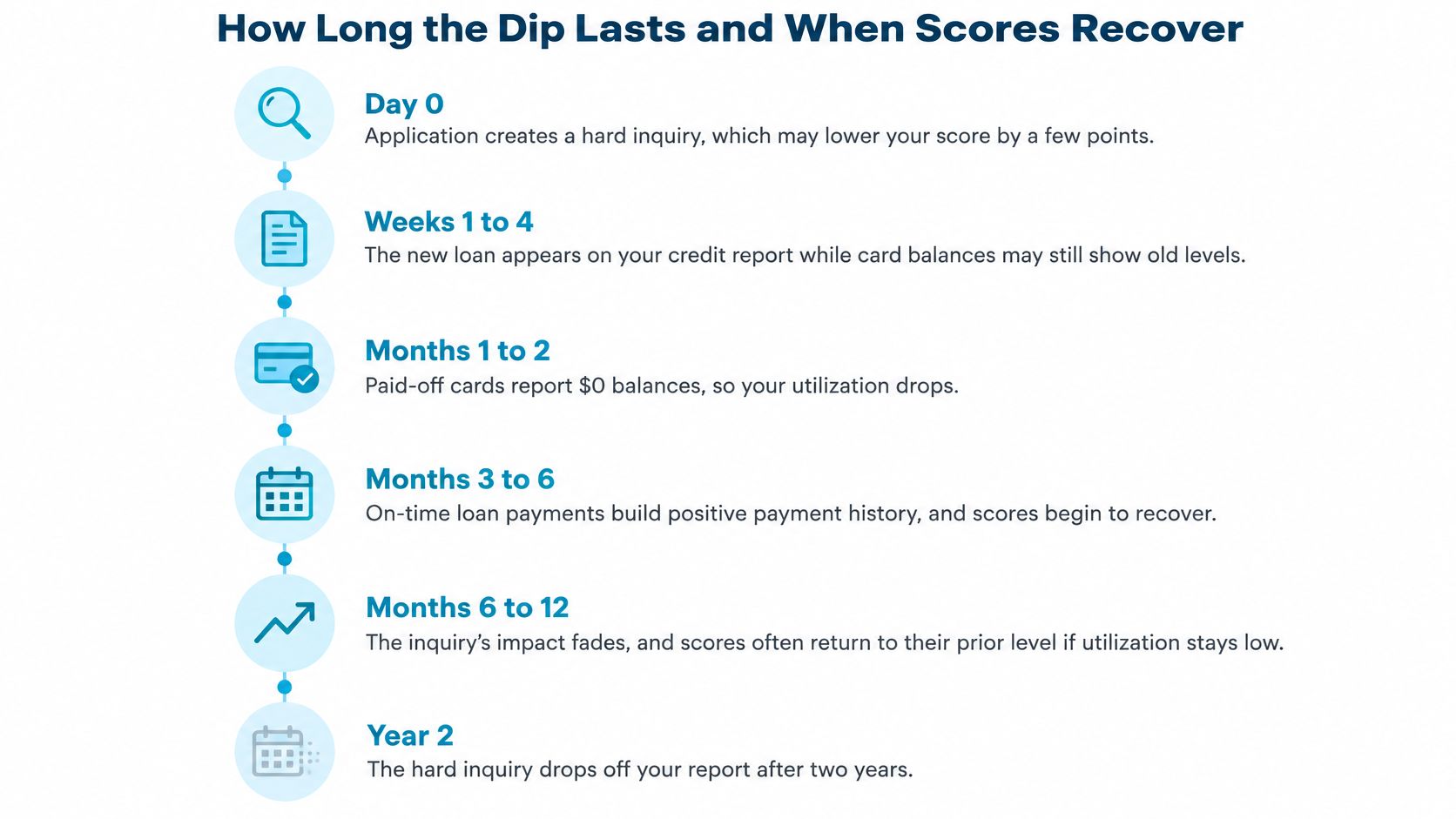
Your score updates in stages because lenders report in stages. Each card issuer and each lender sends its own update on its own schedule, so the file changes in small corrections spread across the first few months.
The hard inquiry lands first, on the day you formally apply. Your card balances still show their old numbers, so the only new fact in the file is that a lender checked it.
A few weeks later the installment loan appears as an open account. The cards may still display last month's balances because their issuers have not reported yet. For a short stretch the report can look worse than your real position, since the loan is on the file while the payoffs have yet to appear.
One card, one clear before and after
Take a card with a $1,000 limit and a $900 balance. That card sits at 90% utilization. Paying it off with consolidation funds drops it to 0%, even while the installment loan remains outstanding. Once the issuer reports the lower balance, typically within a statement cycle or two, the amounts-owed side of the score improves. Scores respond better to balances that sit well under the limit than to balances that crowd it.
Then the slow part begins. Each on-time loan payment adds to payment history, and the inquiry's effect thins with time. Scoring formulas stop counting a hard inquiry after about 12 months, while the new account keeps aging right alongside it. A new account never regains the age it displaced; it steadily grows older, and the on-time record does more of the work with every month that passes. A payment reported 30 days late can seriously harm scores, which is why this timeline only holds if the loan payment runs on autopilot.
How fast all of this moves depends on each lender's reporting cycle and on the depth of your existing history. A dip in the first one to three months is normal, and a paid-off card's lower balance usually shows before the inquiry fades. A score that keeps sliding after the new balances have reported points to something else: a late loan payment, or fresh spending on the cards you just cleared.
How to Consolidate Without Lasting Damage
The goal is one formal application path, paid-off cards that stay open, and a loan payment that is never late. Each step below exists to block a specific kind of damage.
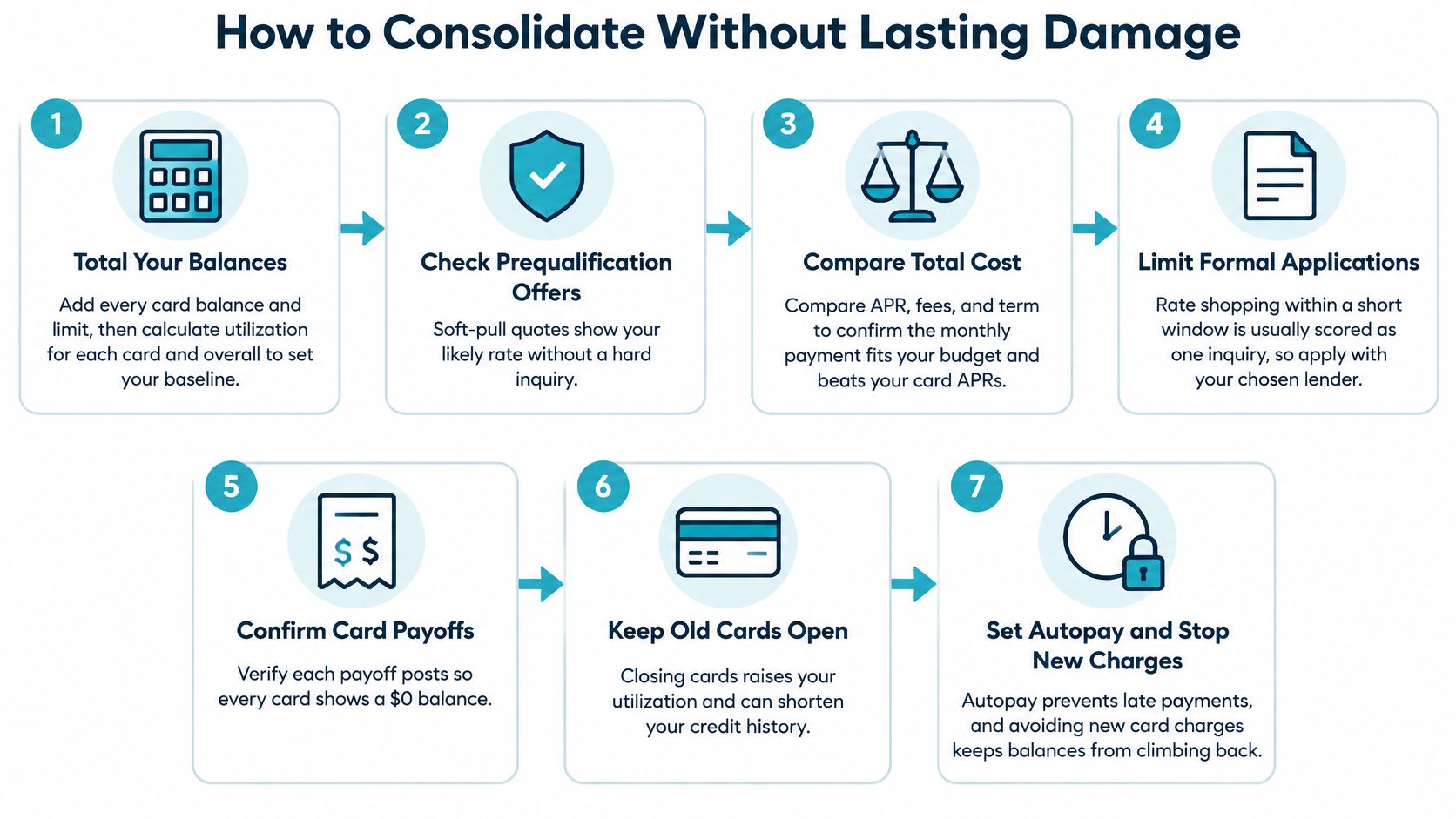
- Total every balance and every limit. Write down each card's balance and its limit, then the combined figures. You need a baseline so you can tell later whether utilization really fell.
- Check prequalification before you apply. Start with lenders that show a likely offer through a soft inquiry. A personal loan soft pull lets you compare rate ranges without turning every quote into a scored inquiry.
- Compare total cost, not the monthly payment alone. Look at APR, origination fees, the term, and the full amount you will repay. A lower payment on a much longer term can cost more than the cards you are leaving.
- Send formal applications only to a short list, inside a short window. Two or three lenders, close together, is enough. Spreading applications over months stacks inquiries because personal-loan requests are not grouped. Applying with a long list of lenders is the most common unforced error at this step.
- Pay the cards directly, then confirm the payoff. Send the loan funds to the card balances the same day if you can. Then check that each issuer shows the balance paid, not merely that the loan funded.
- Leave paid-off cards open unless there is a real reason to close them. An annual fee you will not use, or a card you know you will overspend on, can justify closing. Closing a card only because the balance hit zero cuts available credit and can shorten history. That habit is the second common slip.
- Put the new loan on autopay. The payment amount should leave your account before a late mark is possible. Payment history is the major scoring input, and a miss on the new loan does more harm than the inquiry ever did.
- Read your reports again about two or three months later. Confirm the loan is reporting, the card balances match what you paid, and no account shows a late payment you did not make.
Keeping older cards open preserves both the limit and the age of those accounts, as long as you do not run the balances back up. The inquiry dip is usually temporary. A missed payment on the consolidation loan is not.
When Consolidation Makes Your Credit Worse
The loan is not what ruins the file in most of these stories. The pattern after funding does.
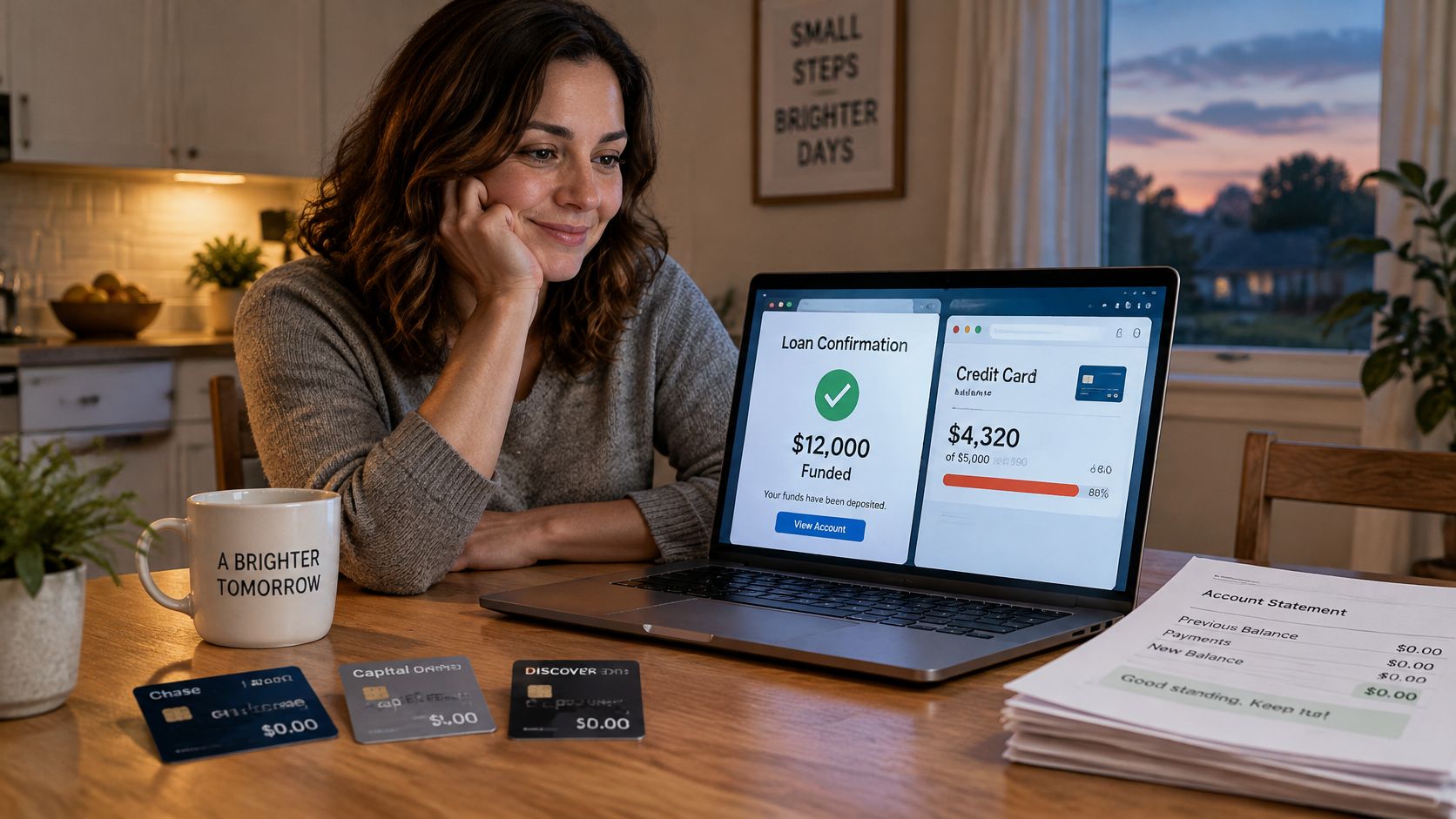
Suppose Maria owes $12,000 on cards with a combined $15,000 limit, so she is using about 80% of that revolving credit. She takes a $12,000 consolidation loan, pays the cards, and utilization on those cards falls to 0%. A few months later she has charged the cards back up to $14,000, about 93% of the limits, and she still has the loan payment. She now owes both. Her score is worse than when she started, and the consolidation did not cause that. The new charges did.
Four patterns that look like the loan and are not
A loan payment goes 30 days past due. That single mark hits payment history, the heaviest category. It hurts far more, and for far longer, than the inquiry from opening the loan.
The oldest card is closed at a zero balance. The limit disappears, so any balance left on other cards is a larger share of a smaller pool. The average age of accounts can fall at the same time. The card was helping by sitting open and unused.
A balance-transfer card arrives with a small limit. Moving most of a large balance onto that card can leave the new card nearly maxed. Utilization stays high on the account that was supposed to relieve it, and the promo rate eventually ends.
Settlement replaces repayment. There is no new installment loan building a clean record. Accounts are often already delinquent before a creditor accepts less than the full balance, and settled accounts can remain on the report for years. Lawsuits and fees are part of that path, not a side note.
The label on the paperwork does not decide the score. The pattern does. On-time loan payments plus cards that stay near zero move the file one way. Late payments, closed limits, or refilled cards move it the other way.
Decide If Consolidation Is Right for You
Consolidation tends to help when three things are true at once. Card balances are high relative to their limits. The offer's APR is clearly below the rates on those cards. The new monthly payment fits the budget with room left over, not just on a perfect month.
It tends not to help when the rate is close to the cards, when origination fees eat the interest savings, when the payment strains the budget, or when the spending that built the balances has not changed. A cheaper loan cannot fix a budget that still relies on the cards.
One practical route is a marketplace rather than a stack of separate applications. A personal loan used to pay off debt can be requested through NextStopLoans, which routes one secure form to independent third-party lenders. The marketplace is not a lender, does not pull credit, does not set terms, and does not require you to accept an offer. Participating lenders may check credit. The service is not available in Arkansas, New York, Vermont, or West Virginia, and rates and fees are listed on the Rates & Fees page.
List your balances, compare total repayment cost across the offers you actually qualify for, and mark the date twelve months out, when that inquiry stops counting in the score.
NextStopLoans is an online marketplace that sends one loan request to independent lenders, including requests for personal loans used to consolidate debt, without the marketplace itself pulling your credit. If you want fewer formal applications while you compare consolidation offers, review the terms lenders return and keep the cards from filling back up. Visit NextStopLoans when you are ready to see what those lenders would offer.