
Personal Loan to Pay Off Debt: A Practical 2026 Guide

You're staring at four credit card statements, a medical bill you keep pushing to next month, and minimum payments that eat your paycheck without visibly shrinking what you owe. Every card has a different due date, a different rate, and the same frustrating outcome. You're paying, but you're not getting out.
A personal loan to pay off debt can fix that structure, but it won't fix the math unless the math works. My take is blunt. This is a tool for lowering total interest and forcing discipline, not a way to make debt feel smaller. If the new loan doesn't beat your current cost after fees, and if you can't stop using the cards afterward, don't do it.
Table of Contents
- When a Personal Loan to Pay Off Debt Actually Makes Sense
- Calculating Real Savings Before You Apply
- Comparing Loan Offers Without Losing the Plot
- Applying Through a Multi-Lender Marketplace
- Fees, Terms, and the Reborrowing Trap
- Tracking Results Month by Month
When a Personal Loan to Pay Off Debt Actually Makes Sense
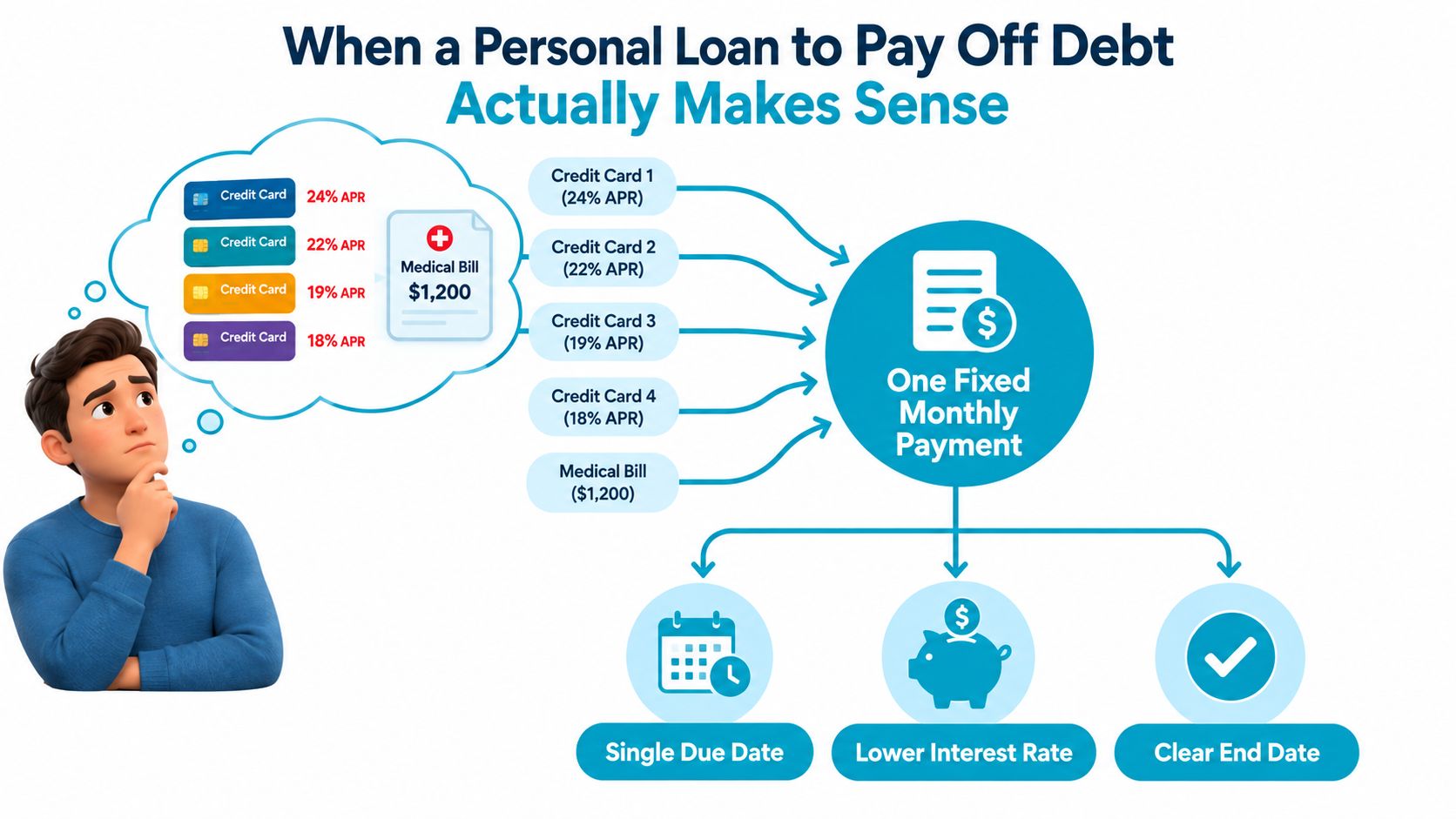
Take a common situation I see. Someone carries balances on three or four cards, plus a medical bill, and pays something on everything while interest replaces the progress. A consolidation loan pays those creditors off and replaces them with one fixed monthly payment, one due date, and a clear end date.
That's useful, but simplification alone isn't a financial win. This works only when three conditions line up at once. The new APR is meaningfully lower than what you're paying now, the term is short enough that total interest stays controlled, and your budget can handle the payment every month without leaning on a card in week three.
Pick the Right Tool First
Don't confuse this with the alternatives. A balance transfer card gives you a promotional window to attack principal, but you need the credit to qualify and the discipline to finish before the regular rate returns. A home equity loan secures the debt against your house, which changes the risk completely. A hardship program from a card issuer may temporarily change terms if you're already struggling to pay.
A personal loan sits in the middle. It's typically unsecured, it has a defined payoff schedule, and it doesn't require you to clear the balance inside a short promo period. If your problem is scattered high-rate balances and you need structure over several years, it's often the cleaner fit.
The Credit Reality
Borrowers with stronger credit histories generally qualify for the most competitive rates, while thin or damaged credit usually means fewer offers and higher APRs. That isn't a judgment, it's pricing. This matters at scale too. A Federal Reserve analysis of personal loan borrowers found outstanding balances reached approximately $356 billion at the end of 2022, with a median account balance of $4,198 and a median monthly payment of $202, and finance companies that commonly serve nonprime consumers held nearly one-fourth of balances.
Do this tonight: List every account you'd consolidate, total the balances, and write down your weighted APR.
If a new APR can't beat that weighted average by at least a few points, or you can't commit to the payment for the full term, stop. You're looking at a reshuffle, not a solution. Reshuffles feel organized for about one billing cycle.
Calculating Real Savings Before You Apply
Most failed consolidations were decided on monthly payment, not total cost. That's exactly backwards. A lower payment can hide a much more expensive loan if the term stretches long enough.
Start by gathering the raw inputs for every debt you plan to include. You need the current balance, the APR, and the minimum payment for each one. Don't estimate from memory, because small errors in APR change the comparison fast.
The Only Comparison That Matters
Use this formula for the new loan. Multiply the monthly payment by the number of months, then add any origination fee that isn't already reflected in the amount you receive. Compare that total against what you'd pay on the existing debts over the same window if you kept paying at least the combined amount you're considering for the loan.
Run your own numbers with a loan calculator for side by side payoff estimates before you talk to any lender. If you can't make the math work on a calculator, a lender's sales page won't make it work either. It'll just present the same cost more attractively.
- Current cost: Add the interest you'd pay keeping the cards, assuming a fixed monthly amount until they're gone.
- Loan cost: Add every scheduled payment plus upfront fees, not just the interest rate printed in large type.
- Break even point: Find the month when cumulative savings from the lower APR finally exceed the fee you paid to get the loan.
A Worked Example
Suppose, for example, you're consolidating $12,000 across three cards at 24% APR into a 36 month loan at 14% with a 5% origination fee. The rate drop is real, and over three years you'll pay noticeably less interest than on the cards if you were making the same payment. The fee, however, adds $600 to your true cost on day one, so your early savings are really just buying back that fee.
Where does it fall apart? Stretch that same balance to 60 months and the monthly payment drops, which feels great, while total interest climbs because you're renting the money for two extra years. Fees work the same way. A fee can swallow the first year of rate savings, meaning you must keep the loan long enough, without refinancing or defaulting, to come out ahead.
Your new APR has to beat your weighted average APR by enough to cover all fees comfortably inside the term you choose. If it barely covers them, it doesn't cover them.
Pick the shortest term whose payment you can make in a bad month, not your best month. That's the version of you who'll finish this loan.
Comparing Loan Offers Without Losing the Plot
Two offers can show the same monthly payment and cost you very different amounts. Lenders know you'll anchor on the payment, so you have to force every offer into the same four fields before you compare anything.
Those fields are APR, term, origination fee, and prepayment penalty. APR is the broadest cost measure because it folds in certain fees, and you can dig deeper in this guide to personal loan APR rates and what drives them. Term decides how long interest keeps accruing. The fee decides how much you pay before you've saved a cent.
Offer Comparison Fields That Drive Total Cost
| Field | Why It Matters | What to Watch For |
|---|---|---|
| APR | It drives interest on every payment | Whether it's fixed or variable |
| Term | Longer terms raise total interest | A lower payment achieved only by stretching |
| Origination fee | It reduces proceeds or raises financed amount | Whether payoff funds still cover every balance |
| Prepayment penalty | It can punish early payoff | Any charge for extra principal payments |
| Total of payments | It's the full price tag | The dollar total, not the monthly figure |
A lender can quote you a friendlier payment just by adding months. That isn't a better offer, it's a longer one. When offers land at different terms, normalize them. Ask what each would cost at the same term, or compare total of payments directly and accept that the cheaper loan may carry the higher monthly payment.
Shop Properly, Then Demand Disclosures
Apply with multiple lenders inside a short window rather than dribbling applications out over months. Scoring models commonly treat rate shopping for the same type of loan within a concentrated period more leniently than scattered inquiries, so bunch your shopping together. Online shopping is now normal in this market. Federal Reserve data on fintech issued personal loans show fintech loans represented about $49.9 billion, or 14% of the market at the end of 2022, with approximately 72% of those loans carrying fixed rates.
That fixed rate point matters for budgeting. Your scheduled principal and interest payment generally won't move when market rates move, so you can build it into a monthly plan and leave it there.
Before you sign anything, get these in writing. Demand the amount financed, the total of payments, the APR with fees itemized, the late payment policy, and a clear statement of whether the rate is fixed or variable. If a lender won't produce that list cleanly, walk away. Good lenders disclose. Slippery ones summarize.
Applying Through a Multi-Lender Marketplace
Once your math checks out, the practical question is how you get offers without filling out the same form at six different lender sites. That's what a marketplace is for. You submit one request, and lenders in the network decide whether to respond.
Be clear on the division of labor. A marketplace like NextStopLoans acts as a connector, not a lender. It doesn't set your APR, approve your loan, or fund it. Participating lenders make those decisions, and while the marketplace itself doesn't pull your credit, lenders reviewing your request may.
How the Request Flows
You'll complete an encrypted online form covering identity, income, employment, and loan purpose, then provide electronic consent. Lender responses often arrive within minutes, and a walkthrough of the personal loan application process from request to funding can help you know what to expect at each step. Reviewing offers carries no obligation. You can read every term and decline all of them.
Eligibility isn't universal. The service is restricted to eligible U.S. residents and isn't offered in every state, so confirm availability before you invest time in the form. If you accept an offer and the lender funds it, money is typically sent by direct deposit as soon as the next business day, depending on that lender's process.
- Confirm payoff amounts: Call or check each creditor for the exact figure, since interest accrues daily on revolving accounts.
- Fund the loan: Borrow enough to clear every targeted balance in full, because a partial payoff leaves the highest rate debt alive.
- Pay creditors directly: Send payments immediately, ideally the day funds arrive, before the money starts looking spendable.
- Verify zero balances: Get confirmation for each account and keep it, because a residual interest charge can restart a balance.
Fund, pay, confirm. In that order, in the same week.
That last step sounds fussy until you've seen someone pay off a card, miss a small trailing interest charge, and discover months later that the account never hit zero. Direct payment to creditors, where a lender offers it, removes the temptation and the delay at once. If funds come to you instead, treat them as already spent. They are. Just not by you.
Fees, Terms, and the Reborrowing Trap
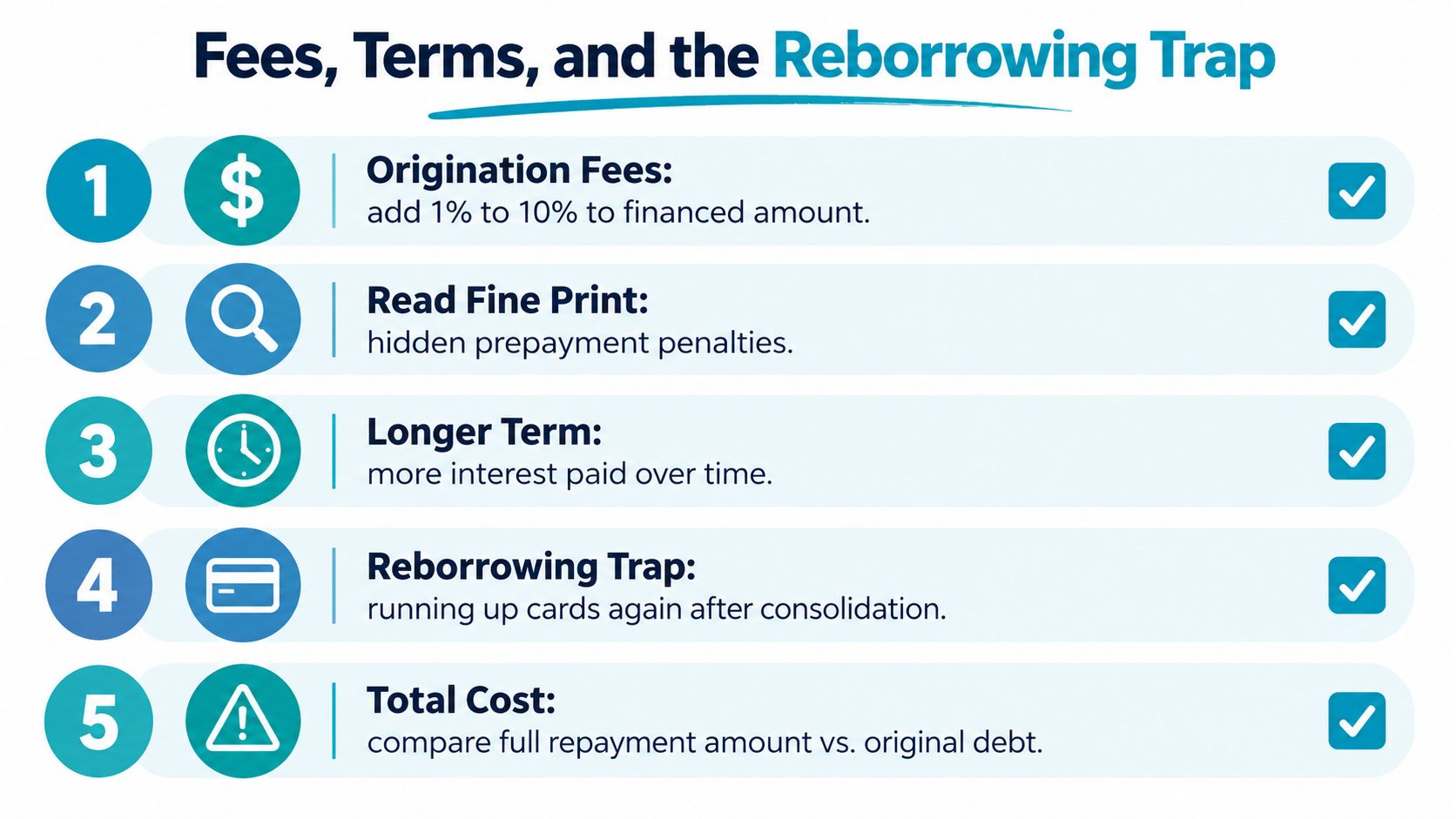
Here's where good consolidations go bad. The loan itself is rarely the villain. The fee you skimmed past, the term you stretched, and the cards you started using again are.
Origination fees sit at the top of that list. For example, a fee in the range described in many lender disclosures can add a meaningful percentage to what you finance, which means you're paying interest on money that never reached your creditors. If the fee is deducted from proceeds, check that the remaining funds still clear every balance. A loan that leaves a few hundred dollars on your most expensive card has failed at its only job.
The Longer Term Illusion
Choosing a longer term lowers your payment by spreading principal thinner, not by making the debt cheaper. You pay interest on a higher average balance for more months, so lifetime cost usually rises. Borrowers tell themselves they'll pay extra later to offset it. Some do. Most adapt to the lower payment and spend the difference, which is how a five year plan becomes five full years of interest.
The Real Cause of Failure
Reborrowing is the dominant reason consolidation backfires, and I won't soften that. Your cards hit zero, the available credit looks like breathing room, and within a few months balances creep back while the loan payment continues. Now you have the installment loan and fresh revolving debt. That's worse than where you started, with better paperwork.
Don't rush to close the paid off cards as a fix, either. Closing accounts can reduce your total available credit, raise your utilization, and push your credit score the wrong way depending on which cards you close and what balances remain elsewhere. Freezing a card, removing it from digital wallets, or cutting spending access while keeping the account open may protect utilization better. Check the consequences for your specific accounts before you shut anything.
The CFPB guidance on consolidating credit card debt cautions that consolidation loans may cost more because of fees or rising rates, and warns about promotions that pressure you to stop paying creditors or transfer money into special accounts. Treat that pressure as a disqualifying red flag.
Secured consolidation deserves its own warning. Using home equity can put your home at foreclosure risk if payments fail, on top of closing costs. Trading unsecured card debt for debt tied to your house, just to get a lower rate, swaps an expensive problem for a dangerous one.
Tracking Results Month by Month
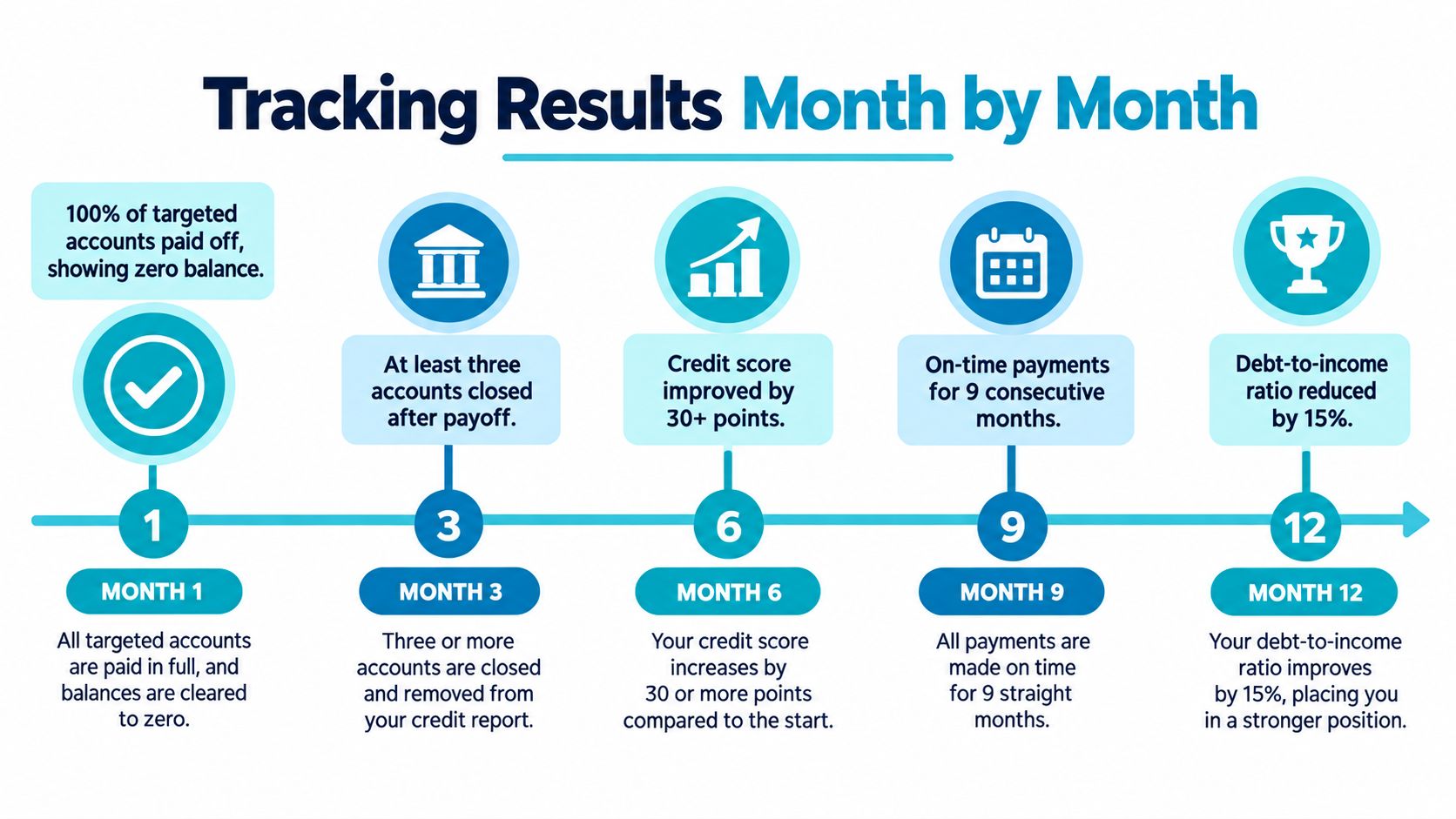
Signing the loan isn't the achievement. Twelve consecutive months of boring, on time, no new balances is the achievement. Measure it that way, with numbers you check on a set day each month.
Define success before your first payment posts. Your targets are 100% of targeted accounts paid and showing zero balances, at least three billing cycles with no new revolving balance, a 100% on time payment rate on the new loan, and a principal balance that declines every single month. If any one of those fails, you don't have a consolidation plan anymore. You have a warning light.
Your Monthly Tracking Sheet
Keep it to four rows so you will maintain it. A spreadsheet, a notes app, or a paper ledger all work if you update them.
- Debt to income ratio: Total monthly debt payments divided by gross monthly income, watched for a steady decline.
- Credit utilization: Revolving balances divided by total revolving limits, which should stay low after payoff.
- Payment to income ratio: Your loan payment against take home pay, checked so the payment still fits if income dips.
- Remaining loan balance: The amortization balance, compared against where the schedule says you should be.
Each number tells you something different. Falling utilization supports your credit profile because you're using less of your available revolving credit. A perfect on time streak builds the payment history lenders weight heavily. A shrinking principal is the proof, in dollars, that the loan is working rather than just moving.
Feelings about debt are unreliable. A declining balance, checked monthly, is not.
Decide at Six and Twelve Months
Set two decision points now. At six months, confirm you're on schedule, your cards are still at zero, and the payment still fits. At twelve months, make a deliberate choice. Stay the course if the plan is working, refinance only if a materially lower APR survives the same fee and total cost test you ran originally, or direct extra cash to principal if your budget has genuinely improved.
Don't refinance out of boredom or because an offer arrived in the mail. Refinance because the math, rerun from scratch, says you'll pay less in total. That's the same discipline that made the original loan a good idea, and it's what turns a Personal Loan to Pay Off Debt from a one day transaction into debt that's gone.
If your math shows a consolidation loan would lower your total cost, visit NextStopLoans to submit one secure request and review responses from lenders in its network without obligation to accept any offer. Compare each response on APR, fees, term, and total of payments, then fund only the loan that clears every balance you targeted.