
Installment Loan vs Revolving Loan: Which One Fits You
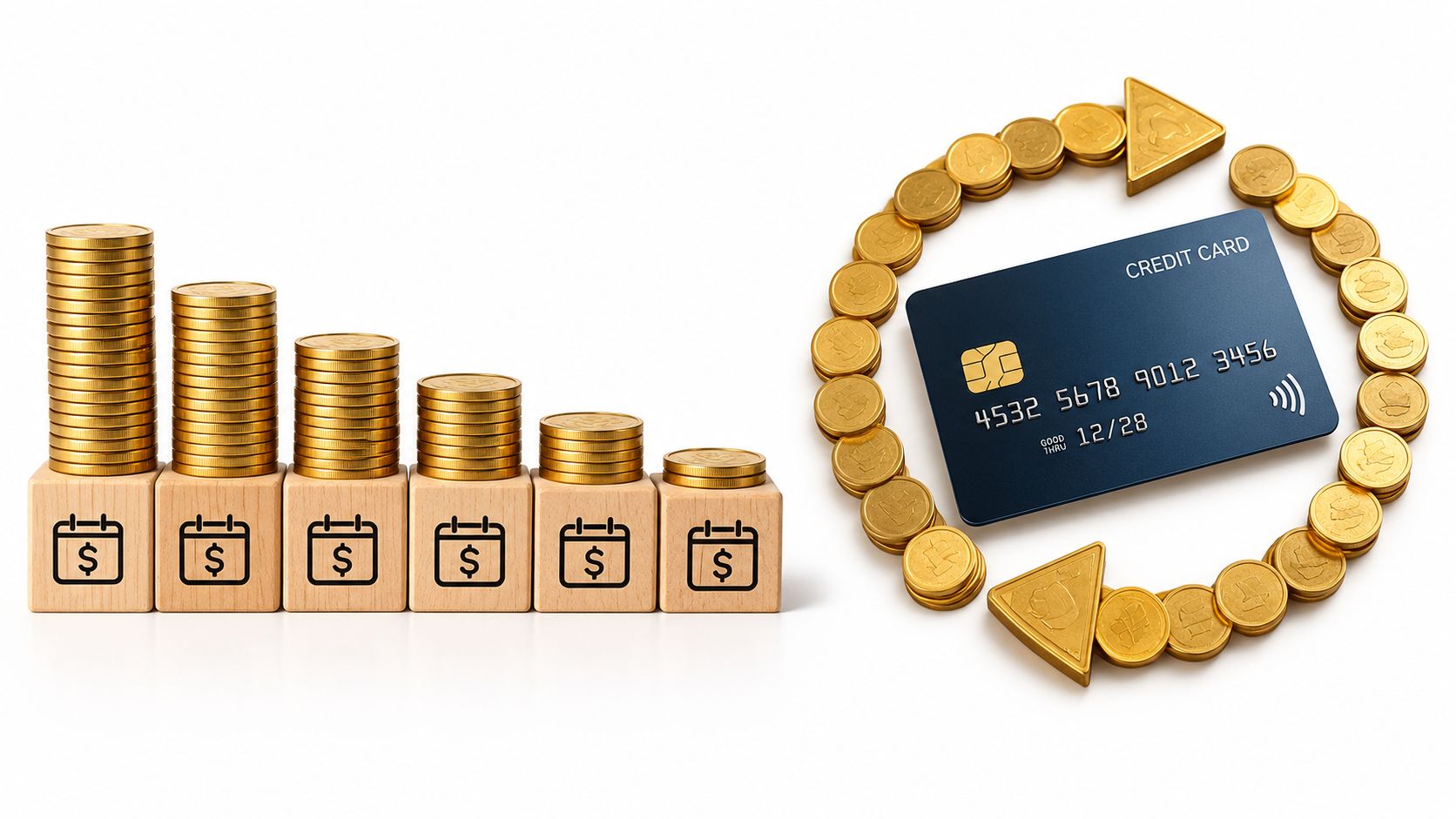
You're comparing two borrowing options because your need doesn't fit neatly into a brochure. Maybe a storm damaged your roof and you need a fixed amount with a payment you can budget. Maybe your credit card balance keeps changing because medical bills, repairs, and travel costs arrive at different times. The right choice depends less on the product name and more on whether your spending is planned, recurring, or already debt.
The basic distinction is familiar, but it no longer tells the whole story. Credit cards remain revolving accounts, yet many issuers now let cardholders convert eligible purchases or balances into fixed-payment plans. That gray area can make a card-based installment plan more useful than either a traditional revolving balance or a separate personal loan, but only when the fees, APR, and repayment rules work in your favor.
Table of Contents
- Two Borrowers, Two Different Problems
- What Each Loan Type Actually Is
- Side-by-Side Comparison That Matters
- Why the Market Is Tilting Toward Installments
- Real Scenarios That Change the Answer
- When Each Option Wins and When It Loses
- How to Decide and What to Do Next
Two Borrowers, Two Different Problems
Maya needs $6,000 to replace a roof after a storm. Her income is steady, the contractor has given her a defined invoice, and she doesn't want an open line of credit sitting in her wallet after the repair is complete. Her priority is simple: receive the money once, make predictable payments, and know when the debt will end.
Devon has a different problem. Freelance income changes from month to month, while medical copays, car maintenance, and travel costs don't arrive on a reliable schedule. Devon values access more than a fixed payoff date and wants to borrow only when a real expense appears, then reuse the available credit after repayment.

Start with the purpose of the borrowing
Maya's roof is a one-time, known expense. An installment loan fits that purpose because she can match the loan amount to the invoice and build the payment into her monthly budget. The account has a defined balance, a repayment schedule, and an expected end.
Devon's expenses are irregular and potentially recurring. A revolving account can be more practical because Devon doesn't need to take the full amount upfront or apply again for every new expense. The tradeoff is that flexibility makes it easier to carry a balance indefinitely.
Practical rule: If you can describe the expense in one invoice and name the month when you want the debt gone, start with an installment option. If you need an ongoing reserve and can control your repayment, evaluate revolving credit.
The modern complication is that Maya and Devon may see similar offers from the same card issuer. A credit card might let Devon convert a purchase into scheduled payments, or let Maya place a large repair charge on a card and select an installment feature afterward. That doesn't automatically make the card cheaper. The borrower still needs to compare the converted plan's fee, effective borrowing cost, payment schedule, and effect on available credit.
What Each Loan Type Actually Is
An installment loan provides a fixed lump sum at the beginning. You repay that amount through scheduled payments over a defined term, usually with each payment covering both principal and interest. The balance declines according to an amortization schedule, and the account closes or is satisfied when the balance reaches zero.
For a hypothetical auto loan of $10,000 at 8% APR over 60 months, the borrower receives the full amount upfront and makes a regular principal-and-interest payment each month. The exact payment and total interest depend on the lender's calculation and any fees, but the important feature is the structure: the borrower can identify the scheduled payoff date before accepting the loan.
Interest on a typical amortizing loan is calculated against the remaining balance. As principal falls, the interest portion of later payments generally falls as well. A fixed APR makes the cost easier to forecast, although borrowers should still check origination charges, late fees, collateral terms, and prepayment rules. A scheduled-payment installment loan is designed for this one-time borrowing pattern.
Revolving credit works differently. A hypothetical credit card with a $5,000 limit and a 22% APR gives the borrower access up to that limit rather than delivering the entire amount as a loan. The borrower can draw, repay, and draw again while the account remains open and available.
The card issuer generally calculates interest on carried balances using a periodic rate, often applied to balances over daily billing periods. Paying the statement balance in full can avoid interest on eligible purchases under the card's terms. Paying only the minimum leaves debt outstanding, and the required payment can change as the balance, interest, fees, and issuer rules change.
| Feature | Installment Loan ($10,000 / 8% / 60 mo) | Revolving Credit ($5,000 limit / 22% APR) |
|---|---|---|
| Access to funds | Full lump sum at origination | Borrow as needed up to the limit |
| Payment pattern | Scheduled payment over a defined term | Minimum or chosen payment that can vary |
| Balance | Declines with amortization | Rises with new charges and falls with repayments |
| Reuse after repayment | Usually requires a new application | Available credit returns as you repay |
| Interest exposure | Based on the remaining loan balance | Based on carried balances and the account's rate |
| Main strength | Predictability | Flexibility |
| Main risk | Rigid obligation | Open-ended repayment |
Hybrid products sit between these categories. Card-linked installment plans keep the borrowing inside a credit card account but assign a purchase or balance to a fixed payment schedule. Buy now, pay later products split a specific purchase into scheduled payments, though the fees, late-payment rules, and credit reporting vary by provider. A line of credit provides reusable access like a card, but may operate through a bank account with different rates, draw rules, and fees.
Side-by-Side Comparison That Matters
The installment loan vs revolving loan decision turns on a few mechanics that change the borrower's outcome. The product with the lower advertised rate isn't automatically better if its fees, restrictions, or repayment behavior don't match the need.
| Criterion | Installment Loan | Revolving Loan |
|---|---|---|
| Disbursement | One fixed amount | Draw only what you need |
| Payment stability | Usually predictable | Changes with balance and issuer rules |
| Payoff timing | Defined by the term | Depends on repayment behavior |
| Interest behavior | Charged against the declining balance | Charged on carried balances, often at a variable rate |
| Available credit | Not reusable after disbursement | Restored as you repay |
| Utilization effect | The balance is treated as installment debt | The balance is measured against the credit limit |
| Prepayment | May have restrictions or fees | Usually flexible, subject to account terms |
| Credit profile | Payment history and overall debt matter | Payment history and utilization matter heavily |
Payment certainty versus access
An installment payment gives you a fixed obligation to plan around. That helps borrowers with steady income, especially when the expense is large and the repayment period needs to be visible from the start. The structure also removes the temptation to reuse the account after the original purchase.
Revolving credit gives you control over timing. You might use part of the limit today, repay it after receiving income, and use the available credit again later. That feature is valuable for uneven expenses, but it creates a responsibility the installment loan doesn't: you must decide how much to borrow and how aggressively to repay every billing cycle.
The credit and interest traps
High revolving utilization can weaken a credit profile even when every payment is on time. A borrower who repeatedly uses most of a card's available limit can look financially stretched, while an installment balance generally isn't evaluated through the same revolving utilization calculation. Payment history still matters for both account types, and missed payments can damage either profile.
Variable APR exposure deserves equal attention. A card balance that looks manageable today can become more expensive if the rate changes or if the borrower continues adding new charges. An installment loan with a fixed rate provides stronger cost certainty, but a variable-rate installment product can carry a different risk and must be reviewed on its own terms.
Prepayment is another overlooked issue. An installment lender may allow early payoff without penalty, but borrowers shouldn't assume that every contract does. A revolving account usually lets the borrower pay more than the minimum, yet the account remains open and available, which can encourage new borrowing after the original balance is reduced.
The useful comparison isn't “fixed or flexible.” It's “which risk can you manage better, payment rigidity or open-ended debt?”
Why the Market Is Tilting Toward Installments
Recent U.S. consumer finance data shows a meaningful difference in the direction of installment and revolving borrowing. In May 2026, outstanding consumer finance installment balances reached $103.40 billion, up 10.4% year over year, while installment accounts increased from 19.96 million to 22.43 million. Revolving balances reached $52.40 billion, up only 0.7%, while revolving accounts declined from 60.76 million to 59.95 million, according to the June 2026 consumer credit trends report.
The Federal Reserve's G.19 figures in that same report showed revolving credit increasing at a 2.5% annual rate, compared with 4.8% for nonrevolving credit. The gap doesn't prove that every borrower should abandon cards, but it does show that installment-style borrowing is expanding faster in the current market.
| Debt Category | May 2025 | May 2026 | Year-over-year change | Direction |
|---|---|---|---|---|
| Consumer finance installment balances | Not provided as a comparable balance in the brief | $103.40 billion | 10.4% increase | Growing faster |
| Consumer finance installment accounts | 19.96 million | 22.43 million | Increase | Growing |
| Revolving balances | Not provided as a comparable balance in the brief | $52.40 billion | 0.7% increase | Nearly flat |
| Revolving accounts | 60.76 million | 59.95 million | Decrease | Declining |
Why borrowers prefer the structure
Fixed-payment products answer three borrower concerns at once. They show the required payment, define the repayment horizon, and reduce the chance that a borrower will keep adding new charges to an old balance. For households trying to regain control of their budget, those features can matter more than instant access to additional credit.
Lenders also receive a clearer repayment profile from a closed-ended loan. That doesn't guarantee approval or a low rate, and it doesn't mean revolving products are disappearing. It means the market is offering more ways to turn a known borrowing need into a scheduled obligation.
The broader historical shift helps explain why revolving credit feels so normal today. Installment borrowing became common for large purchases during the early and mid-20th century, while revolving credit expanded as retailers and banks developed reusable charge accounts. By the end of the 1990s, one historical account reported that about two-thirds of American households used bank-issued revolving credit, compared with one-sixth in the 1970s, as described in this history of U.S. consumer credit.
The current tilt is a structural signal, not a universal verdict. Installments win when certainty matters. Revolving credit remains useful for short-cycle spending, cash-flow gaps, and expenses that can't be predicted in advance.
Real Scenarios That Change the Answer
Maya has a defined repair
Maya needs $6,000 for an HVAC replacement and has a contractor's fixed estimate. An installment loan is the cleaner choice because the amount is known, the need is one-time, and a scheduled payment gives her a visible finish line. She should compare the loan's APR, origination fee, total repayment, and prepayment terms against any card installment offer before signing.
A card-based plan could still work if the issuer offers a lower total cost and doesn't leave her with an unmanageable reduction in available credit. The key is to avoid treating convenience as a discount.
Devon has uneven business expenses
Devon freelances and uses a $10,000 credit limit to manage irregular expenses. Revolving credit can win here because Devon may need only part of the limit at a time and can repay after client invoices arrive. If Devon pays the balance in full under the card's terms, the account may offer useful payment flexibility without converting every expense into a separate loan.
That advantage disappears if Devon repeatedly pays only the minimum. A line of credit may also be worth comparing, particularly if its rate and draw rules fit the business better than a consumer card. Borrowers considering that route can review guidance about a personal line of credit with bad credit, while remembering that approval and terms depend on the lender.
Priya already has expensive debt
Priya carries $14,000 across three cards with APRs ranging from 24% to 27%. Her problem isn't access to new money. It's existing revolving debt that remains expensive while she makes payments and continues managing several accounts.
A consolidation installment loan at 13% could give Priya one scheduled payment and a defined 36-month payoff date. That may reduce interest, but she should accept the loan only if the fees are reasonable and she stops rebuilding the card balances. Consolidation fails when the borrower transfers the debt and then resumes charging the old accounts.
These examples produce different answers because the borrowing purposes differ. Planned spending favors structure, recurring uneven expenses favor access, and existing high-rate debt favors a deliberate payoff plan.
When Each Option Wins and When It Loses
An installment loan wins for a one-time large purchase with a defined cost. The borrower knows how much to request, can compare total repayment before accepting, and gets a payment schedule that fits a budget.
Revolving credit wins for ongoing or unpredictable expenses. A credit card or line of credit lets the borrower draw only what is needed instead of paying interest on money that sits unused.
Installments also win for debt consolidation when the borrower needs a fixed payoff date and can prevent new card balances. The loan doesn't solve overspending by itself, but its closed-ended structure can remove some of the uncertainty from repayment.
Revolving credit wins for a short cash-flow gap that the borrower can repay quickly. The flexibility and grace period can be valuable when the balance is paid in full under the account's terms, but carrying it forward changes the calculation.
A disciplined borrower may also use revolving credit to build a responsible payment record while keeping balances low relative to the limit. That benefit depends on consistent payments and restrained utilization. It isn't a reason to carry costly debt.
The failure modes matter more than the labels
The silent danger of revolving credit is minimum-payment behavior. A low required payment can make an unaffordable balance look manageable while interest continues accumulating and the payoff date moves farther away. New charges make the result worse.
Installment loans have a different weakness: rigidity. A borrower with irregular income may struggle with a payment that cannot be reduced just because a slow month arrived. Prepayment penalties or contract rules can also limit the value of paying early, so read those provisions before accepting an offer.
Card-based installment plans can beat both standalone options in a narrow situation. They may suit a borrower who already has a card, needs to finance one eligible purchase, wants fixed payments, and receives a plan whose fee and total cost are lower than a new loan. They lose their appeal when the plan carries a high fee, restricts available credit, uses a variable rate, or encourages the borrower to keep charging the account.
How to Decide and What to Do Next
Use the next day to make the decision concrete rather than applying blindly.
Define the purpose. Write down whether the need is a one-time purchase, an ongoing expense, or existing debt. A single invoice usually points toward an installment structure. Recurring uncertainty may justify revolving access.
Calculate total cost. Compare APR, origination or plan fees, late charges, required payment, and total repayment. For a card conversion, ask whether the converted balance remains part of the card's available credit and whether new purchases accrue interest under different rules.
Check the rate type. Confirm whether the APR is fixed or variable. A fixed rate makes an installment payment easier to forecast. A variable card or line of credit can become more expensive even when your balance doesn't change.
Read the exit rules. Look for prepayment penalties, early payoff treatment, balance-transfer conditions, deferred interest, and what happens after a missed payment. Don't accept a low advertised payment without understanding the full repayment period.
Review your credit position. Check revolving utilization before applying, and avoid adding a new account if it would leave your budget dependent on minimum payments. Also verify whether the lender reports payments to the credit bureaus and which bureaus receive the information.
Compare actual offers. If you're considering consolidation, review the guidance on whether debt consolidation is worth it, then compare the offer against your current balances and behavior. A lower rate helps only when the new payment is sustainable and the old debt doesn't return.
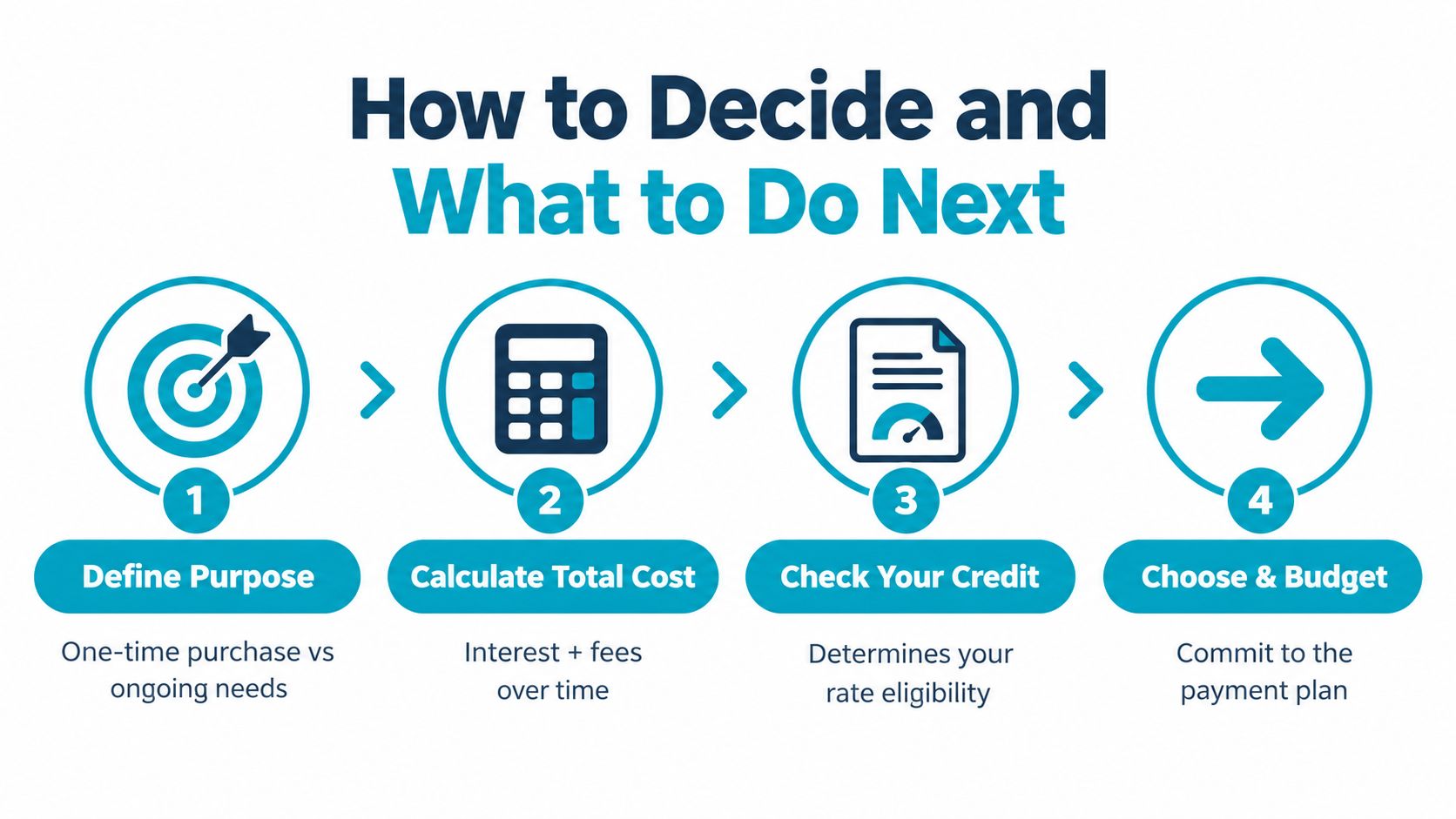
Don't choose revolving credit just because it's convenient, and don't choose an installment loan just because it looks more disciplined. Match the structure to the expense, then select the offer with a payment and total cost you can actually sustain.
NextStopLoans lets eligible U.S. consumers submit one secure loan request that participating independent lenders may evaluate for installment and other financing options. Visit NextStopLoans to compare available offers, review the lender-provided terms, and decide whether any option fits your borrowing purpose and budget.