
Deferred Payment Loan Explained: Costs, Terms, and Options

A deferred payment loan lets you postpone some or all required payments for a set period, but interest often keeps accruing unless the agreement says otherwise, so the pause isn't automatically free. That's the part popular advice gets wrong. "No payments for months" sounds like no cost for months, yet your contract may keep the interest clock running the whole time. Read the pause as a timing change first, and a savings claim only if the paperwork proves it.
Table of Contents
- Why a Deferred Payment Loan Is Not Always a Free Pause
- How Deferred Payment Loans Are Structured
- Deferred Interest Promotions and Their Hidden Risk
- Common Situations Where Borrowers Use Delayed Repayment
- Weighing the Pros and Cons of Delayed Repayment
- Calculating the True Cost of Deferred Payments
- Comparing Alternatives to a Deferred Payment Loan
- How to Take the Next Step Safely
Why a Deferred Payment Loan Is Not Always a Free Pause
Your car needs a repair today, your next steady paycheck is weeks away, and an offer promises no required payment at first. That breathing room can help, but it doesn't erase the bill. You're moving the due date, not deleting what you borrowed.
Pausing a delivery is a helpful comparison. The box still exists, and storage may still cost money while it waits. With a deferred payment loan, storage is often interest, the price you pay for using someone else's money over time.
Three mechanisms decide whether that storage charge is small, large, or waived:
- Interest during the pause: Does interest keep accruing while you aren't required to pay?
- What happens to unpaid interest: Does the lender add it to your balance, leave it separate, or forgive it?
- The product type: Is this a true deferment, or a deferred interest promotion with a payoff deadline?
Don't ask only when payments start. Ask what your balance will be on the day they start.
The word deferred answers the timing question, not the cost question. Before you sign, you need the start date for repayment, the interest rule during the pause, and the total amount you'll repay from first dollar to last. If a salesperson can't point to those answers in writing, you don't have enough information yet.
How Deferred Payment Loans Are Structured
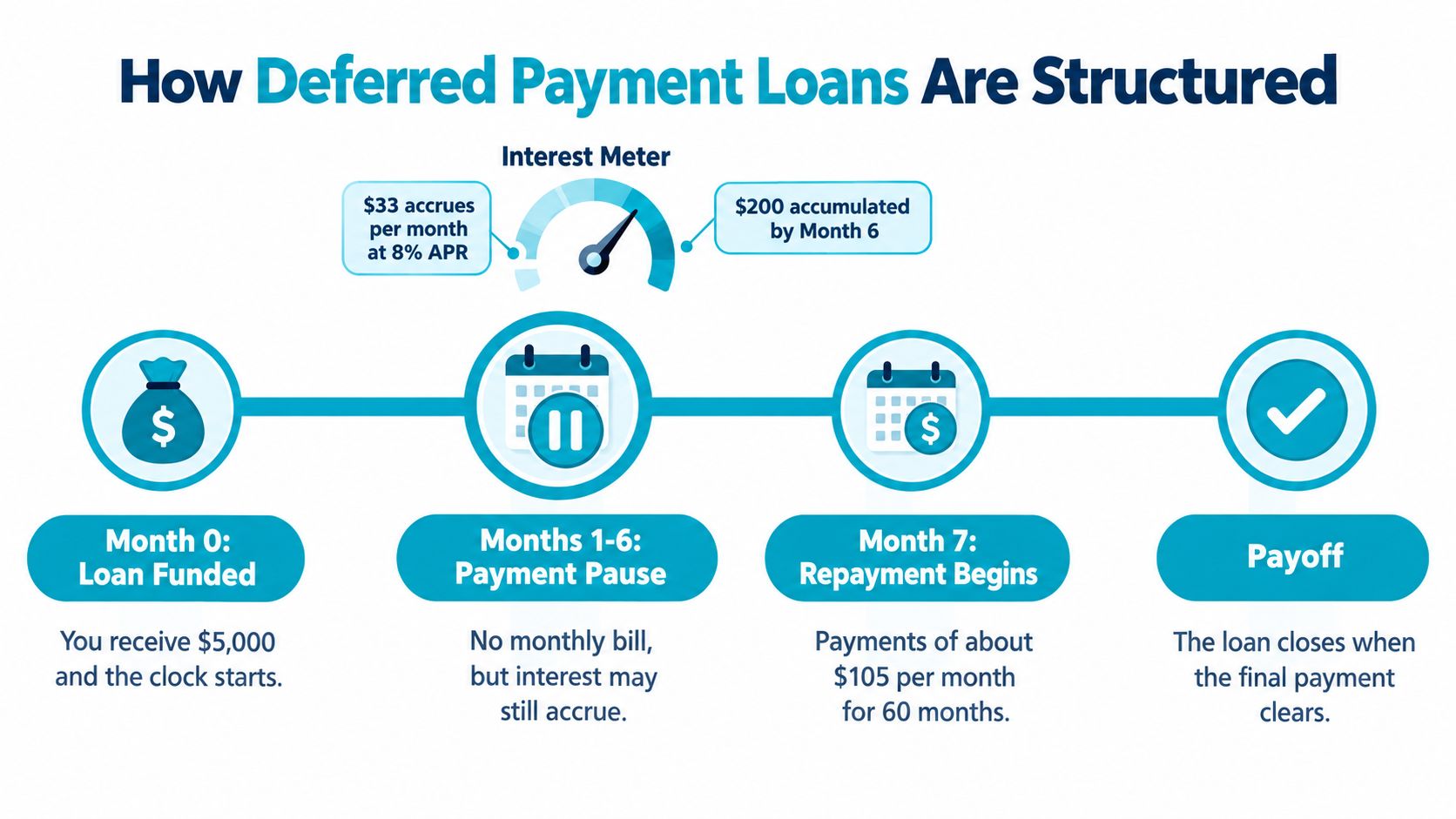
Picture a timeline, not a single loan amount. Money arrives, time passes, payments may pause, and then regular repayment begins. Each stage can carry a different rule, which is why reading only the headline offer leaves gaps.
The Pause and the Meter
The deferment period is the window when scheduled principal payments are postponed. Principal is the original amount you borrowed, before interest and fees. During that window, you may owe nothing each month, a reduced amount, or interest only, depending on the contract.
Interest accrual is separate. Accrual means interest builds up over time, even if no bill is due yet. A loan can pause your payments while the meter keeps running, pause both payments and interest, or use another combination the lender defines.
If unpaid interest is added to principal, that's interest capitalization. After capitalization, future interest is calculated on the larger balance. It's like owing rent on a storage unit, then having unpaid rent added to next month's rent base.
These three ideas aren't interchangeable:
- Payment deferral: You postpone required payments.
- Interest waiver: The lender doesn't charge interest for a defined period or forgives interest that would have accrued.
- Capitalization: Unpaid interest joins principal and can increase later interest.
Your promissory note or loan agreement settles which version you have. That's also where you'll find the repayment start date, payment amount, fees, and what triggers default. If you want the baseline first, review how installment loans work on a fixed schedule, then compare that normal timeline with the pause in front of you.
Structures vary by lender and product, so labels from another offer don't transfer. A student loan, medical financing plan, and retail promotion can all use the word deferred while treating interest differently. Read your own timeline in order, funding, pause, accrual, any capitalization, repayment, payoff, and circle every date.
Deferred Interest Promotions and Their Hidden Risk
A deferred interest promotion isn't the same as a payment deferral, and it isn't always the same as interest free credit. The promotion may delay billing interest while interest accrues behind the scenes from the transaction date on the full original balance. If you don't meet the payoff condition by the deadline, that accumulated interest can become due retroactively.
Consumer Financial Protection Bureau materials describe medical financing where the borrower can owe interest on the full purchase amount rather than only what remains, as explained in the CFPB action involving Springstone Financial and deferred interest medical credit. That detail matters if you've paid most of the balance but miss the finish line by a small amount.
A Worked Example
Take a $5,000 balance at a hypothetical 29.99% annual rate over 12 months. Simple interest on the full amount could reach roughly $1,500 before compounding and fees, subject to the contract's calculation method. Paying only the required minimum may leave a residue at expiration, and that residue can trigger the retroactive charge.
The safer arithmetic is plain. Divide the original balance by the number of promotional months, then pay at least that amount every month. Finish early if you can, because a posting delay near the deadline leaves little room to fix a mistake.
Practical rule: A statement showing $0 interest billed doesn't prove $0 interest is accruing.
Check four contract points before you rely on any promotion. Confirm the exact expiration date, whether a late payment ends the promotion, how payments are applied to promotional and nonpromotional balances, and whether any remaining cents count as failure to pay in full. Those small rules decide whether the promotion saves money or becomes the most expensive option on the table.
Common Situations Where Borrowers Use Delayed Repayment
A family replaces a broken refrigerator and spreads the cost because paying cash would empty the emergency fund. A patient leaves a clinic with a medical bill that can't be settled that day. Another borrower consolidates several balances and needs a short runway to stabilize cash flow before fixed payments begin.
These aren't exotic cases. Delayed repayment often appears when an expense is urgent, income is expected later, or several bills compete in the same month. The pause buys time to organize money, but it doesn't create the income needed for repayment.
Installment borrowing itself is widespread. The Federal Reserve Bank of Boston's analysis found 19.6% of U.S. families with a reference person aged 18 to 76 reported a personal installment loan in 2022, and you can review the breakdown in the Boston Fed analysis of the 2022 Survey of Consumer Finances. Usage reached 41.6% among families denied credit in the prior 12 months and 41.8% among families that had fallen behind on a mortgage or loan, compared with 13.6% in the highest income quartile in that same analysis.
That pattern changes how you should judge an offer. If you're already under payment pressure, clear terms aren't a courtesy, they're protection. You need the repayment schedule, total cost, fees, and eligibility rules before urgency pushes you into a pause you can't exit cleanly.
Weighing the Pros and Cons of Delayed Repayment
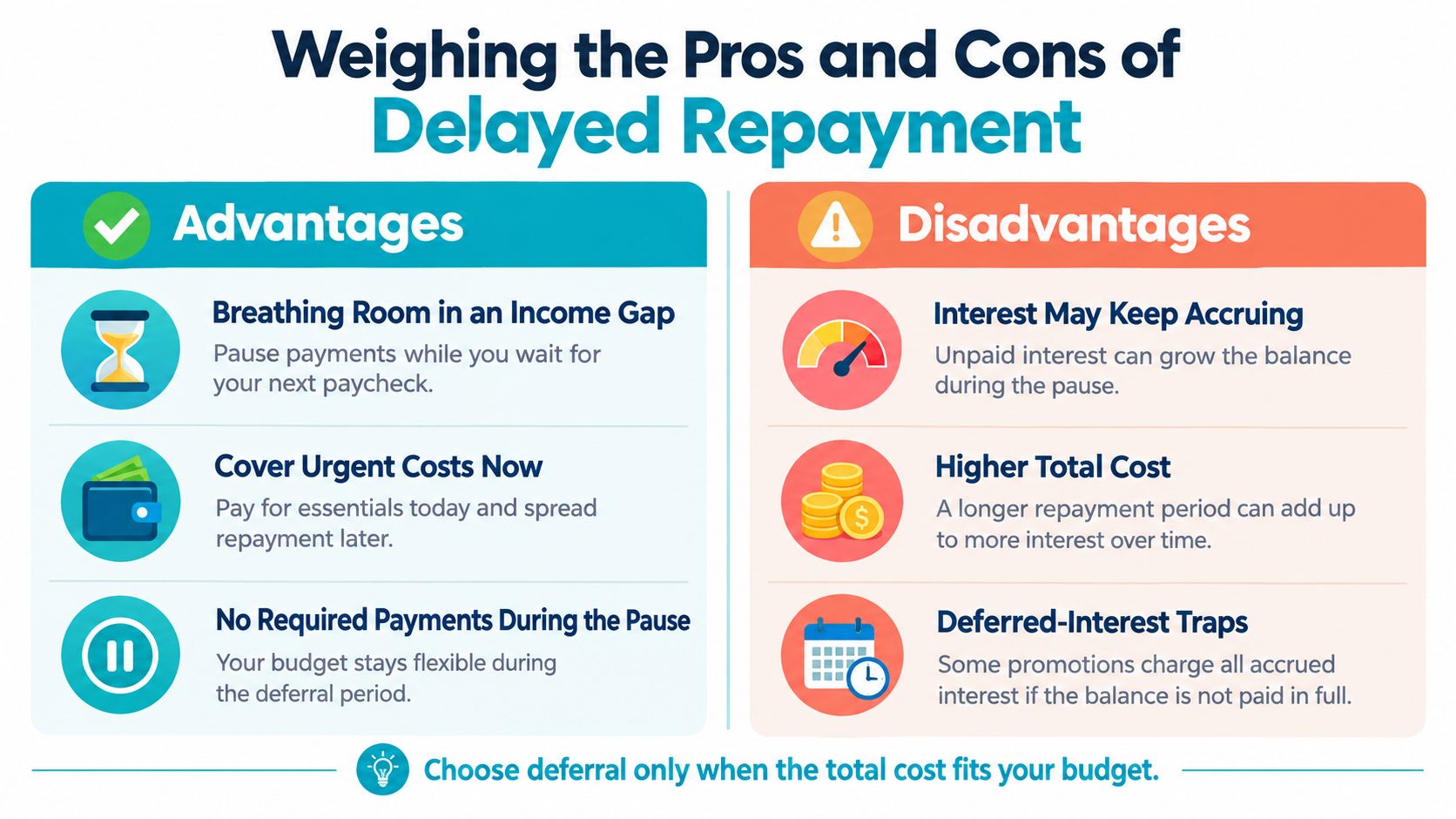
Delayed repayment works best as a bridge to a specific event, a paycheck, reimbursement, bonus, or return to work that you can date and budget around. It works poorly as a vague hope that money will feel easier later. The calendar will arrive either way, and the balance may be larger when it does.
The genuine advantages are practical:
- Breathing room: You can cover an urgent cost without draining cash needed for rent, food, or utilities.
- Timing alignment: Payments can begin after expected income arrives.
- Reserve protection: Keeping a small cash buffer may prevent a second emergency from going straight onto credit.
The disadvantages follow from the same delay. Accrued interest can raise total cost, capitalization can raise the balance entering repayment, and a long quiet period can make the first real payment feel like a new bill rather than part of the original plan.
Postponement also doesn't remove missed payment risk. Federal Reserve household data show 16% of U.S. adults used Buy Now Pay Later in the prior 12 months, up from 10% in 2021, slightly more than one quarter of users were late, and 64% of late payers reported an additional charge, according to the Federal Reserve report on household credit use. Younger users and people earning under $50,000 were more likely to pay late in that data.
Choose deferral only when you can name the repayment source, afford the payment after the pause, and accept the total cost. If any of those answers is fuzzy, the pause is probably postponing a budget problem rather than solving it.
Calculating the True Cost of Deferred Payments
Start with a clean example before you touch a real offer. On a $30,000 balance at 6% annual interest, a one year deferment generates approximately $1,800 in unpaid interest, and if capitalized the balance becomes about $31,800, making the next year's simple interest $1,908, as shown in the CFPB guidance on student loan deferment and interest. The extra $108 in that later year comes from charging interest on earlier unpaid interest.
That's compounding in plain language. You aren't only paying for the original borrowing during the pause. After capitalization, you're also paying interest on the interest you didn't pay.
Cost Scenarios for a $30,000 Balance at 6% With a One-Year Deferment
| Scenario | Unpaid Interest at End of Deferment | Balance Entering Repayment | First Full Year Interest |
|---|---|---|---|
| Interest paid during deferment | $0 unpaid | $30,000 | $1,800 |
| Interest accrued but not capitalized | $1,800 owed separately | $30,000 principal | $1,800 |
| Interest capitalized into principal | $1,800 added to principal | $31,800 | $1,908 |
Read the middle row carefully. Not capitalized doesn't mean forgiven. It means the interest hasn't joined principal yet, so it doesn't raise the base for the next interest calculation in this simple illustration. Your contract may set a specific capitalization date, and that date matters.
Loan type also matters. Subsidized federal student loans may receive an interest subsidy during specified deferment periods, while unsubsidized loans generally leave accrued interest with the borrower. This example reflects common student loan structures, not every private product, so don't copy its treatment onto a retail or medical offer without checking.
For any offer, use this formula:
Total cost = sum of all scheduled payments and fees − original principal
That number tells you more than the monthly payment alone. A lower payment can stretch the same debt over more time. Before comparing offers, review how personal loan APR rates affect total borrowing cost so you can separate the interest rate, fees, and repayment length instead of judging by the pause.
If you can't calculate the balance on your first repayment date, you can't yet compare the offer fairly.
Ask the lender for an amortization schedule that includes the deferment period. Amortization is the payment by payment breakdown of principal and interest over the loan's life. The schedule should show whether the balance grows, stays flat, or falls during every month, including the quiet ones.
Comparing Alternatives to a Deferred Payment Loan
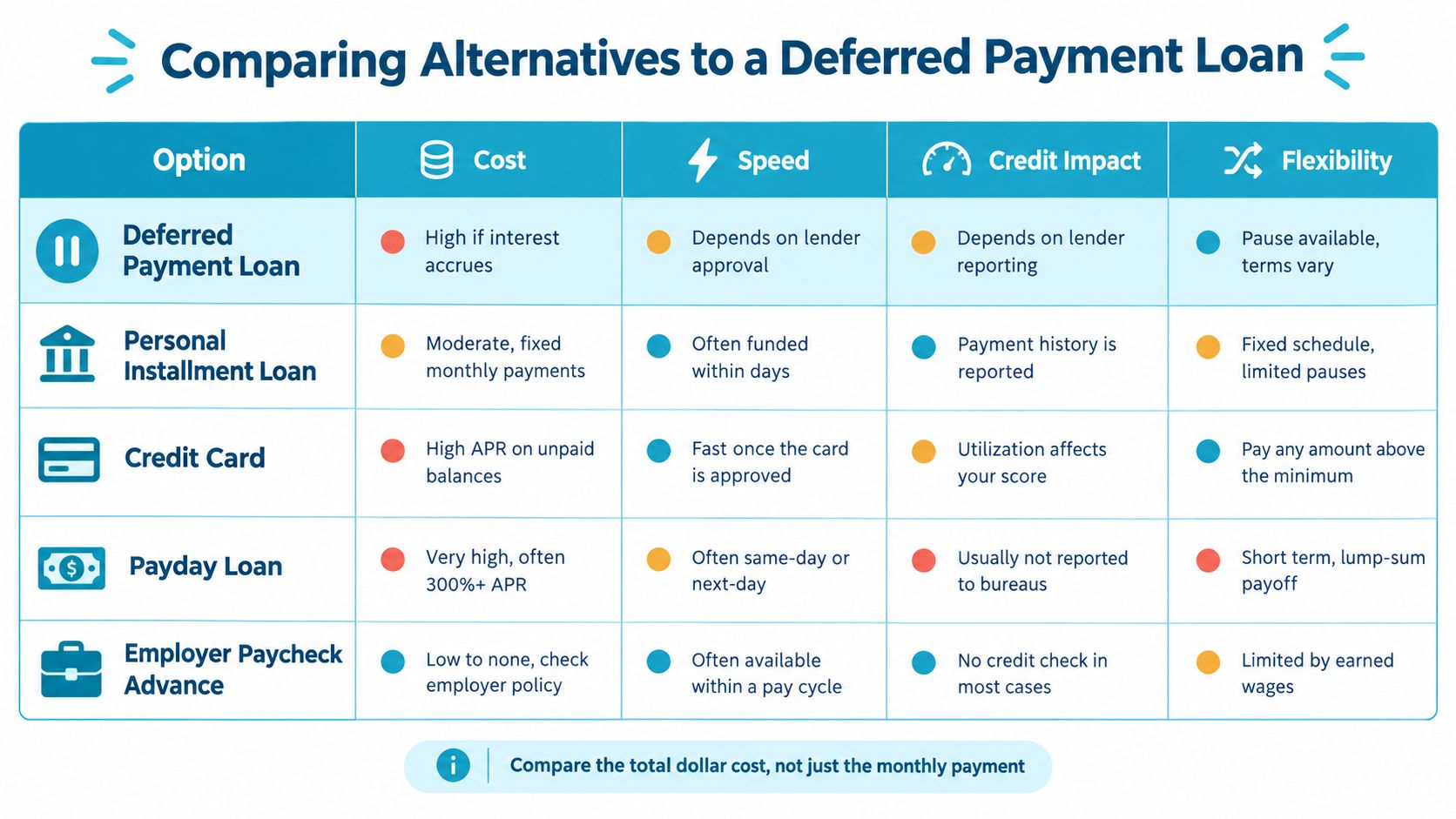
Compare every option with the same four questions: What will it cost in total dollars? How fast can you get it? How may it affect credit? How much flexibility do you have if income slips? A fast option can be expensive, and a flexible option can stay open so long that it costs more than a fixed schedule.
A provider's own payment plan may suit a medical or repair bill because you're negotiating the original bill rather than adding a separate loan. Ask whether the plan charges interest or fees, reports payments, or sends the account to collections after a missed installment. Get the agreement in writing before the first due date passes.
A 0% introductory card can work only if you'll clear the balance before the promotion ends and avoid new spending on the card. A credit union small dollar loan or fixed schedule personal installment loan may cost more upfront in monthly commitment, but the end date and payment are clearer from day one. For future emergencies, a small savings buffer is slower to build, yet it avoids interest entirely when it's available.
For other ways to handle short term cash pressure, compare the options in this guide to payday loan alternatives and their trade offs against any deferred structure you're offered. Use the same total cost formula for each one, not just the amount due first.
One marketplace option is NextStopLoans, which submits a single secure request to a network of independent third party lenders. Those lenders decide whether to make an offer and set the terms. The marketplace doesn't make credit decisions, doesn't pull credit itself, and doesn't require you to accept any offer. Availability is limited to eligible U.S. residents, and Arkansas, New York, Vermont, and West Virginia are excluded.
Don't treat a match as approval or a summary as the contract. The lender's written terms control interest during any pause, fees, reporting, and hardship options. Jurisdiction and lender type can also change your protections, so confirm what applies where you live before you consent.
How to Take the Next Step Safely
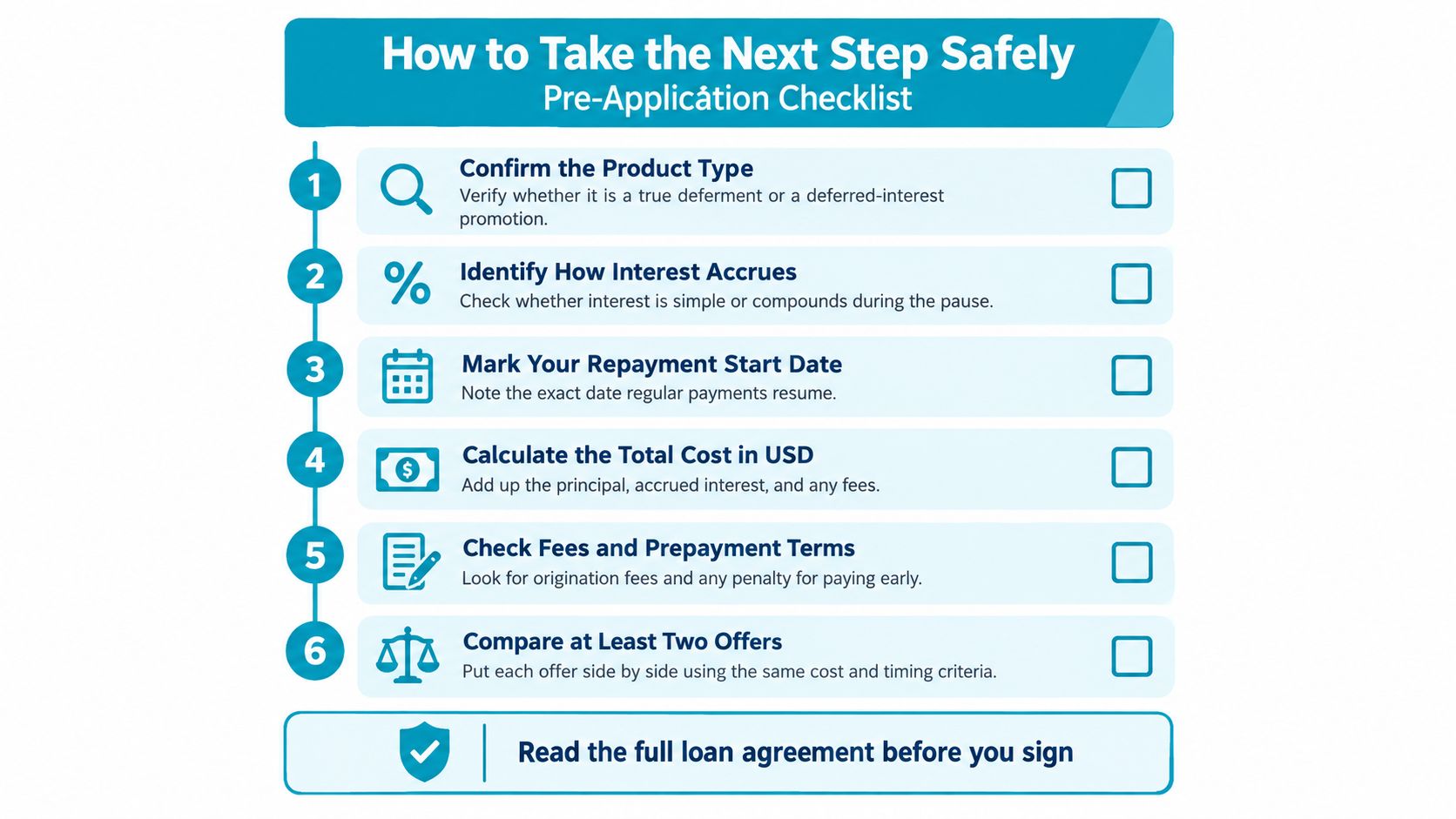
Before you apply, work through the contract in this order:
- Confirm the product type: True deferment, interest waiver, or deferred interest promotion?
- Trace interest during the pause: Does it accrue, and will unpaid interest be capitalized?
- Calculate the full repayment total: Add every payment and fee, then subtract principal.
- Verify the consequences: Check late fees, credit reporting, prepayment terms, and hardship options.
The lender's written terms outrank advertisements, marketplace summaries, and verbal explanations. Review the Rates and Fees, Lending Policy, and FAQ pages before submitting a request, and confirm that any secure form uses 256-bit SSL encryption and clear electronic consent.
If the total cost fits your budget and your state is eligible, compare at least two written offers side by side. Decline any schedule you can't meet without skipping essentials. A deferment helps only when the plan behind it is already funded.
If you've checked the interest rules, capitalization terms, and total repayment cost and still need to compare lender offers, visit NextStopLoans to submit one secure request to its network of independent lenders. Review any written offer carefully, compare it with at least one alternative, and accept only terms whose post pause payments fit your budget.