
How Do Installment Loans Work: A Complete Guide

What would happen if your income fell next month, even though your loan payment stayed exactly the same? Most explanations of installment loans stop at “fixed monthly payments,” but that phrase leaves out the details that determine whether borrowing helps or strains your finances. The payment amount is only one part of the agreement. You also need to understand how much interest accumulates, how quickly the balance falls, what fees apply, and whether the account will actually help your credit.
Table of Contents
- What You Think You Know About Installment Loans
- The Core Mechanics of Installment Loans
- Types of Installment Loans and When to Use Them
- Why Predictability Can Be a Trap
- Real Payment Calculations That Reveal True Cost
- How to Evaluate Any Installment Loan Offer
What You Think You Know About Installment Loans
Your car needs an unexpected repair costing $5,000. The lender's offer looks reassuring: one lump sum now, followed by fixed payments on a predictable schedule. You check whether the monthly amount fits your current budget and feel ready to accept.
That decision may still leave important questions unanswered. How much will you repay altogether? How much of the first payment will reduce what you borrowed? Does the lender charge an origination or documentation fee? If your income drops or another urgent bill appears, will the payment remain manageable alongside everything else you already owe?
An installment loan gives you a defined amount upfront and requires repayment through scheduled installments instead of one lump-sum payment. That structure can make a large expense easier to plan for, but a fixed payment doesn't automatically make the debt affordable. A longer repayment term can make the monthly amount look smaller while leaving the balance outstanding for longer and increasing the total interest.

The monthly payment is not the whole price
Think of a loan offer as a package with several separate parts:
- Principal: The amount the lender advances to you.
- Interest: The cost of using the lender's money.
- Fees: Disclosed charges that may increase the cost or reduce the amount you receive.
- Term: The period over which you make payments.
- Payment schedule: The timing and number of installments.
- Total repayment: The amount you'll pay when every scheduled installment is complete.
A borrower who focuses only on the monthly figure can miss an expensive tradeoff. Lower payments may leave more room in this month's budget, but they may also mean more interest over the life of the loan. A payment can be technically affordable today and still become difficult when rent rises, work hours fall, or another debt payment begins.
The phrase “guaranteed approval” deserves particular caution. No legitimate marketplace can promise that every applicant will receive approval on terms they can afford, because lenders assess applications independently and set their own requirements. Before relying on any offer, learn what guaranteed approval means for installment loans and distinguish marketing language from a firm loan agreement.
The useful question isn't “Can I make this payment today?” It's “Can I keep making it if my financial situation becomes less comfortable?”
The rest of the agreement answers that question. You need to see how every payment is divided, whether the balance declines as expected, and what happens if you pay late or repay early. Once those mechanics are clear, the fixed-payment promise becomes useful information rather than a substitute for comparison.
The Core Mechanics of Installment Loans
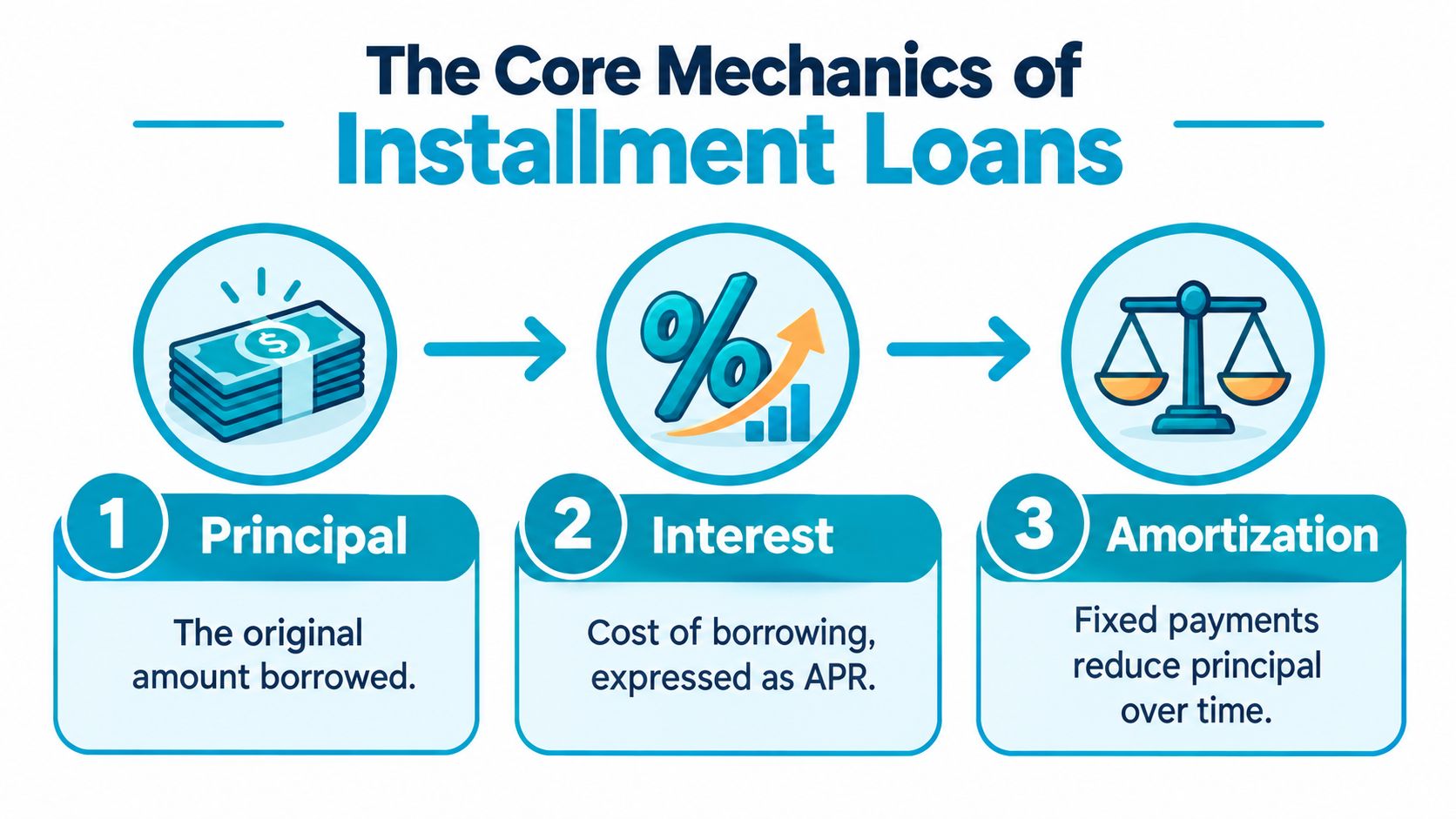
An installment loan usually begins with three ideas: principal, interest, and amortization. Principal is the amount borrowed. Interest is the lender's charge for providing that money. Amortization is the process of gradually reducing the principal through regular payments.
A simple way to picture amortization is a bathtub with water flowing in and a small drain at the bottom. The borrowed money fills the tub at the start. Each payment sends money toward the drain, but interest is calculated on the amount still in the tub. As the balance falls, the interest portion normally becomes smaller, allowing more of a later payment to reduce principal.
Follow one payment through the schedule
Under a standard fully amortizing structure, the lender calculates the scheduled payment using the principal, interest rate, and repayment term. Each installment generally includes both principal and interest, along with any applicable disclosed charges.
At the beginning, the outstanding balance is at its highest. That means the interest calculation applies to a larger amount, so the early payments typically devote more money to interest. Later, after repeated payments have reduced the balance, less interest accrues and more of the scheduled payment goes toward principal.
For example, a $10,000 loan at a 6% annual percentage rate over 60 months would require approximately $193 per month and about $1,580 in total interest, assuming a standard fully amortizing schedule with no additional fees. Those figures come from the specified loan terms, not from the payment amount alone. Extending the term can lower the required monthly payment, but it usually increases the total interest because the balance remains outstanding for more periods. The Federal Trade Commission's explanation of APR describes APR as a broader measure that can include the amount borrowed, finance charges, certain fees, and the length of the borrowing period.
APR and interest rate answer different questions
The stated interest rate tells you the rate used to calculate borrowing costs. APR can provide a broader comparison because it may reflect certain fees and the structure of the borrowing period as well as interest.
That distinction matters when two offers show similar monthly payments. One may include an origination charge, processing fee, or documentation fee that changes the overall cost. Compare the APR, finance charge, number of payments, and total repayment amount instead of assuming the lowest monthly figure represents the cheapest loan.
Also check whether the agreement is fully amortizing. An interest-only period can postpone principal reduction, while a balloon payment can leave a large remaining balance due at the end. A payment schedule that doesn't retire the balance by maturity isn't equivalent to a standard loan that reaches a zero balance through regular installments.
Types of Installment Loans and When to Use Them
“Installment loan” describes the repayment structure, not one particular product. The loan may be secured by an asset or unsecured, restricted to a specific purchase or usable for a broader purpose. The right choice depends on what you need, what you're pledging, and whether the payment remains reasonable after adding your existing obligations.
| Loan Type | Typical Use | Usual Term | Collateral |
|---|---|---|---|
| Personal loan | A flexible expense, such as consolidation, a major purchase, or an emergency bill | Set by the lender and agreement | Often unsecured, though some offers may require an asset |
| Auto loan | Purchasing or refinancing a vehicle | Set by the vehicle financing agreement | Usually the vehicle |
| Home equity loan | A defined home improvement or other large expense using available equity | Set by the loan agreement | Usually the home |
| Specialized credit option | Borrowing when a conventional lender may not approve the application | Varies substantially by lender | May be unsecured or may use an asset, depending on the product |
Match the structure to the purpose
A personal loan can make sense when you need one fixed amount and want a defined payoff schedule. Debt consolidation requires extra care, though. Replacing several debts with one payment may simplify administration, but it doesn't automatically reduce what you owe or make the new borrowing affordable.
An auto loan is tied to a vehicle, and the vehicle typically secures the lender's interest. If you fail to repay, the consequences can include losing the car, which may also affect your ability to work or manage daily responsibilities. A home equity loan carries a different level of risk because the home stands behind the debt.
Specialized options for borrowers with limited or damaged credit may consider factors beyond a conventional credit profile. That flexibility can come with a higher cost, stricter conditions, or collateral requirements. Read the agreement closely before assuming that approval solves the underlying cash-flow problem.
Understand the role of a marketplace
A connector or marketplace isn't the same as a direct lender. A marketplace can route an application to independent lenders, while the participating lender decides whether to approve the request, what rate to offer, and which repayment terms apply. The lender also handles funding and the loan agreement.
That distinction affects how you compare offers. You may see different APRs, fees, terms, and eligibility requirements, and each offer needs its own review. For a clearer comparison of repayment structures, see this guide to installment loans versus revolving loans. Revolving credit lets a borrower draw, repay, and potentially borrow again within a credit limit. An installment loan normally provides the agreed amount once and follows a set payoff schedule.
Why Predictability Can Be a Trap
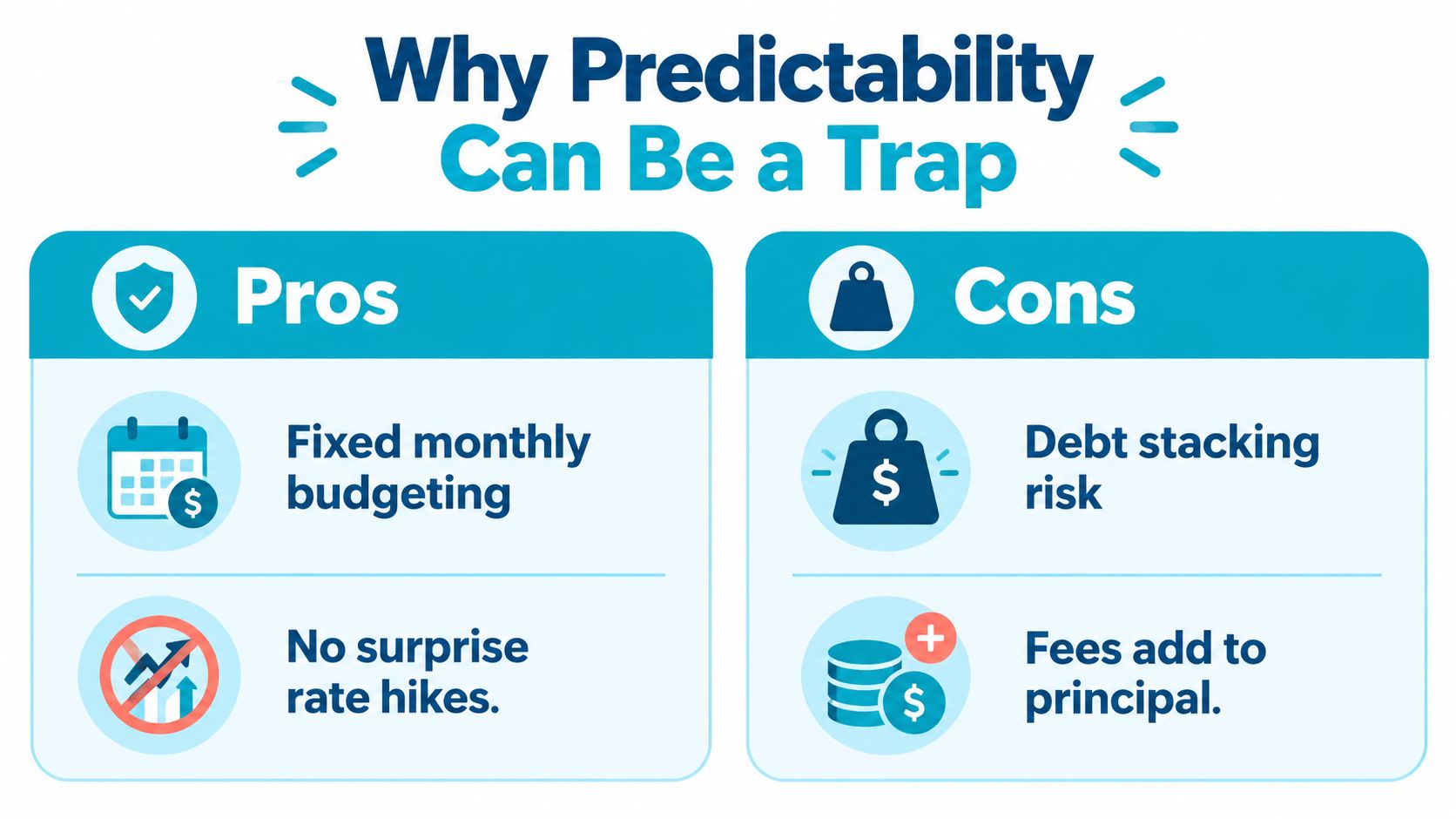
A fixed payment can help you plan, but predictability isn't the same as safety. If you already have rent, utilities, insurance, credit card bills, or another loan payment, adding one more fixed obligation may reduce the money available for food, transport, savings, and unexpected costs.
Debt stacking is the problem. Each individual payment may look manageable when viewed alone, yet the combined obligations can leave little flexibility. If income falls, overtime disappears, or a necessary repair arrives, the loan doesn't pause just because the rest of your budget has become tighter.
Fees and repayment stress belong in the same calculation
A borrower may accept an offer after checking only the scheduled payment. That approach overlooks charges that can increase the cost, reduce the amount received, or apply after a missed payment. The agreement should explain origination charges, late fees, returned-payment fees, optional products, and any conditions attached to early repayment.
The Congressional Research Service discussion of installment lending reported a 70% increase in installment-loan complaints compared with the prior two-year monthly average, while complaints involving unexpected fees or interest rose 82%. Those figures don't prove that every lender or loan is unsafe, but they show why borrowers should ask direct questions about unfamiliar charges before accepting an agreement.
A payment can be fixed while your circumstances change
Test the offer against more than your current paycheck. Ask yourself:
- Income interruption: Could you keep paying if your hours or earnings fell?
- New obligation: Would a medical bill, household repair, or family expense force you to borrow again?
- Existing debt: What happens when this payment is added to every other required payment?
- Available cash: After essentials and debt payments, would you have money left for ordinary surprises?
- Late-payment consequences: When does the lender charge a fee, report delinquency, or begin collection activity?
Credit reporting creates another source of confusion. On-time payments may add positive history if the lender reports them, but reporting isn't universal. Boston Federal Reserve research notes that personal installment loans may not improve credit scores or expand access to mainstream credit when lenders don't report the account to credit bureaus. Ask which bureaus receive payment data, when reporting starts, whether late payments are reported, and whether the account remains on your file after payoff. The Federal Reserve Bank of Boston's analysis of personal installment lending also distinguishes the possible effects of a new account and hard inquiry from the more serious consequences of missed payments, defaults, or collections.
The same analysis cites New York Fed data showing that 4.3% of outstanding household debt was delinquent in the first quarter of 2025, compared with 3.6% in the preceding quarter. That change doesn't establish that installment loans caused the increase. It does reinforce the practical question: if you repay perfectly, what credit benefit will you receive, and what happens if the lender doesn't report?
Real Payment Calculations That Reveal True Cost
Loan math becomes useful when you apply it to a decision. Start with four items from the offer: the amount financed, APR, payment amount, and number of payments. Then compare the total of all scheduled payments with the amount you receive or the purchase price being financed.
A simple formula is:
Total scheduled repayment = payment amount × number of payments
To estimate the interest and disclosed finance cost, compare that total with the amount financed. Then check whether fees were taken from the advance, added to the balance, or billed separately. The agreement and amortization schedule should control your final calculation.
Compare terms at the same rate
Suppose two lenders offer the same principal and the same APR, but one schedules repayment over a shorter period and the other spreads it across more payments. The shorter-term offer will generally require a higher monthly payment, because the borrower must repay the principal more quickly. It will usually produce less total interest because the balance declines sooner.
The longer-term offer can create useful breathing room when the shorter payment would make essential expenses difficult to cover. But the lower monthly figure doesn't mean the offer costs less. Count every payment and compare total repayment before choosing the apparently easier option.
The verified example of a $10,000 loan at 6% APR over 60 months illustrates this relationship: the scheduled payment is approximately $193, with about $1,580 in total interest, assuming no additional fees and a standard amortizing schedule. A loan calculator can help you test different principal, APR, and term combinations, but use the lender's disclosure to confirm fees and the final repayment amount.
Always compare total repayment, not just monthly affordability.
Add fees before comparing offers
An origination fee changes the economics even when the scheduled payment looks attractive. If the lender deducts the fee from the money delivered to you, you may receive less cash than the principal stated in the agreement. If the fee is financed, you may pay interest on that charge as part of the balance.
For example, two offers can show the same borrowed amount and monthly payment while differing in the amount deposited into your account. The offer with the larger fee may provide less usable money and carry a higher overall cost. Review the APR and finance charge, then confirm the net amount you'll receive.
Treat expensive credit as a budget warning
A higher-rate offer can produce a payment that fits on paper but leaves little room for error. This is especially important when a borrower is already dealing with credit-access problems or financial stress. Federal Reserve analysis found that 19.6% of families with a reference person aged 18 to 76 held a personal installment loan in 2022, and the share was higher among families reporting recent credit denial or being behind on a mortgage or loan. The same analysis reported 24.5 million consumers with at least one personal installment loan in 2024 and $251 billion in outstanding personal-installment balances. The Federal Reserve household-credit analysis shows why these loans are common, but popularity doesn't determine affordability.
Run the payment against your full budget, not against the emergency that prompted the application. If the offer requires you to skip essentials, depend on uncertain income, or take another loan to cover ordinary expenses, the arithmetic is already warning you.
How to Evaluate Any Installment Loan Offer
Read the offer in the order that reveals risk. First identify how much money you'll receive, then determine what you'll repay, and only afterward decide whether the payment belongs in your budget. A lender's approval doesn't establish that the loan is suitable for you.
Use a five-part review
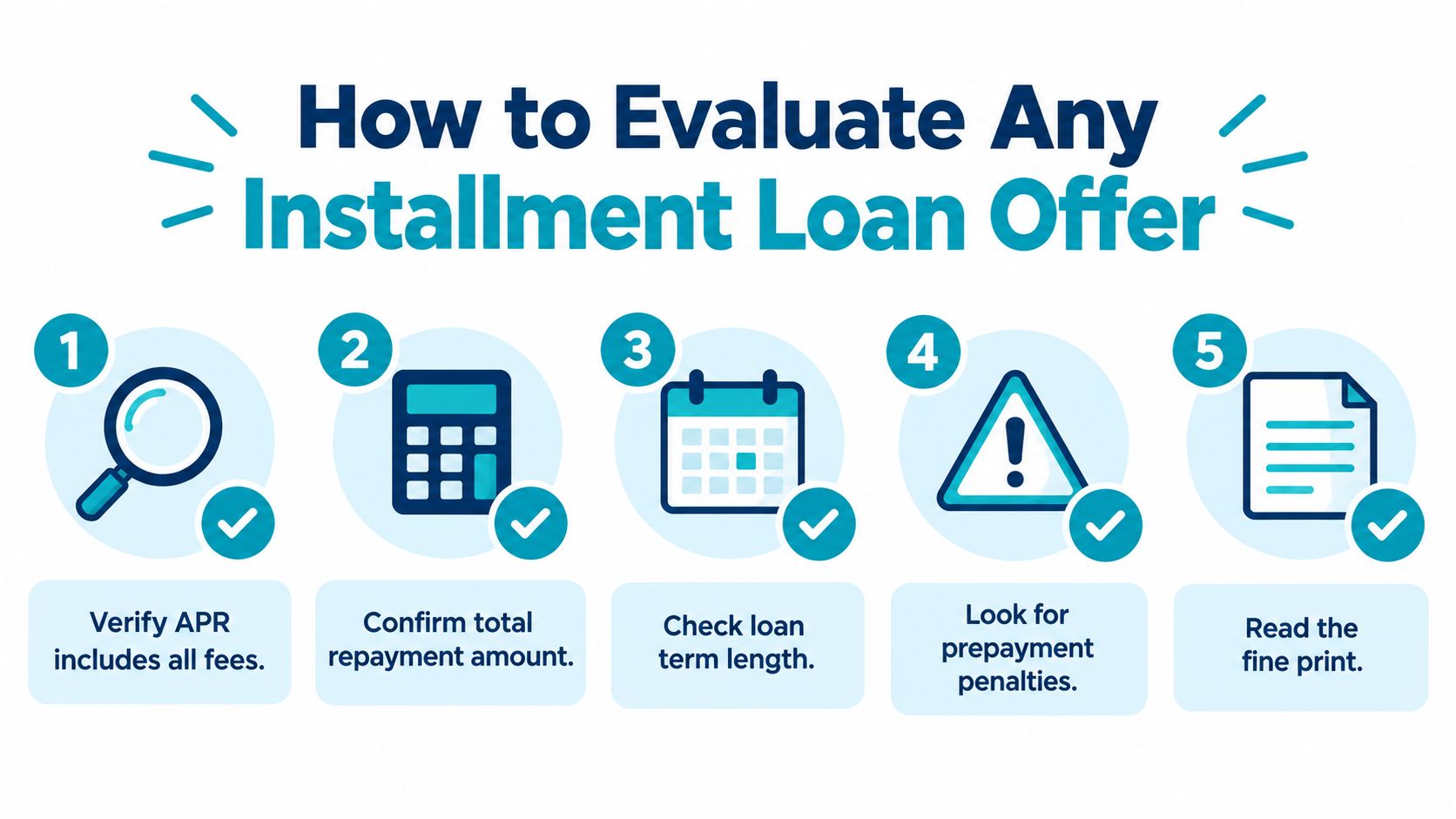
- Verify the APR: Confirm what fees and finance charges the APR includes. Don't compare a bare interest rate from one offer with an APR from another.
- Confirm total repayment: Multiply the scheduled payment by the number of payments, then reconcile the result with the disclosure. Find out whether any fee is paid upfront, deducted from the proceeds, or added to the balance.
- Check the term and schedule: Make sure you know the payment frequency, first due date, final due date, and number of installments. A longer term may reduce the required payment while increasing total interest.
- Ask about early repayment: Determine whether the lender charges a prepayment penalty or applies any special payoff condition. Paying early shouldn't be assumed to reduce every cost automatically, because some fees may already have been charged.
- Read the fine print: Look for late fees, failed-payment charges, collateral provisions, interest-only periods, balloon payments, and collection procedures.
The Consumer Financial Protection Bureau describes amortization and related loan terms as the gradual payoff of a loan through regular payments, with each payment divided between principal and finance charge. Use the amortization schedule to verify that the balance declines and that the agreement doesn't postpone principal repayment or leave a balloon balance.
Ask the credit-reporting questions
Don't accept a promise that “on-time payments build credit” without details. Ask whether the lender reports to one or more credit bureaus, which bureaus receive the information, when the first payment appears, and how the lender handles a paid-off account. Also ask how a late payment is reported and when collection activity may begin.
Finally, test resilience. Keep the loan only if the payment remains workable after essential expenses, existing debt, and a reasonable allowance for disruption. If a lender or application channel presents multiple offers, evaluate each one independently. You aren't required to accept an offer just because you completed an application, and a low monthly payment isn't a substitute for a clear total-cost comparison.
NextStopLoans connects U.S. consumers with independent third-party lenders through an online loan-request marketplace, where lenders independently decide approval, rates, fees, and repayment terms. Visit NextStopLoans to submit a request and review any offers carefully against the APR, total repayment, credit-reporting terms, and budget checks described above.