
Debt Consolidation Loans with No Collateral

You've paid the card bills, but the balances barely seem to move. A retail account is due before payday, another card carries a recurring charge you forgot about, and an offer promising a smaller monthly payment suddenly looks appealing. Before you accept, you need to know whether that payment represents a better deal or just a longer commitment.
Table of Contents
- Start With the Balance Behind the Payment
- Understand How Unsecured Consolidation Works
- Compare Unsecured and Secured Consolidation
- Calculate the True Cost Before Choosing
- Check Eligibility and Evaluate Lender Offers
- See When Consolidation Helps or Hurts
- Protect the Savings After Approval
- Choose Consolidation Only When It Fits
Start With the Balance Behind the Payment
Consider a familiar situation: you use one card for groceries, another for an unexpected repair, and a store account for an earlier purchase. You can cover the minimums, but tracking the accounts takes effort. Meanwhile, interest charges make it difficult to see how much progress you're making.
A consolidation offer seems to solve the visible problem by replacing those bills with a single payment. But payment relief and debt reduction aren't the same thing. A lender can offer a smaller payment by extending repayment, potentially increasing total interest rather than reducing it.
The scale of revolving borrowing helps explain the appeal. U.S. credit-card balances reached $1.23 trillion in the third quarter of 2025, according to the New York Fed's household debt report. That context doesn't tell you whether a particular offer is worthwhile. Your own balances and repayment options do.

Build a portable debt inventory
Before speaking with a lender, create a worksheet you can update and reuse:
- Balances and payoff amounts: Record what each account shows and ask what's required to settle it.
- Interest rates: Note each APR and any conditions affecting that rate.
- Required payments: Include minimums, due dates, and recurring account charges.
- Your actual repayment budget: Write down what you can consistently pay, not just what you paid during a good month.
Keep this inventory beside every offer. Without it, you're comparing a clearly advertised new payment against an incomplete picture of your existing debts.
Starting principle: Evaluate consolidation as a financing change, not a service that makes the amount you owe disappear.
Understand How Unsecured Consolidation Works
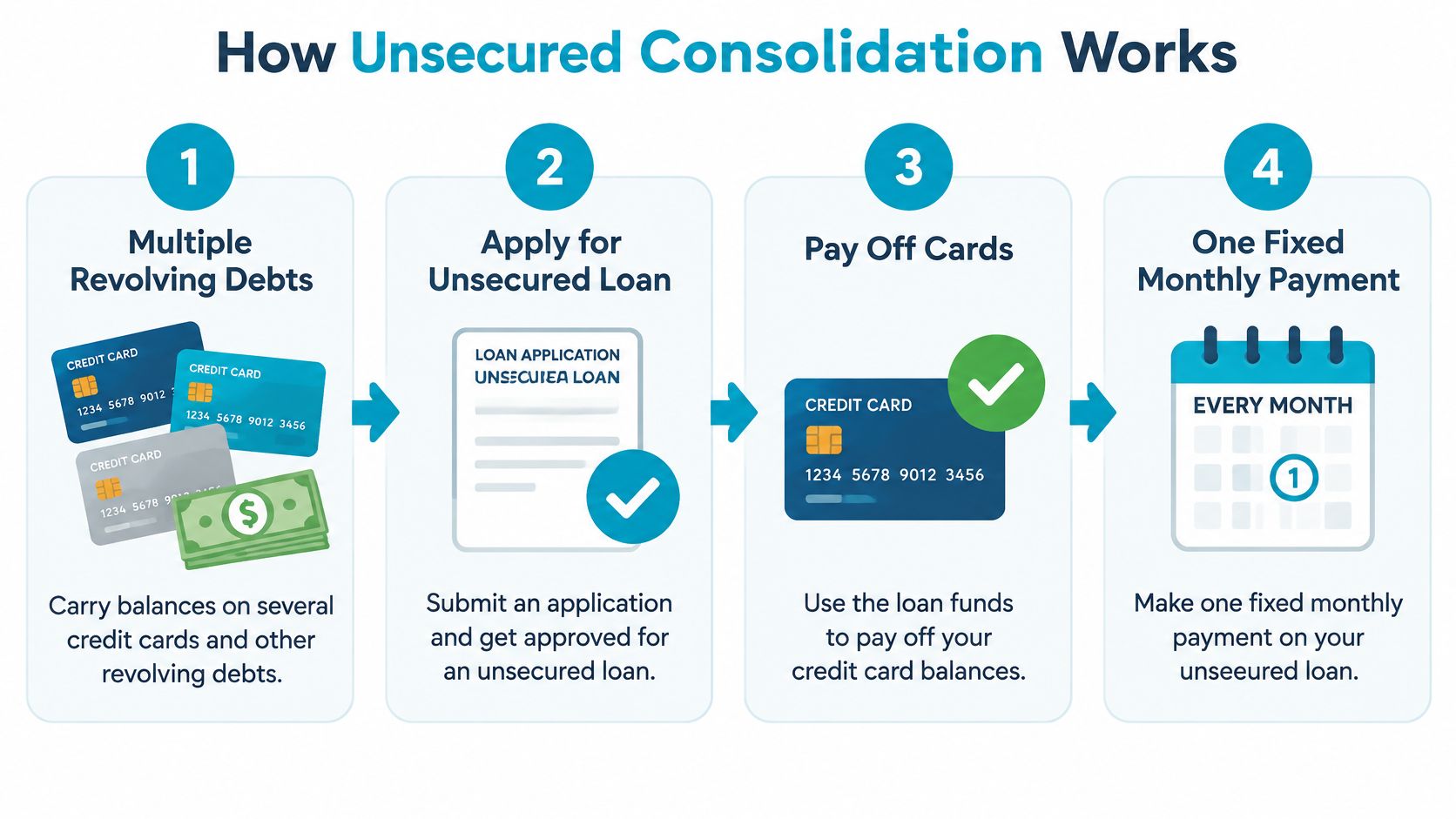
Debt consolidation loans with no collateral are generally unsecured personal loans used to repay existing obligations. You don't pledge a home, vehicle, deposit account, or another specified asset to secure repayment. Instead, the lender evaluates whether your financial profile meets its lending standards.
Think of the transaction as a change in your ledger. Before consolidation, you owe several creditors. After the proceeds pay those creditors, you owe the new lender. The old balances have moved into a different repayment arrangement, and any financed costs may increase the new obligation.
Federal Reserve analysis describes personal loans as generally unsecured and predominantly fixed-rate, which helps explain their appeal for predictable repayment. Its analysis of personal lending and fintech providers also provides context for this segment of consumer borrowing.
Learn the terms before comparing offers
The vocabulary becomes easier when you connect each term to a practical question.
- Principal: How much will you owe on the new loan before future interest accrues?
- Annual percentage rate: What annualized borrowing cost does the lender disclose, including applicable finance charges?
- Origination fee: What does the lender charge to issue the loan, and how will that charge be collected?
- Term: How long does the repayment schedule last?
- Scheduled payment: What amount must you pay on each due date under the agreement?
A fixed rate and a fixed payment can make budgeting more predictable. They don't establish whether the loan is cheaper than your current repayment plan.
You may also encounter the term signature loan while shopping. This explanation of what a signature loan means can help you recognize another label used for unsecured borrowing. The label isn't a substitute for reviewing the actual agreement.
Follow the money through payoff
Ask who receives the proceeds. Will the lender send payment directly to your creditors, or will you receive funds and handle repayment yourself?
Also check whether the available proceeds cover every intended payoff. An offer that looks large enough before deductions may leave an unpaid balance behind. Your goal is a complete, documented transition, not merely approval for a new account.
Compare Unsecured and Secured Consolidation
The central difference between unsecured and secured consolidation is whether you pledge an asset, not whether you're serious about repaying. Both involve borrowing, and neither should proceed just because a lender approves it.
With secured borrowing, the pledged asset gives the lender an additional way to recover money after default. That protection can support more favorable pricing, but it doesn't guarantee a lower-cost offer. With unsecured borrowing, lenders rely more heavily on eligibility standards and pricing to address repayment risk.
Unsecured and Secured Consolidation Compared
| Criterion | Unsecured Consolidation Loan | Secured Consolidation Loan |
|---|---|---|
| Collateral | No specified asset pledged | A specified asset secures repayment |
| Approval dependence | Credit profile, income, obligations, and lender underwriting | Repayment profile plus the lender's collateral requirements |
| Potential pricing | May cost more because there's no pledged asset | Collateral may support stronger pricing, but terms still require comparison |
| Asset-loss exposure | No pledged asset tied to the agreement | Default can put the pledged asset at risk |
| Main decision question | Does the offer justify its cost and required payment? | Do any savings justify adding collateral risk? |
| When to pause | Payment is unaffordable or full costs remain unclear | Payment is unaffordable, terms are unclear, or the asset risk is unacceptable |
Suppose you're comparing an unsecured offer with a loan backed by your home. The secured option may look attractive on price. But using it would change more than the interest charge: you'd be linking repayment to an asset you depend on.
Conversely, avoiding collateral doesn't make an expensive unsecured offer sensible. You can reject an offer without deciding that secured borrowing is the answer.
Separate eligibility from affordability
A lender's approval answers its underwriting question. Your affordability test must answer your household's question: can you make the payment while covering essential expenses and your remaining obligations?
Review the budget after consolidation, including any debts that won't be paid off. Don't assume that combining selected accounts solves a broader gap between income and spending.
Consider how each option would feel during an interruption in income. Would the payment remain manageable? Would you be comfortable with the pledged asset being exposed if you couldn't repay?
A cheaper borrowing rate isn't automatically worth a more serious consequence if repayment fails.
Neither route should proceed when the repayment plan depends on consistently borrowing again for ordinary expenses. In that situation, the immediate task is to address the budget shortfall and discuss available arrangements with existing creditors, rather than choosing collateral based on which lender says yes.
Calculate the True Cost Before Choosing
Compare total repayment under realistic schedules, not just the advertised monthly amount. Start with your existing balances and estimate what you'd pay if you continued a specific repayment plan without making new purchases. Then compare that result with the proposed loan's complete payment schedule.
A hypothetical example doesn't need invented rates to show the trade-off. Suppose you're already paying more than the minimums and expect to finish relatively soon. A new loan stretches repayment over a much longer period: the required payment falls, but the additional interest-bearing time may outweigh a lower rate.
Use a consistent cost worksheet
Ask the lender for its written disclosures and a schedule showing payments through payoff. Review debt consolidation loan terms before accepting unfamiliar language.
| Comparison item | Existing repayment plan | Proposed consolidation loan |
|---|---|---|
| Starting obligation | Current payoff balances | New principal |
| Cash required upfront | Any relevant account costs | Fees paid separately |
| Payment schedule | Planned payments without new borrowing | Contractual scheduled payments |
| Completion | Estimated payoff timing | Scheduled maturity |
| Total cash paid | All payments through payoff | All scheduled payments plus separately paid fees |
Don't count the same fee twice. If a fee is included in the principal, the payment schedule already reflects repayment of that amount. If it's paid separately, include that separate expense when comparing total cash outflow.
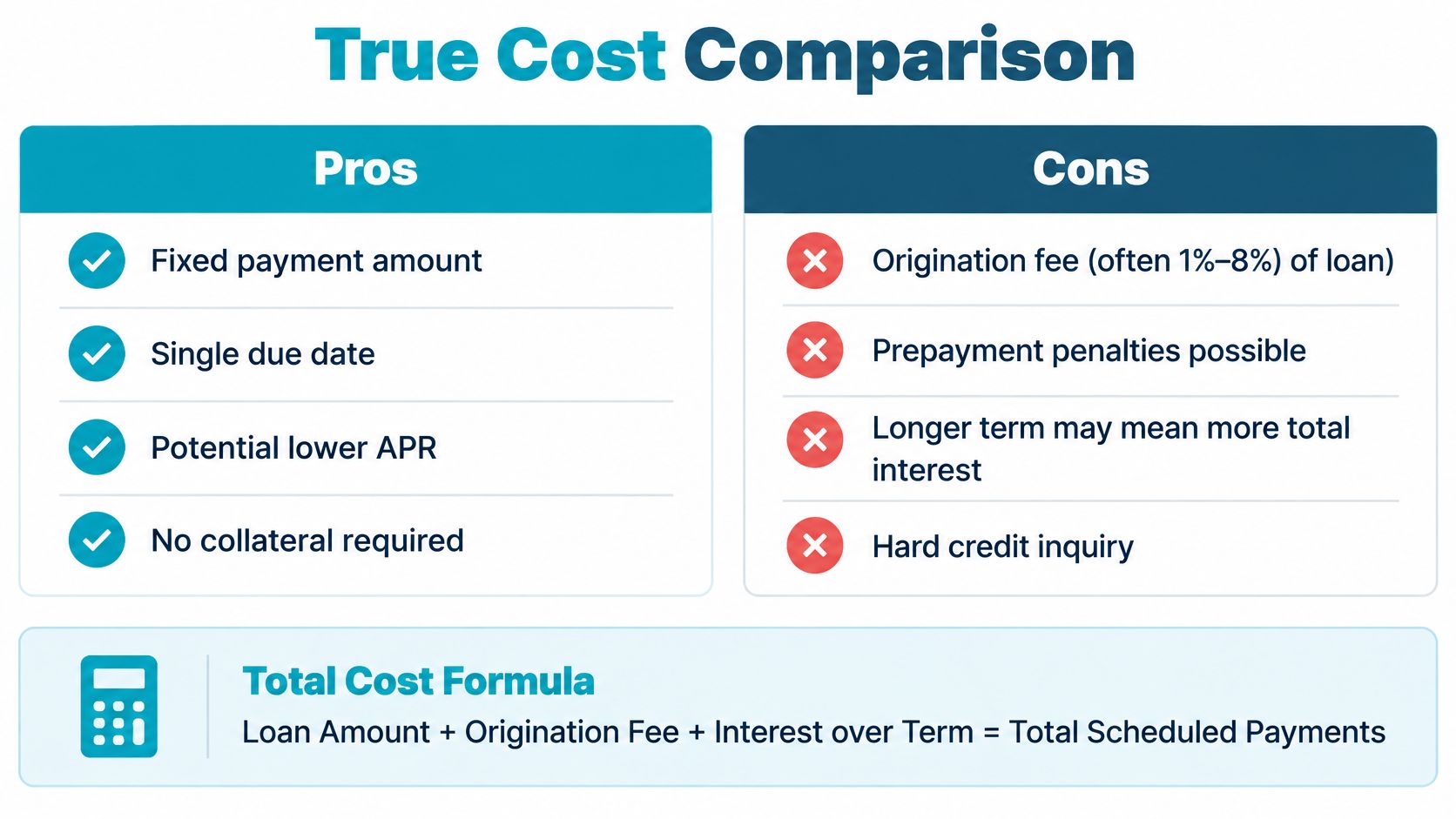
Treat fee figures in general illustrations as examples, not a quote or a verified market range. Your lender's disclosures govern, and a simplified cost formula needs adjustment whenever it would double-count a financed fee.
Establish your break-even point
Your weighted existing APR gives larger balances proportionately more influence. Multiply each balance by its APR, add those results, and divide by the combined balances. This provides a useful rate comparison, but it isn't a complete savings calculation because fees and repayment timing still matter.
For a practical break-even test:
- Estimate the current path: Total the payments needed to repay existing debts under your chosen schedule.
- Calculate the proposed path: Total the new loan's payments and any costs paid separately.
- Compare the difference: The proposed path must cost less to establish repayment savings.
Ask how early repayment works and whether prepayment charges apply. If your plan depends on paying extra, request a comparison that reflects that behavior rather than relying only on the minimum required payment.
A lower payment may still provide valuable breathing room. Just identify it as a cash-flow benefit if the total repayment comparison doesn't show savings.
Check Eligibility and Evaluate Lender Offers
Prepare for underwriting before you focus on advertised terms. Lenders may evaluate your credit history, income, existing obligations, and their own approval criteria. An unsecured application doesn't remove those checks.
Gather accurate information about earnings, housing expenses, and outstanding accounts. Use the same information across requests so you can compare resulting offers meaningfully. This overview of debt consolidation loan qualifications can help you organize that preparation.
Identify who is handling your request
You can approach lenders directly or use a marketplace. NextStopLoans is one marketplace option that submits consumer requests to independent third-party lenders rather than lending money itself. It doesn't make credit decisions, pull credit, or determine the final APR, amount, term, fees, or approval conditions.
Participating lenders may check credit, and multiple lender reviews can involve credit inquiries. Before consenting, ask who may receive the request and what credit-check authorization you're providing. A single intake form shouldn't be interpreted as a promise about how every participating lender will review you.
Poor-credit pathways also require careful comparison. Broader eligibility considerations don't guarantee acceptance, and an available offer may carry materially higher pricing.
Review the offer rather than the advertisement
Keep a written record of the lender's answers:
- Lender identity: Who will issue the loan, and who will receive your payments?
- Proceeds: How much reaches you or your creditors after deductions?
- Repayment: What are the payment amount, frequency, first due date, and final scheduled payment?
- Costs and conditions: What fees, prepayment rules, and funding conditions apply?
- Credit review: What checks are involved, and what consent have you provided?
Read the offer alongside your worksheet, not in isolation. An amount larger than your payoff need isn't necessarily useful, and a payment that excludes remaining debts doesn't describe your full monthly burden.
You're researching a possible agreement, not committing to accept whatever appears. If the lender won't clarify a term in writing, pause the process.
A useful offer should be understandable without relying on a salesperson's reassurance. You should be able to explain who lends the money, where it goes, what you owe, and when repayment ends. If you can't, you don't yet have enough information to make the decision.
See When Consolidation Helps or Hurts
The most useful question isn't whether consolidation works in general. It's which borrowing pattern describes your situation.
A costly balance meets a credible payoff plan
Consider a borrower carrying high-APR revolving debt who receives an offer with lower complete repayment costs. The borrower can afford the scheduled payment without using the paid-off cards for everyday expenses.
Here, consolidation has a defensible purpose: it improves the full-cost comparison and supports a repayment plan the borrower can maintain. The benefit comes from the actual terms and behavior, not from the product's name.
A smaller bill postpones the finish
Another borrower has a modest balance and is already making steady progress. A new offer lowers the monthly obligation by moving the finish much farther away.
That borrower might reasonably value temporary breathing room, but shouldn't describe the offer as saving money unless the calculation supports it. If the original payment remains affordable, extending repayment may solve an inconvenience at an unnecessary cost.
Decision test: Know whether you're buying lower cost, easier administration, or temporary breathing room. Those are different benefits.
Paid-off cards become available spending
A borrower consolidates successfully but continues charging purchases that income doesn't cover. The borrower then has the installment payment alongside newly rebuilt revolving balances.
This isn't merely a theoretical concern. TransUnion found that consolidators initially paid down just over 58% of their credit-card debt, while later research discussed in its analysis of consolidation and credit performance found that many borrowers' card balances returned close to pre-consolidation levels 18 months later.
That finding doesn't mean every borrower repeats the pattern. It does mean a clean card balance shouldn't be treated as newly affordable spending.
Before applying, identify why the old balances accumulated. An isolated expense requires a different response from a recurring mismatch between pay and essential bills. Consolidation is more defensible when the complete economics improve and you have a workable way to prevent the former balances from returning.
Protect the Savings After Approval
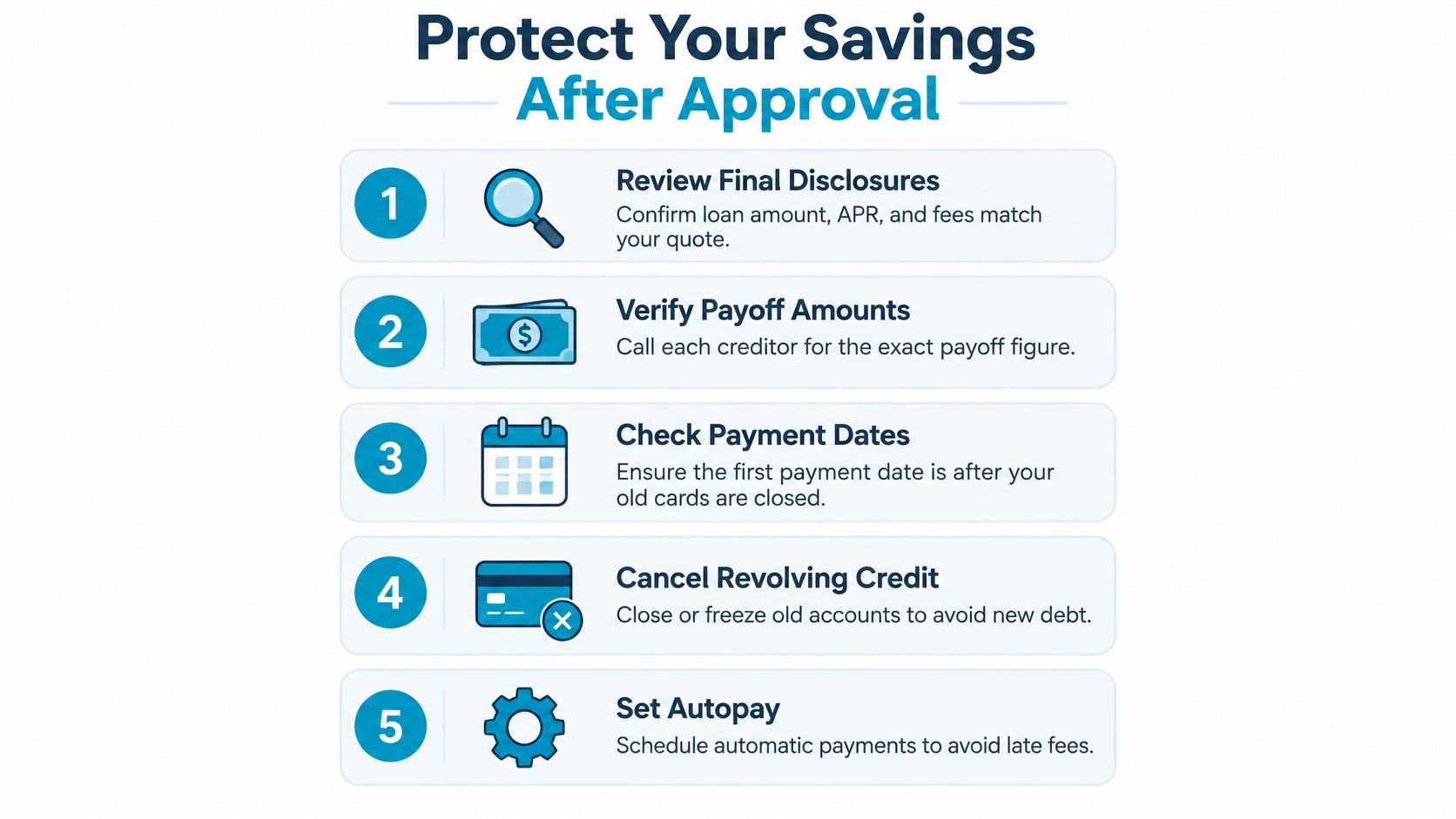
Approval begins the execution stage. Before signing, compare the final disclosures with the offer you evaluated: loan amount, APR, fees, payment schedule, and payoff instructions should all be clear.
If anything changes, rerun your comparison. Don't assume the final agreement is equivalent because the monthly payment looks familiar.
Complete the payoff without losing track
Use lender-directed creditor payoff where available, and verify that each intended account receives the correct amount. Continue monitoring old accounts until payoff is confirmed.
Paying off an account isn't the same as closing it. Despite simplified checklist language, you shouldn't assume accounts must close before the new payment begins. Review the actual first due date, and consider credit-utilization effects before deciding whether to close accounts or reduce limits.
Set up the new installment payment with enough funds available to cover it. Pair automation with account monitoring, an emergency reserve where feasible, and specific spending restrictions for paid-off cards. None of these actions guarantees a particular credit-score outcome.
Verify the business before sending money
Distinguish the roles involved. A marketplace connects borrowers with potential lenders; a lender issues credit. Debt-management providers help arrange repayment, while debt-settlement companies seek negotiated resolutions rather than providing a replacement loan.
The FTC's guidance on spotting debt-relief scams warns consumers against paying before services are performed or a debt-management plan is entered, and stresses written agreements and understanding credit consequences.
Use a firm stop-or-proceed check:
- Identity is unclear: Stop until you can identify the actual lender and any intermediary.
- Money is demanded to release funds: Don't send payment to access a supposedly approved loan.
- Written terms are missing: Don't rely on verbal assurances or pressure to act.
- The service changes: If a loan inquiry becomes a debt-relief pitch, reassess the arrangement before sharing more information.
A legitimate-looking website alone doesn't answer these questions. Verify the agreement and the people receiving your information.
Choose Consolidation Only When It Fits
Approval isn't the finish line. A suitable decision must connect acceptable costs, affordable payments, manageable administration, and a realistic plan for future spending.
Ask yourself what would improve after signing. Would you pay less overall? Would removing competing due dates solve a genuine management problem? Could you handle the new obligation without rebuilding the old balances?
Test the simpler alternatives
Before accepting a new loan, ask existing creditors whether they offer a payment arrangement or other assistance appropriate to your situation. Compare any available arrangement with continuing your own structured repayment plan.
You might discover that your main problem is organizing payments rather than obtaining new financing. Or you might find that the proposed consolidation is worthwhile because it addresses a specific cost or scheduling problem. Neither conclusion should depend on pressure to accept quickly.
- Proceed deliberately: The written terms support your goal, the payment fits, and the post-loan plan is credible.
- Pause when uncertain: Fees, lender identity, payoff logistics, or affordability remain unresolved.
- Decline when unsuitable: The offer adds costs or risks you can't justify.
Treat a marketplace as a discovery tool, not an endorsement of every offer. Verify the lender yourself and accept only when the complete economics and your repayment behavior work together.
For an online way to explore personal-loan options for debt consolidation, visit NextStopLoans, which routes requests to independent third-party lenders. Review any offer against your debt inventory and total-repayment worksheet, and accept only if the lender's written terms fit your budget and payoff plan.