
What Is a Signature Loan and How Does It Work

A signature loan is an unsecured personal loan that relies on your signed promise to repay and your verified income rather than collateral. Because there's no car, house, or savings account pledged to back it, how you're underwritten and what you're charged depend almost entirely on your credit history, existing debt, and ability to repay.
That structure sounds simple, and that is exactly where people get tripped up. They hear unsecured and assume low risk, or they see a monthly payment and assume it is affordable. Neither assumption holds up once you look at pricing, default consequences, and how online requests reach lenders.
Table of Contents
- A Quick Scenario Before the Definition
- What a Signature Loan Actually Is
- How Lenders Decide If You Qualify
- What a Signature Loan Really Costs
- How Online Marketplaces Route Your Request
- What Happens If You Cannot Repay
- How to Verify a Signature Loan Request Is Legitimate
- Key Takeaways and Next Steps
A Quick Scenario Before the Definition
Your car needs a repair you didn't budget for, and payday is still more than a week away. You need the car to get to work, so waiting isn't really an option. You're weighing three paths at once.
You could put the bill on a credit card and deal with revolving interest. You could use the car itself as collateral for a title loan, which puts the vehicle at risk if you fall behind. Or you could sign for a personal loan that's backed by your promise to repay, not by the car.
The Questions You're Actually Asking
Most borrowers in this spot aren't asking for a textbook definition. They're asking practical things.
- How fast do I need the money: Today, this week, or can it wait until you've compared offers properly?
- Do I own an asset I'm willing to risk: A vehicle with equity opens secured options, but it also creates repossession risk.
- Can my credit profile support unsecured borrowing: Without collateral, the lender leans harder on your income and credit history.
- Can I afford the payment after essentials: Rent, utilities, food, and existing debts don't pause because you took a new loan.
If you own your car outright, a title loan may look easier to get. If your credit is stronger, an unsecured option may be available without putting the car on the line. A credit card may be fastest, but it doesn't give you a fixed payoff date.
A signature loan sits in the middle of that decision. It is one option among several, not the default answer. To judge whether it fits, you need four things clear: what the product is, how lenders decide who qualifies, what it costs in total, and what happens if repayment does not go as planned.
What a Signature Loan Actually Is
When people ask what is a signature loan, the plain answer is that it's a personal loan where your signature on the agreement stands in for collateral. You don't pledge a house, vehicle, savings account, or other property. The lender is trusting your promise to repay.
Think of it as a handshake plus paperwork. The handshake part is the trust. The paperwork part is what makes it enforceable.
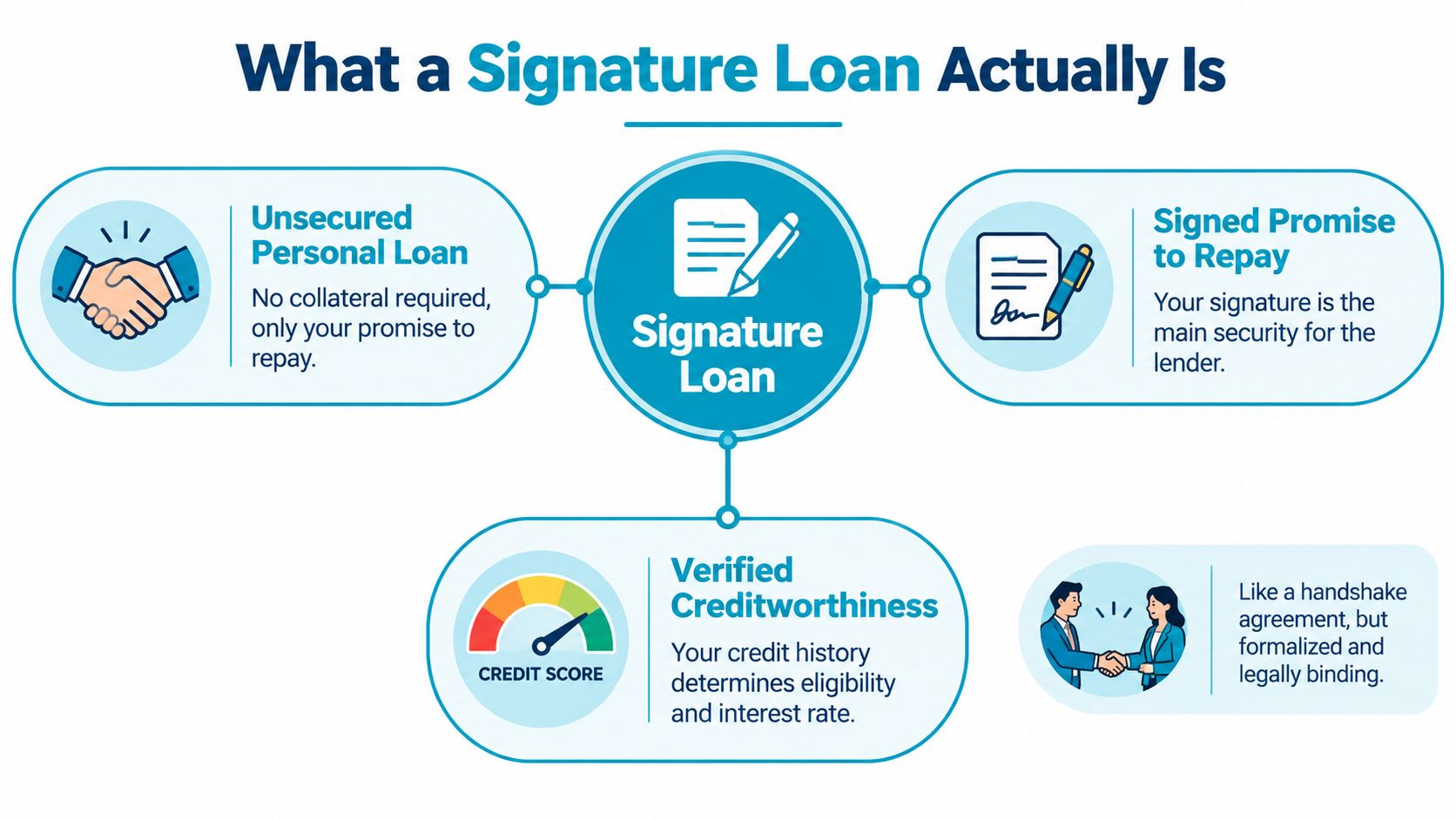
A signature loan is an unsecured, usually closed-end personal loan repaid in scheduled payments, where the borrower's signed promise and verified creditworthiness replace any pledged asset.
Signature loans are generally structured as closed-end installment credit. That means a fixed principal amount, scheduled payments, and a defined maturity date when the loan ends. You borrow once, repay over time, and you're done.
How It Differs From Revolving Credit
A credit card works differently. It's revolving, so you can spend, repay, and spend again up to your limit. There's no fixed end date as long as the account stays open.
A signature loan doesn't refill. If you need more money later, you'd need a new loan and a new approval. That fixed structure can help with discipline, but it also means the payment is locked in whether your income changes or not.
The Consumer Financial Protection Bureau explanation of secured and unsecured loans makes the core distinction clear: unsecured loans require no collateral and rest on the lender's trust that you'll repay. Because the lender has no specific asset to seize after default, unsecured borrowing is considered riskier for the lender and may carry a higher interest rate than secured borrowing.
That risk transfer is the whole product. You keep your assets unpledged. In exchange, the lender prices and underwrites you more strictly.
How Lenders Decide If You Qualify
Approval isn't based on your signature alone, despite the name. Your signature creates the obligation. Your finances determine whether a lender will offer it.
Lenders focus first on cash flow. The OCC guidance on unsecured consumer lending identifies borrower cash flow from employment, business income, investments, government benefits, child support, or alimony as the primary repayment source. If that income isn't verifiable and recurring, approval gets much harder.
What Underwriters Weigh
- Income and payment capacity: Can the payment fit after housing, existing debt, and essential expenses are covered?
- Credit history: Past repayment behavior signals how likely you are to repay this loan on time.
- Existing debt obligations: A lender has limited control over your total debt exposure, so current balances matter a lot.
- A co-signer in some cases: Another person's promise may support approval when your profile alone isn't strong enough.
There's a direct cause and effect here. With no collateral to liquidate, lenders face higher loss severity and fewer recovery options than with secured credit. So they commonly restrict approval to stronger credit profiles, use shorter maturities, or charge higher rates. That's not a penalty. It's how they offset risk they can't recover from an asset.
The OCC also warns that improperly underwritten unsecured loans are among the riskiest consumer loans, precisely because a borrower's total debts can grow beyond what one lender sees. Reading up on personal loan eligibility basics can help you see how these factors combine before you apply.
Practical rule: The advertised payment is only half the test. The real test is whether your verified recurring income still covers essentials after that payment is added.
If the math only works in a perfect month, it probably doesn't work.
What a Signature Loan Really Costs
The number that matters most isn't the interest rate by itself. It's APR, which folds interest and applicable finance charges into one comparison point. Two loans with the same rate can cost very differently once fees and term length are included, which is why learning how personal loan APR and rates work matters before you compare offers.
Term length changes everything. A shorter term raises the monthly payment but reduces total interest paid. A longer term lowers the payment, which feels easier, but it extends your exposure and increases cumulative finance charges.
How Term Length and APR Change a $5,000 Signature Loan
The figures below are illustrative examples to show the trade-off, not offers from any lender.
| Scenario | Number of terms | APR | Monthly payment | Total of payments |
|---|---|---|---|---|
| Shorter term, lower APR | 12 months | Lower illustrative APR | Higher payment | Lower total |
| Mid-length term | 24 months | Higher illustrative APR | Mid-range payment | Higher total |
| Longer term, highest APR | 36 months | Highest illustrative APR | Lower payment | Highest total |
The pattern is what counts. Stretching repayment makes each month feel lighter while making the loan more expensive overall. Always compare the total of scheduled payments, not just the monthly figure in large print.
For a screening benchmark, the FDIC small-dollar lending survey reported that, among banks offering unsecured personal loans, 56% offered small-dollar features defined as a minimum amount of $2,500 or less, an APR of 36% or less including upfront fees and interest, repayment longer than 90 days, and simplified underwriting capable of a decision within 24 hours. That's not a universal legal limit, but it's a useful reference when an offer looks unusually expensive or unusually rushed.
Before accepting anything, compare the amount financed, APR, origination or documentation fees, late-payment charges, prepayment terms, and maturity date side by side.
How Online Marketplaces Route Your Request
A marketplace isn't a lender, and confusing the two leads to wrong expectations about who approves you and who sets your rate. In a marketplace model, the platform collects your request and routes it. Participating lenders make the credit decisions.
With a service like NextStopLoans, you submit a single secure intake form with 256-bit SSL encryption and electronic consent. That request can then be matched across a multi-lender network, with responses typically issued within minutes, rather than you applying separately with each lender.
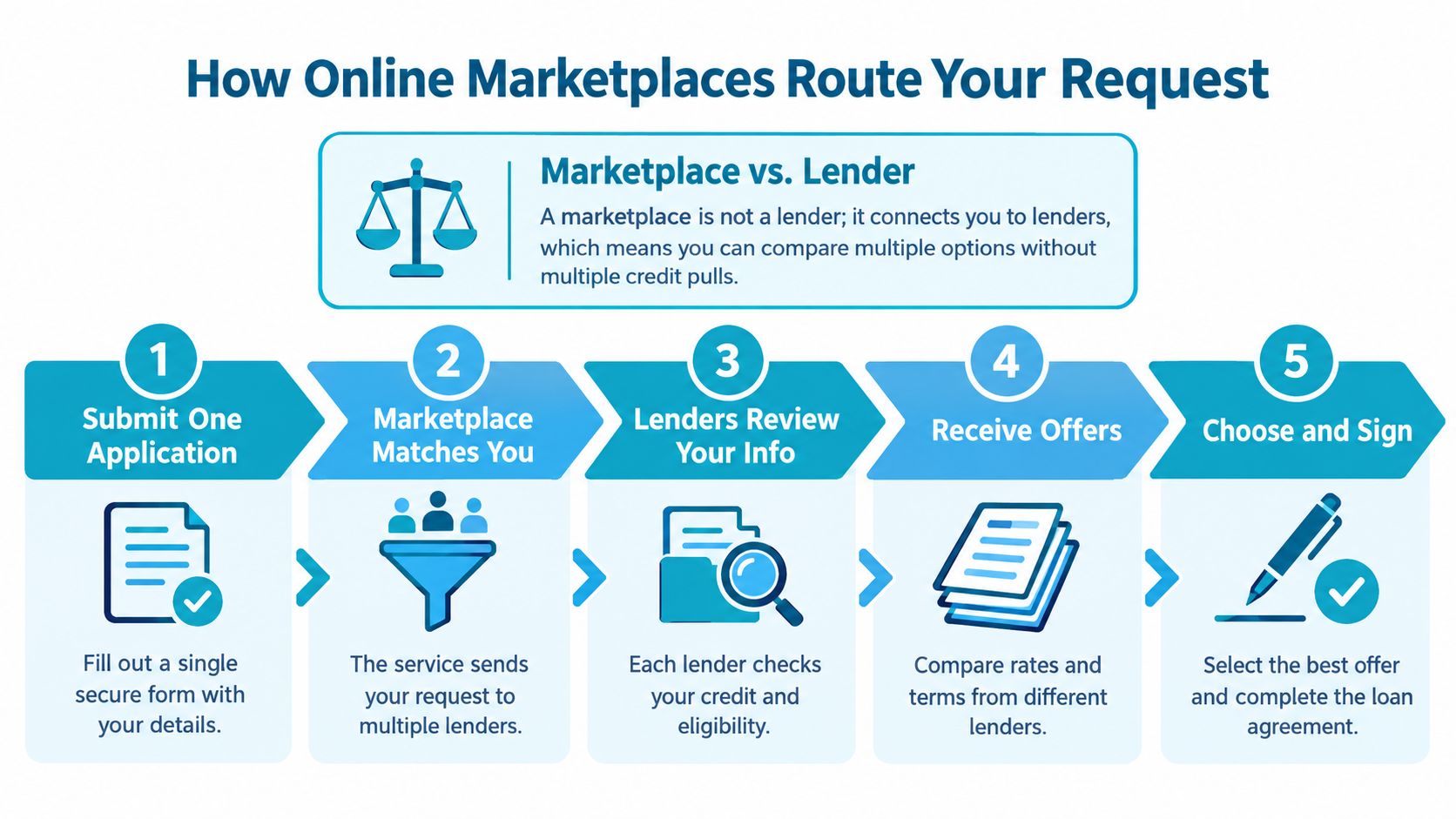
Who Does What
The marketplace doesn't pull your credit and doesn't set terms. Participating lenders may check credit with major and alternative bureaus, and each lender determines approval, rate, fees, repayment period, and funding conditions for its own offer.
If a lender makes an offer and you accept it, funding by direct deposit can occur as soon as the next business day, subject to that lender's processes. That timeline isn't a marketplace guarantee. It's lender dependent.
Availability is also limited. The service is restricted to eligible U.S. residents and isn't offered in every state. Understanding how quick credit connection services route requests helps you see where the matching ends and the lender's underwriting begins.
The practical benefit is efficiency. One request, multiple possible reviews, no obligation to accept any offer presented. The trade-off is that you must read each lender's terms carefully, because the marketplace didn't write them.
What Happens If You Cannot Repay
Unsecured doesn't mean consequence free. It means there's no pledged asset attached to the loan. The debt, and the lender's right to pursue it, remain fully intact.
If you miss payments, expect late fees first. Continued nonpayment can lead to collection activity and negative information reported to credit bureaus. The lender may also file a lawsuit, which can result in a judgment and, where permitted, wage-related collection remedies.
How This Differs From a Title Loan
With a title loan, default can lead directly to repossession of the vehicle you pledged. That loss is immediate and can disrupt your ability to work, which makes recovery even harder.
A signature loan default is less immediately destructive in that specific sense, because there's no car to take. But long-term credit impairment can affect future borrowing, housing applications, and the price you pay for credit for years. Less immediate isn't the same as minor.
Demand for this kind of borrowing hasn't disappeared. Federal Reserve data show U.S. nonrevolving consumer credit increased 2.0% in 2025, indicating continued demand for installment-style borrowing even as repayment risk stays central. Signature loans sit inside that broader nonrevolving category, which the Federal Reserve consumer credit data on Data.gov tracks as credit repaid on a prearranged schedule, with personal loans included alongside motor-vehicle and education loans.
One more detail borrowers miss. Not every creditor reports every account to credit bureaus, so ask whether your lender reports payments. As the FTC guidance on free credit reports context makes clear, most loans are included in credit reports, but reporting isn't automatic for every creditor and every account. On-time payments only help your history if they're reported.
How to Verify a Signature Loan Request Is Legitimate
An online loan request asks for some of the most sensitive information you own, including your Social Security number and bank details. That makes verification part of the borrowing decision, not an afterthought.
The risk is concrete. The FTC received 95,689 reports involving business or personal-loan identity theft in 2024, the most common category among loan or lease related identity-theft reports in the summary of loan fraud and FTC reporting data. Speed is convenient, but it shouldn't outrun caution.
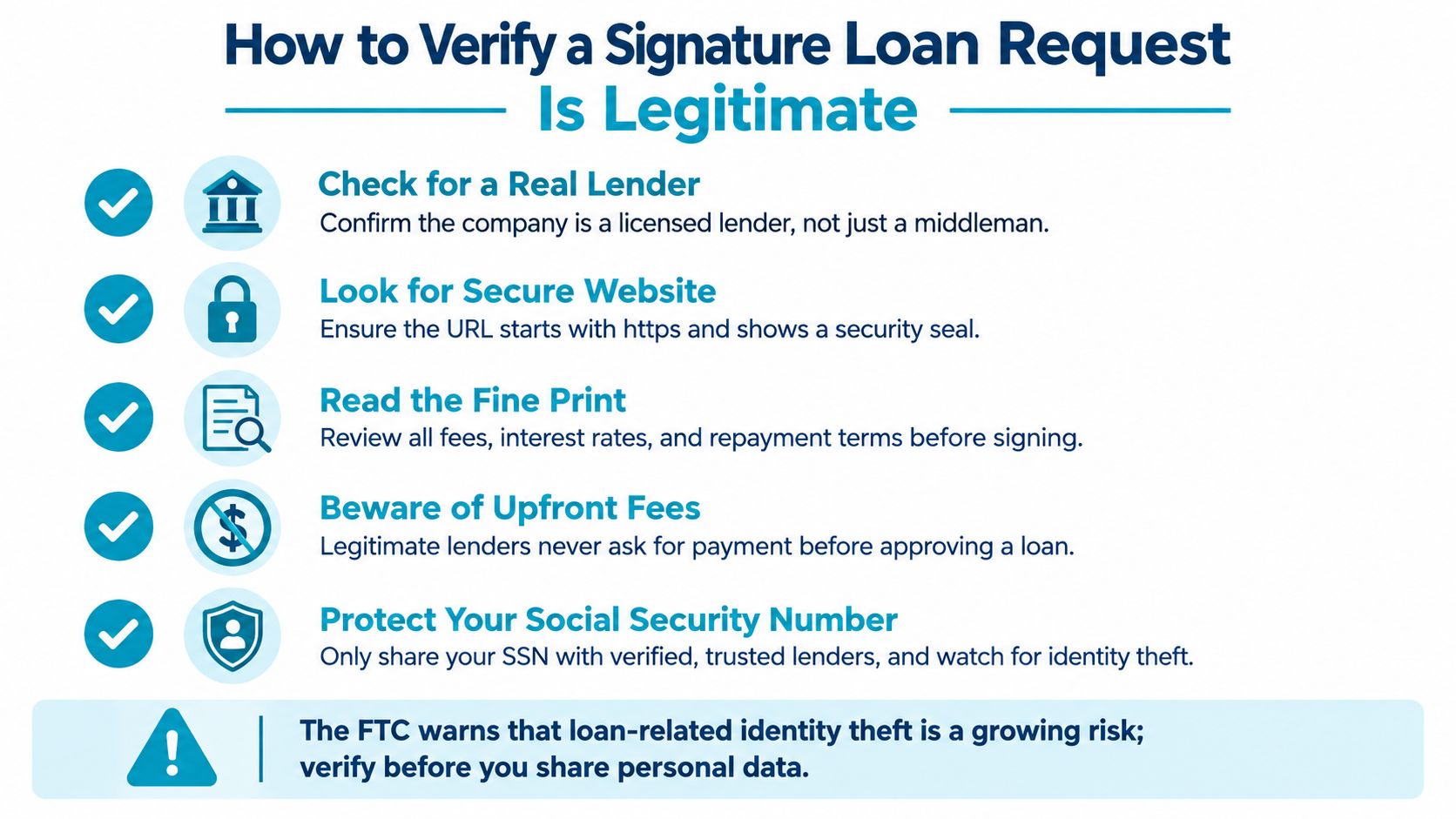
Before You Submit Anything
- Confirm the company's role: Establish whether you're dealing with a lender or a marketplace that routes requests to lenders.
- Identify the actual lender: Know who would fund the loan before you accept any offer.
- Compare APR and total repayment: Don't judge an offer by the monthly payment alone.
- Refuse upfront fee demands: Avoid any provider demanding an upfront fee as a condition of approval.
- Ask about credit inquiries: Find out whether multiple lenders may review your request and whether they use hard or soft inquiries.
If you suspect fraud after submitting information, act quickly. Review your credit reports, report the incident through IdentityTheft.gov, and place a one-year fraud alert with one bureau, which must notify the other two.
If a provider can't clearly explain who the lender is, how your data will be used, and what the loan costs in total, don't submit the request.
Key Takeaways and Next Steps
A signature loan is an unsecured personal loan where underwriting, not collateral, governs both eligibility and price. Your income, credit history, and existing debt do the work that a pledged asset would do in a secured loan. That single fact explains the approval standards, the rates, and the default pathway.
Nearly one in five U.S. households, about 20%, had a personal installment loan in the Federal Reserve's 2022 Survey of Consumer Finances analysis, and usage exceeded 40% among families recently denied other credit or behind on bills. For households under financial stress, that's all the more reason to check affordability before signing, not after.

A Short Decision Checklist
- Confirm the need: Is this expense necessary now, and is borrowing the right way to cover it?
- Test the payment against real cash flow: Does it fit after housing, essentials, and existing debt in a normal month?
- Compare APR and total of payments: Look past the monthly figure to the full cost over the term.
- Verify lender versus marketplace: Know who decides, who funds, and whose terms you are accepting.
- Read the disclosures first: Review Rates & Fees, FAQ, and Lending Policy information before submitting a request.
Marketplaces route one request to multiple lenders, but participating lenders, not the marketplace, determine approval, rate, fees, term, and funding conditions. Keep that boundary clear, verify before you share sensitive data, and only sign when the total cost and payment both fit your budget.
If you're ready to explore signature loan options, NextStopLoans lets you submit one secure online request that can be reviewed by participating lenders, with no obligation to accept any offer. Review each lender's APR, fees, and total repayment carefully, then choose only terms that fit your verified income and budget.