
900 Dollar Loan Bad Credit: 7 Options Compared for 2026
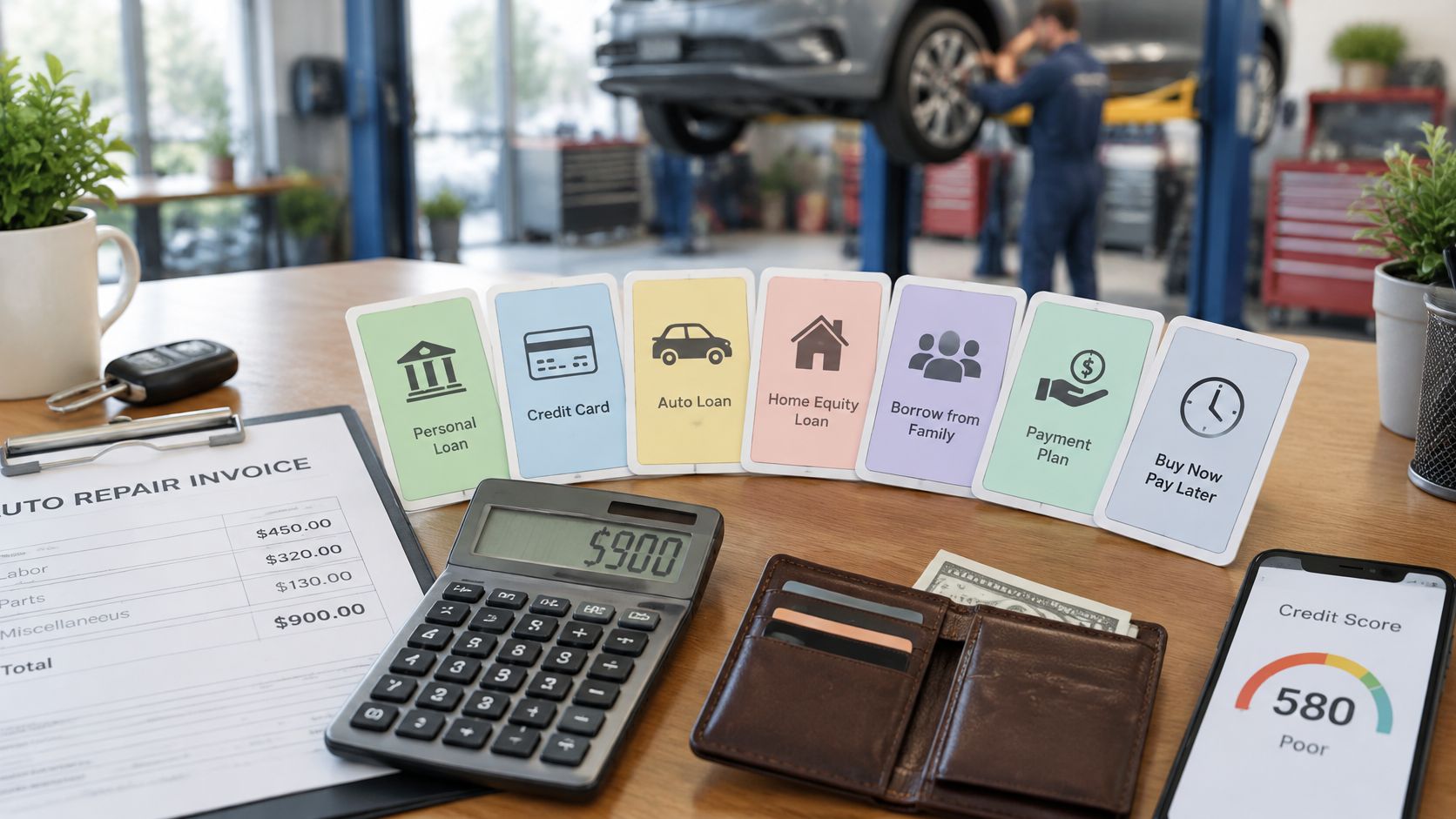
Your car repair bill lands two days before payday. The shop won't release the car without payment, you need it for work tomorrow, and the shortfall is about $900. With bad credit, that gap is harder to fill than it looks.
Many mainstream lenders set minimums at $1,000 or $2,000, so they can't fund an exact $900 need at all. The lenders that will lend $900 often charge APRs high enough to turn a small repair into months of expensive payments. Miss one of those payments, and late fees plus damage to your credit history can follow.
That's why this roundup tests seven options against the exact shortfall, not against brand reputation. For each one, I check the published minimum, the APR range, upfront fees, and whether the total cost fits a 900 dollar loan for bad credit. Some names below are poor fits for $900, and I'll say so plainly. Borrow only what you need, and compare total dollars owed before you accept anything.
Table of Contents
- 1. Next Stop Loans Bad Credit Loans
- 2. NetCredit
- 3. OppLoans
- 4. RISE Credit
- 5. LendingPoint
- 6. Upgrade
- 7. Avant
- How the seven $900 options compare on minimums, APRs, and fit
- Choose the Lowest Total Cost, Not the Fastest Yes
1. Next Stop Loans Bad Credit Loans
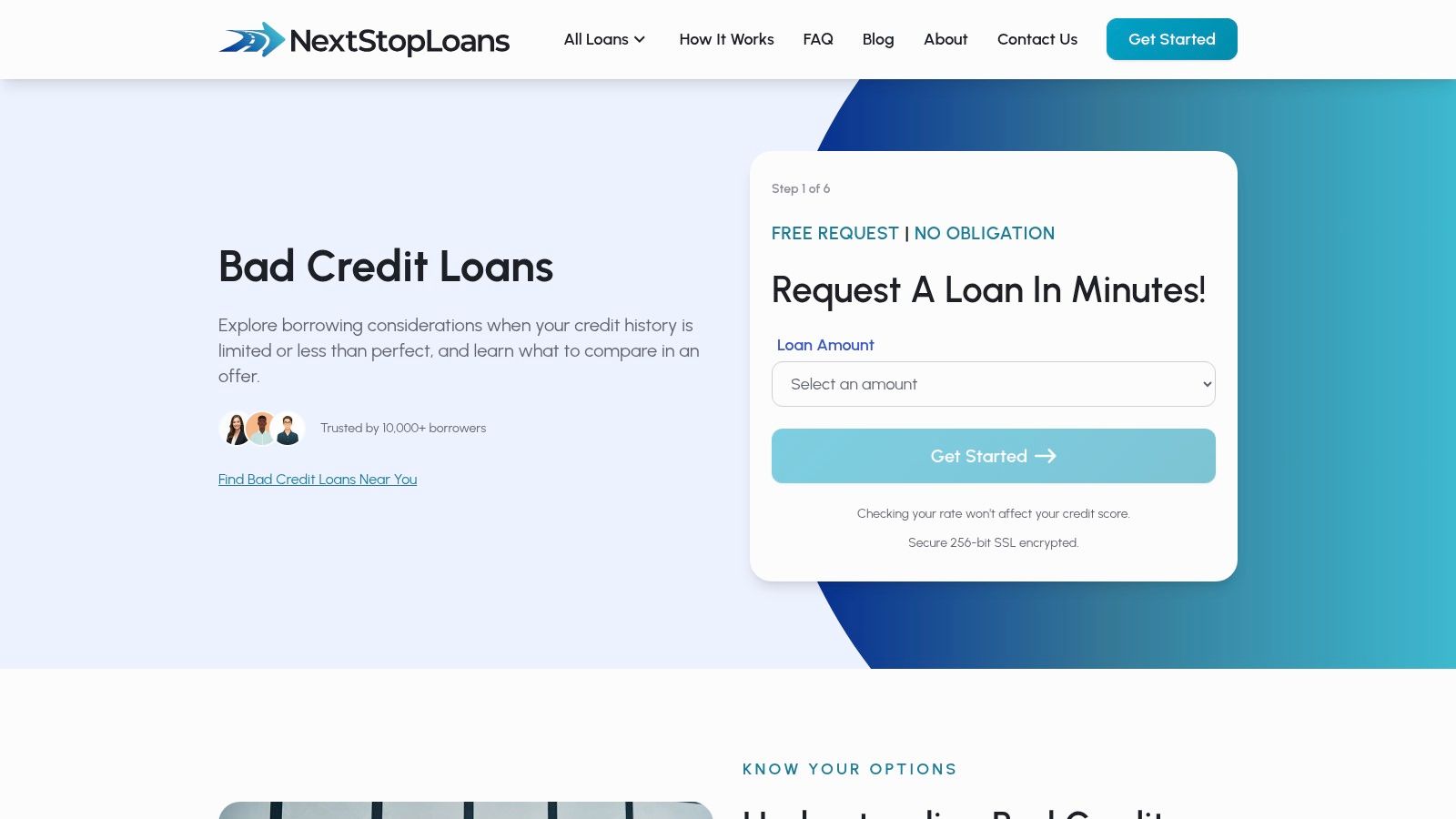
You start with one online request rather than filling out separate applications lender by lender. At Next Stop Loans bad credit loans, you choose a requested amount, submit the secure form from a phone or computer, and the service routes your request to lenders in its network that may consider applicants with bad or limited credit. Participating lenders may respond within minutes.
We're a marketplace, not a lender. Each lender independently decides whether to make an offer, sets its own rates and repayment terms, handles any credit check, and controls funding. We don't pull your credit or look at your creditworthiness, and checking a rate through us doesn't affect your credit score. Lenders in the network may pull credit history from major bureaus and alternative bureaus such as Teletrack or DP Bureau.
How to judge an offer you receive
Use a hard benchmark before you sign. The FDIC survey on banks' efforts to serve unbanked and underbanked households defines an affordable small-dollar loan as less than $1,000, a repayment term of at least 90 days, an APR below 36%, and low or no fees. At that benchmark, a $900 balance repaid over 90 days at a 36% annual rate generates approximately $80 in simple interest before compounding or fees.
If an offer comes in well above that line, price it in dollars, not percentages. Add the finance charge, origination fee, and any late fee exposure to the $900 principal, then check each payment against your take-home pay after rent and utilities.
Practical rule: Approval tells you a lender will lend. It doesn't tell you the payment fits your budget.
- One request, multiple lenders: Your information can be evaluated by several lenders without repeated applications.
- No obligation: You can review an offer and decline it.
- Bad credit focus: Requests go to lenders open to broader underwriting, including current ability to pay.
The limits matter too. Submitting a request doesn't guarantee approval, an offer, or funding, and terms vary by lender and state. You must be at least 18, a U.S. resident, and not live in a state where the loan you're applying for is illegal.
2. NetCredit
NetCredit splits your $900 problem in two. Its personal loan can't solve it, but its line of credit might.
At NetCredit personal loans, personal loans start at $1,000, so there's no exact $900 installment loan on that side. Lines of credit start at $500, which can accommodate a $900 draw if you're approved for at least that much and the product is offered in your state. Checking eligibility doesn't affect your FICO score, which lets you test the water before committing.
Where the cost bites
Price is the weak point. NetCredit lists personal-loan APRs at 34.99% to 99.99%, depending on state and application. Even the low end sits near the top of what most borrowers should pay for $900, and the high end will add substantial interest if you carry a balance for months. A line of credit adds a second risk, because repeat draws make it easy to borrow again before you've cleared the first draw.
Context helps here. The Federal Reserve report on economic well-being and credit access found that in 2024, 34% of U.S. adults applied for some type of credit, and one-third of applicants were denied or received less credit than requested. Don't assume the amount offered will match the amount you asked for.
- Installment option: Fixed payments if you borrow $1,000 or more.
- Line of credit option: May fit a need below the personal-loan minimum.
- State limits: Lines of credit aren't available everywhere, and fees may apply.
If you're weighing this against other high-cost products, compare it with the structures explained in our guide to short-term loans for bad credit, then total every fee. I'd only use the line if you can draw once and repay on a fixed schedule you set yourself.
3. OppLoans
OppLoans is one of the few options here that can lend you $900. That doesn't make it cheap.
Through its OppLoans installment loans page, the published range is typically $500 to $5,000, so $900 sits inside it. Loans are unsecured installment loans originated by lending partners, repaid on a fixed schedule rather than in one payday-style payment. Funding may arrive as soon as the next business day, depending on approval and bank processing.
The APR problem in plain terms
The published APR range is 129% to 195%, with typical terms of 9 to 18 months. Spread over that long a term, interest on $900 can rival or exceed the amount you borrowed. A lower monthly payment isn't a saving if you're paying it for a year and a half. Before you accept, multiply the payment by the number of payments and look at that total, which is the true price of the repair.
Scale matters too. A $900 request is more than twice the $400 emergency benchmark in the Federal Reserve Survey of Household Economics and Decisionmaking report, where 63% of U.S. adults said they could cover a $400 unexpected expense using cash, savings, or a credit card paid in full. The remaining 37% would need borrowing, asset sales, or couldn't cover it.
If you want the mechanics first, how installment loans work explains how fixed schedules allocate principal and interest. OppLoans may consider alternative credit data, and availability varies by state. I treat this as a last-resort fit, workable only if you can repay early and the agreement doesn't punish you for doing so.
4. RISE Credit
With RISE, your state decides whether $900 is even on the menu. Check your state page before you spend time on an application.
On the RISE Credit website, amounts, rates, and availability vary by state. In Utah, for example, the published range is $300 to $5,000, which includes $900, while other states set minimums that may be higher. Some state offers report payments to TransUnion and Experian, and some include a five-business-day period to return the money without risk.
Two features worth weighing
Credit reporting cuts both ways. On-time payments can build a record, but a missed payment gets reported too, and at RISE pricing a missed payment is an expensive mistake. The cited Utah APR range is 99% to 299%, which is among the highest in this list. At those rates, the return window is useful, because it gives you a few days to reverse a decision made under pressure.
Why can rates differ this much for the same $900? A 2025 legislative analysis of small loan rate caps records that 45 states and the District of Columbia cap rates or fees for at least some installment loans, but caps vary substantially, some states permit APRs above 60%, and Idaho, Utah, and Wisconsin rely mainly on an "unconscionable" standard.
- Installment structure: No single payday balloon payment.
- State disclosures: Local pages may show amounts and costs before you apply.
- Feature gaps: The return guarantee and credit reporting don't apply in every state.
I'd compare RISE only after confirming your state's minimum and APR. If your state quote lands near the top of that range, the total cost will dwarf the original $900 need.
5. LendingPoint
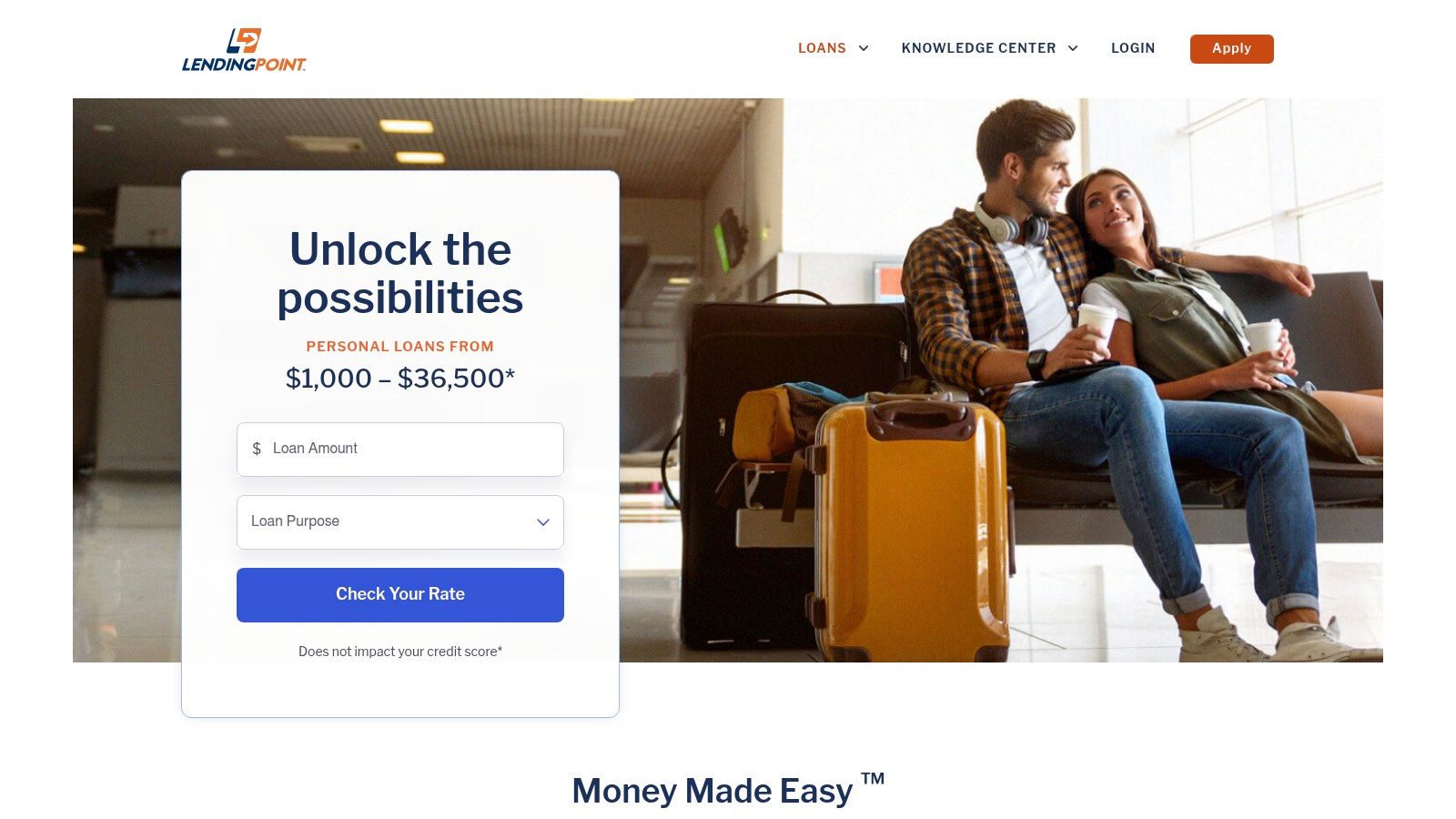
LendingPoint brings the price down, but it can't lend you exactly $900. That's the trade in one sentence.
At LendingPoint, unsecured personal loans run from $1,000 to $36,500, with an advertised APR range of 7.99% to 35.99% and terms of 24 to 72 months. Eligibility includes at least $35,000 in annual income, a verifiable bank account, and U.S. residency requirements. Underwriting looks beyond a conventional credit score, which helps some applicants with thin or damaged files.
When borrowing $1,000 instead makes sense
Borrowing $100 extra isn't automatically wrong, but only if you use the surplus to pay down the balance immediately. The bigger risk is the term. Stretching roughly $1,000 over two to six years keeps payments small while interest keeps accruing, so a cheap APR can still produce a costly loan if you pay slowly. Ask for the total of payments at the shortest term you can afford.
Thin files are common, not unusual. The Federal Reserve Consumer and Community Context report states that in 2024, approximately 32 million U.S. adults were considered unscoreable for credit, including 7 million credit-invisible adults and 25 million adults with thin credit files.
- Lower APR ceiling: Cheaper than the high-cost small-loan options here if you qualify.
- Income gate: The stated income requirement excludes some bad credit borrowers.
- Minimum mismatch: $1,000 is the floor, not $900.
Choose LendingPoint only if you meet the income test and you'll repay far faster than the maximum term.
6. Upgrade
Upgrade is built for larger, planned borrowing, and its fee structure is where a $900 borrower needs to pay attention.
The Upgrade personal loan application lists fixed-rate loans of $1,000 to $50,000 with an advertised APR range of 7.74% to 35.99%. You can check a potential rate online with a soft inquiry, so shopping doesn't affect your credit score. Fixed payments give you a clear schedule from day one.
The origination fee changes the math
Upgrade deducts an origination fee of 1.85% to 9.99% from your proceeds. Borrow $1,000 at the top of that range and you receive roughly $900 in cash while owing interest on the full amount borrowed. That can look like a neat fit for a $900 bill, but you're financing the fee itself, which raises your true cost per dollar received.
Run an ability-to-repay test before you apply. The Federal Reserve report on household credit experiences identifies payday and pawn products as options used by consumers who lack credit history or aren't confident they'd qualify for traditional credit. If you do qualify here, confirm you can cover every payment after rent, food, transport, and existing debts.
A fee deducted from proceeds means you should compare cash received, not the headline loan amount.
- Soft inquiry rate check: Useful for comparison shopping.
- Fixed rate: Payments don't drift upward.
- Availability limits: Advertised rates aren't guaranteed and some offers may not be available in every state.
Upgrade suits you only if borrowing $1,000 or more is useful and the fee still leaves the total cost below a direct $900 option.
7. Avant
Avant is the clearest mismatch in this list for an exact $900 need, and it earns its place as a comparison point for larger expenses.
At Avant, unsecured personal loans run from $2,000 to $35,000, more than twice what you need. The advertised APR range is 9.95% to 35.99%, with repayment terms of 2 to 5 years, and you can check options with a soft credit inquiry. An administration fee may be deducted from proceeds, and other fees may depend on your state.
Why borrowing double is rarely the answer
Taking $2,000 to cover a $900 repair leaves $1,100 sitting in your account, accruing interest and tempting you to spend it. Even at a moderate APR, two to five years of payments on money you didn't need will cost far more than a correctly sized loan. A lower rate on a much bigger balance doesn't beat a higher rate on $900 repaid quickly, in many cases.
The Federal Reserve household expenses report shows how fragmented emergency borrowing is, since among adults unable to cover a $400 expense with cash or its equivalent, 16% would put it on a credit card and repay over time and 10% would borrow from family or friends. Only 3% would use a bank loan or line of credit.
Sizing rule: If a lender's minimum forces you to borrow more than double your shortfall, walk away and borrow the right amount elsewhere.
For the pricing mechanics behind that judgement, see personal loan APR rates explained. I'd consider Avant only if your real need grows to $2,000, for example a repair plus another essential bill you can document.
How the seven $900 options compare on minimums, APRs, and fit
| Item | Loan Type | Listed Minimum | Advertised APR | Fits a $900 Need? |
|---|---|---|---|---|
| Next Stop Loans, Bad Credit Loans | Loan marketplace | Not specified | Set by participating lender | Possibly; lender approval and offer required |
| NetCredit | Installment loan or line of credit | $1,000 personal loan; $500 line of credit | 34.99%–99.99% for personal loans | Possibly through a line of credit, where available |
| OppLoans | Unsecured installment loan | Typically $500 | 129%–195% | Yes, within the published range |
| RISE Credit | Installment loan | Varies by state; $300 in Utah | 99%–299% in Utah | Possibly; depends on state |
| LendingPoint | Unsecured personal loan | $1,000 | 7.99%–35.99% | No; minimum is above $900 |
| Upgrade | Fixed-rate personal loan | $1,000 | 7.74%–35.99% | No; minimum is above $900 |
| Avant | Unsecured personal loan | $2,000 | 9.95%–35.99% | No; minimum is above $900 |
Choose the Lowest Total Cost, Not the Fastest Yes
Start by confirming the amount you need. Get the repair quote, the rent balance, or the bill in writing, and borrow against that number rather than a round estimate. If $900 covers it, a lender with a $2,000 minimum isn't a backup plan, it's a different and more expensive decision.
Next, screen every option by its published minimum. In this list, OppLoans and, in some states, RISE can fund $900 directly, NetCredit may do it through a line of credit, and LendingPoint, Upgrade, and Avant cannot fund an exact $900 based on their published ranges. That single check eliminates half your applications.
Compare total dollars, then legality
For each surviving offer, write down four numbers: the APR, every upfront fee including origination or administration charges, the late payment fee, and the total repayment amount. A lower advertised APR isn't automatically cheaper if the term runs longer or fixed fees are larger. Divide each scheduled payment by your monthly take-home pay, and reject any loan you couldn't still pay in a month when hours get cut.
Confirm the loan is legal in your state before you sign. Some states cap the APR and charges for an online personal loan, and you must not be a resident of a state where the loan you're applying for is illegal. Loans from a state with no limiting laws, or from a bank not governed by state laws, may carry an even higher APR.
- Amount first: Match the loan to the documented shortfall.
- Minimum check: Skip lenders whose floor exceeds your need.
- All-in cost: Add origination, documentation, and late fee exposure to interest.
- Payment fit: Test every payment against income left after essentials.
Remember who does what. A marketplace only routes your request, and independent lenders set the final APR, fees, term, and credit inquiry. You can review any offer and decline it, and submitting a request doesn't guarantee approval. When you're ready, start a request for the amount you need, compare whatever comes back against the checklist above, and accept only the offer with the lowest survivable total cost.
If you need a 900 dollar loan with bad credit, NextStopLoans lets you submit one secure online request and have it routed to lenders that may consider your current ability to pay, not just your past. Compare any offer by its total repayment amount and decline it if the cost doesn't fit. Start your request today at NextStopLoans.