
Short Term Loans for Bad Credit: Real Costs and Risks

Most payday loans do not end when the next paycheck arrives. In a review of more than 12 million storefront transactions across 30 states, the Consumer Financial Protection Bureau found that more than 80% of payday loans were rolled over or followed by another loan within 14 days. Only 15% of borrowers repaid every payday debt when it was due without defaulting or borrowing again inside that window. Those CFPB figures reframe short-term loans for bad credit. The hard part is rarely getting approved. The hard part is paying the full balance on the original due date.
This walk-through uses one dollar example, then shows what changes if repayment slips. It also covers how to check who holds the account and how to fix a credit-report error after the loan is gone.
Table of Contents
- What a $300 Bad-Credit Loan Really Costs
- How Lenders Decide When Your Credit Is Weak
- Eligibility Requirements for Bad-Credit Applicants
- How a Two-Week Loan Turns Into a Debt Cycle
- Safer Alternatives Before Taking Any Short-Term Loan
- Apply Through a Marketplace Only After the Loan Fits
What a $300 Bad-Credit Loan Really Costs
A typical two-week payday loan charges about $15 per $100 borrowed. Spread over a 14-day term, that fee annualizes to an APR of about 391%, according to Federal Trade Commission guidance on payday and car title loans. The APR looks extreme because a two-week charge is stretched across a full year. The dollar fee is the number that hits your checking account.
Start with a clean payoff, before anything goes wrong.
You borrow $300. The fee is $15 times three, which is $45. On the due date you repay $345: the $300 principal plus the $45 fee. If that $345 is sitting in the account when the lender debits it, the loan is over in 14 days. That single repayment is the baseline. Every later row in the table is what happens when that debit does not clear.
What each renewal adds
A renewal does not shrink the $300 principal. You pay the fee that is already due, and you owe a new fee for the extra two weeks. One renewal means two fee periods. Six renewals mean seven fee periods, because the original period still counts.
| Scenario | Fee periods | Total fees | Total repaid | Time in debt |
|---|---|---|---|---|
| Repaid on time | 1 | $45 | $345 | 14 days |
| Renewed once | 2 | $90 | $390 | 28 days |
| Renewed three times | 4 | $180 | $480 | 56 days |
| Renewed six times | 7 | $315 | $615 | 98 days |
Read the last row slowly. $315 in fees is more than the $300 you borrowed, and you still repay the principal. Total cash out is $615, and you have been in the loan for 98 days, not two weeks.
Federal consumer guidance requires the lender to disclose the finance charge and the APR in writing. Use that paper. Compare the dollar finance charge, the total you will repay, the maturity date, the rollover rules, late fees, and returned-payment fees. A single periodic fee hides the stack. A plain-language look at how payday loan rates are built helps you line those items up before you sign.
For many bad-credit applicants, easier access is the trade for much higher pricing. A payment that looks manageable as one two-week bill becomes unaffordable if the paycheck is already spoken for.
Before you sign, write down one number: the exact amount due on the due date, fees included. If you cannot cover that figure from money you will have available, the $345 case is not your case.
How Lenders Decide When Your Credit Is Weak
For secured credit-building products covered by the Federal Reserve, 93% of holders had no credit score or a nonprime score in 2024. That finding describes those products, not short-term bad-credit loans. It does show that credit-building products can serve people whose credit files are limited or marked by past problems.
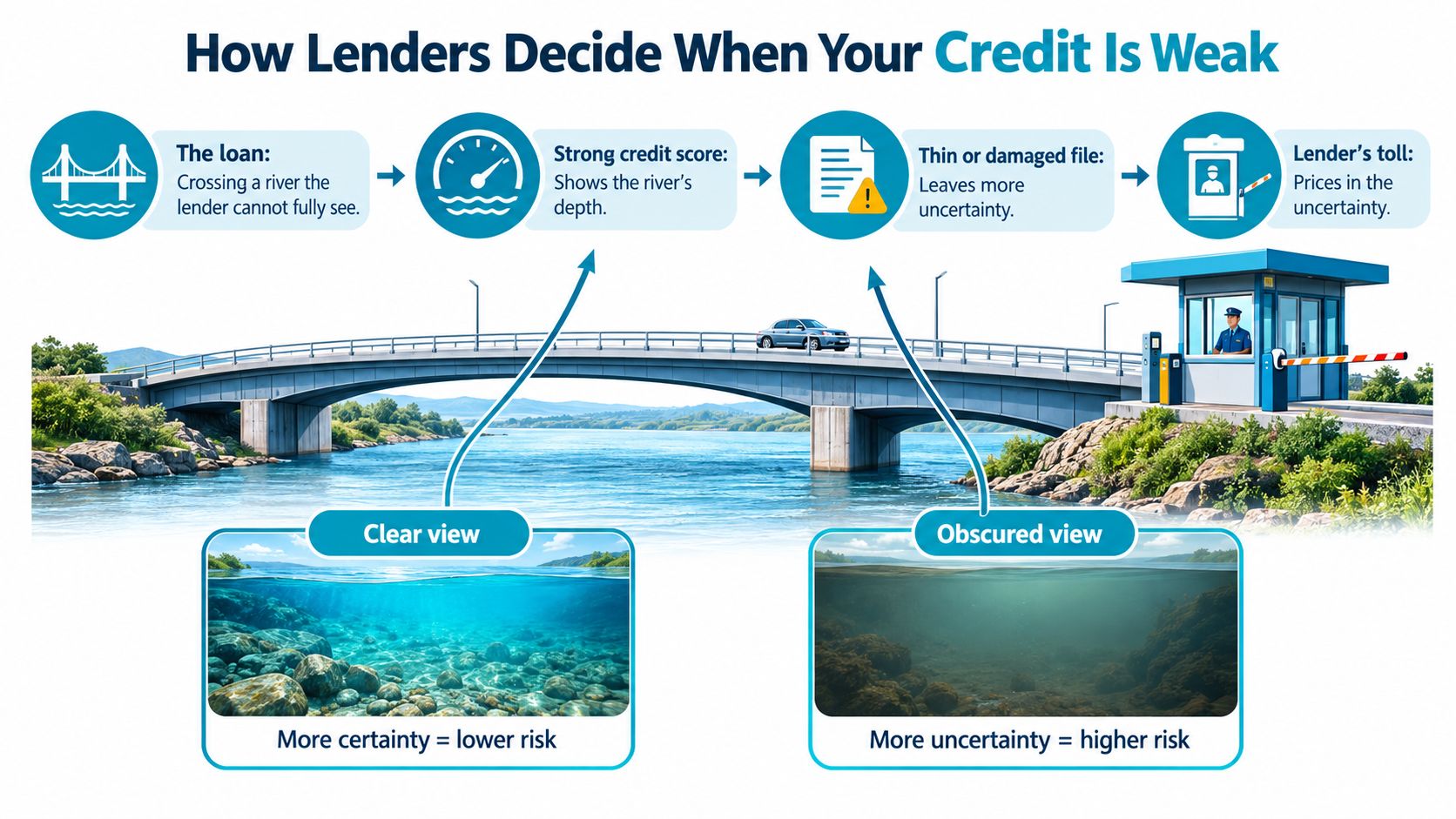
A credit score works like a depth gauge on a bridge crossing. It gives a lender a quick reading of payment history, balances, and accounts. A thin file or late payments leave more uncertainty. The lender may respond with a higher fee, a shorter term, or a smaller loan. That is underwriting, a judgment about repayment risk, not character.
The Federal Reserve reports that, in 2024, more than 3 million people in its credit-product sample held secured small-dollar credit-building products, about 1% of the covered adult population. Of those holders, 93%, or 2.8 million people, had no credit score or a nonprime score, according to the Federal Reserve's overview of credit-building products. These figures describe secured credit-building products specifically. They should not be read as counts or characteristics of short-term loan borrowers.
Signals that stand in for a score
When a score is missing or weak, a lender may review account activity to estimate whether repayment is likely.
- Average balance: Money left after bills can suggest a debit will clear. A balance that regularly reaches zero leaves less room for a payment.
- Deposit regularity: Paychecks, benefits, or client payments arriving on a pattern give a clearer income record than one large deposit followed by no regular deposits.
- Overdraft frequency: Repeated overdrafts can signal that the account has little room for another bill.
- Income stability: Direct deposits from the same employer or documented benefit payments provide evidence of income.
- Time on the job: A short work history offers less evidence of a steady paycheck, though it does not automatically mean rejection.
- Reported rent or utilities: If those payments are sent to a credit bureau, they may show a payment history missing from the credit file.
- Other loans and a rough debt-to-income picture: Existing payments reduce the cash available for a new one.
These signals help explain how a lender may assess risk, but they do not predict a specific decision. A marketplace and a lender also play different roles. A marketplace may forward your request without checking your credit. A participating lender may check a major bureau, an alternative bureau, or both. The lender decides the amount, fee, and due date.
If an offer arrives, check which lender is named on it and who will service the loan. Keep the agreement and payment records. If a lender reports an account or payment incorrectly, compare the entry with those records and contact the company that furnished the information to request a correction. The marketplace may have delivered your application, but the lender's documents identify who is responsible for the loan.
Eligibility Requirements for Bad-Credit Applicants
These are typical minimums, not a promise that any one lender will say yes. Each company writes its own rules. Bad credit changes some rows and leaves others alone.
| Requirement | Typical standard | Why lenders ask | Bad-credit variation |
|---|---|---|---|
| Age | 18 or older; 19 in some states | Legal capacity to sign | Same for every applicant |
| Income | No fixed minimum; the lender sets the amount | Shows a repayment source | Benefits, gig, or self-employment income can count with documents |
| Bank account | Open checking account, often at least 3 months old | Debit repayment and deposit history | Account history can stand in for a missing score |
| Residency | U.S. resident in a state the lender serves | State licensing | Excluded states are listed in the application steps |
| Identity | Government ID and Social Security number | Verification and fraud checks | Same for every applicant |
| Credit check | Varies by lender | Risk pricing | Some lenders use alternative bureaus or no score |
A fuller pass over what personal loan eligibility usually includes is worth reading before you start an application, so you are not guessing at the paperwork.
Three profiles lenders actually see
A salaried worker with a score near 540. Steady direct deposit is the strength. Expect a request for a recent pay stub or a benefits-style payroll record, plus an open checking account in your name. The request most often stalls when the account was opened last week, or when the paycheck is smaller than the payoff the lender would debit.
A freelancer with irregular deposits. The score may be thin because income never sat on a W-2. Six months of bank statements that show money coming in, even if the amounts jump around, give the lender a repayment source. The weak spot is a statement full of transfers from your own savings and almost no outside deposits. Label client payments so they are obvious.
A retiree on fixed benefits. Employment length does not apply. Social Security, a pension, or a similar deposit can count when it is documented and it lands in the account the lender would debit. A decline here usually traces to an account that cannot cover the full payoff after rent and medicine, not to the absence of a job.
Gather proof of income and the last few months of bank statements before you apply. One complete package lets the lender decide in a single pass instead of pausing for documents you could have attached at the start.
How a Two-Week Loan Turns Into a Debt Cycle
Calling the product short-term describes the contract, not what most borrowers experience. The CFPB's storefront study, noted above, found that most of these loans did not end at the next paycheck.
A later look at repayment behavior makes the chain clearer. CFPB research highlights report that more than 80% of payday loans were rolled over or reborrowed within 30 days. About 20% of borrowers defaulted on the first loan or after reborrowing, and nearly half of those defaults came after at least three reborrowing events. Studied borrowers also averaged $185 in bank penalty fees from failed electronic debits, separate from anything the lender charged.
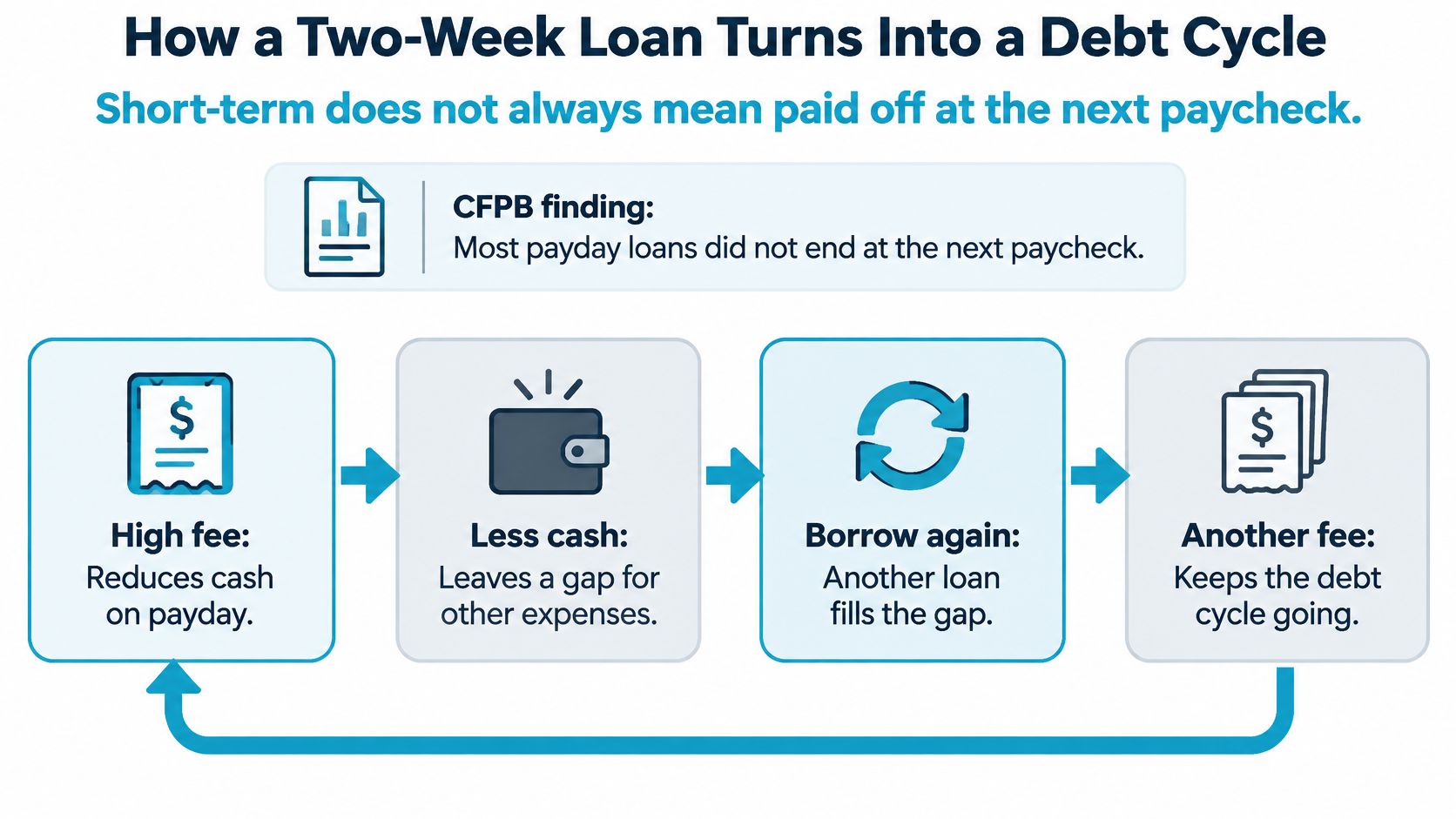
The chain, one link at a time
The fee comes out on payday, so less cash is left for rent, food, and the bills that were already due. The shortfall pushes a renewal, a second loan, or a debit that the bank returns. The returned debit can trigger the bank penalty on top of a new lender fee. The smaller balance then makes another short-term loan feel like the only way to get to the next check.
The real question is not whether you can get the first loan, but whether you can repay the full balance on the due date without borrowing again.
Use two screens before you apply. First, residual cash: what is left after essential expenses and the debt payments you already have. Second, whether a single payoff fits inside that cash. Also read the payment authorization. Some agreements allow the lender to attempt the debit more than once. Each failed attempt can add a bank fee like the ones in that $185 average.
When a missed payment costs more than the fee
A late fee can sit on top of the rollover fee, so the cost of slipping is larger than the original finance charge. An unpaid balance can move to collections. A collection entry, or a reporting error, can follow you for years after the cash emergency is over.
Same sequence, in the dollars from the $300 example. You needed $345 on day 14. A renewal means another $45 while the $300 is still outstanding. Miss the debit and the bank's penalty is a separate bill. By the time fees from six renewals pass the principal itself, the original two-week gap is no longer the debt you are paying.
Safer Alternatives Before Taking Any Short-Term Loan
For a hypothetical $400 emergency, adults use several ways to find the money, and payday borrowing is one of the less common choices. The Federal Reserve's 2024 household survey reports that 63% could cover the expense with cash or its equivalent. Among the remaining responses, 15% would use a credit card and carry the balance, 10% would borrow from family or friends, 3% would use a bank loan or line of credit, 2% would use a payday loan, deposit advance, or overdraft, and 7% could not pay right away. These categories total 100%. The Federal Reserve's summary of that survey shows that carrying a card balance is a more common fallback than payday borrowing. It can still be costly, and a higher balance can raise credit utilization.
| Option | Typical cost | Speed | Credit reporting | Best when |
|---|---|---|---|---|
| Payday or title loan | About $15 per $100 per two weeks (about 391% APR) | Same day to next business day | Varies; title loans put your vehicle at risk | Last resort only |
| Credit union payday alternative loan | A smaller, capped charge; ask for the dollar cost and APR in writing | Often days; check membership rules | Varies; ask the credit union | You have a membership and a small, short need |
| Credit card balance | Often above 20% APR | Immediate if you have available credit | Balance raises utilization | You can clear the balance within a few months |
| Biller payment extension | Usually no interest; late fees possible if refused | Same day by phone | Usually none | Utility, medical, or rent bill |
| Employer paycheck advance | Often low or no fee; varies by employer | One to two business days | Usually none | Your employer offers the benefit |
A payday loan's clearest advantage is speed, and that speed comes at a high cost. A title loan also puts your vehicle at risk. A credit union loan may take a few days, but a longer repayment schedule can mean smaller weekly payments. Compare the total amount due, not only the payment size. For more possibilities, review payday loan alternatives that do not start with a rollover.
Ask for time before you borrow
Call the biller before the due date. Tell them when payment is due, how much you can pay now, and when you can pay the rest. Ask them to confirm the new date in writing, such as by email or a portal message. That record can help if a late fee appears despite the agreement.
An employer paycheck advance may help, but check its terms first. Ask human resources about any fee and whether the full advance will come out of your next paycheck. If you already belong to a credit union, or can join, ask whether it offers a payday alternative loan. Membership rules and loan limits differ. Get the full repayment amount in writing before deciding.
Choose the lowest-cost option that provides the amount you need. Then check how and when you must repay it. A cheaper option may take longer to arrange, while a faster one may leave too little for other bills. The right choice is the one whose cost and timing you can manage.
Apply Through a Marketplace Only After the Loan Fits
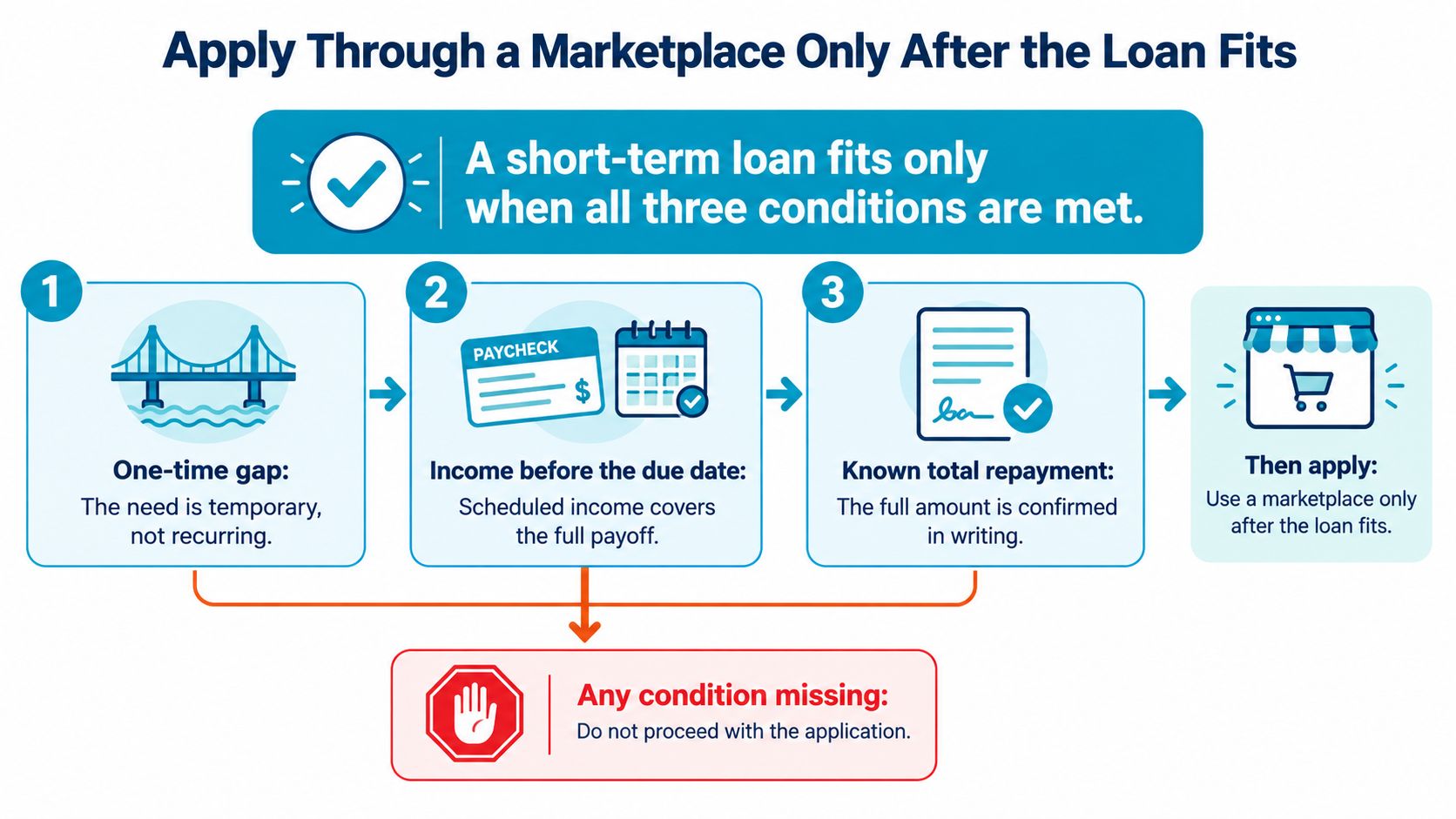
A short-term loan fits only if it covers a one-time gap, income scheduled before the due date can repay it in full, and the exact payoff is written down. Check your remaining cash after the payment, using the residual-cash test from the debt-cycle discussion. A repayment plan should work like a bridge to your next paycheck, not a guess about money that might arrive. If paying it leaves you short on essentials, stop before submitting an application.
Red flags that mean walk away
- Guaranteed approval: A legitimate lender reviews your ability to repay. A promise of approval before that review is a warning sign.
- A fee before funding: Upfront application or “processing” charges can signal an advance-fee scam.
- Pressure to sign today: Take time to read the offer. Do not let a deadline rush you into unclear terms.
- No total repayment in writing: Without the full payoff amount, you cannot compare the cost with your available cash.
- Gift cards or unusual payment methods: Repayments should use a standard account, not a cash-like product.
- A company that will not name itself: Get its legal name so you can check whether it is licensed.
Who decides, and who you can complain to
Marketplaces such as NextStopLoans connect applicants with independent lenders. You submit one secure form, protected by 256-bit SSL encryption, and give electronic consent for the request to be shared with potential lenders. The marketplace does not pull your credit or set your rate. A lender may check your credit and decides whether to offer a loan. Before you e-sign, confirm which company will service the loan, collect payments, and handle complaints.
Consumer reports include complaints about unfamiliar or fraudulent small-dollar accounts, incorrect credit-report entries, and paid or settled accounts that were not updated. The Federal Reserve's 2025 report on household economic well-being provides context on household finances, but it does not establish complaint counts. The practical lesson is to identify who holds your loan and keep records in case a payment or credit report is wrong.
- Confirm that you are a U.S. resident and check the states listed in the application to see whether the service operates where you live.
- Write down the exact amount due on your next payday, including fees. If it fails the residual-cash test, do not proceed.
- Send one request rather than scattering applications across lenders.
- Compare offers by total repayment, due date, APR, rollover rules, and late or returned-payment fees.
- Ask who decides, services the loan, collects payments, and handles complaints. Check the lender's license in your state.
- Get the total repayment and late-fee rules in writing before signing. You can decline an offer.
- Save the signed agreement and the payoff confirmation.
- After repayment, review your credit reports. If an entry is wrong, dispute it with the company that furnished the information and with the credit bureau.
A loan you can repay on the due date is a bridge. A loan you can only renew is a debt.
Before comparing offers, gather the written payoff figure and three months of bank statements. If repayment still does not fit, call the biller and ask for a written extension instead of borrowing.
NextStopLoans routes one encrypted loan request to independent lenders, which set their own terms, including for applicants with thin or damaged credit. Compare the full payoff, due date, and fees, and decline any offer that does not fit your available cash. If you want to review offers, start at NextStopLoans.