
100 Dollar Loan Costs, Fees and Better Options

Payday fees commonly range from $10 to $30 per $100 borrowed, and a $15 fee on a two-week loan means $115 due and an APR of almost 400%. A 100 dollar loan can cover an immediate shortage, but it's affordable only if repaying it won't leave you short again.
The most useful question isn't how quickly you can get approved. It's whether the money left after your next paycheck's essential expenses can cover the entire repayment. Treat the advertised speed as a convenience, not evidence that the loan fits your budget.
Table of Contents
- What a 100 Dollar Loan Costs Up Front
- Payday Cash Advance and Installment Paths
- Rollover Fees That Keep the Principal Alive
- Cheaper Ways to Cover the Same Gap
- Cash Flow Gaps a Small Loan Cannot Fix
- Eligibility Checks and Application Steps
- Confirm the Offer Before You Accept
What a 100 Dollar Loan Costs Up Front
Cost of borrowing $100 for about two weeks
The examples below use the fee range and credit-card comparison published by the Consumer Financial Protection Bureau, which reports payday fees of $10 to $30 per $100 borrowed, an APR of almost 400% for its two-week, $15-fee example, and about $1.25 in interest for its credit-card comparison.
| Offer | Finance charge | Term | Amount due | APR signal |
|---|---|---|---|---|
| Payday at a $10 fee | $10 | About 14 days | $110 | About 261%, calculated |
| Payday at a $15 fee | $15 | 14 days | $115 | Almost 400% |
| Payday at a $30 fee | $30 | About 14 days | $130 | About 782%, calculated |
| Credit card balance at 30% APR | About $1.25 | 2 weeks | About $101.25 | 30% |
The repayment totals add the principal to the stated charge. The calculated payday APRs annualize the fee over the assumed term; they aren't personalized quotes or legal maximums.
A payday loan is one kind of small-dollar borrowing, not a description of every loan for this amount. Its defining budget challenge is the lump-sum repayment. You receive the principal now, then need enough available money to return that principal plus the finance charge on the agreed date.
Why a modest fee produces a high APR
APR, or annual percentage rate, puts borrowing costs on an annual scale so you can compare different terms. It doesn't mean you'll necessarily pay an entire year's interest on a short loan. The actual dollar charge matters for your immediate budget, while APR helps show how expensive that charge is relative to the amount borrowed and the time you have it.
Both measures deserve attention. Looking only at APR can obscure the cash you must have ready; looking only at the fee can make repeated short-term borrowing seem less expensive than it is.
Practical rule: Compare the money you receive with the money you must return, then put the repayment date on your actual pay calendar.
Read the offer as a payment obligation
Before signing, find these lines in the lender's disclosure:
- Finance charge: The dollar cost of borrowing, separate from the principal.
- Total repayment: The full amount you'll need to settle the scheduled obligation.
- Payment date: The date the money must be available, not merely the date you expect a paycheck.
- APR: The annualized cost that helps you compare offers with different terms.
The CFPB's guidance also explains that lenders must disclose the finance charge and APR before you sign. Don't substitute a banner advertisement or an estimated payment for the actual agreement.
For help interpreting rate language, use our guide to payday loan rates. Keep optional services, transfer charges, and any other listed costs in your comparison rather than assuming the advertised fee is the complete price.
Payday Cash Advance and Installment Paths
Say you need money for a necessary purchase before your wages arrive. Two offers may provide the same amount today while creating very different obligations later. The repayment shape matters as much as the label.
For scale, the Federal Reserve's credit-bureau analysis found a median small-dollar-loan balance of $507 and a median monthly payment of $89 at the end of 2023. Those figures describe a broader market, not the terms you should expect on a smaller request.
A single payment versus scheduled payments
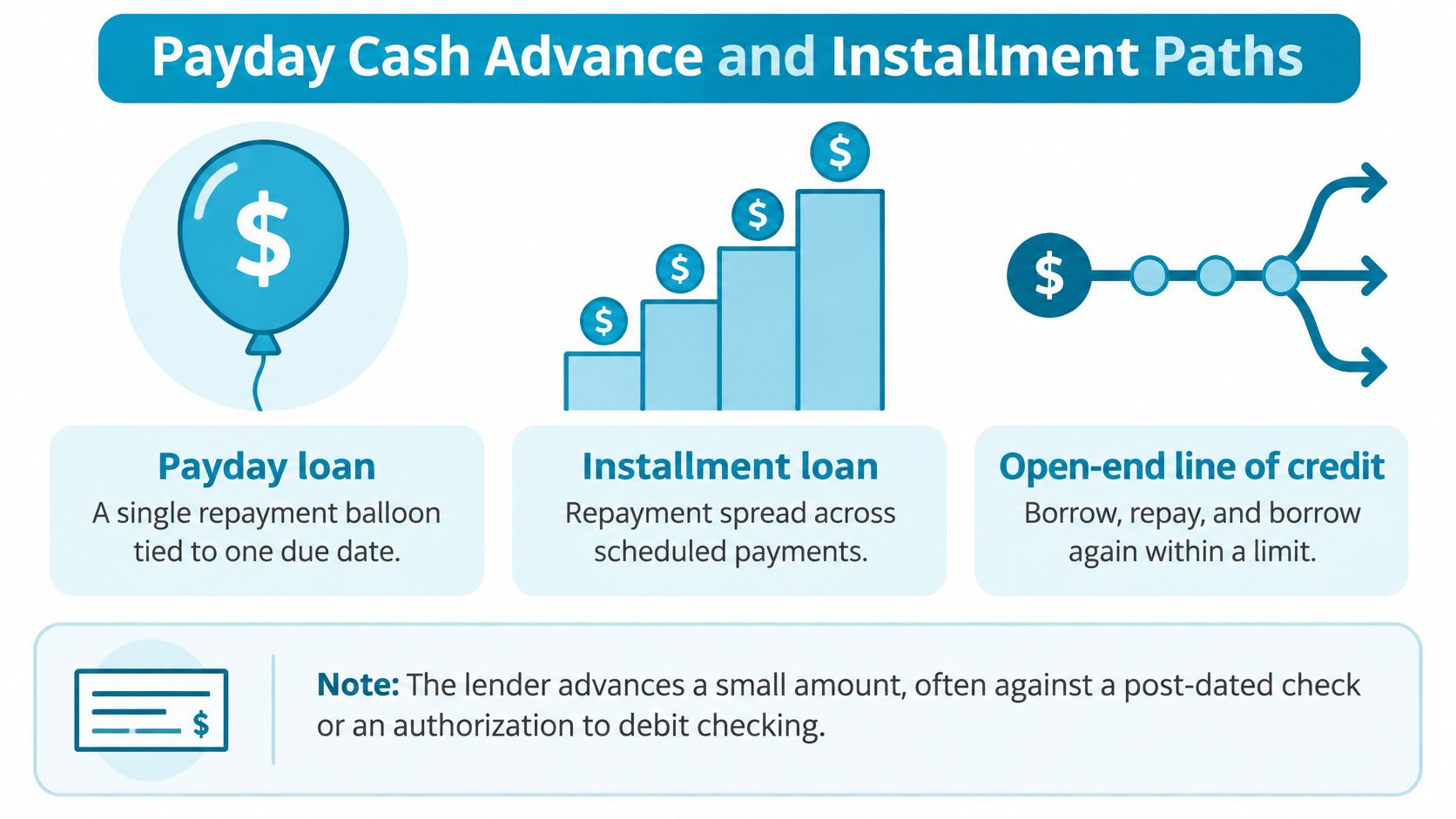
With a payday loan, the agreement calls for a single repayment tied to a due date. A lender may ask for authorization to debit your checking account or another repayment arrangement. Your task is to determine whether the entire withdrawal fits, not whether you can afford just the fee.
With a short installment loan, repayment is divided across scheduled payments. That can reduce the amount due at any one time, but a smaller payment doesn't establish that the overall offer is cheaper. Read the full schedule and total cost, including the final payment.
A cash advance needs closer inspection because the term doesn't tell you enough. An employer-linked advance, app advance, and credit-card cash advance can use different repayment methods and charges. Find out whether repayment comes from a deposit, a bank debit, or a card bill.
Don't confuse an advance with an ongoing credit limit
An open-end line of credit allows borrowing, repayment, and further borrowing within an approved limit. Unlike a closed-end installment loan, it may remain available after you repay what you initially used. That flexibility requires discipline because drawing again can postpone the point when you're debt-free.
Use the agreement to answer a few concrete questions:
- Repayment structure: Is this a single payment, a fixed schedule, or an ongoing balance?
- Collection method: Will the lender debit your account, deduct wages, or send a bill?
- Balance reduction: Does each scheduled payment reduce what you borrowed?
- End point: What must happen for the obligation to be completely paid off?
Choose the structure your income can support. Don't stretch a small emergency into a longer commitment merely because the individual payments look comfortable.
Rollover Fees That Keep the Principal Alive
A missed due date can lead to an extension rather than repayment. The important distinction is that paying for more time isn't the same as paying down debt.
The Federal Trade Commission's payday and car-title loan guidance explains that a lender may extend an unpaid loan for another two or four weeks, with additional fees while the original principal remains due; its fee mechanism supports the illustrative $15-per-cycle calculations below.
Cost of extending a $100 loan at $15 per cycle
| Cycles | Fees paid | Principal still owed | Cash owed before principal falls |
|---|---|---|---|
| 1 cycle, about 2 weeks | $15 | $100 | $115 if paid in full |
| 2 cycles | About $30 | $100 | About $130 total outlay to settle |
| 3 cycles | About $45 | $100 | About $145 before other charges |
This table counts borrowing periods, not extensions added after the initial period. “Fees paid” means cumulative fee cost; if you've already paid some fees, they aren't also part of the remaining payoff. The last column combines those fees with principal to show total outlay, rather than claiming every dollar remains unpaid.
Follow the principal, not just the payment
Read down the principal column. It doesn't fall because this example assumes fees buy additional time without reducing the borrowed amount.
That's why a payment confirmation can be misleading if you don't inspect how the lender applied the money. You may have successfully paid a charge while making no progress toward closing the loan.
An extension can also crowd out the money you intended to use for groceries, transportation, or another bill. If those expenses haven't changed, the later paycheck may offer no more room than the paycheck that couldn't cover the first due date.
Money leaving your account isn't proof that your principal balance is shrinking.
Questions to ask before an extension
Get the proposed arrangement in writing and ask:
- Payment allocation: Will any part of the payment reduce principal, or does it only purchase another borrowing period?
- Withdrawal authorization: Can the lender automatically collect extension fees, and on what dates?
- Full payoff: What exact amount would close the account, including outstanding charges?
- Security: Is a vehicle title or other collateral attached to the obligation?
- Other arrangements: Can the lender offer a repayment arrangement that reduces the balance instead of renewing it?
State rules can restrict loan amounts, charges, and extensions, so the illustration isn't a statement of what every lender may legally offer. Don't assume a rollover is available, permitted, or your only response to difficulty paying.
Contact the lender before a failed withdrawal if you expect a problem. Ask specifically for an arrangement that leads toward repayment rather than another fee-only cycle.
Cheaper Ways to Cover the Same Gap
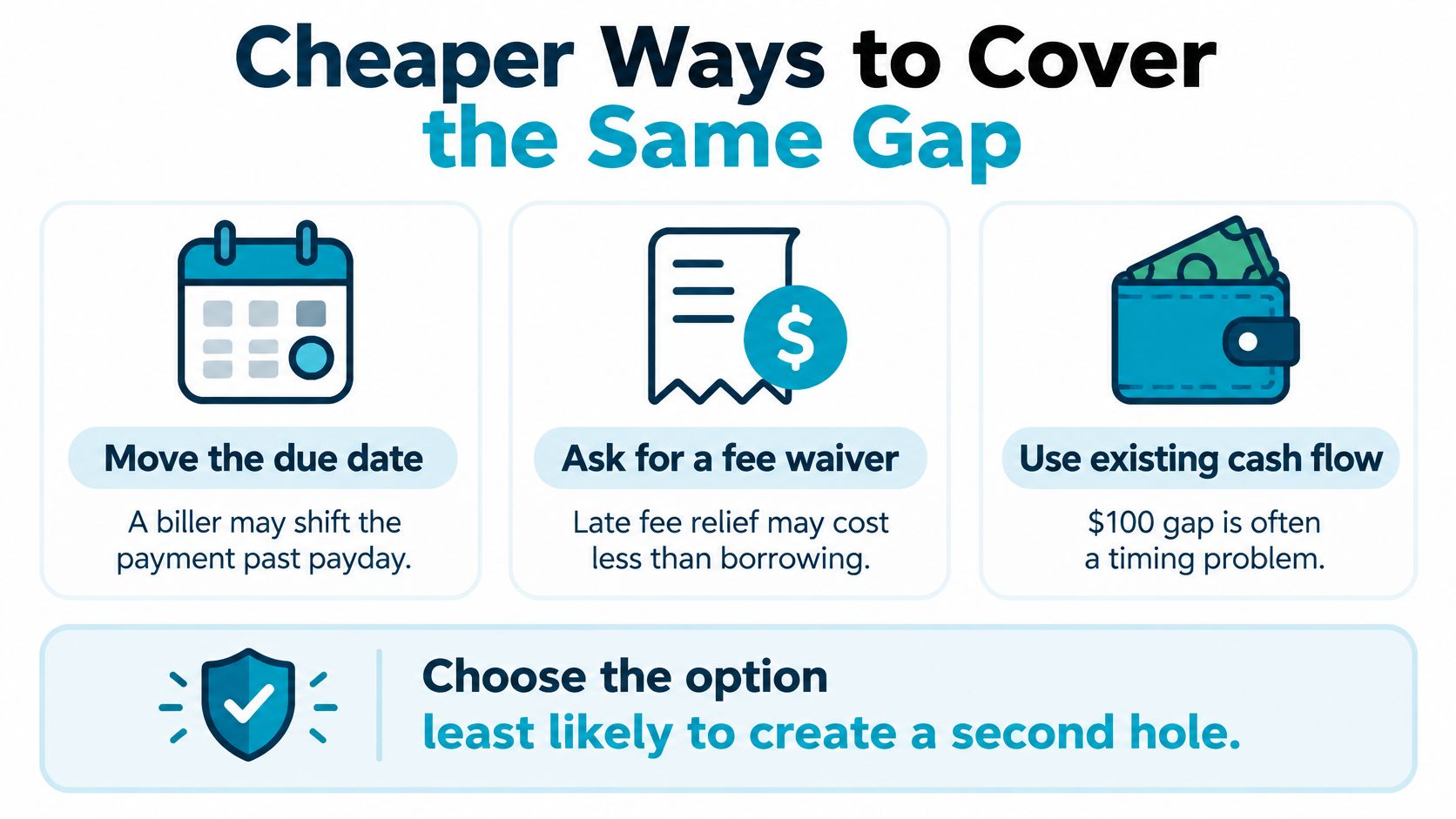
Start with the bill you're trying to pay. If the biller will move the due date, waive a charge, or accept a manageable payment arrangement, you may resolve the shortage without adding a new lender to your budget.
An employer advance can also help when the employer already offers one. But it brings wages forward rather than increasing them, so check the reduced paycheck before accepting.
Compare the account consequences
The Federal Reserve's report on consumer financial conditions cites CFPB data showing an average BNPL loan amount of $135 and reports that 11% of BNPL users in the 2025 household survey had a payment trigger an overdraft or nonsufficient-funds fee during the prior year.
That finding doesn't mean every buy now, pay later agreement is expensive. It means a purchase described as interest-free can still produce a bank-account cost when the installment arrives.
Ways to cover a $100 gap besides a new payday loan
| Option | Fits when | Typical cost on about $100 | Second-shortfall risk |
|---|---|---|---|
| Ask to delay a bill | The biller will move the date past payday | No charge if waived; otherwise the biller's stated fee | Lower when the revised date leaves room for essentials |
| Employer paycheck advance | Your employer already offers one | The employer's disclosed fee, if any | The later paycheck is reduced |
| Credit card paid in full next statement | You can make the purchase directly and clear the statement | Check purchase interest and grace-period eligibility | A carried balance can make later bills harder to cover |
| Buy now, pay later | You need a purchase, not cash | Check interest, late charges, and bank fees | Scheduled installments can overlap other withdrawals |
| Friend or family | Both people can agree on repayment | No finance charge if both agree | Missed repayment can damage the relationship |
| Bank overdraft | A bank permits a transaction despite insufficient funds | The bank's disclosed overdraft charge, if applicable | The fee and negative balance reduce available deposits |
The table uses contract terms where there isn't a reliable universal price. Don't assume an employer advance is free, that a relative won't charge interest, or that every bank handles an insufficient balance identically.
Match the alternative to the expense
A credit-card purchase and a credit-card cash advance aren't interchangeable. Check each transaction's fees, interest treatment, and payment rules before moving money. An option that works for buying groceries may not work for a bill requiring cash or a bank transfer.
For BNPL, list every outstanding installment in your calendar before adding another purchase. Ask how late payments are handled, whether withdrawals are automatic, and whether activity is reported to credit bureaus.
Our guide to payday loan alternatives can help you identify other possibilities. Compare them by total cost, payment timing, and the money left afterward, not by whether an advertisement promises an immediate decision.
Choose for the following payday: The better option is the one that resolves today's need without making an essential payment impossible later.
Cash Flow Gaps a Small Loan Cannot Fix
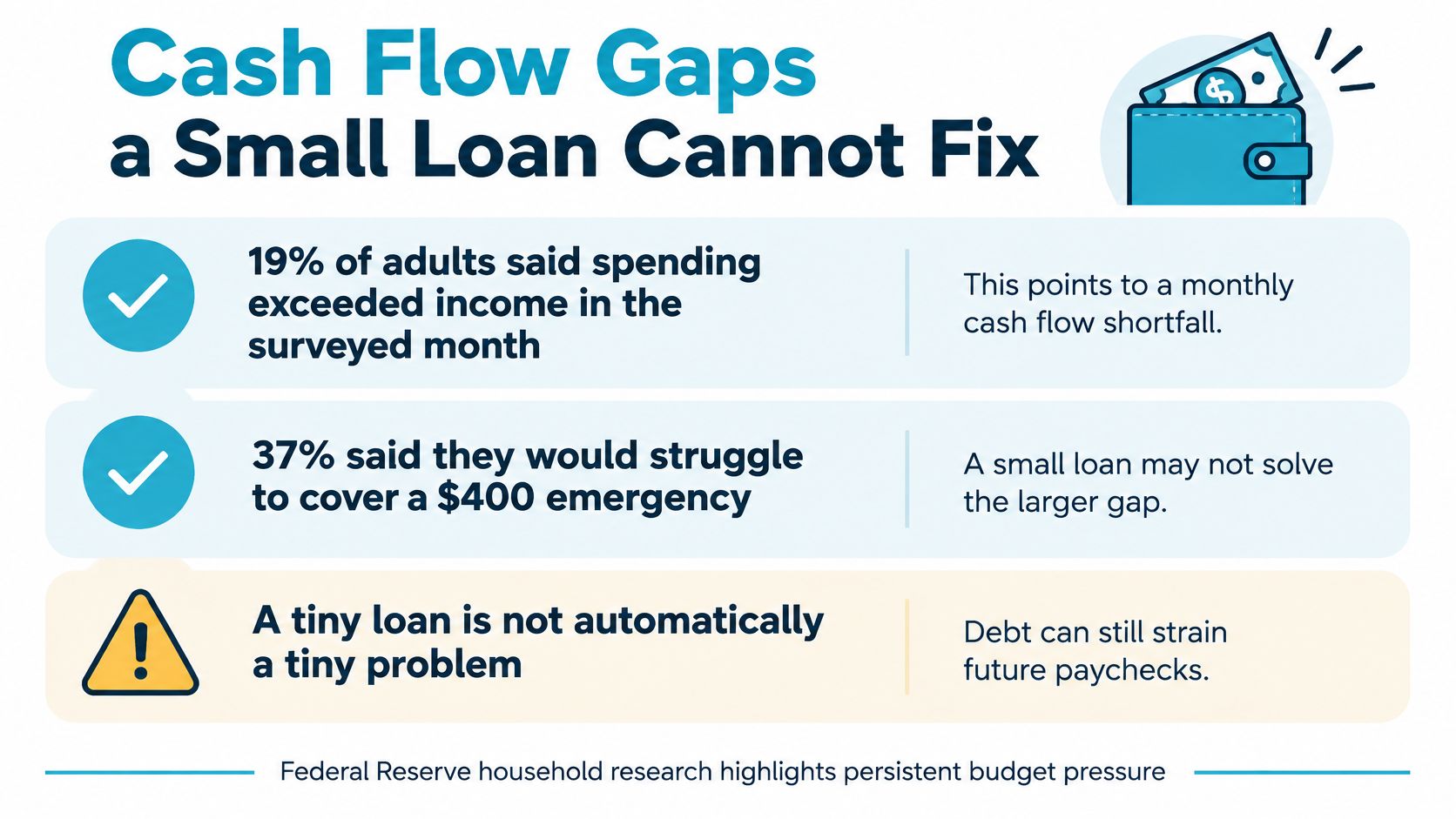
The Federal Reserve's household-finance analysis reports that 19% of U.S. adults said spending exceeded income in the surveyed month, while 37% couldn't cover a small emergency using cash, savings, or a credit card paid off at the next statement during 2022–2024. That distinction matters: a borrowing need can reflect either awkward timing or an ongoing mismatch between income and expenses.
A tiny loan isn't automatically a tiny financial problem. The amount requested tells you what's missing today, not whether there's room to repay it tomorrow.
A timing gap and an income gap need different answers
Consider a hypothetical household with a utility payment due before wages arrive. The coming paycheck covers normal expenses and leaves enough for the proposed repayment. Borrowing might bridge the timing mismatch, although moving the utility date could accomplish the same thing without a finance charge.
Now consider a household whose rent, food, transportation, and existing payments already consume its next paycheck. A new advance lets the household pay something today, but the repayment adds another claim against income that was already fully committed. The loan doesn't solve that underlying shortage.
Neither household benefits from judging the offer by approval speed alone. They need different responses because their repayment capacity differs.
Build a payday balance before applying
Use your bank's scheduled-payment screen, recent statements, and pay information. Write down:
- Today's shortage: The essential amount you can't cover, excluding optional spending.
- Available income: The take-home deposit you can reasonably rely on by the payment date.
- Committed spending: Rent, food, transportation, scheduled debits, and existing debt payments before the following income arrives.
- Proposed repayment: The complete loan payment, including disclosed charges.
Subtract committed spending from available income. If the result can't cover the proposed repayment, approval wouldn't make the loan workable.
Leave room for expenses that don't appear as automatic drafts. Food and transport still cost money even when your banking app doesn't list them as upcoming transactions.
When the paycheck remains short, prioritize payment arrangements and assistance with essential bills. Borrowing should address a temporary timing problem, not conceal a budget that still won't balance after the funds arrive.
Eligibility Checks and Application Steps
Qualification and affordability are separate questions. A lender may be willing to make an offer that you shouldn't accept, so finish your own cash-flow check before submitting personal information.
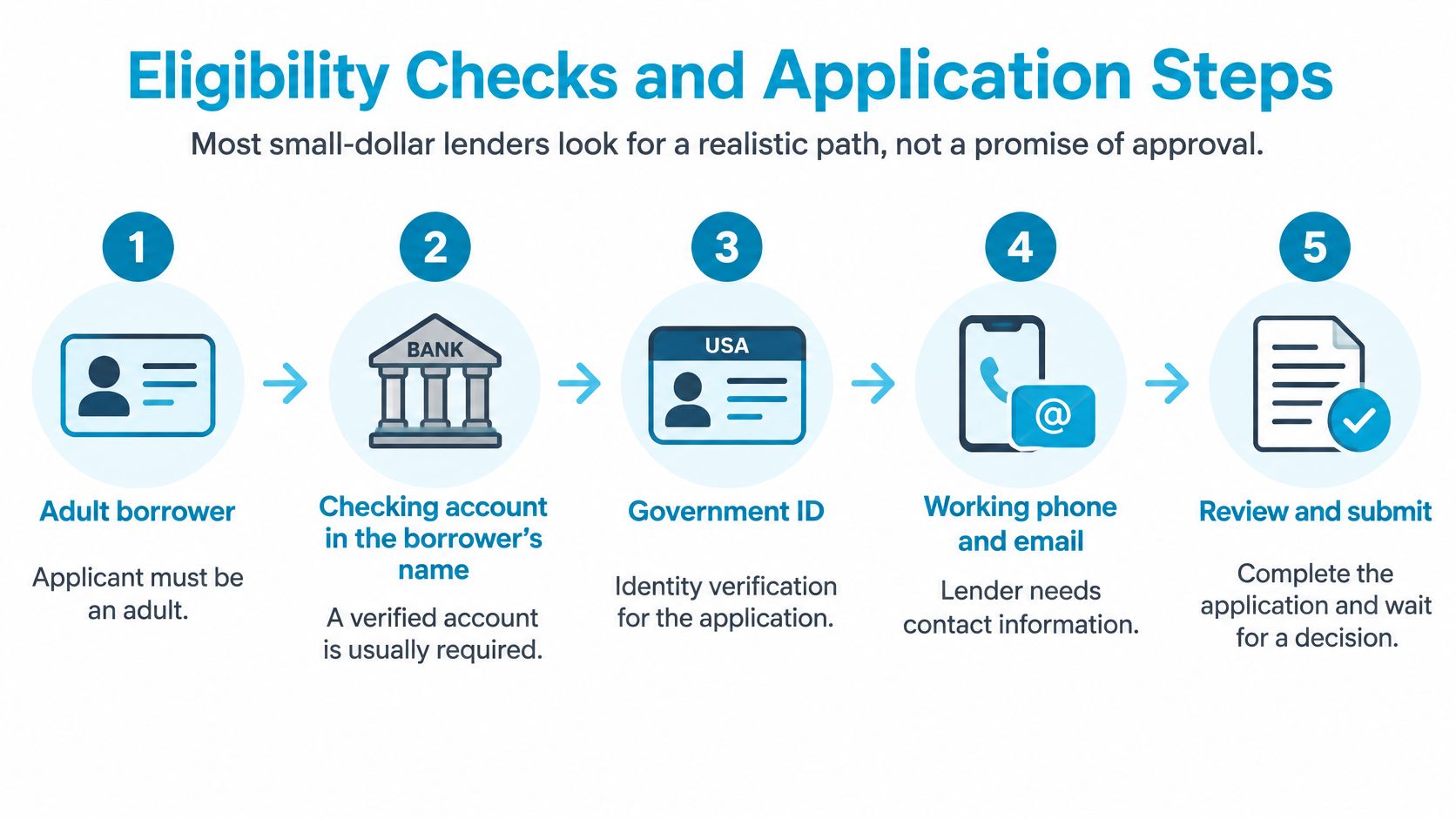
For our personal-loan request process, basic requirements include being at least 18, having a checking account, and being employed with regular income and a known pay frequency. Meeting these requirements doesn't guarantee approval; independent lenders make the credit decision.
Prepare for verification, not just a quick form
Have identification, current contact details, account information, and income records available. A lender may need documents to verify what you enter, so use information that matches your records.
Don't assume a bad-credit pathway means no credit review. We don't pull credit as a marketplace, but participating lenders may check major or alternative credit bureaus. Our payday loan requirements guide explains the kinds of information to prepare.
Follow a deliberate application sequence
- Recheck repayment capacity. Confirm that essential spending still leaves room for the complete payment, so you don't apply for an obligation your paycheck can't support.
- Compare deposit and debit timing. Seek a payment date after funds are available, because an expected deposit isn't the same as cleared money.
- Gather accurate documents. Keep identification, routing and account numbers, and income details ready to reduce avoidable verification delays.
- Submit the request and inspect the offer. Read the finance charge, total payments, APR, payment schedule, and withdrawal authorization so you understand the actual obligation.
- Sign only acceptable terms and save them. Use the lender's required electronic acceptance process and retain the agreement as your record.
- Reserve repayment money. Account for the scheduled withdrawal in your spending plan so another purchase doesn't use the same funds.
Stop before signing if the repayment doesn't fit. Don't treat approval as a deadline that forces you to accept.
Funding is a separate event from an application response. Some lenders require additional documents, and in some circumstances application materials may need to be faxed. Keep paying attention to the original bill's deadline while verification is underway.
Check the lender's identity and applicable state authorization before sharing sensitive information. Availability and permitted terms depend on where you live; an online form doesn't make every advertised product available everywhere.
Confirm the Offer Before You Accept
Accept only when these conditions are all true:
- The price is clear: You know the dollar finance charge and any other listed costs.
- The repayment fits: Essential expenses and existing commitments leave enough money for the complete payment.
- The date works: Funds will be available before the scheduled collection.
- The debt can end: Repayment won't require another advance, extension, or overdraft.
If a condition fails, pause rather than sign. A smaller advertised payment, quick response, or convenient application can't replace a workable repayment plan.
Use a marketplace only after the budget test passes
At NextStopLoans, we route a consumer's request to independent third-party lenders. We aren't the lender, don't set the rate, and don't guarantee approval. You can review an offer and decline it without an obligation to accept.
Our process has three steps: request a loan, agree to terms, and get your money. The form asks for the requested amount, personal information, and where funds should be deposited. Don't increase your borrowing just because an available form option or lender offer is larger than the expense you need to cover.
If approved, you accept by electronically signing the lender's offer and returning it. Funds are deposited directly into your bank account, usually as fast as the next business day, although lender processing and additional documentation can affect timing.
Our service is for eligible U.S. residents and isn't available in every state, including Arkansas, New York, Vermont, and West Virginia. Check availability before treating a possible match as part of your payment plan.
NextStopLoans offers an online request service that connects consumers with independent lenders for review of available borrowing options. If you're considering a 100 dollar loan, visit NextStopLoans to check the request options, then accept only terms that your repayment calendar can support.