
What Is a Cash Loan? Types, Costs and Risks

A cash loan provides money now in exchange for repayment under agreed terms. Its cost depends on more than the amount you receive: the finance charge, repayment dates, and any renewals all affect how much you pay before the balance reaches zero.
Most cash loans are small, often a few hundred dollars. That can make the total cost easy to underestimate. A short repayment period may leave little time to fit the payment into your budget, while renewing a past-due loan can add lender-set charges. The key question is not only how quickly the money arrives, but how much you will repay and when.
Table of Contents
- What a Cash Loan Means in Plain Terms
- Cash Loan Types Compared Side by Side
- What a Cash Loan Really Costs
- Who Qualifies and Who Actually Lends
- How a Cash Loan Works from Request to Repayment
- Compare Total Repayment Before You Accept an Offer
- Benefits, Drawbacks and Cheaper Alternatives
What a Cash Loan Means in Plain Terms
Think of a cash loan as rent on money. You get the use of someone else's funds today, and you pay for that use over time. The amount you borrow is the principal, the extra you pay is the finance charge stated in dollars, and the dates and amounts you agree to are the repayment schedule. Those three pieces are the whole anatomy of the deal, and you should be able to point to each one in writing.
The parts are easier to see when you write them down.

A worked example with $300
Say you borrow $300 and agree to repay $345 on a set date. The principal is $300, the finance charge is $45, and the repayment schedule is one payment of $345 on that date. The $45 is the price of getting the money early. If the same $300 were repaid over six monthly payments, the finance charge would be different, but the structure would still have the same three parts.
A cash loan is an umbrella term, not a single product. It covers short payday advances, installment loans repaid over months, personal or signature loans, and title loans secured by a vehicle. The FDIC's 2002 analysis of payday lending describes payday loans as small-dollar, short-term, unsecured credit, where the borrower generally promises repayment from the next paycheck or another regular income payment.
The test: If you can name the amount received, the finance charge in dollars, and the date each payment is due, you understand the offer in front of you.
The lender named in the agreement sets those numbers. Your search, an ad, or an application site doesn't set them. Before you sign, find the three parts on the page.
Cash Loan Types Compared Side by Side
The fastest way to choose is to match the loan to the expense, not to the label. The table separates four common structures by use, repayment, collateral, and the cost to check first.
Cash loan types by use, repayment and collateral
| Type | Typical use | How it is repaid | Collateral | Main cost to check |
|---|---|---|---|---|
| Payday | Bridge to next paycheck | One payment, usually on next payday | Usually none (unsecured) | Fee per $100 and renewal terms |
| Installment | Planned or larger expense | Fixed payments over several months | Usually none (unsecured) | Total of all payments and late fees |
| Personal or signature | Major purchase, medical bill, debt consolidation | Fixed payments under agreed terms | Often none (unsecured) | APR and origination fees |
| Title | Larger sum when you own a vehicle | Payments on agreed schedule | Vehicle title | Repossession terms and fees |
How to read the comparison
The first column tells you when the product fits. A payday loan is a bridge to your next paycheck, usually repaid in one payment on your next payday. An installment loan spreads a planned or larger expense over several months with fixed payments set by the lender.
The third and fourth columns tell you what you're risking. A title loan uses your vehicle as collateral, which is why the repossession terms deserve a close read. Payday, installment, and personal loans are often unsecured, which means no asset is pledged, but that doesn't make them cheap.
The last column tells you where to look first. For payday, check the fee per $100 and the renewal terms. For installment, add up every payment and check late fees. For personal or signature, compare the APR and origination fees. For title, read the repossession terms before you sign.
Emergency loan and cash loan are marketing labels, not a single product design. A lender can apply either label to a payday, installment, or personal product. Check the agreement rather than the label.
For a closer look at how two common short-term products differ, read this payday loan vs cash advance comparison.
A matching test for your expense
Name the expense, its deadline, and whether one payment or several is realistic. A bill due Friday with a paycheck landing Monday points to a different product than a $2,000 medical balance you can repay over six months. If you can't describe the repayment in one sentence, the product doesn't fit yet.
What a Cash Loan Really Costs
The FDIC small-dollar-lending analysis tracks the fee levels below and what they become when annualized.
Payday fees per $100 and their approximate APR
| Fee per $100 borrowed | Approximate APR | Context |
|---|---|---|
| $10 | about 261% | Low end of typical payday fee range (FDIC) |
| $20 | about 521% | High end of typical payday fee range (FDIC) |
| $25 | about 652% | Average online payday fee (FDIC) |
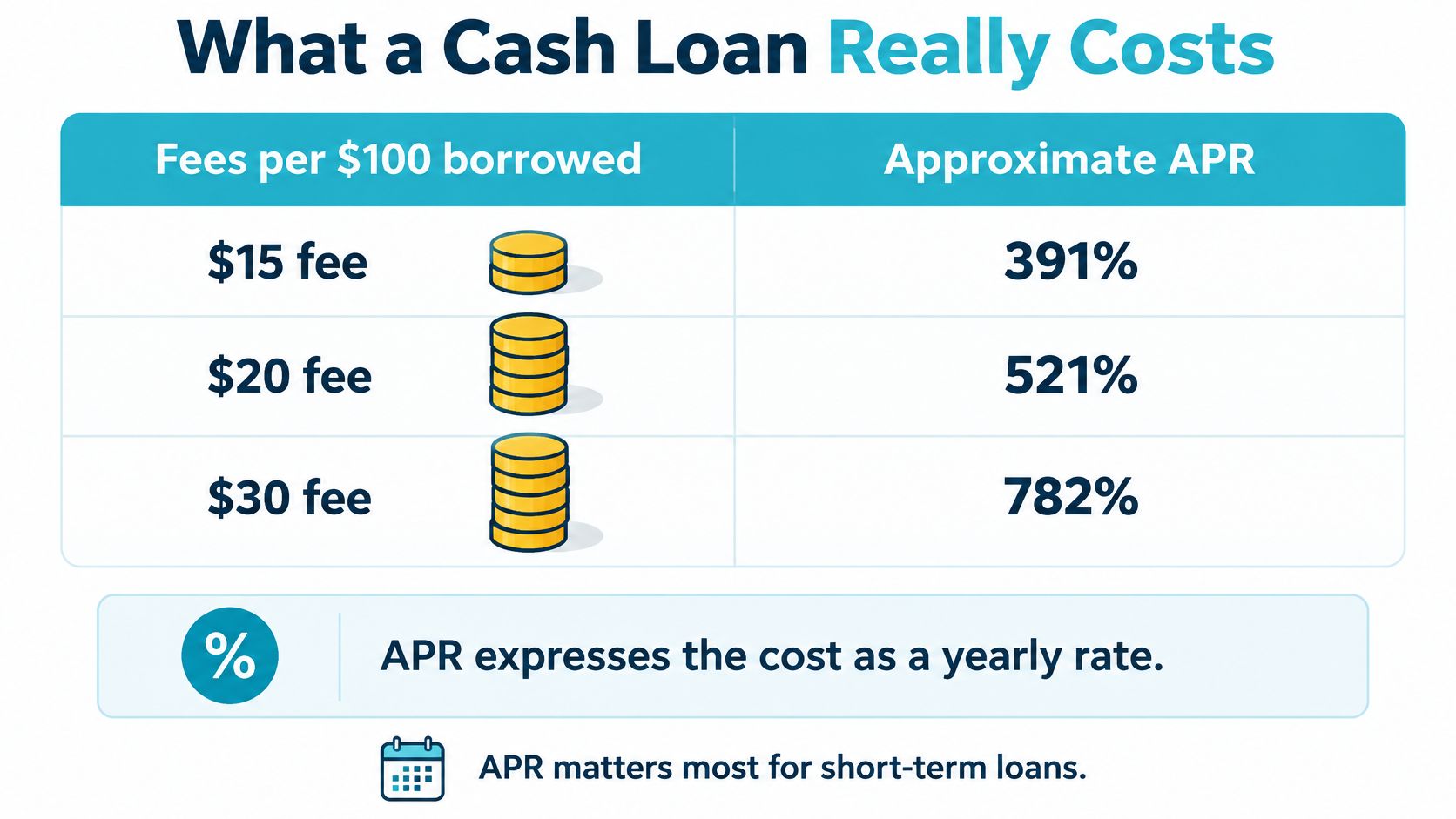
APR is the cost of credit expressed as a yearly rate. It folds in the interest rate, loan fees, and repayment duration, so it lets you compare offers with different terms. A $10 fee on $100 sounds small because $10 is small. Stretched across a year at a two-week repayment cycle, the same fee structure equals about 261% APR.
That doesn't mean you hand over 261% of the principal in one payment. It means the fee, repeated over a year, would amount to that annual rate. The dollar figure is what you pay now; the APR is what the schedule costs when annualized.
The pattern is easier to see side by side.
The renewal multiplier
The fee alone understates the burden because many borrowers don't pay once and finish. That same FDIC analysis found that 80% of borrowers used at least three loans per year, 76% of all loans were renewals or re-borrowings within one pay period, and the average borrower remained indebted for five months during the year. For an average $375 loan, borrowers taking eight to eleven loans annually could pay about $520 in fees on that extension of credit.
That's the hidden cost. A $15 or $20 charge feels manageable at the counter. Repeated every pay period, it becomes a subscription to debt with no new money to show for it.
These figures describe payday lending. Installment and personal loans may cost much less, and their rates and durations can be substantially lower. The formula still applies. Total cost equals the finance charge on each loan multiplied by the number of times it is renewed or re-borrowed.
Who Qualifies and Who Actually Lends
Approval starts with a short list of basics. At NextStopLoans, the basic requirements to qualify for a personal loan are being at least 18 years old, having a checking account, and being employed with regular income and pay frequency. Those are minimums, not a guarantee. Each lender sets its own criteria.
What the lender decides
The lender decides approval and loan terms at the time of your application. A responsible lender may check your credit with one or more bureaus. That's why the terms you see come from the lender, and why the lender's agreement and disclosures are the documents to read.
A marketplace plays a different role. NextStopLoans connects people with a lender from its network of approved lenders. We're not a lender and don't make credit decisions. We don't pull your credit or look at your creditworthiness; responsible lenders do.
A marketplace can move your request quickly. It can't approve you, price the loan, or change the lender's terms.
State rules also matter. Some states restrict or prohibit certain cash loans, and what you can get is tied to where you live. Our service isn't available in every state.
A short pre-application checklist
- Age. Confirm you're at least 18.
- Bank account. Have a checking account ready for deposit and repayment.
- Income details. Know your employer, pay frequency, and next pay date.
- Lender identity. Identify which lender's terms will apply before you sign.
A lender may also ask for proof of income or identity, and each lender and product can set different requirements. If any item is missing, fix it before you apply. A fast rejection isn't a shortcut.
How a Cash Loan Works from Request to Repayment
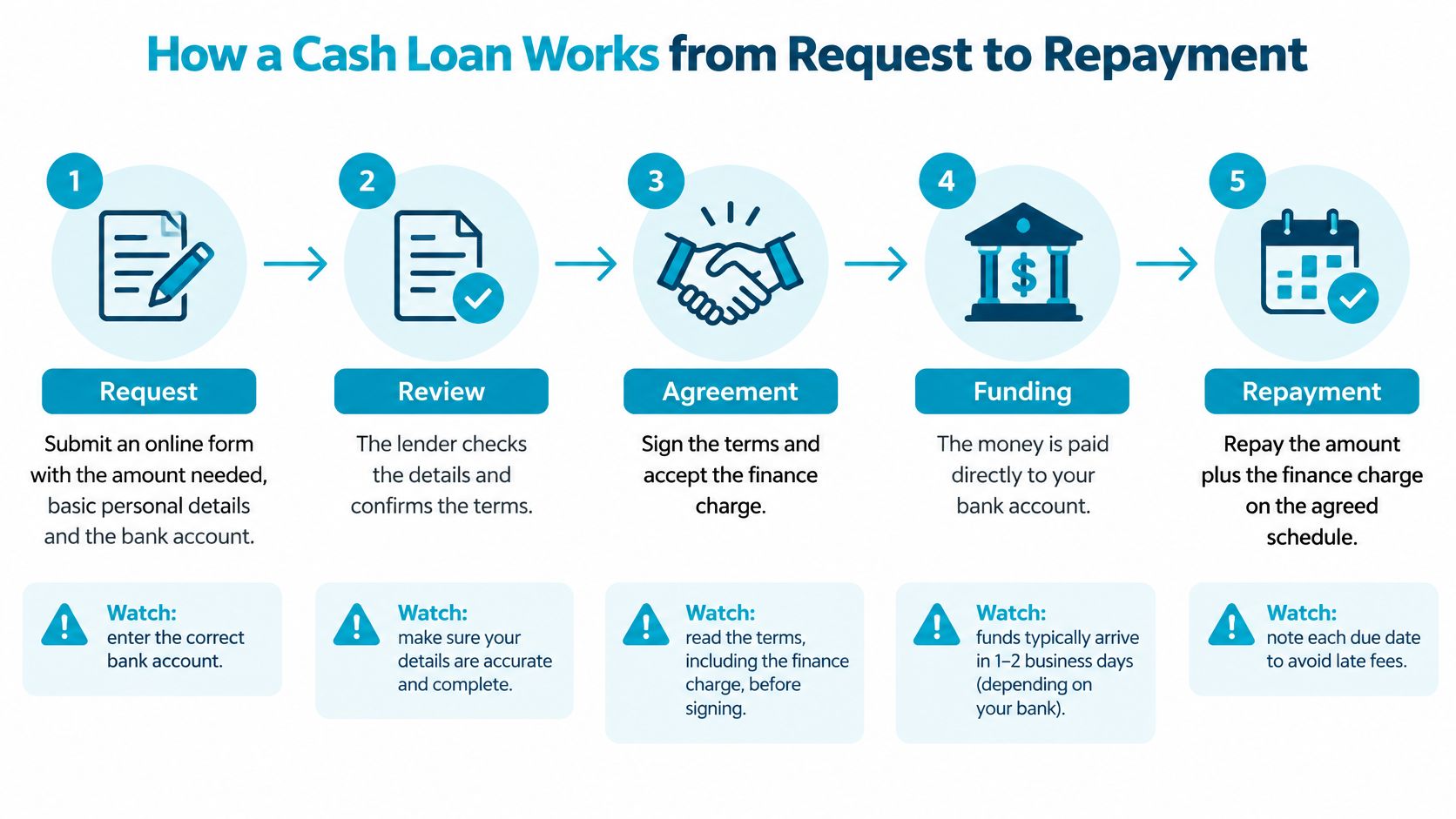
At NextStopLoans, a loan is accepted when you electronically sign the lender's offer and send it back. That signature is the moment the terms become binding, so it deserves more attention than the form that came before it. The request itself doesn't create a loan. The path from request to repayment runs through five stages.
The flow looks like this.
Five stages from form to final payment
- Request. You submit an online form with the amount you need, basic personal details, and the bank account where funds should go. It takes minutes. Common slip: entering an account you don't control or a number you haven't checked.
- Offer. The lender reviews the request and responds, often quickly when the request is shared with several lenders. Watch for: treating the first number you see as final before comparing the finance charge.
- Agreement. You read the terms and accept by signing electronically. Frequent mistake: signing before you've found the payment amount and due date.
- Funding. Funds are deposited directly into your bank account, usually as fast as the next business day. Each lender sets its own funding time, and sometimes faxed documents are required. Easy error: assuming same-day cash.
- Repayment. You pay on the agreed dates. Usual miss: missing a due date because you didn't expect the debit.
The stage that causes the most trouble is the last one. A payment that fits your budget on paper can fail if it lands before your paycheck or on the same day as rent. Put every due date on your calendar before you sign.
Before step three, confirm the payment amount, the due date, and what happens if the payment is late. If any of those is unclear, don't sign.
Compare Total Repayment Before You Accept an Offer
Two cash loan offers can quote the same interest rate and still cost different amounts. Origination, documentation or other additional fees may apply to an online personal loan, and late payment or non-payment can add penalties on top. Compare the complete offer, not the headline rate.
The pre-signature checklist
- Amount received. Confirm the dollars that will reach your account.
- Finance charge in dollars. Ask for the fee as a dollar figure, not only a rate.
- APR. Use the annual percentage rate, which includes fees and the repayment term.
- Payment dates and total repayment. Write down every due date and the sum of all payments.
- Late and non-payment fees. Find out what happens if a payment is missed.
- Renewal and automatic debit. Check whether the lender can renew the loan or pull payments automatically.
The Federal Trade Commission's guidance on payday and car title loans gives a clean example. A typical two-week payday loan charging $15 per $100 borrowed corresponds to a 391% APR. The fee is $15 on a $100 advance. Annualization exposes what happens when the same balance is financed again and again over short periods.
NextStopLoans connects borrowers to participating lenders through one online form. The lender sets the terms and makes the credit decision, and we receive compensation from our lenders based on advertising services. Run the numbers in our loan calculator before you accept. Our How It Works, Rates & Fees and FAQ pages set out the disclosures.
Decline any offer whose total repayment can't be met on the due date without missing rent or utilities.
Benefits, Drawbacks and Cheaper Alternatives
The usual pitch says a cash loan is the answer to an emergency. It can be, for a narrow set of cases. The more useful question is whether the repayment fits the rest of your month.
When the benefits are real
- Speed when a deadline is real. Funds can arrive quickly, often by the next business day.
- Access without a branch visit. You can submit a request online and sign electronically.
- Predictable payments with installment products. A fixed schedule lets you plan around known dates.
- No collateral with many unsecured types. You don't put an asset on the line, though the cost can still be high.
What the drawbacks look like
A title loan puts your vehicle at risk if payments stop. Late-payment and non-payment fees can add to the balance. Some lenders in our network may automatically renew a short-term loan that becomes past due, and renewal adds charges set by the lender; the term is identified in the loan agreement.
Cash doesn't mean low risk. The Federal Reserve's 2025 household well-being report found that 63% of U.S. adults said they could cover a hypothetical $400 emergency using cash, savings, or a credit card paid off at the next statement, while only 2% said they would use a payday loan, deposit advance, or overdraft and 3% would use a bank loan or line of credit; 12% said they could not pay the expense immediately, and 7% of adults reported using a payday, pawn, auto-title, or tax-refund-anticipation loan, up one percentage point from the prior year.
The first question isn't whether a cash loan is available. It's whether the repayment fits after rent, utilities, food, and existing debt.
Segment by the size and timing of the gap. A same-day bill may call for savings or a payment arrangement with the creditor. A larger unavoidable expense may fit installment credit with predictable payments. Check a bank or credit union loan, or a credit card you can pay off in full at the next statement, before you take a short-term loan. This guide to payday loan alternatives walks through the choices.
Then ask whether you need credit at all. If you proceed, use the total repayment test, not the amount received.
NextStopLoans connects you with a lender from its network of approved lenders through one secure online request, and the service is free. You can review any offer, check the finance charge and repayment schedule, and decline if the terms don't fit. Visit NextStopLoans to start your request.