
Title Loan Max: How Much You Can Borrow Against Your Car

A small title loan can put a much more valuable car at risk. The useful question isn't just how much a lender will advance against your vehicle, but whether you can repay the debt without sacrificing the transportation you need.
A title loan max is a ceiling, not a recommendation. The state sets the legal boundary, the lender evaluates the collateral and application, and your household budget determines whether accepting the offer makes sense.
Table of Contents
- How Vehicle Value and Equity Set Your Maximum Advance
- State Caps and Other Limits on Title Loans
- Typical Title Loan Amounts Versus the Legal Maximum
- What Each Loan Amount Costs in Fees and Renewals
- How Much Payment You Can Sustain
- Repossession and Lien Risks to Your Vehicle
- Alternatives to Borrowing Against Your Car
- Confirm Your Offer Before You Sign
How Vehicle Value and Equity Set Your Maximum Advance
Your potential advance is constrained by the lender's equity-based calculation, its own lending maximum, and any applicable state cap. The lowest applicable ceiling governs. Even then, a lender may decline the application or offer less after reviewing your income and other requirements.
The table below is a hypothetical planning exercise, not a statement of typical lender percentages. It assumes a clear-title vehicle with no existing lien and applies an illustrative advance range solely to show how collateral calculations work.
Illustrative title loan advance by vehicle value
| Vehicle value (no lien) | Illustrative advance at 25% to 50% of value | What usually limits the amount |
|---|---|---|
| $3,000 | $750 to $1,500 | A lender's minimum vehicle value or minimum advance could exclude it |
| $8,000 | $2,000 to $4,000 | An applicable state dollar cap could reduce the upper end |
| $25,000 | $6,250 to $12,500 | Compare the collateral calculation with the state and lender ceilings |
Don't treat the percentages in this illustration as an advertised offer. A higher vehicle value creates more potential collateral, but it doesn't establish what a particular lender is permitted or willing to advance.
Establish the value the lender actually uses
A retail listing price isn't necessarily the figure a lender will accept. You can consult Kelley Blue Book, J.D. Power, or NADA Guides as valuation references, but ask the lender which valuation method, condition rating, mileage, and vehicle specification it uses.
Trade-in, wholesale, private-party, and retail estimates answer different questions. If you calculate an advance from a retail asking price while the lender uses a lower liquidation estimate, your expectation will be too high before underwriting even begins.
Use this sequence when reviewing an estimate:
- Identify the appraisal basis. Get the lender's accepted vehicle value rather than substituting an online asking price.
- Establish the lien payoff. Ask any existing creditor for a payoff statement. The current statement balance may not equal the amount needed to release its lien.
- Clarify the calculation order. Ask whether the lender applies its advance percentage to vehicle value or available equity.
- Separate payoff from cash proceeds. If an existing obligation must be paid from the new loan, that portion won't reach your bank account.
- Apply the legal and lender limits. A generous collateral estimate doesn't override either restriction.
- Check income eligibility. Collateral alone doesn't establish approval or an affordable payment.
The calculation order matters. Applying a percentage to net equity isn't the same as applying it to the full vehicle value and then subtracting an existing payoff. Don't accept an estimate that leaves that distinction unexplained.
Ask for a net-proceeds estimate
Use a title loan estimate calculator to organize the inputs, then request a written breakdown from the lender. It should distinguish gross principal, any existing lien payoff, any amounts withheld, and the cash you'll really receive.
Planning rule: Compare your cash need with net proceeds, not with the largest number displayed in the offer.
State Caps and Other Limits on Title Loans
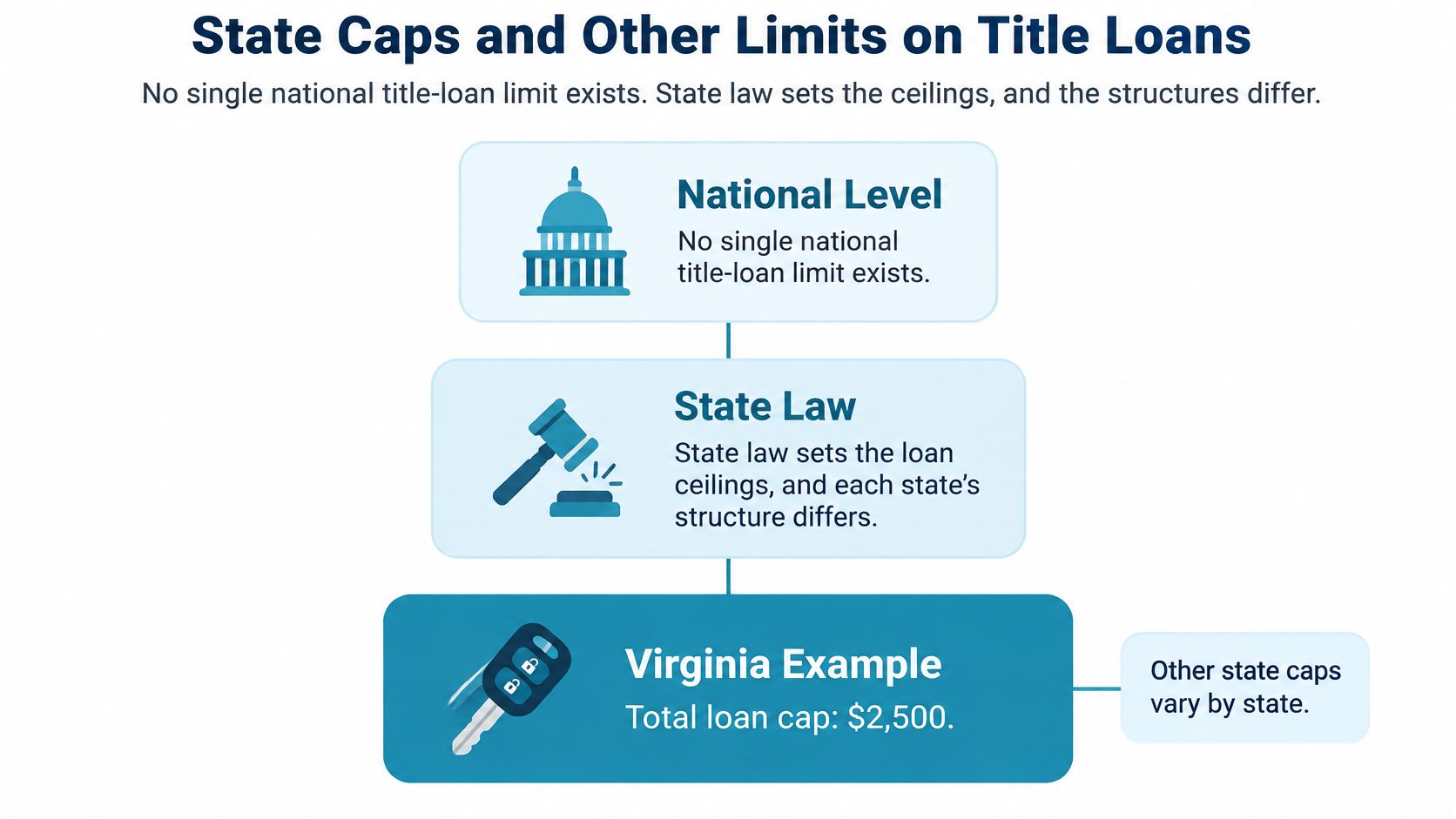
In Virginia, the legal ceiling is $2,500, but that does not mean every borrower can receive that amount. The Virginia motor-vehicle title-lending regulations also require a minimum term of six months and generally limit the maximum term to 24 months, with a shorter-term exception tied to income-based monthly-payment thresholds.
These are legal boundaries, not approval guarantees. A vehicle may have substantial equity, yet the permitted advance can still be constrained by state law. And even an offer within the legal limit may be more than a borrower's budget can sustain.
Different restrictions answer different questions
There is no single national title-loan maximum. State rules may cap the principal, limit the advance as a share of vehicle value, regulate repayment terms, or restrict charges.
Types of title loan limits and how they apply
| Limit type | How it works | Example |
|---|---|---|
| Dollar cap | Sets an outer boundary on principal | Virginia's total-loan ceiling |
| Term limits | Restrict the repayment period | Virginia's minimum and generally permitted maximum terms |
| Payment-based term test | Conditions a shorter term on payment affordability | Virginia's income-based shorter-term exception |
| Percentage of value | Limits the advance relative to the collateral | A rule capping the advance at a set share of the vehicle's value, which the lender's calculation must stay within |
| Restricted states | Prevents access to a particular product or service | Confirm both legal eligibility and marketplace availability |
Each restriction addresses a different part of an offer. A dollar cap limits principal; a charge restriction affects borrowing cost; and a term rule governs the repayment schedule. Meeting one limit does not establish that the offer complies with the others.
Check the rule and the provider separately
Start with your state financial regulator or attorney general's consumer information. Check whether the product is permitted, which license applies, and whether the business named in the proposed agreement holds that license.
An online request form does not confirm that a loan is available in your state. Marketplace coverage and an individual lender's eligibility rules are separate considerations.
The practical hierarchy is clear: state law sets the outer ceiling, lender underwriting determines the offer, and your budget determines whether the payment is sustainable. The legal maximum is a boundary, not a borrowing target. A safe amount is one you can repay while protecting a vehicle worth far more than the advance.
Typical Title Loan Amounts Versus the Legal Maximum
The Consumer Financial Protection Bureau's auto-title-loan findings describe a median loan amount of $694 and a mean of $959, drawing on nearly 3.5 million anonymized single-payment auto-title-loan records from nonbank lenders issued between 2010 and 2013. The CFPB also identified a median annual percentage rate of 317%, showing why a modest principal shouldn't be mistaken for inexpensive credit.
The median describes the middle of the loan-size distribution. The mean is higher because larger loans pull the arithmetic average upward.
Neither measure describes the amount you'll qualify for. More to the point, neither tells you what your household can safely repay.
What the gap actually tells you
An advertised maximum describes the upper boundary of a product, not its ordinary use. Comparing that maximum with a typical principal can therefore create a misleading expectation about what an applicant is likely to receive.
The historical figures also don't establish why each borrower selected a particular amount. A smaller loan could reflect a smaller cash need, limited collateral, underwriting, or another constraint; the loan-size figures alone can't distinguish those explanations.
- Don't treat the maximum as a target. Start with the expense you're trying to cover.
- Don't infer affordability from loan size. A comparatively small balance can still produce an unmanageable payment.
- Don't treat historical amounts as current quotes. Request the actual terms available for your application.
The important comparison isn't your offer against another borrower's principal. It's the cash you receive against everything you'll have to repay.
The CFPB findings concern historical single-payment lending, not every current title-loan product. Their useful lesson is narrower: the size of the advance doesn't communicate the cost of the debt. You need the finance charge, repayment schedule, and total of payments before deciding whether an offer solves the cash shortage.
What Each Loan Amount Costs in Fees and Renewals
Illustrative total cost by repayment scenario
The following is a hypothetical calculation, not a quoted rate or a claim about current lender pricing. It assumes a 25% fee per 30-day period, charged on unchanged principal, with no additional charges.
| Scenario | Amount borrowed | Finance charges | Total paid |
|---|---|---|---|
| Single payment after 30 days | $1,000 | $250 | $1,250 |
| Three renewals, then payoff in month four | $1,000 | $1,000 | $2,000 |
| Six renewals, then payoff in month seven | $1,000 | $1,750 | $2,750 |
| Hypothetical $700 single payment | $700 | $175 | $875 |
The arithmetic is simple, but the distinction is important: paying a fee isn't necessarily paying down principal. Under this hypothetical structure, the borrower can make repeated payments while still owing the entire original advance.
Renewal changes the total, not necessarily the balance
A renewal may move the payoff date without reducing the debt. Whether renewal is permitted, and on what terms, must be checked against the contract and applicable state rules.
Ask the lender to show how each proposed payment is allocated. You need to know what goes toward principal, what pays borrowing charges, and what remains outstanding afterward.
Don't confuse the ability to make the renewal payment with the ability to repay the loan. Those are different budget tests.
Term length and additional charges need separate treatment
A longer schedule can reduce an individual payment when the loan amortizes. It can also increase total borrowing costs, so comparing payment size alone can favor an offer that costs more overall.
Check whether the agreement includes title or lien charges, processing charges, late-payment charges, or returned-payment charges. Ask which amounts are financed, which are withheld from proceeds, and which arise only after a particular event.
The hypothetical table excludes those costs. Your comparison should use the lender's written total rather than assuming a fee illustration captures every obligation.
- For a single-payment offer: Identify the full amount due on the maturity date.
- For an installment offer: Review the payment schedule and whether the balance reaches zero at the final scheduled payment.
- For a proposed extension: Get the added cost and new payoff amount before agreeing.
A guide to car title loan interest rates can help you distinguish an advertised periodic charge from an annualized borrowing rate. For the actual offer, request the APR, finance charge, amount financed, and total of payments in writing.
Cost check: If the repayment plan works only after assuming an extension, evaluate the extension as part of the original decision.
How Much Payment You Can Sustain
The collateral calculation answers what might be available. Your cash-flow calculation answers what you can repay without missing essentials or depending on another loan.
Build that calculation around the dates money arrives and bills fall due. A monthly surplus can look adequate while the account still runs short before the loan payment clears.
Build a payment limit from actual cash flow
Use bank statements, pay records, and upcoming bills rather than a best-case estimate.
- List reliable take-home income. Separate regular earnings from overtime, gifts, or other money you can't count on.
- Subtract essential expenses. Include housing, utilities, food, insurance, transport, childcare, and existing debt payments.
- Allow for irregular necessities. Vehicle maintenance and other unavoidable expenses don't disappear because they aren't billed monthly.
- Match the remaining cash to the due date. Check that it will be available when payment is required.
- Test the full obligation. For a single-payment loan, use the payoff amount, not merely the charge required to extend it.
Treat the remaining cushion as an upper boundary, not an amount you should automatically commit. Spending every available dollar on debt leaves no room for a delayed paycheck or an essential repair.
A repayment plan isn't sustainable if it requires every expense and every payday to go exactly as expected.
A smaller advance helps only if it still covers the underlying need and produces a workable repayment schedule. If reducing the loan leaves the bill unpaid while adding another obligation, negotiate the original expense instead.
Ask yourself a concrete question: can I make this payment on time, cover necessities, and keep the car available for work and daily life? If the answer depends on renewal or fresh borrowing, decline the offer.
Repossession and Lien Risks to Your Vehicle
The CFPB research highlights document reports that one in five single-payment auto-title borrowers ultimately had a vehicle seized. That finding concerns the borrowers and product studied, but it identifies a consequence that deserves more attention than the advertised maximum.
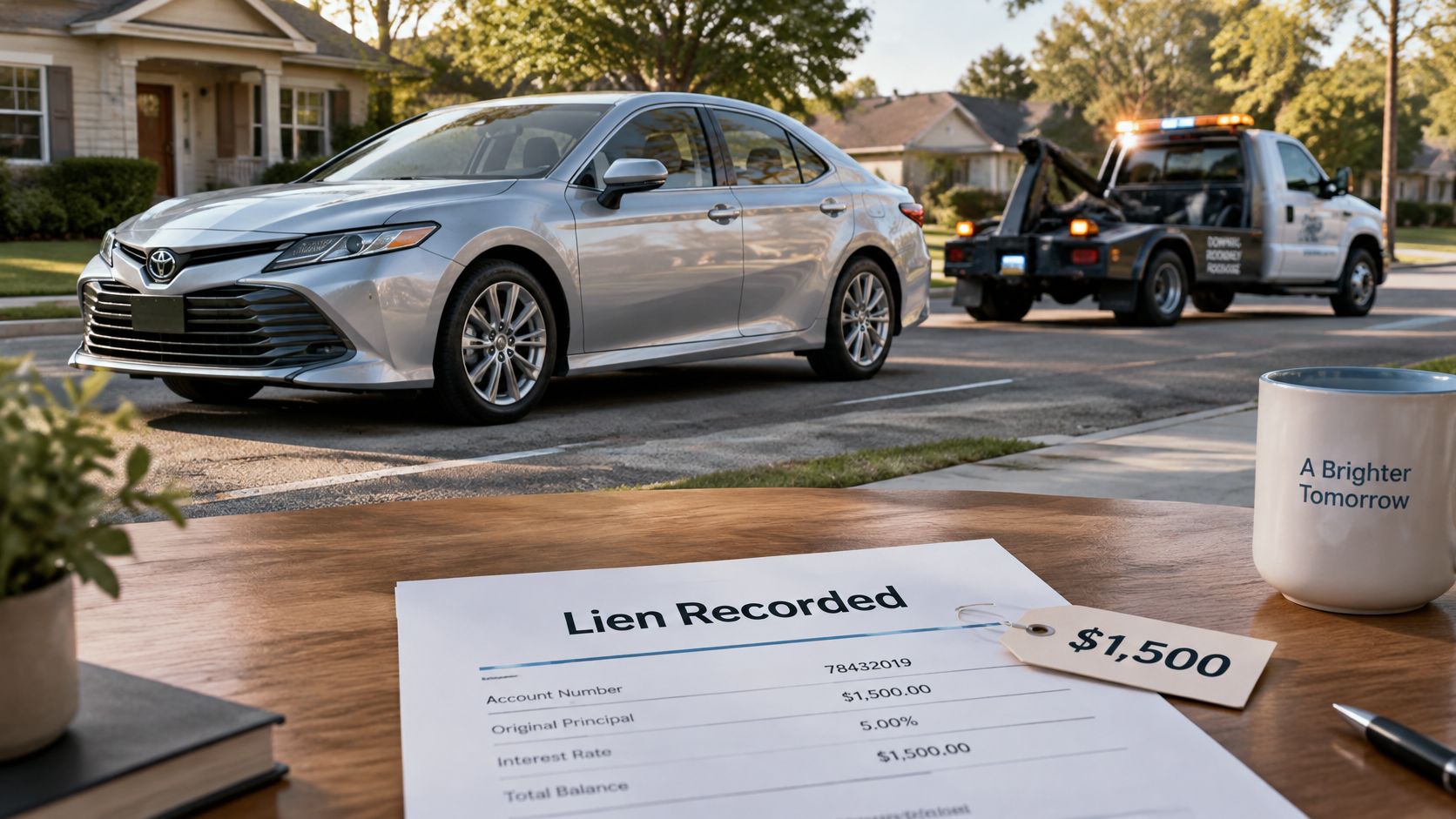
A title loan uses the vehicle as collateral. The lender's lien connects the debt to the car, so default can threaten more than your credit or bank balance.
Read the default terms before you need them
Review what constitutes default, whether a notice or opportunity to cure applies, and what the agreement says about repossession. The governing state rules matter, so don't assume another borrower's experience establishes your rights.
A partial payment may not bring the account current or prevent repossession. If the lender agrees to a repayment arrangement, obtain written confirmation of the arrangement and its effect on collection activity.
- Before a missed payment: Ask for available hardship arrangements and their cost.
- After repossession: Request the notices, balance information, and available redemption or reinstatement options applicable to your situation.
- After a sale: Request an accounting showing proceeds, charges, and any claimed remaining balance or surplus.
State law and the agreement determine the relevant procedures and whether a deficiency can remain after sale. Don't assume handing over the vehicle automatically settles the debt.
Protect the transportation, not just the asset
Losing a car can disrupt employment, childcare, and medical appointments. Those consequences can make the original cash shortage harder to resolve.
After full payoff, obtain confirmation that the debt is satisfied and verify how the lien will be released. Keep the payoff statement and release documentation rather than relying only on an account screen.
The strongest reason to reject an unaffordable offer isn't that the advance is small or large. It's that the repayment failure could remove an asset you need to keep earning income.
Alternatives to Borrowing Against Your Car
A title-loan ceiling is not a target. Compare other ways to cover the expense, weighing what you receive against the cost and what you could lose if repayment fails.
Alternatives to a title loan compared
| Option | Typical cost | Best fit | Main limit |
|---|---|---|---|
| Credit union Payday Alternative Loan | Subject to a federal interest-rate cap and limits on application fees | Short-term cash need | Membership and program eligibility |
| Personal installment loan | Interest and fees specified in the offer | An expense requiring scheduled repayment | Credit assessment and lender approval |
| Employer payroll advance | Often free or carries a small per-advance fee | A gap before payday | Employer policy and available earned wages |
| Secured credit card | Card interest and applicable fees | Purchases rather than an immediate cash shortage | Requires a security deposit |
| Sell or trade in the vehicle | Selling expenses and any replacement transport cost | Resolving a cash need without a new loan | Sale proceeds must address the existing payoff |
Compare actual offers by total cost and by the consequences of missed payments. A loan without a vehicle lien may protect your transportation, but the payment still needs to fit your budget, and its fees should be clear.
Match the alternative to the expense
For a medical or utility bill, ask the provider whether it offers a hardship arrangement or payment plan. Adjusting the original bill may avoid taking on a separate debt with another creditor.
If you are comparing credit products, use the same cash need and a realistic repayment horizon. A personal loan versus credit card comparison can clarify how scheduled installment payments differ from revolving credit.
A secured credit card may not address an immediate cash shortage because it requires a deposit. Cash advances also may have different terms from card purchases, so check which transaction you would use and what it costs.
Consider what happens if the plan fails
Selling the vehicle avoids taking out a title loan, but it may be impractical if you need the car to get to work. Compare sale proceeds with the existing payoff and the cost of replacement transportation, not just the bill you need to cover.
Nonprofit credit counseling may be an option if the shortage reflects a broader pattern of debt payments exceeding available income. Ask what services it provides, what charges apply, and what limitations to expect before enrolling.
Set each realistic option beside the title-loan offer using net cash received, total repayment, due dates, and collateral at risk. The legal maximum says little about what your budget can sustain. Favor the smallest workable amount and a repayment plan that does not put a vehicle worth far more than the advance at risk.
Confirm Your Offer Before You Sign
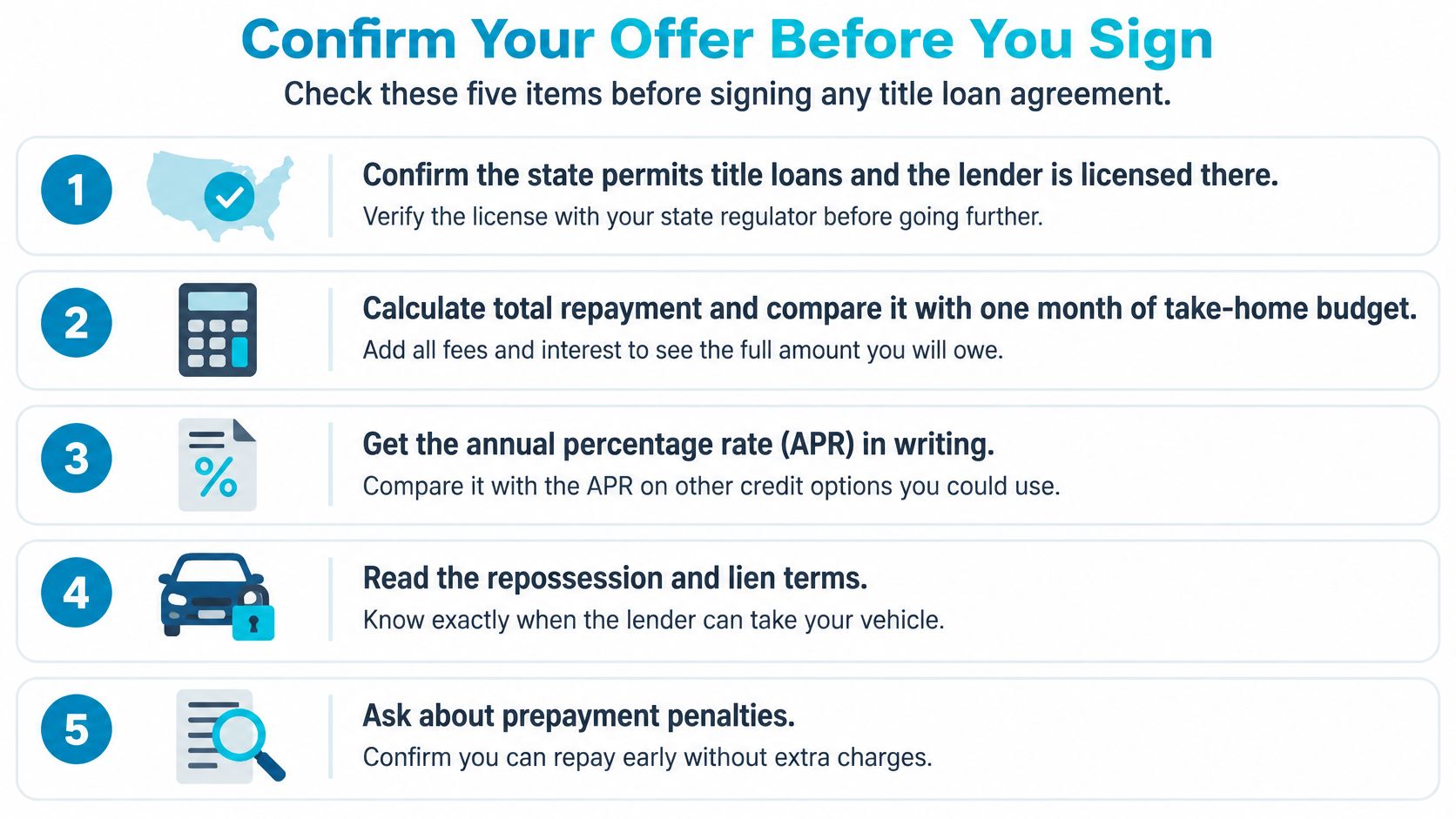
Use the written agreement, not an advertisement or a verbal estimate, for the final decision. Resolve missing terms before authorizing a lien or signing repayment documents.
- Confirm legal eligibility. Verify that the state permits the product and that the lender holds the applicable license.
- Calculate total repayment. Include scheduled borrowing charges and compare payment dates with available cash.
- Get the disclosures in writing. Request the APR, finance charge, amount financed, and total of payments.
- Check conditional charges. Read renewal, prepayment, late-payment, returned-payment, and title-related terms.
- Confirm lien release. Ask who handles it and what documentation you'll receive after payoff.
- Read the default provisions. Identify missed-payment consequences and applicable notice or cure rights.
- Decline an unworkable schedule. Don't sign if repayment depends on obtaining an extension.
Distinguish the marketplace from the lender
NextStopLoans is an online marketplace that routes requests to independent third-party lenders, including requests for title loans; it doesn't make credit decisions or set loan terms. Its service isn't available in Arkansas, New York, Vermont, or West Virginia.
The lender named in the agreement is responsible for the offer. Direct questions about approval, charges, repayment, and collateral to that lender, and retain its written answers.
Before accepting, compare the complete obligation with the alternatives available to you. The right outcome may be a smaller advance, another product, a negotiated bill, or no new borrowing.
Visit NextStopLoans to submit an online request for consideration by independent lenders, with title loans among the listed options. If you receive an offer, compare its net proceeds, full repayment cost, and vehicle-lien terms before deciding whether to accept.