
Personal Loan vs Credit Card: Which Should You Choose

You're staring at a large bill, a nearly full credit card, or both. One option offers a fixed payment and a finish date. The other lets you borrow again, pay less during a difficult month, and postpone the problem. The cheaper product on paper isn't always the product you can successfully repay.
The right personal loan vs credit card decision depends on two questions: what will the borrowing cost in total, and which repayment structure is less likely to fail when your cash flow gets tight? A personal loan often wins for a known balance carried over time. A credit card can win for a purchase you'll clear quickly or during a genuine promotional period. Neither wins automatically.
| Criterion | Personal loan | Credit card |
|---|---|---|
| Borrowing structure | Fixed installment loan | Revolving line of credit |
| Access | Lump sum issued once | Reusable credit up to a limit |
| Rate | Usually fixed for the term | Often variable, sometimes promotional |
| Repayment | Scheduled payment and defined end date | Minimum payment with no built-in payoff date |
| Best fit | One-time expense or consolidation | Short-term spending or flexible access |
| Main risk | A fixed payment may become unaffordable | Balance can linger and grow expensive |
Table of Contents
- Two Borrowers, Two Choices, Two Different Outcomes
- What a Personal Loan Actually Is
- What a Credit Card Actually Is
- Comparing the Two Side by Side
- Why a Lower Personal Loan APR Can Still Cost More
- Four Scenarios That Make the Choice Clear
- How to Run Your Own Break-Even Calculation
- Which Repayment Structure Is Less Likely to Fail
Two Borrowers, Two Choices, Two Different Outcomes
Two people receive the same $7,000 medical bill.
The first person puts it on a credit card. The minimum payment fits the budget, so there's no immediate crisis. Months pass, then years. New purchases join the old balance, the minimum remains deceptively manageable, and one missed payment threatens additional fees and credit damage. The borrower has made every payment, but the debt still feels permanent.
The second person takes a fixed-rate personal loan for the same obligation. The lender provides a lump sum, the borrower pays the medical provider, and autopay withdraws the same scheduled amount each month. The borrower knows when the balance should reach zero. That certainty doesn't make the payment painless, but it makes the obligation visible and easier to plan around.
The product doesn't determine success by itself. Your cash flow, repayment timeline, and behavior do.
The first borrower chose flexibility. The second chose structure. Either choice could work under different conditions. A credit card is useful when the borrower can repay quickly or has a qualifying promotional offer. A personal loan is useful when the amount is known and the borrower needs a firm payoff schedule.
The danger comes from choosing based only on the advertised rate or the lowest monthly payment. A credit card's minimum can hide a long repayment horizon. A personal loan's lower payment can hide a longer term, an origination fee, or a rate that reflects weak credit.
That's why the decision is structural before it's mathematical. Ask what happens during an ordinary month, then ask what happens during a bad one. The better product is the one whose failure mode you can survive and whose repayment plan you can follow.
What a Personal Loan Actually Is
A personal loan is an installment loan. You borrow a defined amount once, receive the proceeds, and repay the balance through scheduled payments over a set term. Most personal loans are unsecured, so the lender generally evaluates your credit profile, income, existing obligations, and other risk factors instead of requiring a vehicle or home as collateral.
The mechanics are straightforward:
- You request a fixed amount. The lender may approve less than you requested, or may decline the application.
- You receive a lump sum. Interest generally begins accruing once the loan is funded.
- You repay on a schedule. Each payment covers interest and principal, with the balance declining according to the amortization schedule.
- You reach a contractual end date. If you make the required payments, the loan is designed to be paid off at the end of the term.
A personal loan differs from a credit card because you can't usually draw from the balance again after repayment. That limitation is a feature for borrowers who need debt to end rather than remain available.
Where personal loans fit
Borrowers commonly use personal loans for debt consolidation, medical expenses, home repairs, weddings, and other major planned purchases. The common thread is a known funding need that can be separated from everyday spending.
Before accepting an offer, read the amount you'll receive, the APR, the monthly payment, the term, the total repayment amount, and every fee. An origination fee may be deducted from your proceeds, which means a loan advertised for a particular amount might deliver less cash than expected. If you need a specific amount in hand, calculate the net proceeds rather than relying on the headline principal.
A personal loan can make budgeting easier because the payment doesn't fluctuate with new purchases. But that predictability creates a responsibility. The lender generally expects the scheduled payment even when your income falls. Use this plain-language guide to how personal loans work before comparing offers.
What a Credit Card Actually Is
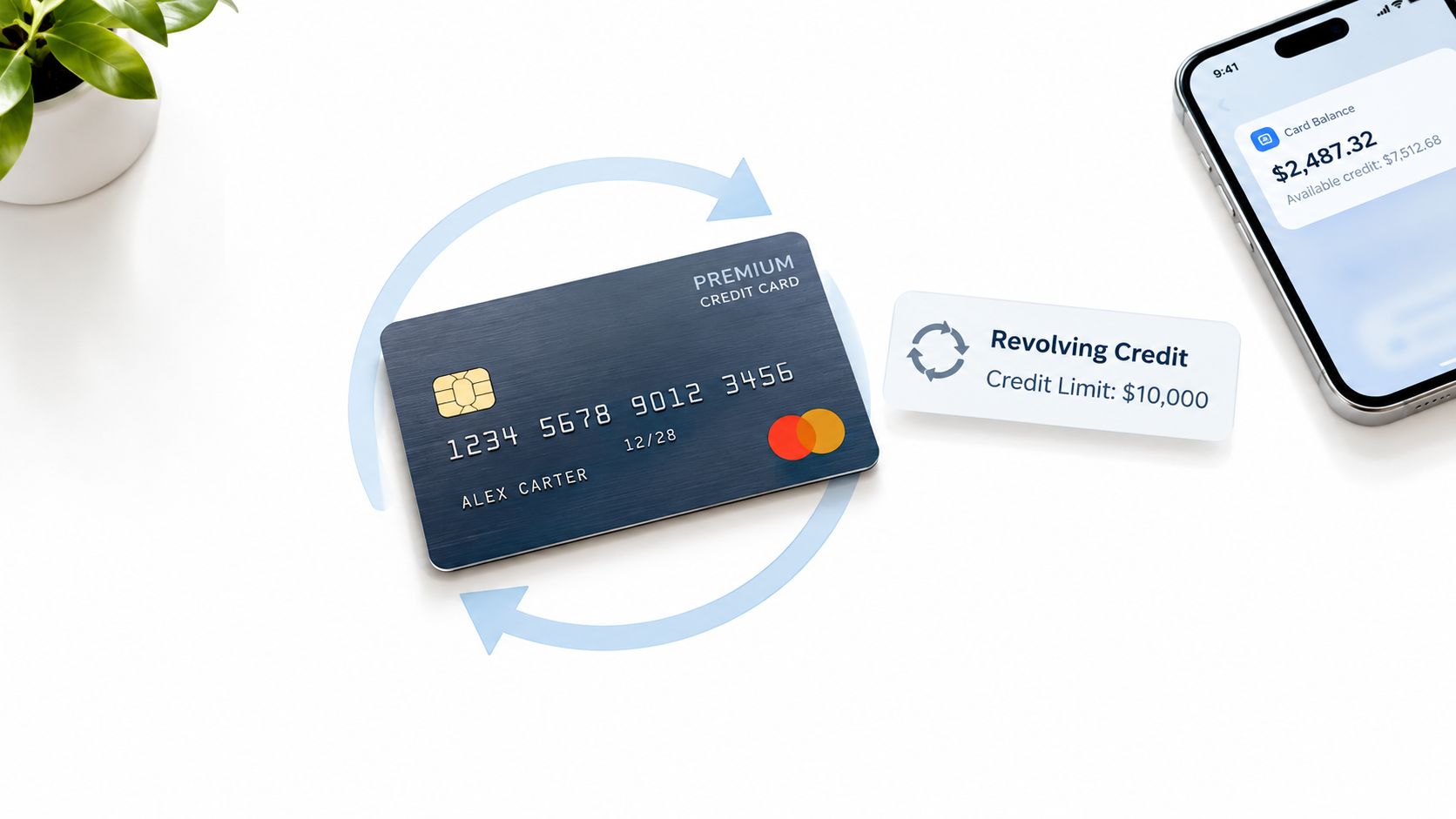
A credit card is revolving credit. The lender gives you a credit limit, and you can borrow, repay, and borrow again as long as you remain within that limit and comply with the account terms. You aren't given a fixed payoff date when the account opens.
A card can be convenient for ordinary purchases because you may pay the statement balance in full and avoid interest under qualifying grace-period rules. If you carry a balance, interest applies according to the card agreement. The APR may be variable, and the minimum payment can keep the account current without reducing the balance quickly.
Credit cards also distinguish between purchases and cash advances. A cash advance often has different fees, a different interest rate, and less favorable interest treatment than an ordinary purchase. Never assume that withdrawing cash from a card costs the same as using it at a merchant.
Flexibility has a price
A credit card's flexibility helps when expenses are irregular or repayment will happen quickly. It becomes dangerous when the borrower treats the minimum payment as a payoff strategy. Because the account remains open, the borrower can continue adding purchases while paying down the old balance.
Some cards offer promotional APR periods. A genuine 0% introductory offer can be cheaper than a fee-bearing personal loan if you can clear the balance before the promotional rate ends. The offer's expiration date, balance-transfer fee, eligibility rules, and post-promotion APR all matter.
Credit cards also provide protections that personal loans and cash generally don't. Depending on the transaction and applicable law, cardholders may have rights to dispute certain billing errors and protections against unauthorized use. Those protections don't eliminate the cost of carrying a balance, but they can matter when a purchase goes wrong or fraud occurs.
The clean distinction is simple. A personal loan is closed, scheduled, and finite. A credit card is open, reusable, and flexible. Choose with that difference in mind, not just the rate displayed in an advertisement.
Comparing the Two Side by Side
The rate is the first number most borrowers notice, but it's only one part of the comparison. In the reported Federal Reserve period, the average APR for 24-month personal loans was approximately 11.40%, according to the Federal Reserve's G.19 release. The same release measures personal-loan rates and credit-card rates differently, so you shouldn't treat the figures as perfectly interchangeable.
Credit-card pricing can become especially punishing when a balance persists. Federal Reserve Bank of St. Louis data summarized in its household credit-card analysis found average credit-card debt rates rising from approximately 15% in November 2021 to about 21% in November 2023, while comparable personal-loan rates rose from roughly 9% to 12%. The historical gap supports a practical conclusion: a fixed-term loan has often been cheaper than revolving card debt, but your offer may differ.
The six comparisons that matter
Payoff date. A personal loan creates a scheduled finish line. A credit card doesn't. Minimum payments can keep an account current while extending repayment for a long time.
Payment behavior. The loan payment is contractual. A card's minimum can fall as the balance changes, which makes the account easier to carry but can slow progress toward zero.
Fees. A personal loan may include an origination fee. A card may charge an annual fee, balance-transfer fee, cash-advance fee, or late fee. Compare the fee schedule, not just the interest rate.
Credit utilization. A card balance uses part of your available revolving limit and can affect your credit profile. A personal loan is installment debt, so it isn't measured as revolving utilization. Paying down cards with a loan may reduce utilization, but only if you don't rebuild the balances.
Access. A card provides reusable access after approval. A personal loan provides a one-time disbursement. Reusable access is useful for uncertain expenses, but it also makes repeated borrowing easy.
Risk under stress. A card may offer a lower required payment during a difficult month, while a loan demands its scheduled installment. The card's flexibility can prevent a missed payment, but it can also keep the debt alive.
| Criterion | Personal loan | Credit card |
|---|---|---|
| Interest calculation | Fixed-rate amortization in many offers | Revolving APR on carried balances |
| Term | Defined | No required payoff date |
| Funding | One-time lump sum | Reusable limit |
| Cost traps | Origination fee and extended term | Minimum payments, new purchases, rate changes |
| Credit effect | Installment account | Revolving utilization |
| Strongest use | Known expense carried over time | Fast repayment or qualifying promotion |
For a deeper explanation of the structural difference, see this guide to installment loans and revolving loans. The distinction matters more than the product label because it determines how your balance behaves after the initial transaction.
Why a Lower Personal Loan APR Can Still Cost More
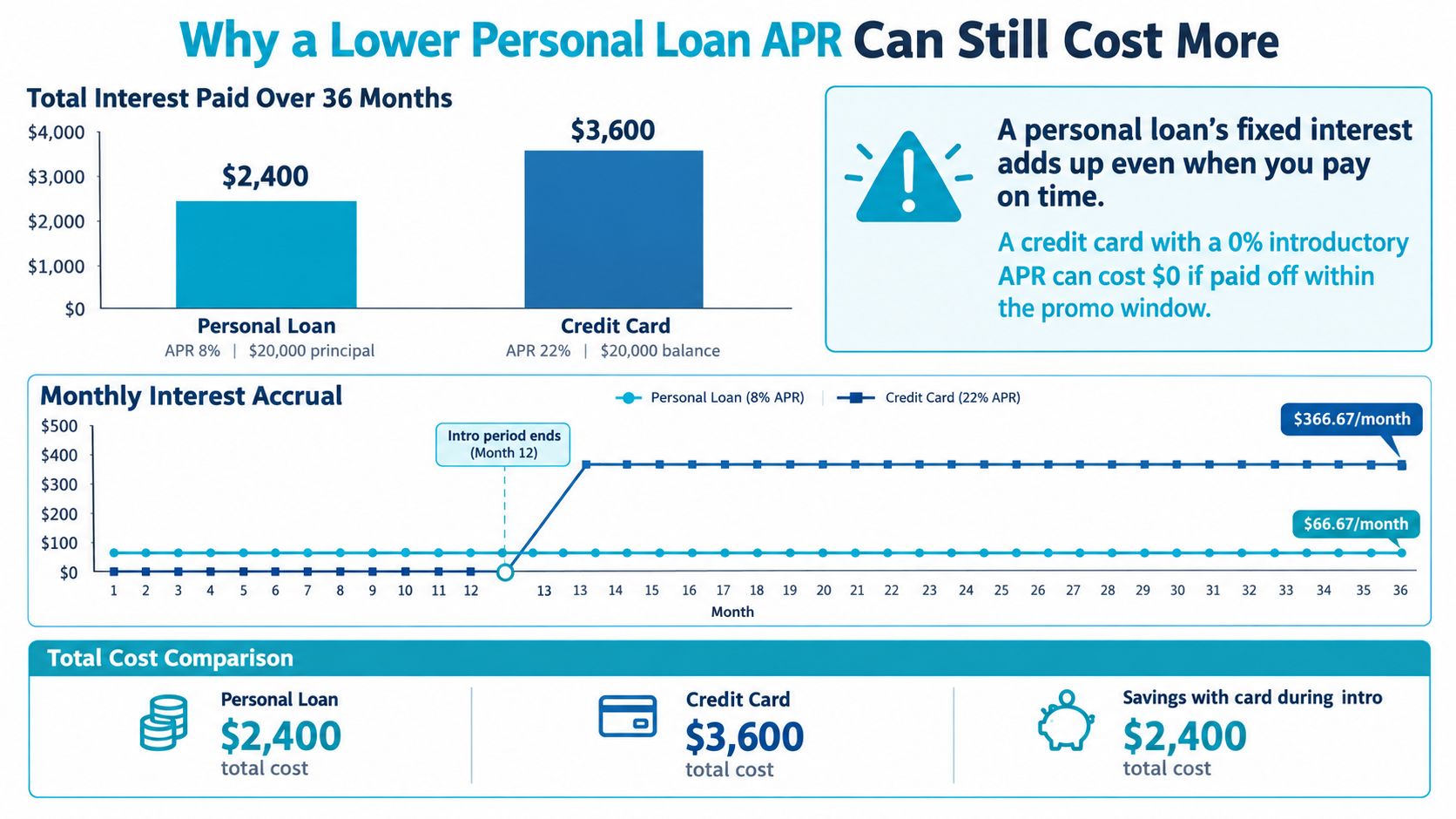
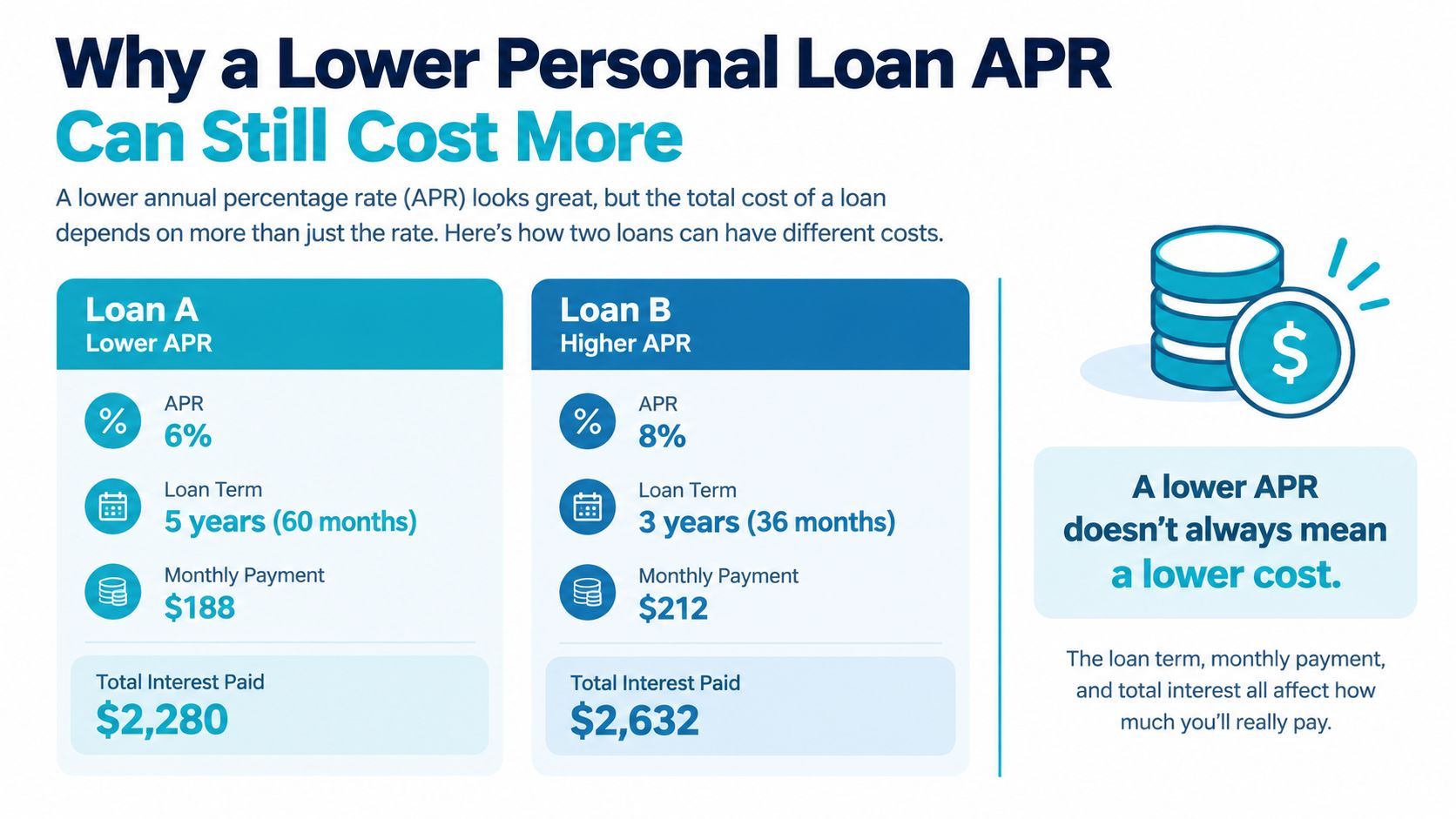
A lower APR is evidence, not a verdict. Total dollars paid decide whether the loan is cheaper.
Start with the origination fee. A lender may deduct the fee from your proceeds or add it to the balance. Either way, the amount you receive, the amount you repay, and the quoted APR need to be read together. A borrower who needs a precise amount for a bill could discover that the loan delivers less cash than expected after the fee.
Term length creates the second trap. Stretching repayment lowers the required monthly payment, but it gives interest more time to accumulate. Two loans with the same APR can have very different total costs when their terms differ.
The break-even example
Suppose a lender offers a $10,000 personal loan at 11% APR over 60 months and charges a 5% origination fee. Treat those figures as a calculation example, not a universal market quote. The fee changes the economics before the first payment, and the five-year term keeps the balance outstanding longer than a borrower might expect.
Now compare that with a credit-card balance paid in full during an 18-month 0% promotional window, assuming the card's terms provide that rate and the borrower makes the required payments before the promotion ends. The card can cost less in interest despite having a higher post-promotion APR, because the borrower exits before that rate applies.
The comparison changes completely if the borrower misses the deadline, makes new purchases, or cannot afford the payment needed to clear the card in time. The loan becomes more attractive when the card balance would otherwise persist at a high APR.
Use this cost formula
For each option, calculate:
- Net funds received, especially after loan fees.
- Total scheduled payments across the full term.
- Interest and account fees paid before the balance reaches zero.
- Payment required to finish before a promotional rate expires.
- Cost if repayment takes longer than planned.
A borrower with a thin credit file may receive a personal-loan offer well above the average. In that case, the apparent advantage over a credit card can disappear. Conversely, a borrower who qualifies for a low-fee loan and currently carries expensive card debt may save money while gaining a definite payoff date.
Don't compare a promotional card to a loan using the card's permanent APR alone. Don't compare a personal loan to a card using the loan's advertised rate alone. Put both offers on the same timeline and compare the total cash leaving your account.
Four Scenarios That Make the Choice Clear
An emergency expense
Your vehicle fails, a medical provider requires payment, or an essential repair can't wait. If you need a known lump sum and repayment will extend beyond a short period, a personal loan usually deserves the first serious comparison. Its fixed schedule can stop a one-time emergency from becoming an open-ended card balance.
A credit card may still be the better emergency tool when you can repay the charge quickly or when the card offers a genuine promotional period you can meet without relying on hope.
Recommendation: Choose the personal loan when the expense is one-time, the loan's total cost is lower, and the scheduled payment fits verified cash flow.
A planned large purchase
A planned purchase gives you time to compare offers. A credit card with a qualifying 0% promotion can win if you know exactly how much you must pay each month to clear the balance before the promotion ends. Set that payment immediately and treat the expiration date as a hard deadline.
A personal loan is better when the promotional payment is unrealistic or when you value a fixed rate more than the possibility of interest-free borrowing.
Recommendation: Use the promotional card only when the payoff schedule is affordable and documented. Otherwise, take the predictable loan.
Debt consolidation
Consolidation can replace several revolving balances with one installment payment. That may simplify the budget and reduce interest when the personal-loan APR and fees are lower than the card costs.
The operational risk is serious. Paying off cards frees available credit, and a borrower who keeps spending can end up with both the personal loan and new card balances. The consolidation only works if the borrower changes the system that produced the debt, such as spending limits, emergency savings, or automatic transfers.
Recommendation: Consolidate only when the new payment fits the budget and you have a concrete plan to stop rebuilding card debt.
Building credit
A credit card used responsibly can establish revolving credit and demonstrate payment management. A personal loan can add installment history, but borrowing money solely to create a credit mix may be a poor financial trade if the interest and fees outweigh the benefit.
Never take on debt you don't need just to chase a score change. If you already need the funds, make on-time payments and keep the account within its intended use.
Recommendation: Use the product that solves a real financial need. Don't pay interest for a credit profile you could build more cheaply through responsible existing accounts.
How to Run Your Own Break-Even Calculation
Run the comparison on your numbers, not an average borrower's numbers.
- Write down the card terms. Record the current APR, balance, minimum-payment formula, fees, and any promotional expiration date.
- Write down the loan terms. Capture the APR, principal, origination fee, term, monthly payment, prepayment language, and net proceeds.
- Calculate several timelines. Compare total dollars paid if the balance is cleared in 6, 12, 24, and 36 months. Use the personal loan calculator to test the loan payment, then compare it with the card's required payoff amount.
- Add the failure scenario. Calculate what happens if the card balance remains after the promotional period or if you miss a payment. Also check whether a personal-loan prepayment penalty reduces the benefit of paying early.
- Stress-test the payment. Subtract rent, utilities, food, insurance, transportation, existing debt payments, and a realistic emergency reserve from dependable monthly income. If the loan payment works only in a perfect month, it doesn't work.
The answer isn't the lowest APR in isolation. It's the option that produces the lowest realistic total cost without relying on a repayment plan you're unlikely to maintain.
A card can be cheaper if you clear it before the promotional rate ends. A loan can be cheaper if the card balance will otherwise revolve at a much higher APR. If both options fail your cash-flow test, borrowing more isn't the solution. Reduce the expense, negotiate the bill, seek nonprofit debt counseling, or delay the purchase where possible.
Which Repayment Structure Is Less Likely to Fail
A repayment plan fails when a normal financial shock turns the required payment into an impossible one. Before choosing a personal loan or credit card, ask which structure can survive an income interruption, an unexpected bill, or a month of poor budgeting.
Credit-card delinquency reached its highest level since 2010 in the third quarter of 2024 before declining in the fourth quarter. Borrowers with nonprime credit scores drove much of the increase, according to the Federal Reserve's Financial Stability Report. Rising card balances and serious delinquency transitions reinforce the same warning: revolving credit becomes dangerous when repayment depends on consistently having money left over.
A fixed personal-loan payment creates discipline, but it does not adjust when income drops. A credit card gives you more flexibility during a bad month, yet the balance can remain outstanding, keep utilization high, and grow if you continue charging expenses. The better choice is the structure you can maintain under pressure, not the product with the lowest advertised APR.
Check the failure points
- Autopay risk: Keep enough cash in the payment account to prevent an automatic debit from causing overdraft fees or making another bill fail.
- Prepayment terms: Confirm that early repayment carries no charge before counting on a shorter loan term to reduce interest.
- Promotion expiration: Record the exact promotional end date and the payoff amount required to clear the balance before the rate changes.
- New borrowing: Decide what happens to a paid-down card after consolidation. Remove it from shopping accounts, lower the limit if appropriate, or freeze access if continued use would restart the debt.
- Emergency funds: Identify how you will pay for the next urgent expense without adding a second balance.
Choose a personal loan when you need a defined amount, can comfortably make the fixed payment, and the total cost after fees is meaningfully lower. Choose a credit card when you can repay quickly, need reusable access, or can clear a genuine promotion on schedule. A lower monthly payment does not make borrowing affordable if the balance will survive longer than planned.
If neither option passes a realistic cash-flow test, do not borrow more. Reduce the expense, negotiate the bill, seek nonprofit debt counseling, or delay the purchase.
NextStopLoans is a marketplace connector, not a lender. It sends consumer loan requests to independent third-party lenders. Those lenders make the credit decision, set the terms, and handle funding. Review every offer, APR, fee, and repayment obligation before accepting anything.
NextStopLoans can connect eligible U.S. borrowers with independent lenders for personal-loan requests, including major expenses and debt consolidation. To compare potential options with your credit-card costs, visit NextStopLoans and review each lender's terms carefully before accepting an offer.