
Title Loan Estimate Calculator: A Practical Guide

A $1,000 title loan with a $250 30-day finance charge produces a $1,250 initial payoff, but one identical renewal raises the modeled payoff to $1,500 before any additional fees. That's why a useful title loan estimate calculator must show more than the first payment, it must project the full cost, renewal exposure, and consequences of default.
You may be looking at a fast cash option because a repair, bill, or missed paycheck has arrived before your bank balance recovered. The first number on a lender's page can look manageable, especially when it shows only a monthly charge or the amount due on the first date. The harder question is what happens if you can't repay the entire balance then.
A calculator can make that question visible. It can organize the vehicle value, existing lien, amount financed, finance charge, fees, due date, renewal assumptions, and state rules into a planning estimate. It can't guarantee approval, predict a lender's final offer, or remove the risk that your vehicle serves as collateral.
Table of Contents
- What a Title Loan Estimate Calculator Actually Does
- Inputs the Calculator Needs and Why Each Matters
- The Core Calculation From Principal to APR
- Modeling Renewals and Partial Payments
- Fees Beyond the Finance Charge
- Why Vehicle Equity Does Not Equal Affordability
- State Rules That Change Every Output
- Comparing the Estimate Against the Lender's Written Offer
- Decision Checklist Before You Apply
- Frequently Asked Questions About Title Loan Estimate Calculators
What a Title Loan Estimate Calculator Actually Does
A title loan estimate calculator turns the terms you enter into an approximate borrowing-cost schedule. At minimum, it should show the amount financed, finance charge in dollars, itemized fees, total of payments, stated APR when it can be determined, and scheduled due date. It should also distinguish the initial payoff from what you might owe after a renewal.
That distinction matters because a lender's quote and a calculator result answer different questions. Your estimate uses assumptions supplied by you, while a lender's written disclosure uses the lender's valuation, underwriting, fee schedule, state requirements, and contract terms. A marketplace such as NextStopLoans can route a request to independent lenders, but it doesn't set their terms or make the credit decision.
Four jobs the estimate should perform
- Size the borrowing: Use vehicle value, existing lien payoff, and the lender's loan-to-value limit to estimate a possible principal amount.
- Project the cost: Add the finance charge and every disclosed fee instead of displaying a nominal rate alone.
- Expose renewal risk: Apply a separate charge for each rollover and show cumulative fees, remaining balance, and the next due date.
- Surface legal caveats: Use the borrower's state to flag whether title lending is available and which protections may affect the estimate.
The CFPB's analysis of single-payment vehicle title loans reviewed nearly 3.5 million loan records from more than 400,000 borrowers. The loans typically lasted about 30 days, had an amount near $700, and carried an APR of approximately 300%. Only about 12% of borrowers repaid principal, fees, and interest in one payment without quickly borrowing again.
Treat the result as an educational model, not an offer. Before accepting anything, compare the estimate with the lender's written APR, finance charge, fee schedule, due date, renewal terms, and repossession provisions.
Inputs the Calculator Needs and Why Each Matters
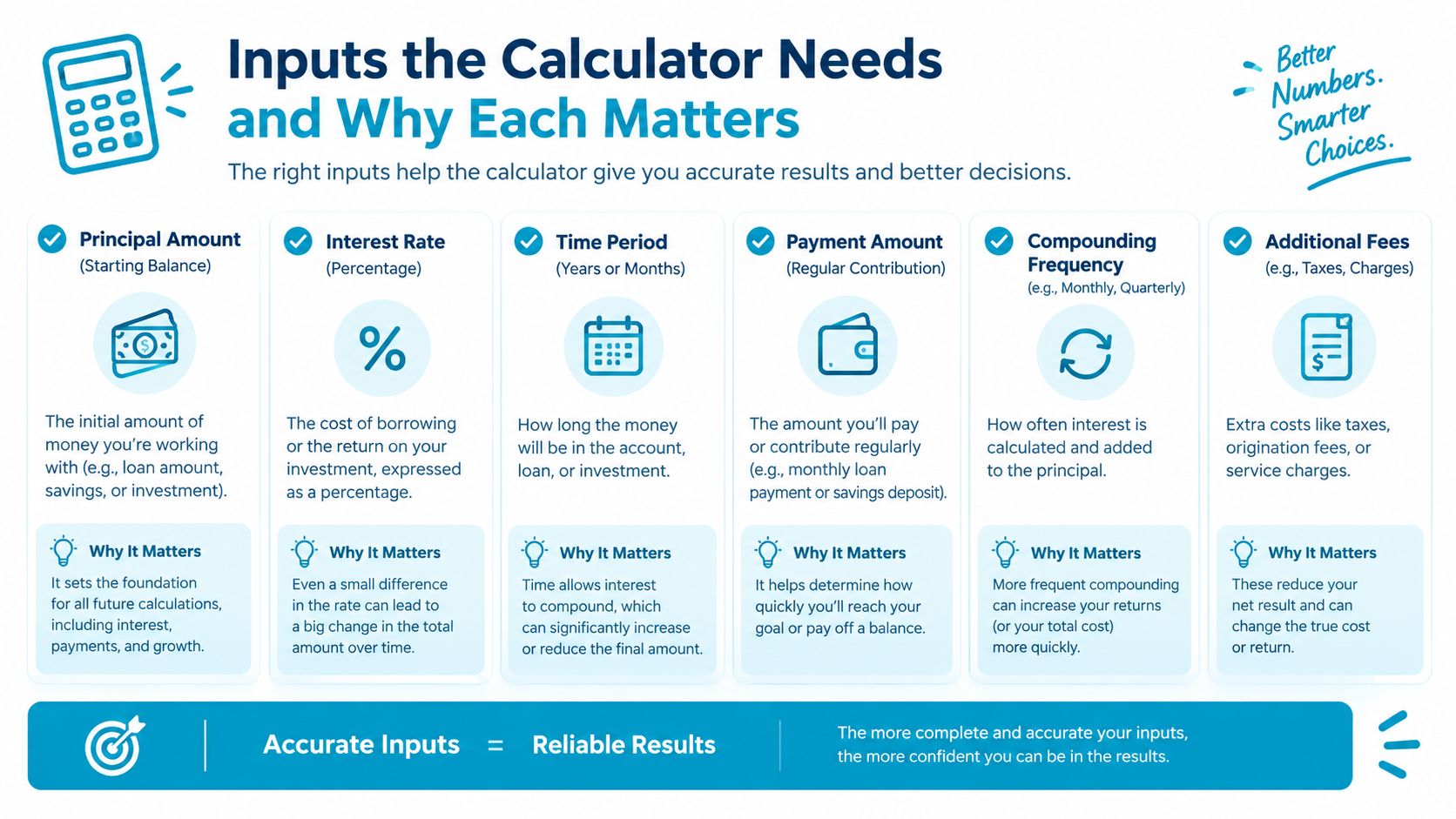
A reliable estimate starts with accurate inputs. Gather the vehicle information, current lien details, requested loan terms, fees, and state before entering anything. If a field is missing, the result may look precise while leaving out the factor that controls true cost.
Start with the vehicle and its equity
Enter the make, model, year, mileage, and condition because lenders may value the same vehicle differently depending on its resale prospects. Then choose the valuation basis, such as private-party value or trade-in value. A lender may use a different guide or wholesale assessment, so this input creates an estimate rather than a guaranteed valuation.
Subtract the existing lien payoff from the estimated vehicle value to find approximate equity. If the car is valued at $5,000 and the existing lien payoff is $1,000, the equity baseline is $4,000. The calculator still needs the lender's loan-to-value ratio, or LTV, because the lender may advance only a portion of that value.
Add the loan terms and charges
Enter the requested term in days, such as 15 or 30 days, along with the finance charge or stated rate. Then list the origination, processing, lien, document, notary, and optional add-on fees separately. Don't bundle them into one unexplained number, because a separate fee can change both the dollar cost and the APR calculation.
Finally, enter your state. State law can affect whether the product is available, the permitted cost, renewal rules, notice requirements, and repossession rights. The guide to how title loans work can help you identify the terminology before you enter the figures.
Practical rule: If you can't find a fee or renewal term in the written disclosure, mark it as unknown instead of assuming it's zero.
Use this checklist before calculating:
- Vehicle data: Make, model, year, mileage, and condition.
- Value and lien: Estimated value and current lien payoff.
- Borrowing limit: LTV percentage or maximum amount offered.
- Pricing: Term, finance charge, APR, and all itemized fees.
- Repayment path: Expected payment date, possible renewals, and partial-payment plan.
- Location: State of residence and, for online offers, the lender's licensing information.
The Core Calculation From Principal to APR
The core math begins with the amount advanced, not the vehicle's full value. Suppose the vehicle's private-party value is $5,000, the lender applies a 26% LTV cap, and the requested term is 30 days. The estimated principal is:
$5,000 × 26% = $1,300
For a simple worked example, assume the lender advances $1,000, charges a $250 30-day finance charge, adds a $50 origination fee, and adds a $25 document fee. The initial scheduled payoff is the principal plus the disclosed finance charge and fees.
| Line Item | Value |
|---|---|
| Amount financed | $1,000 |
| 30-day finance charge | $250 |
| Origination fee | $50 |
| Document fee | $25 |
| Total of payments | $1,325 |
| Scheduled term | 30 days |
| Scheduled due date | 30 days after funding |
The basic formula is:
Total of payments = principal + finance charge + itemized fees
Here, that's $1,000 + $250 + $50 + $25 = $1,325. The finance charge alone is $250, but the borrower's total cost of credit also includes the $75 in listed fees.
Why APR needs the same inputs
APR is not just the monthly charge multiplied by a number of months. It annualizes the cost using the amount borrowed, finance charge, applicable fees, and the exact borrowing duration. Federal consumer guidance explains that APR reflects those components, while the Truth in Lending Act requires standardized disclosures for covered closed-end credit, including the finance charge and APR. See the consumer guidance on title-loan costs and disclosures.
For this example, the simple annualized cost approximation is:
($250 + $50 + $25) ÷ $1,000 × 365 ÷ 30 × 100 = 395.42%
That figure is an illustrative calculation, not a substitute for the lender's legally required APR disclosure. The exact APR may depend on how the finance charge, fees, payment timing, and amount financed are treated under the applicable disclosure rules. A calculator should label the result clearly and preserve the exact term instead of hiding the assumptions.
For another perspective on rate terminology, review how title-loan interest rates are described, then compare the dollar finance charge and total repayment rather than relying on a rate headline.
Modeling Renewals and Partial Payments
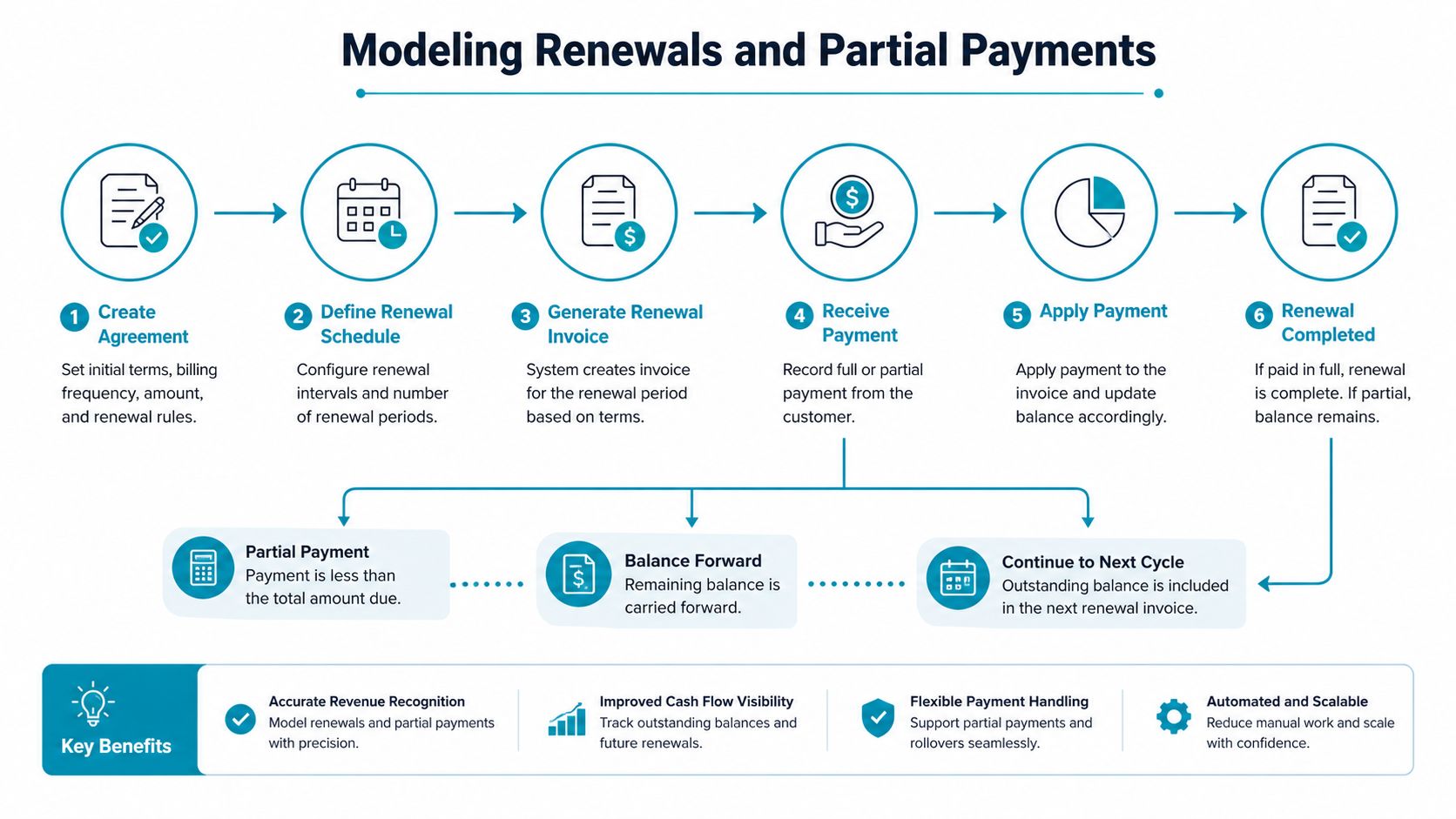
The first due date is only one possible point on the repayment path. If the borrower can't pay the full $1,325 in the worked example, the lender may offer a renewal, refinance, or rollover under the contract. Each structure must be modeled separately because the new charge might apply to the original principal, the outstanding balance, or another amount defined by the agreement.
Assume the same $250 finance charge applies once at renewal. The initial payoff is $1,325. Adding the second $250 charge produces a modeled payoff of $1,575, before any additional renewal, late, or processing fees.
What a renewal view should show
A useful screen should display each event in order:
- Funding: Principal advanced and fees added.
- Initial maturity: Finance charge and total due on the first date.
- Renewal: New finance charge, renewal fee, and revised due date.
- Partial payment: Amount paid and the balance it reduces.
- Next maturity: New charge calculated under the written agreement.
- Cumulative result: Total fees, total payments, and remaining balance.
Now test a $500 partial payment on day 20. The result depends on the contract. If the lender applies the payment to principal, the outstanding principal falls from $1,000 to $500 before renewal. A $250 charge based on that reduced principal would be different from a $250 flat renewal charge. If the lender applies the payment first to fees or accrued finance charges, the principal may not fall by the full $500.
That's why the calculator must ask how payments are allocated. It should show the balance after every event and state whether the renewal charge is flat, simple-interest based, or lender-specific. A first-payment-only result hides these differences and can materially understate the likely cost when renewal occurs. The CFPB research found that more than four in five loans were renewed on the due date, while more than half of borrowers took at least four consecutive loans.
Fees Beyond the Finance Charge
A finance charge isn't the entire price. A calculator that reports one rate and one payoff number can miss charges that appear at different stages of the transaction.
Up-front charges may include origination, processing, lien-recording, document, and notary fees. Enter each one separately, identify whether it's financed or paid at closing, and show its dollar effect. Optional add-ons should also be listed independently because a borrower needs to know whether removing an add-on changes the amount financed or only the cash due at signing.
Payment-event charges arise later. A late fee or returned-payment fee may be triggered by a missed or unsuccessful payment. The calculator should let the borrower model those charges without assuming they apply, since the contract and state rules determine when they can be imposed.
Default and repossession charges require a separate scenario. Storage, towing, repossession, and sale-related fees may be added after the vehicle is taken. The Federal Trade Commission explains that failure to repay can allow a lender to repossess and potentially sell the vehicle. The federal policy overview of vehicle-title lending also highlights the importance of comparing the finance charge, APR, total payments, and repossession provisions.
| Fee category | When to check it | Calculator treatment |
|---|---|---|
| Origination and processing | At funding | Add as an itemized charge |
| Lien and document fees | At funding | Show separately from the finance charge |
| Late and returned-payment fees | After a missed payment | Add only in the selected default scenario |
| Storage and repossession fees | After repossession | Display in the collateral-risk scenario |
| Sale-related charges | After vehicle sale | Deduct from sale proceeds when allowed |
Ask for the complete fee schedule before signing. If a calculator combines every fee into a single unexplained amount, its result is harder to verify.
Why Vehicle Equity Does Not Equal Affordability
A vehicle can have substantial equity and still support an unaffordable loan. Research cited by the Center for Responsible Lending paired a median loan-to-value ratio of about 26% with an APR of approximately 300%, showing that a borrower may pledge an asset worth far more than the cash received while paying an extreme annualized cost. See the research on prohibited vehicle-title loans.
The equity figure also doesn't measure what the vehicle does for your life. Losing it can disrupt commuting, school travel, medical appointments, and the ability to earn income. A calculator should therefore show equity at risk, not present collateral as evidence that the payment is affordable.

The sale-value comparison
The research reported a median title-loan amount of $1,000 to $2,000, compared with a median repossessed vehicle value of $20,000 to $30,000. Those figures don't mean a borrower receives the vehicle's value after default. The lender applies sale proceeds to the debt and permitted costs, and state law controls whether a surplus or deficiency remains.
Model three values independently:
- Vehicle value: The estimated sale value before default.
- Outstanding obligation: Principal, accumulated finance charges, and permitted fees.
- Net sale proceeds: Sale amount after repossession, storage, and sale costs where applicable.
A vehicle's equity is therefore better understood as collateral exposure than as a safety cushion. Before borrowing, ask whether you could continue working and meeting basic obligations without the car. If the answer is no, the calculator's repossession scenario deserves more attention than the maximum amount a lender might offer.
State Rules That Change Every Output
A title loan estimate can be mathematically correct and still be legally inapplicable. State law may determine whether title lending is permitted, how much a lender can charge, the loan duration, renewal limits, notice requirements, redemption rights, and whether a lender can pursue a deficiency balance after sale.
Enter the borrower's state before calculating. Then verify the lender's license and the contract's governing-law language. Don't assume an online application bypasses local rules just because the lender operates from another state.
Online availability requires caution
Recent research reported that high-cost vehicle-title lending is prohibited in 33 states and the District of Columbia. The same research said respondents in 22 states plus Washington, D.C. reported obtaining such loans online despite prohibitions. These findings make the state field a compliance safeguard, not a cosmetic form question. See the research on online vehicle-title lending in prohibited jurisdictions.
A reliable calculator should produce a warning when the entered state may restrict the product. It should also identify which parts of the result remain uncertain:
- Availability: Whether a title-backed loan may be offered to a resident.
- Pricing: Applicable rate, finance-charge, and fee limits.
- Renewals: Whether rollovers are limited, prohibited, or structured differently.
- Default process: Notice, cure, redemption, and repossession requirements.
- Sale outcome: Treatment of surplus proceeds and any deficiency balance.
An online estimate is informational until the lender provides compliant written disclosures for your state. If a lender says the transaction is legal only because the application is online, pause and confirm the position with your state regulator or attorney general before sharing documents or signing.
Comparing the Estimate Against the Lender's Written Offer
Use the estimate as a line-by-line checking tool. The lender's agreement should identify the amount financed, finance charge, applicable fees, payment timing, APR when determinable, and consequences of nonpayment. If the written offer differs, update the calculator and run the renewal and default scenarios again.
| Calculator Field | Lender Disclosure Line | What to Check |
|---|---|---|
| Amount financed | Amount financed | Confirm the cash received and any financed fees |
| Finance charge | Finance charge in dollars | Check the charge for the stated term |
| Itemized fees | Fee schedule | Identify origination, lien, document, and optional charges |
| Due date | Payment or maturity date | Confirm the exact calendar date |
| Total of payments | Total of payments | Check whether it assumes on-time repayment only |
| Renewal terms | Rollover or renewal clause | Find the new charge, balance, and due date |
| Default terms | Repossession provisions | Check notice, sale, redemption, and deficiency language |
A lower-looking offer still needs a full comparison. Ask whether the apparent improvement comes from a longer term, a different payment allocation, excluded fees, or a renewal condition that shifts cost later. Don't compare monthly amounts alone.
NextStopLoans operates as a marketplace that routes requests to independent third-party lenders, rather than setting the final APR, fee schedule, or due date. If you use an online title-loan lender request pathway, treat each lender's written agreement as the controlling document and keep a copy before accepting.
Decision Checklist Before You Apply
Use four yes-or-no decisions before submitting a request.
Inputs gathered
Do you have the vehicle value, existing lien payoff, requested amount, term, itemized fees, and state? If not, the estimate is missing information that can materially change the result.
Math understood
Can you state the finance charge in dollars, the total of payments, the scheduled due date, and the APR shown in the disclosure? If you only know the monthly rate, you haven't completed the comparison.
Risk surfaced
Have you modeled at least one renewal, a partial-payment possibility, and a default scenario that includes repossession exposure? If the answer is no, the first payoff isn't the full decision.
Verification done
Does every important figure match the lender's written offer, and have you considered whether another borrowing option could meet the need without putting your vehicle at risk? If the offer changes after you ask questions, recalculate rather than relying on the original screen.
A simple rule can guide the final choice: apply only when you understand the complete repayment path and can protect essential transportation if the plan fails. If you can't answer each question with confidence, delay acceptance and seek a lower-risk alternative or qualified consumer guidance.
Frequently Asked Questions About Title Loan Estimate Calculators
Can an online estimate be legally available in a restricted state?
Not automatically. State law controls availability and consumer protections, and an out-of-state website doesn't necessarily override those rules. The calculator should require your state and flag uncertainty, while you verify the lender's license and written disclosures before proceeding.
What can repossession cost beyond the loan balance?
The dollar result depends on the contract and state. A lender may apply sale proceeds to the balance and permitted towing, storage, repossession, or sale charges, and a deficiency may remain if proceeds don't cover the obligation. The non-dollar loss can include transportation, work access, and the ability to meet other bills.
Is NextStopLoans the lender that sets my terms?
No. NextStopLoans is an online marketplace that submits consumer requests to independent third-party lenders. Those lenders make decisions, set terms, and handle funding, so the final offer must be checked against the lender's own disclosures.
What if a lender offers terms that look better than my estimate?
Enter the new figures into the calculator rather than assuming the offer is cheaper. Check the amount financed, dollar finance charge, fees, APR, due date, renewal rules, and repossession language. A lower initial payment may reflect a longer or more expensive repayment path.
If you're considering title-backed funding, use NextStopLoans to submit a secure request that may be evaluated by independent lenders, then compare any offer against the full-cost estimate in this guide. Visit NextStopLoans to review available request options and lender disclosures before deciding whether to accept or decline an offer.