
Self Employed Loans No Proof Income How to Qualify

You're self-employed, the money is coming in, and yet a lender's application keeps asking for a W-2 or a recent pay stub you don't have. A rideshare driver, freelance designer, consultant, online seller, or small business owner can look financially capable in real life and still be declined because the application doesn't fit a payroll-based checklist.
The phrase self employed loans no proof income creates the wrong expectation. Legitimate lenders generally won't approve a loan based only on what you say you earn. They need evidence that your income exists and can support repayment. The difference is that evidence doesn't always have to come from an employer.
Table of Contents
- What No Proof Income Really Means for Self Employed Borrowers
- Alternative Proof That Lenders Actually Accept
- Where to Find Self Employed Loans Without Traditional Income Docs
- How to Prepare a Stronger Application Without Pay Stubs
- Risks Costs and Red Flags to Watch Before You Accept
- Your Next Steps to Request Funding With Confidence
What No Proof Income Really Means for Self Employed Borrowers
A W-2 employee usually proves income with employer-issued records, such as pay stubs and tax forms. A self-employed borrower may receive 1099s, invoices, client payments, platform deposits, or business revenue instead. That income can be real, but it may arrive irregularly and pass through several accounts before it reaches the borrower personally.
That's why “no proof income” is usually a description of a documentation mismatch, not a genuine absence of verification. Self-employed and gig workers have historically used alternate records such as 1099s, invoices, tax transcripts, and business records, as explained in Fannie Mae's guidance on documentation for self-employed borrowers.

What lenders mean by proof
For many major U.S. lending markets, the conventional starting point is the borrower's last two years of signed federal tax returns, often including Schedule C or another business schedule. Lenders may also request recent bank statements and a year-to-date profit-and-loss statement. Current self-employed income documentation guidance reflects this broader document package rather than a single pay stub.
Alternative underwriting changes the source of evidence, not the lender's need to assess repayment capacity. A lender may review deposits, identify business revenue, examine recurring obligations, and calculate qualifying income from cash flow. The application still needs a credible financial story.
Why deposits alone aren't automatically enough
A large deposit can come from a client, a transfer between accounts, a loan, a tax refund, or the sale of an asset. Those sources don't all represent ongoing income. Underwriters therefore look for patterns over time and may ask you to explain unusual credits.
This matters most when income is seasonal or declining. A strong recent month won't necessarily offset inconsistent deposits across the available history. The practical question is whether the lender can document income that appears stable enough for the proposed payment.
This guide is for freelancers, gig workers, independent contractors, and business owners who don't have traditional payroll records. The right goal isn't to find a lender that asks for nothing. It's to assemble proof that accurately represents how you earn.
Alternative Proof That Lenders Actually Accept
The strongest application replaces a missing pay stub with a coherent document stack. A lender should be able to trace money from the work you perform to the deposits you receive, then compare that income with your obligations.
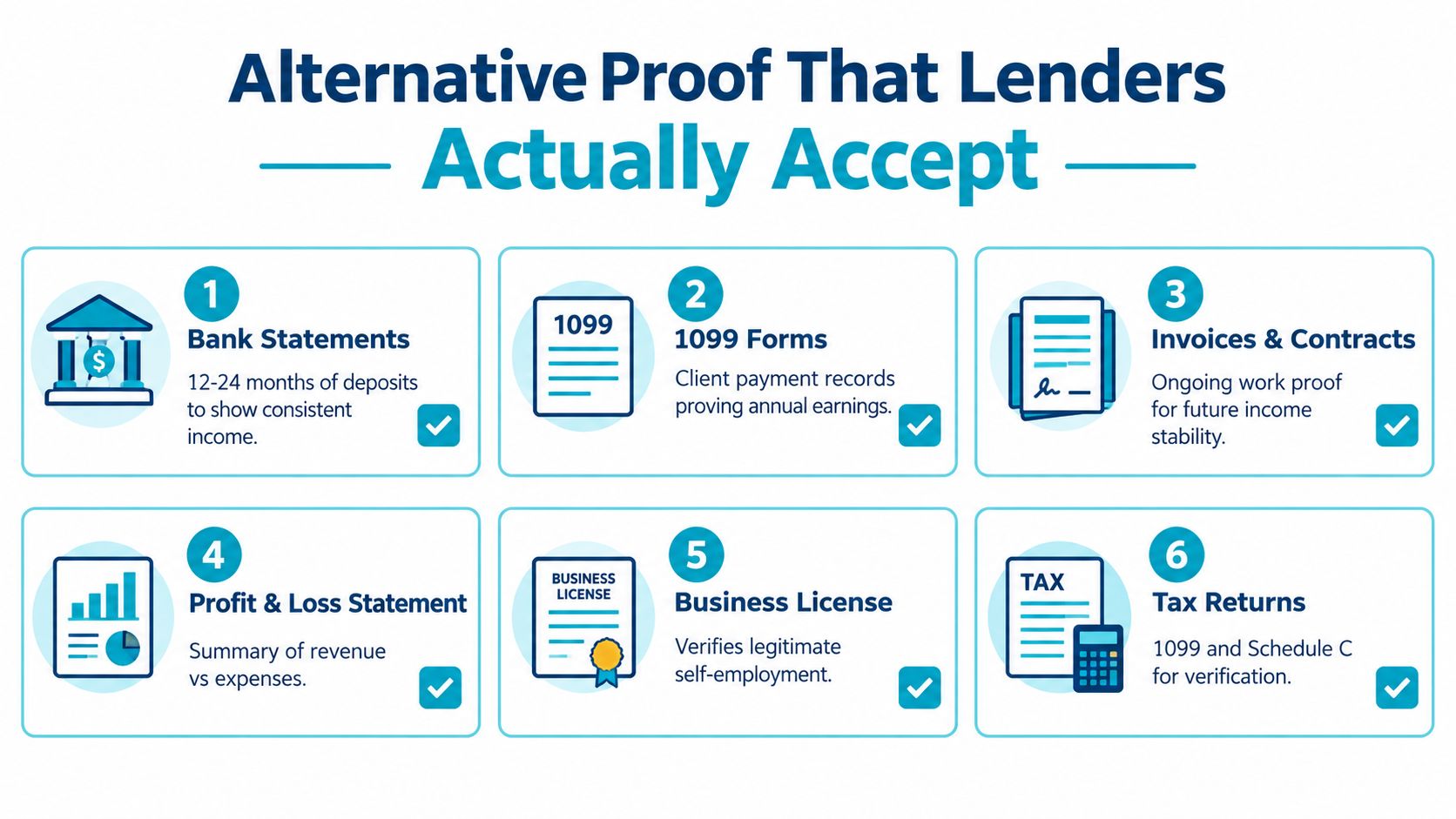
Fannie Mae's self-employed underwriting documentation explains that borrowers are commonly evaluated with signed federal tax returns or IRS transcripts. When traditional income proof is weak, lenders may use 12 to 24 months of business or personal bank statements to assess cash-flow stability and average balances.
Build the file in a lender-friendly order
Collect statements: Download complete statements for the period requested, including every page, even pages that contain no transactions. Use the accounts where clients, platforms, or customers pay you.
Identify recurring revenue: Mark deposits that relate to completed work, sales, commissions, or platform earnings. Keep a short note for deposits that need explanation.
Remove non-income inflows: Separate transfers between your own accounts, credit proceeds, refunds, and one-time asset sales. Counting them as earnings can make the file look inflated and trigger questions.
Create a cash-flow summary: Estimate average monthly net business receipts after ordinary business expenses. Don't present gross deposits as spendable income if a meaningful portion pays suppliers, contractors, inventory, or operating costs.
Match the result to the payment: Add the proposed loan payment to existing monthly debt obligations. A lender will judge whether the documented cash flow can carry the total, not whether one month looked impressive.
Support the explanation: Add 1099s, invoices, contracts, a current profit-and-loss statement, business registration or license records, and client documentation where appropriate.
A rideshare driver might combine platform earnings statements, bank deposits, mileage or expense records, and tax documents. A freelance designer could provide invoices, signed contracts, client deposits, and a year-to-date P&L. An Etsy seller may need marketplace payment records, inventory invoices, business bank statements, and evidence that deposits are connected to ongoing sales.
The documents don't need to be identical across professions. They need to be consistent with the way the business operates.
Practical rule: Deposit consistency usually matters more than one unusually high month. Lenders want a pattern they can use, not a peak they can't reproduce.
A current P&L is especially helpful when tax returns lag behind the business. It can show recent revenue and expenses, but it should reconcile with the bank activity. If the P&L says revenue is rising while the account shows no corresponding deposits, expect additional questions.
Keep the original files organized by account and month. Rename them clearly, preserve transaction descriptions, and write a short explanation for transfers or unusual credits before the lender asks. Clean preparation won't guarantee approval, but a disorganized file can create avoidable doubt.
Where to Find Self Employed Loans Without Traditional Income Docs
Different lender types solve different documentation problems. An online personal loan network may accept a broader income profile, while a bank-statement specialist may focus heavily on deposit history. A credit union might offer relationship-based review, whereas a secured lender cares more about the collateral and its value.
Independent consumer guidance confirms that lenders may consider bank statements, 1099s, tax returns, P&L statements, business licenses, client letters, or collateral as alternatives to a standard payroll file. This overview of personal loans for self-employed borrowers is useful because it frames the issue correctly. You're usually comparing types of verification, not searching for a loan with no verification.
Compare the routes before submitting
| Lender Type | Alternative Docs Accepted | Trade Offs to Expect | Best For |
|---|---|---|---|
| Online personal loan network | Income details, bank records, 1099s, invoices, and other documents requested by participating lenders | Terms and availability vary by lender, state, credit profile, and documented cash flow | Borrowers who want to submit one request for potential offers |
| Bank-statement specialist | Business or personal statements, P&L records, and supporting business documents | May price higher or impose tighter repayment conditions than standard lending | Borrowers with strong, traceable deposits but weak tax-return income |
| Credit union | Tax records, statements, account history, and personal explanations | Membership, underwriting policy, and processing speed can vary | Borrowers with an established relationship and stable account activity |
| Secured loan provider | Vehicle or other acceptable collateral, plus income and identity documents | Missed payments can put pledged property at risk | Borrowers with usable equity who can repay confidently |
| Title loan provider | Vehicle title, vehicle information, identity records, and income details | Collateral risk and repayment pressure can be substantial | Borrowers considering short-term, vehicle-backed funding only after reviewing safer alternatives |
A marketplace such as NextStopLoans' explanation of title loans without traditional income proof can help you understand the collateral route, but don't confuse a matching service with a lender. A marketplace routes a request to independent lenders. Those lenders decide whether to approve, what documents to request, and which terms to offer.
Choose the route based on the weakness in your file. If your deposits are steady but your tax returns show heavy deductions, a bank-statement path may fit. If your income is difficult to document but you own an asset with meaningful equity, secured borrowing may be available, although the risk is higher. If your income is solid but a lender wants additional repayment support, a qualified co-signer can strengthen the application.
The wrong route can turn a documentation problem into an expensive debt problem. Compare the likely evidence required, the payment, the total repayment, and what happens if revenue falls.
How to Prepare a Stronger Application Without Pay Stubs
Approval odds improve when you remove uncertainty before the request reaches underwriting. Don't submit a pile of screenshots and hope the lender interprets them correctly. Present a clean record that shows where money comes from, how regularly it arrives, and what payment your cash flow can support.
For many U.S. self-employed borrowers, the conventional file includes two years of signed federal tax returns, often with Schedule C or another business schedule, alongside recent bank statements and a year-to-date P&L. This overview of proof of income for self-employed applicants describes the documentation lenders commonly expect.
Clean up the financial trail
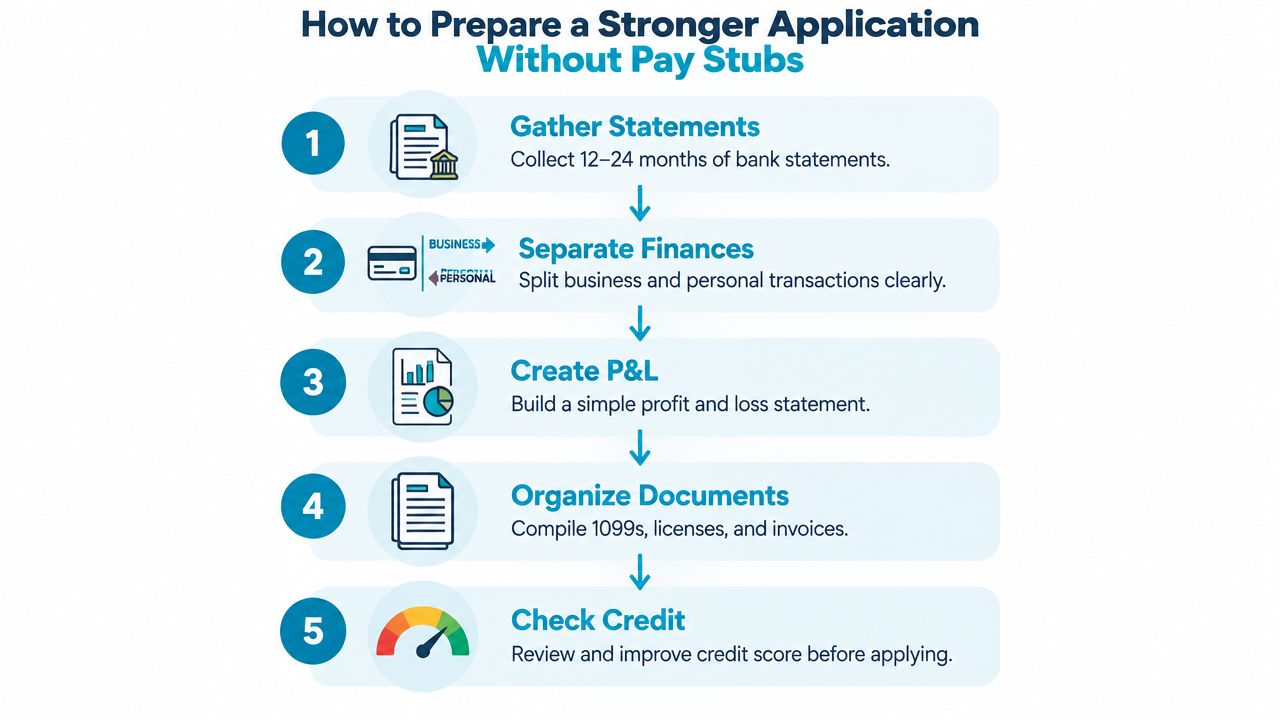
Start with complete bank statements for the period the lender requests. If business and personal transactions are mixed, label the categories clearly. Going forward, use a dedicated business account when practical. Separation makes revenue easier to verify and prevents personal transfers from being mistaken for business income.
Prepare a current P&L that lists revenue, operating expenses, and net income. Keep it consistent with your statements and invoices. If the business is seasonal, explain the cycle briefly instead of pretending every month produces the same revenue.
Review the proposed payment against your existing obligations. Lenders assess debt-to-income capacity, so reducing avoidable monthly debt before applying can make the file easier to approve. Don't take on new credit solely to make the application look stronger. That can create another obligation and complicate the review.
Handle irregular income honestly
A short explanation letter can help when the numbers are accurate but unusual. Keep it factual:
- Name the income source: Explain whether deposits come from design retainers, delivery platforms, consulting contracts, commissions, or online sales.
- Explain large credits: Identify transfers, reimbursements, asset sales, or one-time payments that aren't recurring income.
- Describe seasonality: State when demand normally rises or falls and point to the records that support the pattern.
- Address a decline: If revenue has fallen, explain the cause and provide current contracts or invoices only if they reflect realistic future work.
A co-signer makes sense only when that person understands the legal responsibility and has the capacity to repay if your business income drops. Collateral can also improve access, but it exposes an asset to repossession or sale if you miss payments. Use either option to solve a defined underwriting weakness, not because a lender makes approval sound guaranteed.
Pre-submission checklist
Before requesting funding, confirm that you have:
- Complete statements: Include the requested accounts and full statement periods.
- Income records: Gather 1099s, invoices, contracts, platform reports, and tax documents that apply.
- Business evidence: Add a license, registration, or other record showing legitimate self-employment where available.
- Current P&L: Reconcile revenue and expenses with the bank activity.
- Payment estimate: Calculate the proposed payment alongside existing debts.
- Credit review: Check your reports for identity errors, accounts you don't recognize, or inaccurate balances.
- Explanation notes: Prepare concise answers for transfers, unusual deposits, and income changes.
When using a secure multi-lender request form, submit accurate gross monthly income information and keep documents ready for any participating lender that asks for verification. Personal loan eligibility guidance can help you understand the information typically considered before you apply.
Risks Costs and Red Flags to Watch Before You Accept
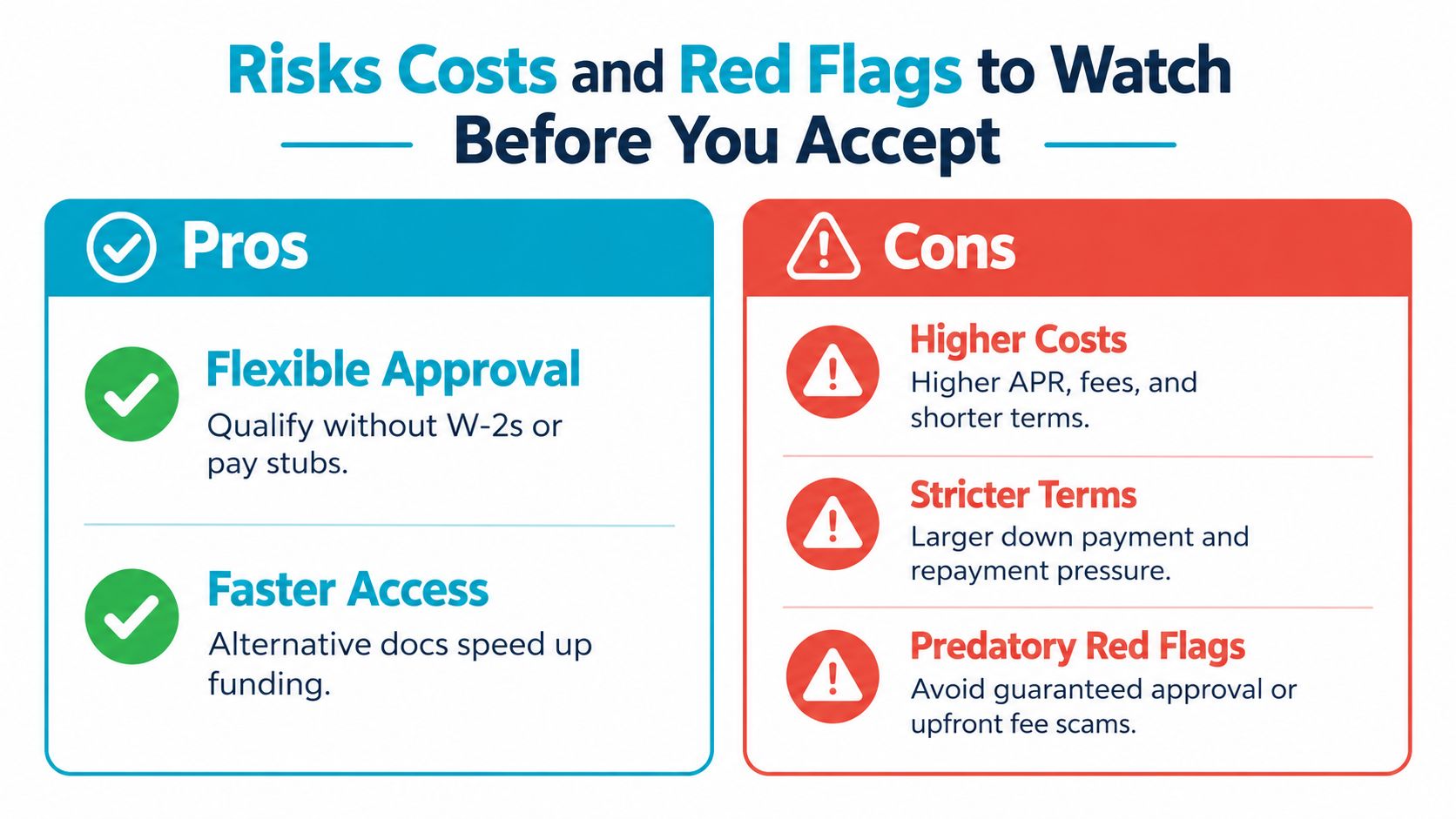
Alternative documentation gives lenders less standardized information, so the loan may carry more restrictive terms than conventional financing. Industry guidance notes that borrowers without traditional proof can face higher rates and shorter terms, and some products may require substantial balances or collateral. Guidance on self-employed underwriting factors supports the broader point that documentation flexibility doesn't eliminate lender risk.
Read the offer, not the headline
Compare the annual percentage rate, origination or administrative fees, payment frequency, total repayment, late charges, and any prepayment terms. A lower advertised rate can still produce an unaffordable payment if the repayment period is short. Ask whether the lender can change the payment, require automatic withdrawals, or add fees after a missed payment.
Declining or volatile income deserves special attention. Recent self-employed qualification guidance emphasizes that lenders often examine income history and consistency, not merely whether deposits exist. A bank statement showing money in the account won't rescue an application if the trend suggests repayment capacity is weakening.
Watch for these warning signs:
- Guaranteed approval: No legitimate lender can promise approval before reviewing the application and relevant information.
- Upfront payment demand: Be cautious if someone requires a fee before funding and refuses to provide clear written disclosures.
- Pressure to pledge essential property: Don't risk a vehicle, equipment, or other asset you need to earn income unless the payment is clearly manageable.
- Missing terms: Decline any offer that doesn't state the rate, fees, payment schedule, and consequences of default.
- Confusing marketplace language: A matching service can present potential lender connections, but it doesn't approve the loan or set the terms.
If you're researching loans with no income, treat the phrase as a prompt to examine verification requirements, not as permission to skip repayment analysis. Read every disclosure, verify the lender's identity, and walk away if the offer depends on urgency rather than transparent terms.
Your Next Steps to Request Funding With Confidence
Start by identifying the actual weakness in your application. Is the problem that you have no pay stubs, that your tax returns understate business income, that deposits are irregular, or that existing debt leaves too little room for another payment? The answer determines whether you should pursue bank-statement review, a secured product, or a co-signed application.
Prepare the evidence before submitting:
- Gather account records that show your real business cash flow.
- Add supporting documents, including 1099s, invoices, contracts, tax records, licenses, and a current P&L where applicable.
- Explain unusual activity so transfers and one-time deposits aren't mistaken for recurring income.
- Calculate affordability using the proposed payment and your existing obligations.
- Compare written offers by APR, fees, repayment schedule, collateral exposure, and total cost.
The phrase no proof of income shouldn't push you toward an unverified promise. It should prompt you to present proof in the form your work generates. Stable deposits, consistent records, and an honest explanation are more useful than a single strong month or an application that leaves gaps.
NextStopLoans operates as an online connector that can submit one secure request to a network of independent third-party lenders. Responses are typically provided within minutes, and funding may occur as soon as the next business day if a lender approves, subject to lender processes. The service doesn't make credit decisions, set loan terms, or operate in every state, so review each lender's disclosures and accept an offer only if the payment fits your cash flow.
If you're a freelancer, gig worker, or small business owner without traditional pay stubs, NextStopLoans can route one secure request to participating lenders that may consider your income details and alternative documentation. Submit accurate information, review any offers carefully, and choose funding only when the repayment terms are realistic for your business.