
Loans with No Income: 7 Options and Key Risks

If you have no verifiable employment income, you may still have options, but lenders generally need collateral, documented cash flow, a co-signer, or another credible basis for repayment. When none of those exists, assistance programs and payment arrangements are usually safer than taking on new debt.
A car repair, medical bill, rent shortfall, or utility shutoff can make loans with no income sound like a simple solution. The critical distinction is whether you lack a W-2 paycheck or whether you have no repayment resources at all. Retirees may have benefits, freelancers may have deposits, and property owners may have assets, even when a conventional pay stub isn't available.
True income-free lending is uncommon. In a California study of payday lenders, 96% said borrowers needed some type of income, and 93% required proof of income according to the California Department of Financial Institutions study. The practical choices below are organized by what replaces conventional income verification, including collateral, cash flow, another person's credit, alternative documents, flexible underwriting, and non-loan help.
Independent lenders control approval, rates, fees, funding, and repayment terms. Compare the full cost, payment schedule, default consequences, collateral exposure, and co-signer liability before accepting anything.
Table of Contents
- 1. Asset-Based Lending and Collateral-Secured Loans
- 2. Bank Account Analysis Loans
- 3. Guarantor and Co-Signer Loans
- 4. Peer-to-Peer Lending Platforms
- 5. Secured Credit-Builder Loans
- 6. Income Verification Alternatives
- 7. Installment Loans with Flexible Underwriting
- No-Income Loan Options, 7-Point Comparison
- Choose the Least Risky Path You Can Repay
1. Asset-Based Lending and Collateral-Secured Loans
A paid-off vehicle, valuable equipment, or another eligible asset can sometimes support borrowing when employment income can't. Title loans are the most recognizable example. The lender focuses on the vehicle's equity, condition, and market value, then records a security interest in the title. Other secured loans may use savings, investment assets, or property as collateral.
This structure can help a retiree with no W-2 income who owns a vehicle outright, or a self-employed worker whose earnings fluctuate. It doesn't make the loan affordable by itself. The asset gives the lender a recovery path, while you still need a realistic plan for every payment.
Read this guide to online secured loans before submitting an application. Ask how the lender determines value, what loan-to-value limit applies, whether insurance is required, and what happens after a missed payment.
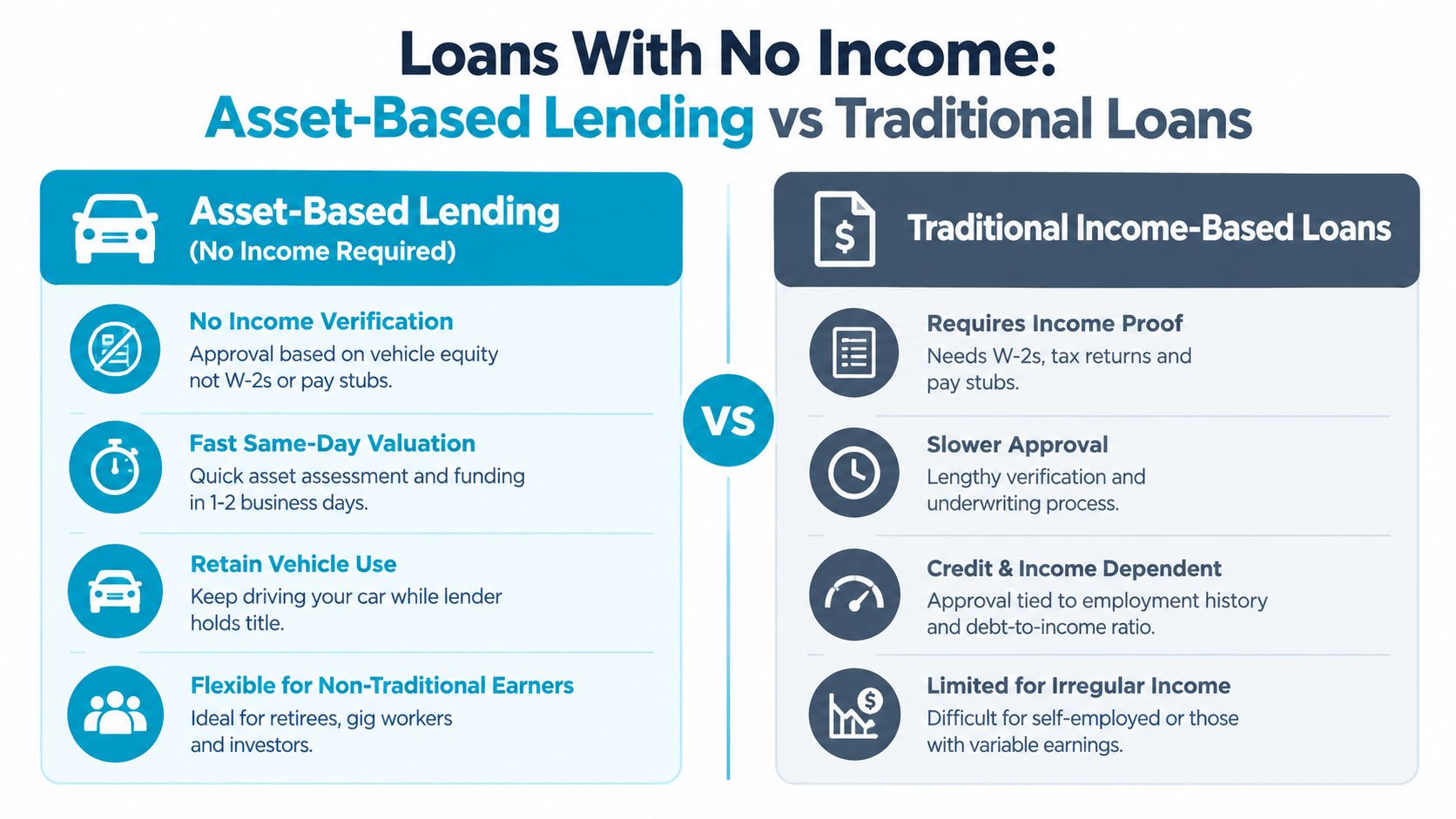
What you risk
The central trade-off is access versus asset loss. If you pledge your car for an emergency expense and default, repossession could remove transportation you need for work, medical care, or daily life. A loan secured by property or investments can create larger consequences if the lender enforces its rights.
Before applying, gather the title, registration, and insurance records. Confirm that you own the asset outright or understand any existing lien. Compare several lenders' fees, repayment periods, and repossession policies, then borrow only what the asset and your budget can safely support.
Practical rule: Never pledge an essential asset unless your repayment plan remains workable during a weak-income month.
2. Bank Account Analysis Loans
A lender may evaluate cash flow instead of a traditional paycheck by reviewing deposits and withdrawals in your bank account. This approach can fit freelancers, rideshare drivers, contractors, people receiving investment income, and others whose money arrives irregularly.
The lender may look for recurring deposits, ordinary spending patterns, overdraft activity, and available balances. A bank statement doesn't prove that future income will continue, so the review should focus on whether the proposed payment fits your actual cash flow rather than on the largest deposit you received.
You may need to provide complete statements or connect an account electronically. Prepare records that show where deposits come from, especially if you use several accounts. A dormant account or unexplained transfer can make the application harder to assess.
For background on the difference between fast short-term products and broader underwriting, review this explanation of payday loans with no credit check.
Make the cash-flow case clearly
Don't inflate your ability to repay by counting one-off transfers, borrowed money, or temporary assistance as recurring income. Identify stable deposits and separate them from irregular receipts. If you recently started self-employment, waiting until your account reflects a clearer pattern may produce a more accurate review, but it won't guarantee approval.
Check whether the lender uses a recurring-payment authorization, charges an origination fee, or withdraws payments directly from your account. A loan that appears manageable on paper can cause overdraft fees and missed obligations if the payment date doesn't match your deposit schedule.
Cash-flow underwriting is more flexible than a pay-stub-only process, but it still asks the same fundamental question: what money will repay the debt, and how dependable is it?
3. Guarantor and Co-Signer Loans
A co-signer can replace your missing income and credit strength with their own. The arrangement works because the lender can pursue the co-signer if you fail to pay. That makes this option potentially useful for a student, unemployed borrower, or person with irregular income, but it also transfers serious risk to someone close to you.
A parent might co-sign for a young adult's moving costs. An adult child might support a retiree facing a medical bill. A sibling might back a vehicle repair loan when transportation is necessary for training or future employment. These situations can work only when both people understand the obligation and the borrower has a credible repayment source.
Protect the relationship
Discuss the loan before anyone fills out an application. Review the amount, interest rate, payment dates, late fees, and total repayment together. The co-signer should understand that the obligation can affect their ability to borrow and may damage their credit if payments are missed.
Create a backup plan for a missed payment. Decide who will make the payment, how quickly they must be notified, and whether the borrower will maintain a separate reserve for installments. Put the agreement in writing, even when the co-signer is a close relative.
A co-signer isn't a substitute for repayment capacity. They're a second person who becomes responsible when the first repayment plan fails.
Never pressure someone into signing because an application feels urgent. If your only repayment plan is “I'll find work soon,” postpone borrowing or seek assistance first. A co-signed loan can preserve access to credit, but an unaffordable loan can damage two households instead of one.
4. Peer-to-Peer Lending Platforms
Peer-to-peer platforms connect applicants with investors through an online process. Some platforms consider a broader borrower profile, such as work history, education, credit behavior, and the explanation behind irregular earnings. That wider review may help a freelancer or self-employed applicant who doesn't have conventional payroll records.
It doesn't turn a weak application into a strong one. Investors still want evidence that repayment is plausible, and the platform or funding partner may apply credit, identity, debt, and affordability checks. Rates and fees can also vary significantly by risk assessment.
Build an accurate profile. Explain how you receive money, identify recurring clients or contracts where relevant, and disclose obligations. Bank deposits, invoices, benefit records, or business records may help establish context, but never submit altered documents or treat projected earnings as current income.
Match the product to the urgency
Peer-to-peer funding may not suit an immediate crisis. The application, review, investor commitment, and disbursement process can take longer than a lender that offers an instant decision. If rent, utilities, or medical care is at risk, contact the provider first and ask about a payment arrangement.
Use a P2P loan only when the fixed payment fits your budget. Review the annual percentage rate, origination fee, late-payment policy, prepayment terms, and total amount repaid. Don't choose a longer term solely because it lowers the monthly payment. A lower payment can still produce a higher total cost.
The strongest application is one that explains stable repayment resources, not one that merely tells a persuasive personal story.
5. Secured Credit-Builder Loans
A credit-builder loan usually works differently from an emergency cash loan. The lender places the borrowed amount into a secured savings account or certificate, and you make scheduled payments. After the loan is completed, the funds become available to you, subject to the account terms.
That means this option usually won't solve today's overdue bill. It can help someone with limited income prepare for future borrowing by creating a payment record and building savings at the same time. Ask whether the lender reports payments to Equifax, Experian, and TransUnion, and confirm the reporting policy before signing.
Use it as preparation, not emergency funding
A credit-builder loan makes sense when you can make every payment from existing resources. Missing payments defeats the purpose and can create fees or credit damage. Automatic payments can reduce missed due dates, but only if the linked account reliably contains enough money.
Start with a payment amount that leaves room for essential expenses. Don't use a secured savings product to justify taking a separate high-cost loan. The goal is to build a stronger financial base, not to stack obligations.
Review the account's interest, administrative fees, early-payoff rules, and access restrictions. Some products release funds only after the final payment, while others may provide access under different conditions. Read the agreement rather than assuming every credit-builder loan follows the same structure.
This pathway replaces current income verification with available savings and payment discipline. It is useful for credit rebuilding, but it isn't a fast source of cash for someone with no repayment capacity.
6. Income Verification Alternatives
“No income” often means “no standard employment documentation.” Lenders may consider Social Security or disability benefits, pensions, rental receipts, investment distributions, self-employment deposits, or other documented resources. The CFPB's Ability-to-Repay and Qualified Mortgage framework, effective in 2014, established a major U.S. lending benchmark by requiring creditors to verify the income or assets used to qualify with reasonably reliable third-party records as explained in the CFPB's compliance guide.
The CFPB lists possible records such as W-2s, payroll statements, tax returns, bank statements, benefits documentation, and employer records. The same framework shows why mainstream lenders generally can't rely only on an applicant's oral statement. Flexible underwriting still exists, but it usually requires some evidence of repayment ability.
Prepare documents that match the source of your money:
- Benefits records: Provide current award or benefit statements from the administering agency.
- Pension records: Show the payment amount and frequency.
- Rental income: Organize leases, deposit records, and any property-related obligations.
- Investment income: Include statements showing distributions, interest, or dividends.
- Self-employment receipts: Provide bank records, invoices, contracts, or business financial statements where requested.
Show stability, not just a deposit
A lender needs to understand whether the money is recurring, available, and sufficient after essential expenses. Separate gross receipts from the amount you can use for debt payments. Rental income, for example, may come with maintenance, insurance, taxes, or vacancies.
Don't submit more documentation than requested without protecting sensitive information. Use secure upload channels and read the lender's privacy policy. Check how the lender defines qualifying income, whether it accepts benefits, and whether it requires additional verification.
This is often the most sensible route for applicants who have resources but lack a W-2. It doesn't guarantee approval, and documented income can still be too low or too irregular for the requested payment.
7. Installment Loans with Flexible Underwriting
Flexible installment lenders may consider applicants with nontraditional income, limited credit history, or complicated financial circumstances. Instead of demanding a conventional payroll profile, they may review benefits, deposits, employment history, debt obligations, or other repayment signals.
The benefit is a fixed repayment structure. You know the scheduled payment and term, unlike an open-ended balance that can remain expensive when you keep paying fees. The downside is that flexible approval often comes with a higher price, tighter eligibility rules, or both.
Read this explanation of installment loans and approval claims carefully before applying. No legitimate marketplace or lender can promise approval without reviewing your circumstances, and no loan becomes affordable merely because the application is easy.
Judge the payment, not the approval
Calculate the total repayment from the contract's payment schedule. Add the scheduled payments and required fees, then compare that amount with the money you receive. Check whether the lender charges an origination fee that reduces the proceeds, whether late fees apply, and whether early repayment changes the cost.
Keep the term as short as your budget can safely handle, but don't choose a payment that forces you to miss rent, food, utilities, insurance, or other essential bills. A longer term may lower the scheduled payment while increasing the total interest paid.
Use flexible installment credit for a necessary expense or a carefully evaluated consolidation plan, not for routine spending. If your income is genuinely zero and you have no asset, co-signer, benefits, or other repayment source, don't treat this as a solution. Seek assistance before creating a payment obligation you can't support.
No-Income Loan Options, 7-Point Comparison
| Loan Option | How it Works ✨ | Speed & Quality ★ | Typical Cost 💰 | Best For 👥 | Key Pros / Risks 🏆 |
|---|---|---|---|---|---|
| Asset-Based Lending (Title/Collateral) | Collateral (vehicle title) used; approval by asset equity | Fast valuation & lender response; funding 1–2 business days ★★★★ | Varies by state; LTV ~25–50%; 💰 moderate–high | 👥 Vehicle owners, retirees, gig workers | 🏆 No income docs; Risk: repossession, title held by lender |
| Bank Account Analysis Loans | Underwrite via 60–90 days of bank statements (cash-flow based) | Digital docs; quick decisions (minutes–days) ★★★★ | $500–$10K typical; 💰 moderate | 👥 Freelancers, self-employed, gig economy | 🏆 Reflects real cash flow; Cons: share banking data; irregular deposits hurt approval |
| Guarantor / Co‑Signer Loans | Co‑signer's income & credit secure the loan; co‑signer liable | Quicker with strong co‑signer; approval speed varies ★★★★ | Often lower APR than no‑income options; 💰 lower–moderate | 👥 Borrowers with trusted family/friend co‑signer | 🏆 Lower rates & credit-building; Risk: relationship strain, co‑signer legally liable |
| Peer‑to‑Peer (P2P) Platforms | Borrower profile listed to individual investors; alt data used | Longer funding timeline (7–14 days); platform dependent ★★★ | APR varies; origination fees 1–6%; 💰 moderate | 👥 Applicants who can tell their story and have fair credit | 🏆 Flexible underwriting & no collateral; Cons: funding not guaranteed, higher credit thresholds |
| Secured Credit Builder Loans | Borrower deposits held in account; payments reported to bureaus | Slow (12–24 months) to build credit; reliable reporting ★★★ | Deposit size $300–$2,500; APR 15–30%; 💰 locked funds | 👥 No‑credit or poor‑credit borrowers building history | 🏆 Builds credit + savings; Cons: funds inaccessible during term, not for emergencies |
| Income Verification Alternatives | Accepts bank statements, benefits, investment & rental docs | Quick uploads; decisions often 1–2 days if lender accepts ★★★★ | Varies by lender; 💰 moderate | 👥 Retirees, investors, nontraditional earners | 🏆 Broad acceptance of income types; Cons: requires organized documentation, some lenders discount alt income |
| Flexible Installment Loans | Unsecured fixed‑term loans with permissive underwriting & alt data | Fast approval/funding (1–2 business days) ★★★★ | APR ~10–36%; $500–$10K; 💰 moderate | 👥 No‑income borrowers needing predictable payments | 🏆 Predictable monthly payments & no collateral; Cons: higher APR than banks, variable terms |
Choose the Least Risky Path You Can Repay
Start with the repayment source, not the loan amount. Ask whether you have documented cash flow, an asset with usable equity, a willing co-signer, benefits, pension income, rental receipts, investment distributions, or another verifiable resource. If you have none, borrowing is likely to move the problem rather than solve it.
Use this order of preference:
- Non-loan help first: Ask a utility, medical provider, landlord, insurer, school, or creditor about a payment arrangement, hardship plan, deferral, or reduced-cost service.
- Alternative documentation next: If you have benefits, pension payments, rental income, or deposits, gather records and seek underwriting that recognizes them.
- Unsecured installment credit only when affordable: Compare the APR, fees, payment amount, total repayment, term, and funding timing.
- Collateral last among borrowing options: Understand exactly what you could lose after a missed payment.
- Co-signing only with a written plan: Both parties should understand the legal obligation and default consequences.
Check state availability and lender disclosures before accepting an offer. Product rules vary, and some lenders don't serve every state. Review the lender's rates and fees, lending policy, privacy policy, and advertiser disclosures. A lender may check your credit even when the marketplace itself doesn't pull it.
NextStopLoans operates as a marketplace, not a lender. It submits requests to independent third-party lenders, while those lenders make credit decisions, set terms, and handle funding. The marketplace doesn't guarantee approval or dictate the offer you receive. Participating lenders may review credit with major or alternative bureaus.
If an offer requires a payment you can't make in a weak month, decline it. Fast funding doesn't reduce the amount owed, remove default risk, or protect collateral. The safest decision may be a payment arrangement, nonprofit assistance, benefits support, employer advance, family help, or another non-loan resource.
Loans with no income can be possible when something credible replaces a conventional paycheck. They aren't a safe answer when there is no repayment basis at all.
NextStopLoans offers an online request form that can route your information to independent lenders considering personal, emergency, installment, payday, or title-backed funding. Review the lender's offer and disclosures carefully, then visit NextStopLoans to see whether your documented repayment resources fit an available option.