
Title Loan Without Proof of Income How It Works

You need cash for a repair, utility bill, or medical expense, but you work through apps, receive benefits, run a small business, or recently lost a job. There's a car in the driveway, yet no recent pay stub or W-2 to upload. That's when the phrase title loan without proof of income can look like a simple solution.
The important distinction is that no traditional pay stub doesn't always mean no financial review. Some lenders may focus on the vehicle's title and value, while others may ask for bank statements, benefit letters, tax records, or another sign that you can make the required payments. Approval, cost, and legality also depend on the lender and the state where you live.
This guide explains how title loans work, what substitute documents may count, why collateral alone doesn't prove repayment ability, and which alternatives may reduce the risk of losing your transportation. NextStopLoans is a marketplace connector, not a lender, so it doesn't make credit decisions or set loan terms. If you're starting with the basics, its overview of title loans can provide additional context, but you should compare every offer carefully before accepting it.
Table of Contents
- Introduction to Title Loans Without Traditional Income Proof
- How Title Loans Work and Why Income Verification Matters
- What Lenders Accept Instead of Traditional Pay Stubs
- True Costs and Risks When Income Is Not Verified
- State Laws and Regulatory Rules That Affect Approval
- Smarter Alternatives to Title Loans Without Income Proof
- How to Improve Eligibility and Find Lenders Through NextStopLoans
Introduction to Title Loans Without Traditional Income Proof
A title loan is secured by a vehicle. You generally offer the vehicle title as collateral, and the lender evaluates the car's value when deciding whether to make an offer. The phrase “without proof of income” usually means the lender may not require a conventional employment document, such as a pay stub, but that wording can hide an important condition. The lender may still want evidence that money regularly reaches you.
The CFPB's 2016 rulemaking record describes title lending as an asset-based product. Some lenders didn't require income information and instead relied on the title and collateral value, while others requested proof of income. The same record cited about 1.1 million U.S. households reporting a vehicle title loan in the prior 12 months in 2013, another estimate of about 2 million consumers using title loans annually, and estimated 2014 originations of $2.4 billion. These figures appear in the CFPB rulemaking record on payday and vehicle title lending.
Those figures describe a meaningful credit product, not a guarantee that a lender will approve you. A lender still has to decide whether the vehicle is acceptable collateral, whether the title is clear, whether the loan is permitted where you live, and whether the repayment schedule makes sense.
The questions that matter before applying
Ask three questions before focusing on the phrase “no proof of income”:
- Can I show repayment ability another way? Regular deposits, retirement payments, disability benefits, or business revenue may provide a clearer picture than a single pay stub.
- What happens if my income varies? A lender may review patterns over time rather than accept one unusually strong deposit.
- Could repayment put my car at risk? If the vehicle is essential for work, medical appointments, or family care, losing it may create a larger problem than the original bill.
The practical answer is often “no traditional pay stub,” not “no underwriting.” Understanding that difference can help you avoid applying under a false assumption and can make it easier to compare a secured loan with less risky options.
How Title Loans Work and Why Income Verification Matters
A title loan connects two separate ideas: collateral and repayment ability.
First, the vehicle secures the loan. You provide a title, and the lender may place a lien against it. The vehicle's condition, market value, ownership status, and existing liens can affect the offer. You may continue driving the car, but the lender has a legal interest in the vehicle until you satisfy the agreement.
Second, the lender considers how you'll make payments. A car can secure a debt, but it doesn't create cash for the next payment. That's why income verification matters even when the lender is willing to accept the vehicle as collateral.
Think of collateral like a security deposit on an apartment. The deposit gives the landlord protection if you fail to pay, but it doesn't show that you can cover rent every month. Income evidence plays the role of your rent-payment plan. It helps answer whether the loan can end with repayment rather than repossession.
What the application usually considers
A lender may review:
- The vehicle and title. The lender may need proof that you own the vehicle and that no conflicting lien prevents it from being used as security.
- Your identity and residence. Identification and contact details help the lender complete the application and comply with applicable rules.
- Your available repayment evidence. This could include recurring deposits, benefits, pension payments, or business records.
- The loan structure. The payment amount, due dates, fees, and consequences of late payment matter as much as the initial amount offered.
- State requirements. A lender can't necessarily use the same process in every state.
The CFPB has documented both models: some title lenders have relied heavily on vehicle value, while others have required income information. That variation is why an advertisement for a title loan without proof of income shouldn't be read as a promise that collateral alone equals approval.
A strong application starts with an honest answer to a basic question: after paying rent, food, utilities, existing debts, and transportation costs, what money will remain for this loan?
What Lenders Accept Instead of Traditional Pay Stubs
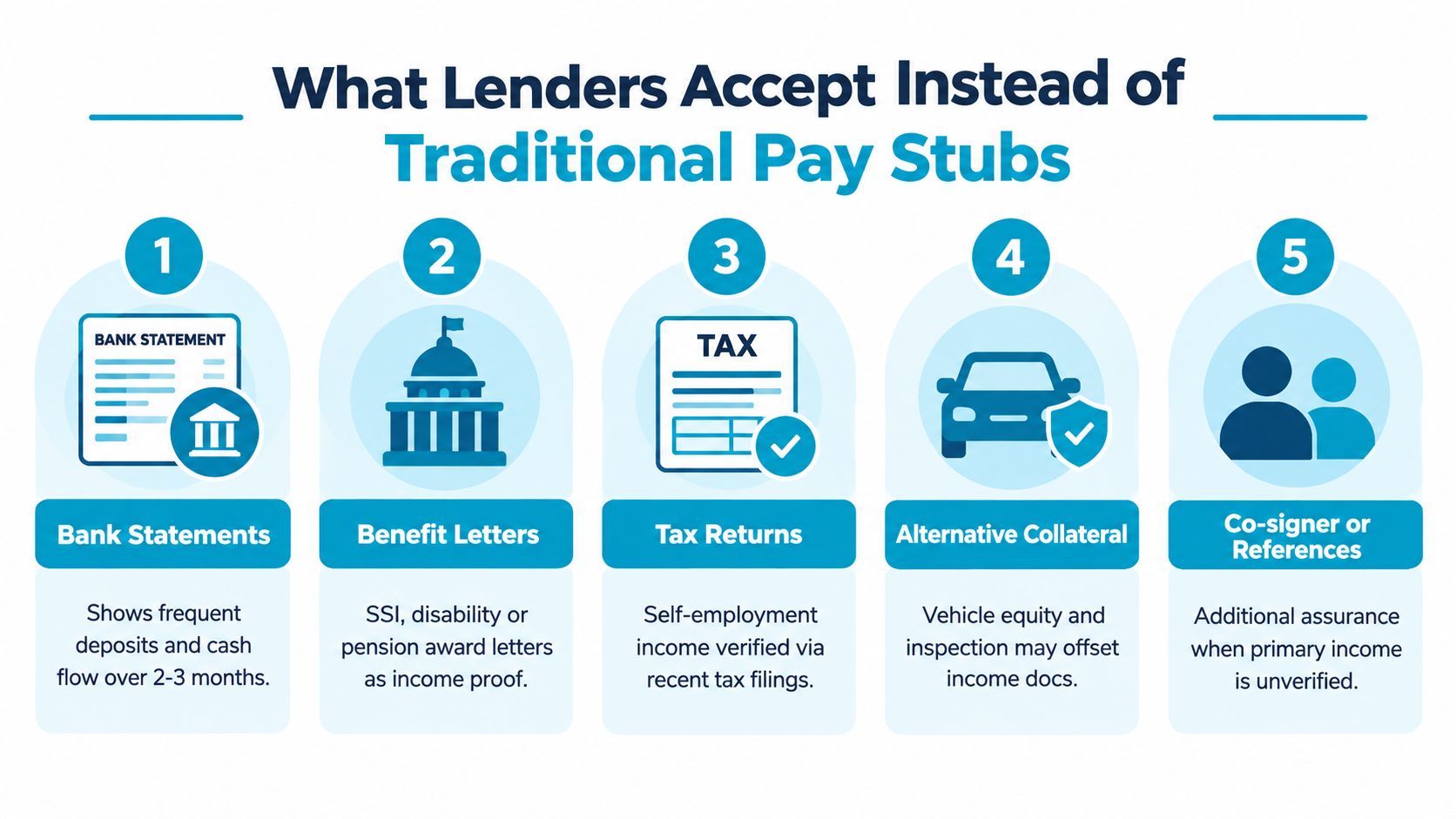
“Proof of income” can mean more than an employer-issued document. For borrowers with irregular or nontraditional earnings, the lender may look for evidence of recurring cash flow. The document should help show where money comes from, how often it arrives, and whether the pattern is likely to continue during the repayment period.
Bank statements and deposit patterns
Bank statements can show deposits from gig platforms, clients, family support, benefits, or other sources. A lender may examine whether deposits are recurring and whether the account also shows regular obligations. A single large deposit may be less useful than a consistent pattern of smaller payments.
Gather complete statements rather than edited screenshots. Make sure your name and account details are visible if the lender requires them, and don't assume that every deposit will be treated as income. Transfers between your own accounts, borrowed money, and one-time sales may not demonstrate ongoing repayment capacity.
Benefits, retirement, and pension income
Retirees and benefit recipients may not receive pay stubs, but they may have formal documentation. Possible examples include:
- Benefit award letters: Social Security, Supplemental Security Income, or disability documentation may show the benefit amount and payment schedule.
- Pension statements: A pension administrator's statement can establish recurring retirement income.
- Payment history: Bank records showing the actual deposits may support the letter or statement.
The lender may also consider whether the income is ongoing and whether any restrictions affect its use. You should provide current documents, because an old award letter may not reflect the present payment amount.
Self-employment and gig earnings
Self-employed borrowers can prepare recent tax filings, profit-and-loss records, invoices, contracts, or business account statements. Gig workers may have platform payout summaries, earnings dashboards, or deposit histories from driving, delivery, freelance, or task-based work.
The challenge is volatility. A lender may want to understand the difference between gross revenue and money available after fuel, insurance, equipment, taxes, and other business expenses. Prepare a simple monthly picture before you apply. List average incoming payments, necessary work costs, household bills, and the proposed loan payment.
Other possible support
Some lenders may consider a co-signer, additional collateral, or documented support from another source. These options don't eliminate risk. A co-signer can become responsible for the debt, and additional collateral can place another asset in danger.
Virginia's statute illustrates the broader direction of ability-to-repay rules. It requires a reasonable attempt to verify income using recent pay stubs or other written evidence of recurring income, including a bank statement, as described in the Virginia income-verification requirement. The practical lesson is simple: no pay stub may be acceptable, but no repayment evidence is a different matter.
True Costs and Risks When Income Is Not Verified
A borrower may own a car and still lack enough dependable cash to repay a title loan. Ownership provides collateral, not proof that the next payment will be available. If income arrives irregularly, a fixed due date can push the borrower toward renewing the loan instead of clearing it.
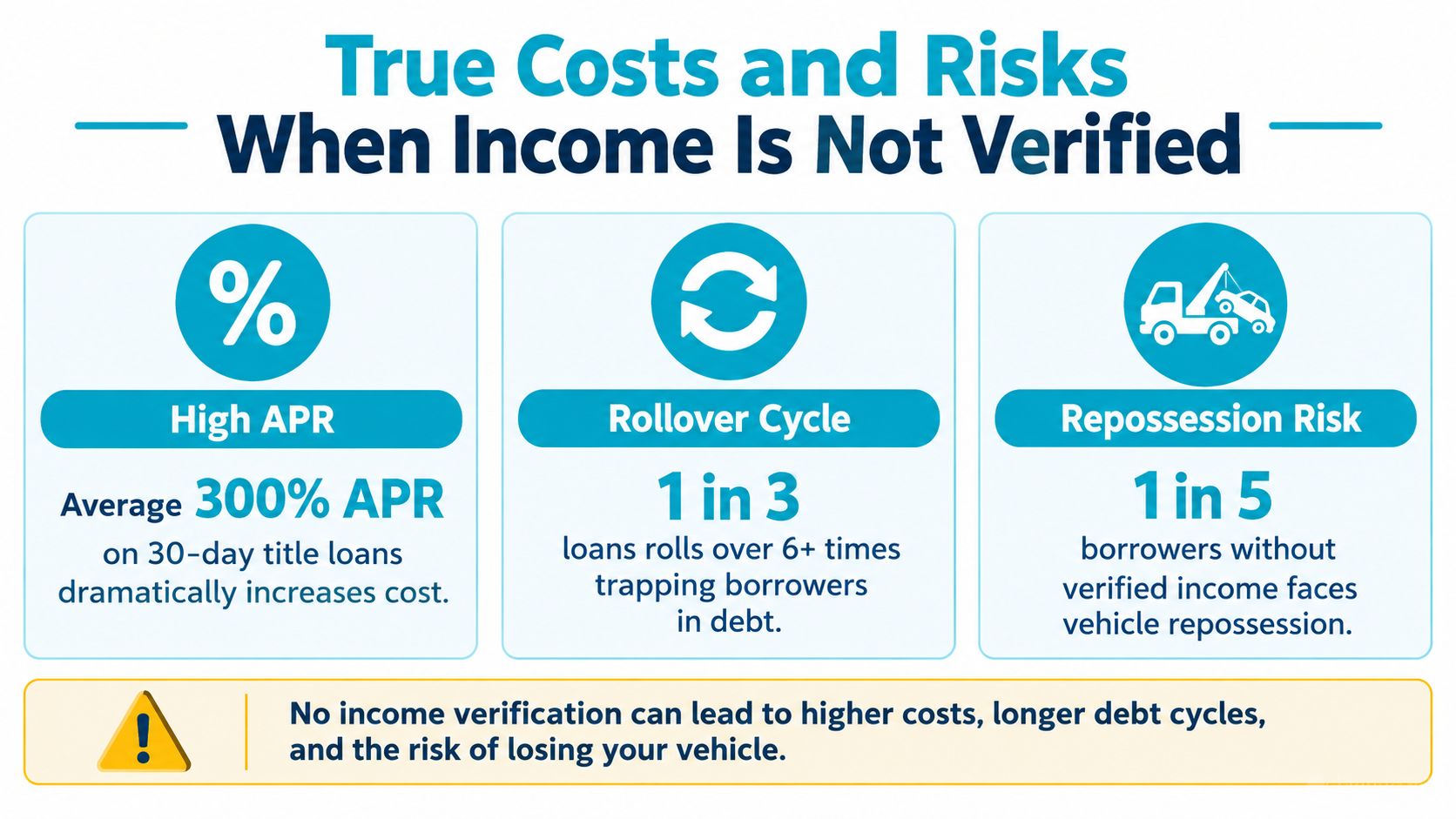
The CFPB reported a median title-loan amount of $694, a mean of $959, and APRs near 300% in its discussion of auto title lending research and borrower outcomes. An APR near 300% means fees and interest can take a large share of the borrowed amount. Review car title loan interest rates before comparing offers, because a payment that looks manageable may cost far more over the full term.
Why rollovers change the calculation
A rollover happens when the borrower cannot repay the balance and takes another loan or extends the existing obligation. It can postpone an immediate default, while adding fees, interest, or another due date. The original cash shortage remains.
The CFPB reported that 56% of vehicle title loan sequences involved four or more loans, 36% involved seven or more loans, and 23% involved ten or more loans within a 12-month period. These sequences do not necessarily represent separate emergencies. They show how a short-term loan can become a continuing obligation.
Write down the full repayment before signing. Start with the amount received, add every finance charge and fee, then record the total due and exact date. Compare that figure with the money remaining after housing, food, transportation, insurance, and other necessary costs.
Practical rule: If the first payment requires another loan, the agreement probably does not fit your cash flow.
The vehicle can be the repayment mechanism
The CFPB found that one in five borrowers who took out a single-payment auto title loan had their vehicle seized for failing to repay. A separate CFPB analysis found that about one-third of loan sequences defaulted and about one in five ended in vehicle repossession, as documented in the CFPB report on single-payment vehicle title lending.
Losing the car can also mean losing access to work, childcare, medical care, or groceries. Before applying, consider that wider consequence, rather than measuring risk only by the missed payment. A lower-cost option that takes longer to arrange may protect the vehicle you depend on every day.
State Laws and Regulatory Rules That Affect Approval
A title loan without proof of income isn't available under one national set of terms. State law changes the answer. Some jurisdictions prohibit or restrict title lending, while jurisdictions that permit it may impose requirements on disclosures, loan structure, repayment ability, licensing, and repossession.
That means an online advertisement can't tell you whether the product is legal or available at your address. The lender must apply the rules connected to the borrower's state, and its own underwriting policy may be stricter than the legal minimum.
Income verification as an ability-to-repay control
Virginia provides a clear example. Its law requires a lender to make a reasonable attempt to verify income with recent pay stubs or other written evidence of recurring income, such as a bank statement. For a borrower without a conventional job, that can still leave a path to consideration, but it requires documentation of a recurring source.
The CFPB's 2017 rule framework also addressed verification of net monthly income and recurring income documentation for covered short-term and balloon-payment loans. The framework is available in the CFPB final rule materials. These rules show why a lender may ask for alternative records even when its marketing says “no pay stub required.”
What to verify in your state
Before submitting personal information, check:
- Availability: Confirm that title lending is offered to residents of your state.
- Income rules: Look for requirements involving recurring income, net income, or ability to repay.
- Title conditions: Ask whether the title must be clear and solely in your name.
- Late-payment consequences: Read the agreement's repossession and renewal language.
- Marketplace coverage: Online connectors may not serve every state, and participating lenders can have different geographic limits.
Never assume that approval means the loan complies with every rule you need to understand. Read the lender's disclosures, verify the total repayment amount, and ask which entity is making the credit decision. If the answer depends on a state-specific exception or unusual structure, consider speaking with a qualified local consumer-law professional before pledging your vehicle.
Smarter Alternatives to Title Loans Without Income Proof
If a repair bill is due Friday and your paycheck is irregular, a title loan can look like the fastest answer because your vehicle provides security. That security does not show whether your monthly budget can handle repayment. Earlier CFPB research found that many single-payment vehicle title loans ended in default, and a substantial share led to repossession. Those outcomes show why a car's value is not a substitute for evidence that you can repay.
“No proof of income” should mean an alternative way to document repayment ability, not automatic approval. A gig worker might use platform payout records and bank deposits. A retiree could provide benefit or pension statements. A self-employed borrower may need tax records, invoices, or business-account history. These documents help a lender see recurring funds and available cash flow, while the vehicle only provides collateral.
Compare each option by asking what it places at risk:
| Option | Collateral Required | Income Proof Flexibility | Key Tradeoff |
|---|---|---|---|
| Personal installment loan | Usually none | May accept alternative income, depending on lender | May cost more for weaker credit, but the vehicle is not directly pledged |
| Credit union secured loan | May require an asset | Often requires documented repayment ability | A structured term may help, but the pledged asset remains at risk |
| Credit card cash advance | None beyond the existing account | No new income review if the credit line is already available | Fees and interest can be high, and interest may begin immediately |
| Family or friend loan | None, unless privately agreed | Usually based on trust and a written repayment plan | Unclear terms can create financial stress and harm the relationship |
| Utility, medical, or rent payment plan | None | Usually based on the bill and hardship situation | You may need to negotiate before the account becomes harder to manage |
| Community or public assistance | None | Eligibility depends on the program | Funds may be limited to specific essential expenses |
Match the solution to the bill. For medical costs, ask about a payment plan or financial-assistance review. Contact a utility provider before service interruption. Food, housing, and transportation needs may fit local nonprofit or public programs better than new secured debt.
A family loan can cost less, but write down the amount, due dates, and response if income changes. A cash advance may be convenient when available credit already exists. Calculate its fee and interest first.
If a secured product remains necessary, compare the total repayment amount, not just the deposited amount. Resources about online secured loans can help you review secured borrowing, but the participating lender decides the actual terms and eligibility. Collateral may support an application, yet documented repayment ability still determines whether the payment fits your budget.
How to Improve Eligibility and Find Lenders Through NextStopLoans
Better preparation won't guarantee approval, but it can make your financial situation easier for a lender to evaluate. Start by gathering the documents that match how you earn money. A gig worker might prepare platform payout records and bank statements. A retiree might collect a pension or benefit letter with matching deposit history. A self-employed borrower may need tax filings, invoices, and a clear account of business expenses.
Next, review the vehicle itself. Confirm that the title is available, ownership information is accurate, and any existing lien is understood. Collect current insurance and identification documents if the lender requests them. Don't estimate the vehicle's value based only on an online listing. The lender may use its own valuation and inspection process.
A careful application process
Use this sequence:
- Calculate available cash flow. Subtract essential bills and existing debt payments from reliable monthly income. Don't count uncertain future earnings as if they're guaranteed.
- Organize supporting records. Provide complete, readable documents and explain irregular deposits rather than hiding them.
- Review the offer slowly. Identify the amount received, fees, APR, payment dates, total repayment amount, renewal terms, and repossession language.
- Confirm state availability. Make sure the lender serves your state and follows the rules that apply to your transaction.
- Protect your choice. You don't have to accept an offer because you applied or were approved.
NextStopLoans operates as a connector to independent third-party lenders. Its secure online form uses 256-bit SSL encryption, routes requests to lenders in real time, and doesn't require you to accept an offer. Lenders handle decisions and funding, with funding potentially occurring as soon as the next business day, subject to the lender's process and approval.
Before signing: Make sure the payment fits your budget without another loan, and make sure you understand exactly how a missed payment could affect your vehicle.
If the numbers only work under perfect conditions, pause. Compare an unsecured loan, a negotiated payment plan, community assistance, or a private loan with written terms before putting your title at risk.
NextStopLoans connects eligible applicants with independent lenders through a secure online request form, including pathways for borrowers considering vehicle-secured funding. Visit NextStopLoans to review available options, confirm state availability, and compare any lender terms before accepting an offer.