
Personal Loan to Buy a Car: Costs, Terms and Risks
A lower monthly payment looks like the safer way to buy a car. It often isn't. Stretch the term, roll in fees, and the balance can stay higher than the car is worth long after the first payment feels easy. A personal loan to buy a car can fund the purchase without a lien. It does not erase the cost of borrowing, the speed of depreciation, or what happens if you fall behind.
Table of Contents
- Personal Loan vs Auto Loan at a Glance
- How a Personal Loan Pays for a Car, Step by Step
- How Loan Term Changes the Total You Repay
- Depreciation and Owing More Than the Car Is Worth
- Worked Examples of a Car Loan Cost
- Check Affordability and Confirm the Loan Before You Apply
Personal Loan vs Auto Loan at a Glance
Yes. A personal loan can pay for a car. The lender deposits a lump sum, and you use that cash to complete the purchase.
| Criterion | Personal loan | Auto loan |
|---|---|---|
| Collateral | None; the car is not pledged | The car secures the loan and the lender holds a lien |
| Typical APR | 5.99% to 35.99% across our lender network, set by credit, lender, and state | Often priced below an unsecured loan for a similar credit profile |
| Loan term | 61 days to 84 months across our lender network | Commonly 36 to 84 months |
| Down payment | Often optional, but a larger amount cuts the balance | Commonly expected, and it lowers the amount financed |
| Consequence of default | No vehicle-specific repossession, but credit damage and collections | Lender can repossess the car |
| Funding speed | Can be as fast as the next business day, subject to the lender's process | Often arranged at the dealership at purchase |
An auto loan uses the car as collateral and the lender holds a lien. An unsecured personal loan rests on your credit profile, income, and existing debts.
That choice sits inside a very large market. The Federal Reserve G.19 release reported about $1.562 trillion in outstanding motor-vehicle loans in 2025, up from $1.388 trillion in 2021. Those balances are non-revolving credit repaid on a schedule, and the growth reflects higher vehicle prices and larger amounts financed, not only more cars sold.
A personal loan can serve a similar purchase purpose without a vehicle lien. Do not assume it is cheaper or safer. The two numbers that matter most in that table are APR and total repayment. The rest of this guide shows how to calculate both.
How a Personal Loan Pays for a Car, Step by Step
Think of the loan as a cash payment the lender hands you. You spend it on the car. The lender takes no claim on the vehicle. You still owe every dollar on the schedule you signed.
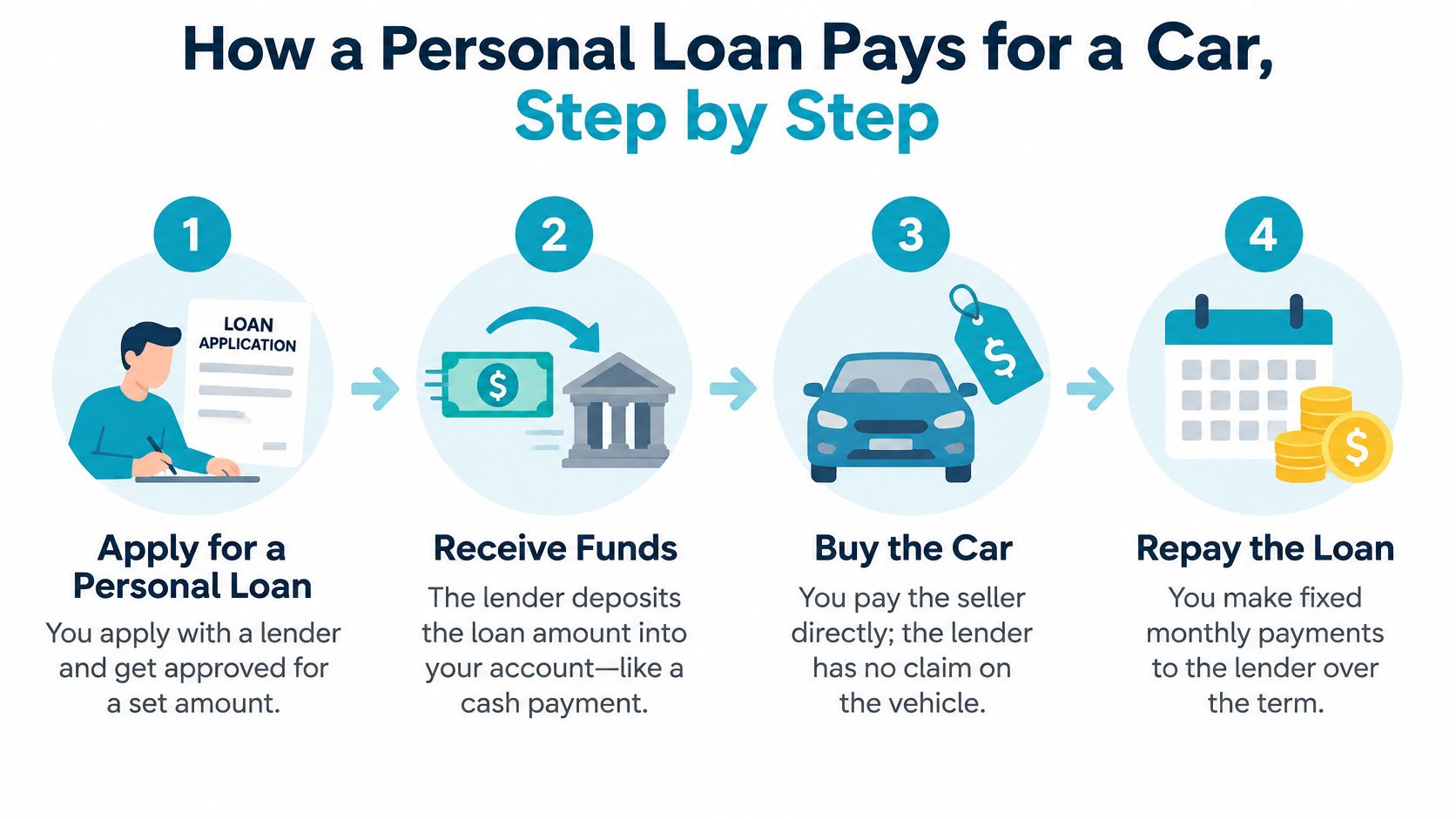
The four actions, and the check that goes with each
- Fill in the request. Our online form takes minutes. It asks for the loan amount, some personal information, and the bank account where funds should be deposited. Before you submit, check that the amount matches the car price plus the taxes and fees you need, not a round number you hope will be enough.
- Review the offer. The lender presents the APR, fees, and repayment terms. Read the finance charge and the total of payments, not only the installment. Submitting information does not guarantee approval, and the lender sets the final terms.
- Sign electronically. A loan is accepted when you electronically sign the lender's offer and send it back. Pause if the APR, term, or fees differ from what you expected. Once you sign, those terms are the contract.
- Receive the funds and pay the seller. Loan funds are deposited directly into your bank account, usually as fast as the next business day. Confirm the deposit has cleared, then pay the seller by the method the sale requires.
Who can start a request
The basic requirements are straightforward.
- Age: You need to be at least 18.
- Account: You need a checking account for the deposit and for repayments.
- Income: You need employment with regular income and a steady pay frequency.
Those items open the door. They do not set your rate. Credit history, existing debts, and the lender's own rules decide whether an offer appears and what it costs.
Practical rule: Treat the offer screen as the real decision point. If the APR or fees are higher than you modeled, decline it. You are not obligated to accept.
Once you pay the seller, you own the car with no lien from this loan. The monthly repayment stays the same whatever the car is later worth. Selling it, totaling it, or watching the market price fall does not shrink the installment.
How Loan Term Changes the Total You Repay
The monthly payment alone misleads. Compare APR, amount financed, term, finance charge, and total of payments before you accept anything.
The Consumer Financial Protection Bureau auto loan guide walks through a $20,000 loan at 4.75% APR. Interest is about $1,498 over 36 months, $1,999 over 48 months, $2,508 over 60 months, and $3,024 over 72 months. Stretching the term from three years to six cuts the payment from about $597 to about $320, and it more than doubles lifetime interest.
| Term | Monthly payment | Total interest |
|---|---|---|
| 36 months | about $597 | $1,498 |
| 48 months | about $458 | $1,999 |
| 60 months | about $375 | $2,508 |
| 72 months | about $320 | $3,024 |
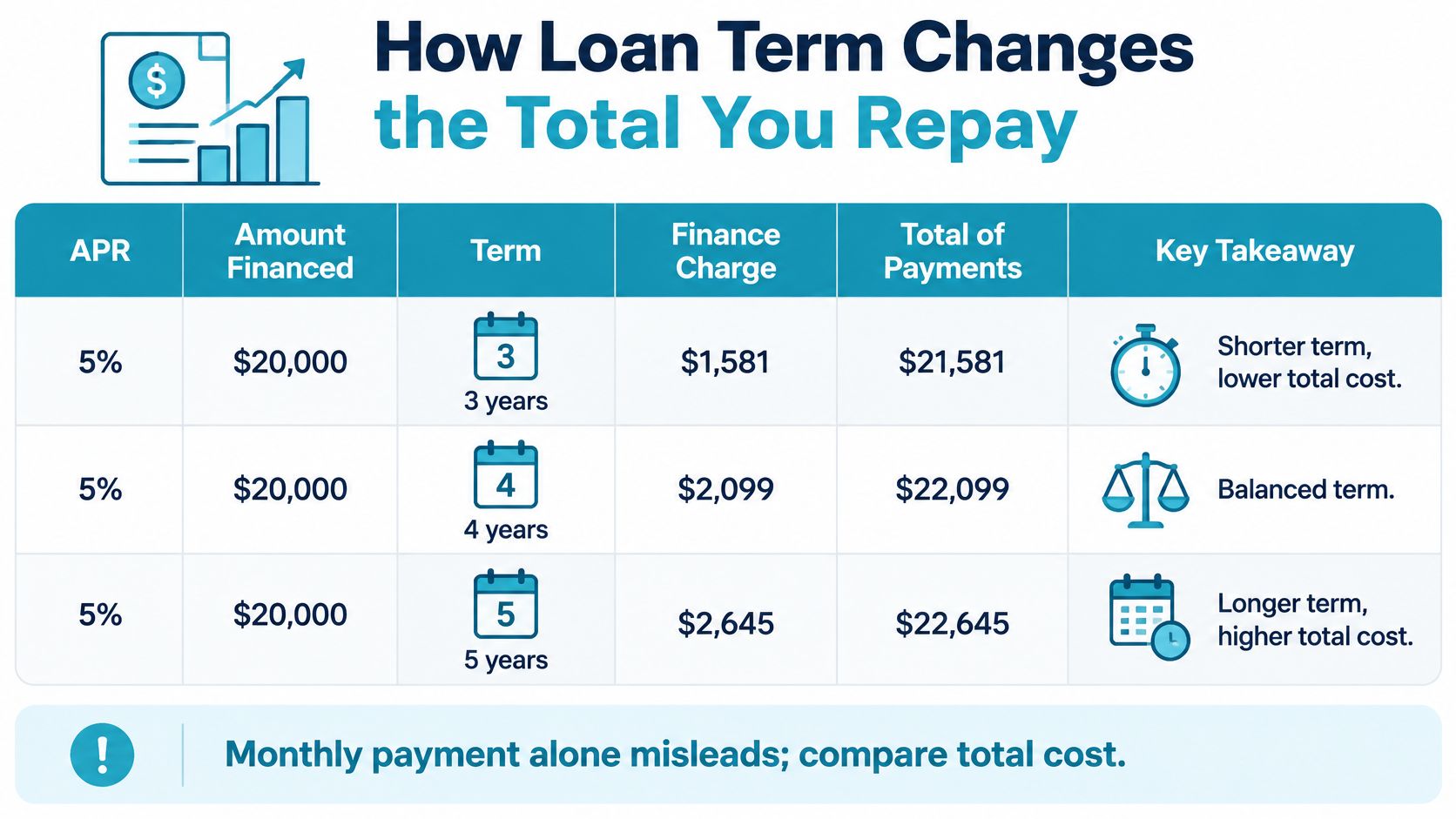
Why each extra year costs more
Amortization is the reason. Each payment splits between interest on the current balance and a bite of principal. Early payments are heavy on interest, so the balance falls slowly. A longer schedule requires a smaller principal bite each month, which leaves a larger balance earning interest for more months. You are not getting a discount. You are renting the same money for longer.
That 4.75% example is a teaching case, not a quote you should expect. Our lending partners price loans from 5.99% to 35.99%. At the high end of that range, adding years multiplies the finance charge much faster than the table above.
What gets rolled into the balance
The amount you repay is often larger than the sticker.
- Origination, documentation, and other fees may apply to an online personal loan.
- Taxes, government fees, and optional add-ons can be financed instead of paid in cash.
- Late-payment, non-payment, and other penalties may apply to both short-term and online personal loans.
APR already folds in interest and mandatory fees. Optional products and some penalties sit outside that number, so read the itemized offer. Some states cap the APR and the amounts of charges. Loans from a state with no limiting laws, or from a bank not governed by state laws, may carry an even higher APR.
Choose the shortest term whose payment still fits your budget. Run total repayment across at least three terms, including one you can live with and one that only looks cheap. A personal loan term comparison is the right place to test that trade-off before you sign.
Depreciation and Owing More Than the Car Is Worth
Say you finance $25,000. If the car's market value falls about 20% in the first year, it is worth roughly $20,000 while the loan balance is still higher, because early payments are packed with interest. You owe more than you could get by selling or trading the car. That gap is negative equity.
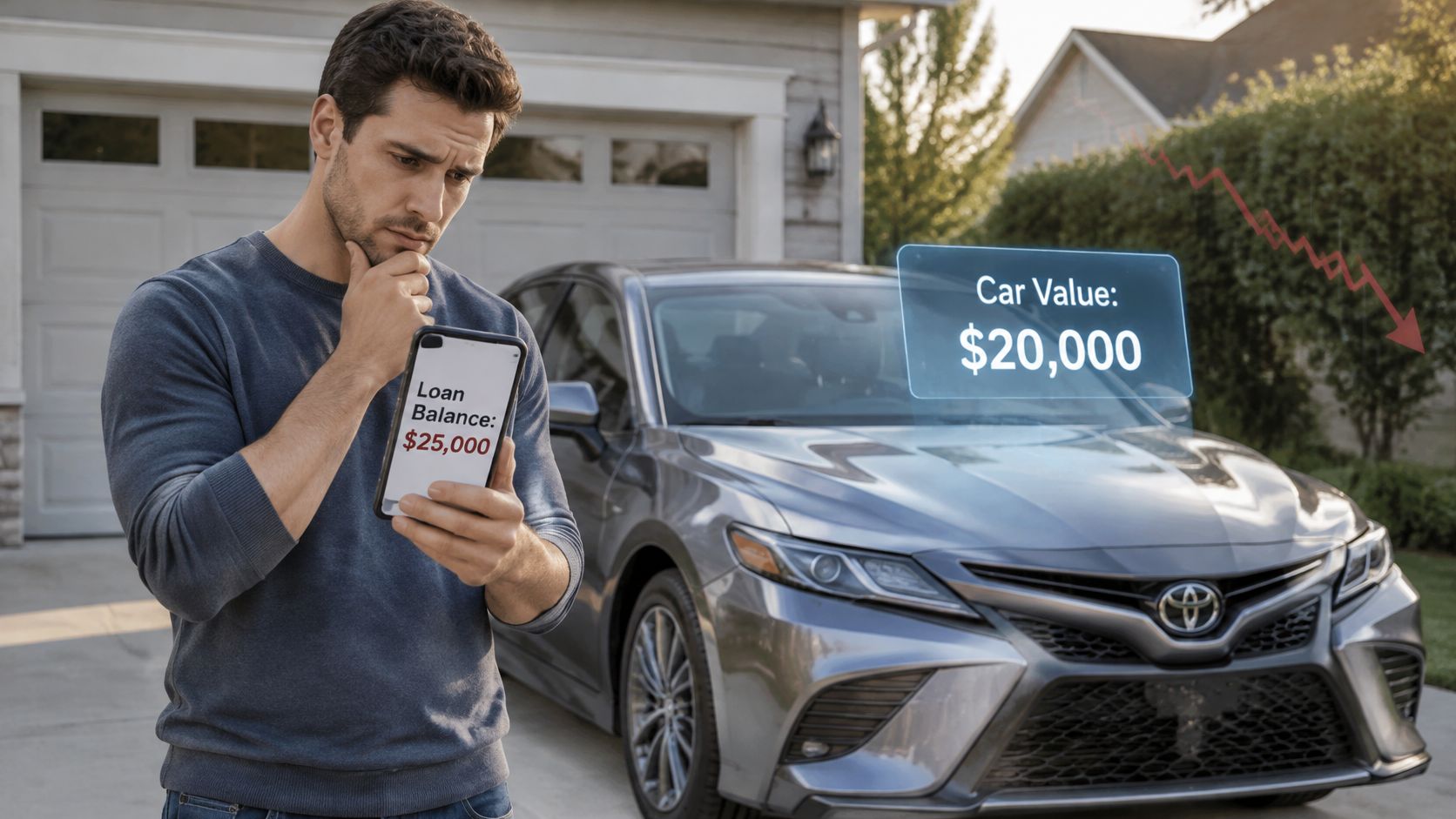
Kelley Blue Book reports that new cars depreciate about 30% over the first two years. An illustrative path leaves about 84% of value after year one and 72% after year two, and many vehicles lose about 20% or more in the first year alone. A used car can drop in lumpier steps, especially if mileage, condition, or a model-year change hits resale value.
What widens the gap
Four choices make negative equity worse.
- A small down payment leaves almost the full price on the loan while value falls from day one.
- A long term slows principal reduction, so the balance trails the car's price.
- Taxes and add-ons rolled in raise what you owe without raising what a buyer will pay.
- A high APR keeps early payments aimed at interest, so principal barely moves.
The unsecured loan does not cancel this
An unsecured personal loan creates no vehicle lien, so the car is not pledged and a missed payment does not trigger vehicle-specific repossession. The debt does not care. Default still damages your credit and can lead to collections. If you sell the car or it is totaled, the full balance remains owed. Insurance pays the car's value, not your payoff. You write a check for the difference.
Three moves shrink that exposure. Put a meaningful amount down when you can. Skip paid add-ons you would not buy with cash. Pick a term that pays principal down faster than you expect the car to lose value, and keep cash aside for insurance, maintenance, registration, fuel, and repairs.
Check the balance against a realistic trade-in value every six months. If the gap is growing, extra principal payments are the direct fix.
Worked Examples of a Car Loan Cost
Two representative examples, both for $5,000, show how APR and term move the cost of a car loan. Rates, fees, and terms on any actual offer are set by the lender in the loan agreement, so use these as practice math.
Example A. A $5,000 loan over 48 months at 19.25% APR. The monthly repayment is $134.16. Total repayment is $6,439.50, of which $1,039.50 is interest.
Example B. The same $5,000 over 3 years at 10% APR. The monthly repayment is $161.34. Total repayment is $5,808.24, of which $808.24 is interest.
What actually drives the gap
Example A looks cheaper every month, by about $27. It costs roughly $630 more over the life of the loan. Two levers do the work: the APR is nearly double, and the balance stays outstanding for an extra year. Origination, documentation, and other fees can apply on top of the interest in either offer, which would widen the gap further.
A lower monthly payment works like a thinner slice of a longer meal. Each bite is smaller, but you keep eating for twelve more months. When a low installment is paired with a high rate and a long term, it is often the most expensive option on the table.
Run your own numbers on the NextStopLoans loan calculator using the APR and any fees printed on the offer itself.
A four-step break-even check
Use this when you are choosing between an unsecured personal loan and a secured auto loan.
- Build the amount financed. Add the car price, taxes, government fees, and any add-ons you cannot pay in cash.
- Price each offer. Calculate total repayment from that offer's APR, fees, and term. Keep the monthly payment beside it, not in front of it.
- Estimate resale. Pick the year you expect to sell or trade, and use a conservative resale value for that mileage.
- Find the gap. Subtract that value from the balance you would still owe. A positive gap is cash you must bring to the sale.
The offer with the lower total repayment is not always the safer one. If it leaves a larger gap in the year you plan to exit, you have traded interest savings for a payoff problem. Price both risks, then pick the offer you can finish.
Check Affordability and Confirm the Loan Before You Apply
A lender's yes answers one question: whether you are likely to repay. It does not answer the question that matters to you: whether the payment leaves enough to run the car. Approval is a credit decision. Affordability is a household decision.
Keep the loan payment plus insurance, registration, fuel, and maintenance at a level your take-home pay covers comfortably, with room left for savings and repairs. A useful test is to subtract the new payment and a month of driving costs from your pay before you ever request a loan. If what remains is thin, a repair in month four could force a missed installment, and missed installments are where the costs start: late fees, credit damage, and a balance that keeps accruing interest.
Payment strain is already common. In a 2025 Open Lending survey of 1,001 U.S. adults, median monthly payments for new vehicles among near- and non-prime borrowers rose 56% from the 2017–2019 period to 2023–2024, while 70% of surveyed consumers planned to buy a vehicle within two years. Demand and strain are rising together.
Match the route to the situation
| Your situation | Better fit | Why |
|---|---|---|
| Strong credit and dealer financing at a low APR | Auto loan | Collateral usually supports lower pricing |
| Private seller or a dealer who needs cash at closing | Personal loan | Funds can be deposited directly to complete the sale |
| Payment only fits at 72 months or longer | Smaller loan or older car | A lower balance cuts interest and negative-equity risk |
| Limited credit and an urgent need | Personal loan from a lender open to broader underwriting | Approval may be easier, often at a higher APR |
| The car will lose value fast and you plan to sell within two years | Larger down payment and shorter term | The balance falls faster than the car's value |
Your debt-to-income ratio is the gauge lenders read, and you should read it first. It compares what you owe each month with what you earn, so stacking a car payment on card minimums, another auto note, or rent that already stretches you pushes it higher. Run a debt-to-income calculation that includes the new payment, insurance, and a repair cushion. That figure is more honest than the installment alone.
An unsecured personal loan also moves risk rather than removing it. Because no loan-to-value check limits what you borrow against the car's worth, the discipline of keeping the balance below resale value sits entirely with you. The car itself is not collateral, yet default still brings penalties and credit damage.
What to confirm before you submit
- Total repayment across at least three terms, using the full amount financed.
- The APR written in the offer. NextStopLoans cannot provide the exact APR you will be charged; lenders in the network offer APRs from 5.99% to 35.99%, and each lender sets the number when you apply.
- Fees, including origination and documentation charges on an online personal loan, plus late payment and non-payment penalties.
- Repayment options the lender offers, such as installments or paying the balance in full at a later date, and whether renewal is available.
- Dealer add-ons you would drop if you were paying cash.
- The payment after running costs, not the payment in isolation.
NextStopLoans is a marketplace, not a lender. One secure request goes to independent lenders in the network, and those providers make the approval decisions and set the loan terms when you apply with them. Submitting does not guarantee approval, and you may decline any offer without obligation.
Decision rule. If the monthly payment and total repayment both fit after insurance, fuel, and a repair reserve, submit the request. The online form takes minutes and asks for the loan amount, some personal information, and the account where funds should be deposited. Compare each offer's APR, fees, and total repayment side by side before you e-sign anything. If either number fails, reduce the amount, save longer, choose an older car, or add a co-borrower before you apply. Money that arrives as fast as the next business day does not make a high-cost loan a good purchase.
If you are ready to compare real offers for a personal loan to buy a car, we connect you with independent lenders through one secure request, and you can decline any terms that do not fit. Visit NextStopLoans to start the request, review APR, fees, and total repayment, and decide only after the numbers work.