
How to Calculate Debt to Income Ratio: Worked Examples

You know the number the lender wants before you finish filling out the form. It's not your credit score, and it's not your salary. It's the slice of your income already promised to other people, and most borrowers get it wrong in the same two ways: they count spending that isn't debt, and they plug in the money that lands in the checking account instead of what they earned before deductions.
Say you have a mortgage, a car payment, two credit cards, and a reason to want $8,000. You can work out the answer on a phone calculator in about four minutes. You can work it out a second time for the version of your budget that includes the new payment, which is the number a lender cares about.
The point of learning how to calculate debt to income ratio properly isn't to pass a test. It's to stop being surprised by an answer someone else computes about you.
Table of Contents
- Calculate Your DTI Step by Step with a Worked Example
- Which Income and Debts Lenders Count
- Worked Examples for Joint, Self-Employed and Variable Income
- What Your Ratio Means and How Lenders Read It
- Lower Your Ratio Before You Apply
Calculate Your DTI Step by Step with a Worked Example
Debt-to-income ratio (DTI) compares the payments you're required to make each month with your gross monthly income, the amount you earn before taxes and other deductions. The Consumer Financial Protection Bureau puts the formula in one line: DTI = (total monthly debt payments ÷ gross monthly income) × 100.
The CFPB's own illustration uses a borrower with a $1,500 mortgage payment, a $100 auto-loan payment, and $400 in other monthly debts, for $2,000 in total monthly debt. Against $6,000 of gross monthly income, the arithmetic is ($2,000 ÷ $6,000) × 100 = 33.3%, usually spoken as 33. That borrower has committed about 33 cents of every gross dollar to debt payments, leaving roughly 67 cents for taxes, utilities, food, insurance, and savings.
| Input | Monthly amount | Role in the formula |
|---|---|---|
| Mortgage payment | $1,500 | Debt numerator |
| Auto loan payment | $100 | Debt numerator |
| Other monthly debts | $400 | Debt numerator |
| Total monthly debt | $2,000 | Sum of debt payments |
| Gross monthly income | $6,000 | Denominator, before taxes |
| DTI | 33.3% (about 33%) | Total debt ÷ income × 100 |
Three inputs, two operations. Whether the answer is worth anything depends on which payments you put in the top line, so the steps matter more than the division.
The four steps and the slip that follows each one
- List every required monthly payment. Mortgage or rent, auto loan, student loan, personal loan, credit card minimums, court-ordered support, and the payment on any loan you're still deciding about. DTI measures obligations, not habits, which is why groceries and gas stay out. The frequent slip is entering a card balance instead of the minimum due on the statement.
- Convert income to a monthly gross figure. Divide annual salary by 12, so $72,000 becomes $6,000. Hourly workers multiply the rate by typical weekly hours, multiply by 52, then divide by 12. The frequent slip is using take-home pay, which shrinks the denominator and inflates the ratio by roughly the size of your withholding.
- Divide total monthly debt by gross monthly income. $2,000 ÷ $6,000 = 0.333. Keep the full decimal here instead of rounding early, because a file that sits near a lender's cutoff can flip on a tenth of a point.
- Multiply by 100 and round to one decimal. 0.333 × 100 = 33.3%. Say it as "about 33 percent" and move on.
Check before you trust it. Run the division twice, once with the card minimum you were actually billed and once with the balance. That single substitution creates more bad estimates than any other input.
Front-end DTI and total DTI
Two versions of the same fraction circulate. Front-end DTI counts only housing costs, so the borrower above would land at $1,500 ÷ $6,000, or 25%. Total DTI, often called back-end, counts every required payment, which is where the $2,000 and the 33.3% come from. Ask which version a lender wants before you quote a number back to them.
Uneven income needs one extra decision. Use a typical month, or the average of the last 12 months of deposits, not your best month. Variable earners who estimate from a strong quarter tend to be the ones whose files stall later.
The sanity check before you trust the number
If the percentage comes out higher than you expected, work through two checks before you change anything else.
- Confirm no debt is missing. A small payment on a card you rarely use still belongs in the numerator.
- Confirm the income is gross. If you divided take-home pay, redo it with the pre-tax figure.
Then write the finished worksheet as three lines: one total for monthly debt, one total for gross monthly income, one percentage. Everything after this is just redoing that worksheet with different inputs.
Which Income and Debts Lenders Count
Two borrowers with identical paychecks can end up several points apart because they counted different things. One divides by gross salary, the other by take-home pay. One includes the payment on the loan being applied for, the other forgets it exists. The table below is the working version of what typically lands on each side of the fraction.
| Item | Usually counted | What changes the answer |
|---|---|---|
| Rent or mortgage payment | Yes | Mortgages may add property taxes, insurance and HOA charges |
| Auto, student or personal loan | Yes | Use the required monthly payment, not the payoff balance |
| Credit card | Yes | The minimum payment due on the statement |
| Child support or alimony | Yes | Counted when court-ordered; the lender's own list decides |
| Utilities, groceries, phone | No | These are living costs, not debt obligations |
| Gross salary or hourly wages | Yes (income) | Income before taxes and deductions |
| Self-employment income | Yes (income) | Net profit after business expenses, often averaged over two years |
| Overtime and bonuses | Sometimes | Depends on a documented history |
Read down the right-hand column and a pattern appears. The numerator holds payments you're contractually required to make, and the denominator holds income you can document. Everything else, from a grocery bill to a phone plan, is a living cost. Living costs don't appear in the fraction, even though they're the reason the fraction matters to your budget.
The most common miss is the payment that doesn't exist yet. When a lender underwrites your application, the new loan's monthly payment goes into the numerator alongside your current debts. Basic calculators skip it, so the ratio you compute at home is usually lower than the one computed on the lender's desk. Add your estimated new payment to the debt total and you'll see the figure the underwriter sees.
Mortgage-style underwriting widens the debt side considerably. The CFPB's mortgage rules note that the debt side may take in the proposed loan payment, simultaneous secured loans, property taxes, required insurance, homeowners-association charges, ground rent, and special assessments. None of those sit on a credit report, which explains why a borrower can be startled by a figure a lender computes. Mortgage-style underwriting follows its own debt-to-income limits under the Qualified Mortgage rules, and those limits do not carry over to personal, payday, installment, or title loans.
On income that moves. Where earnings have declined, recent evidence may control the calculation rather than a long-run average, which is the approach the mortgage guidance applies to income trends.
Four errors account for most bad files: leaving out the new payment, using annual income without dividing by 12, substituting take-home pay, and ignoring a falling income trend. Fix those and the remaining gap between two offers usually comes down to what each lender chooses to include. Build your worksheet around that lender's list rather than a generic one.
Worked Examples for Joint, Self-Employed and Variable Income
The arithmetic stays the same in all three cases below. What changes is which income you're allowed to put in the denominator.
Two earners apply together. One brings $4,000 of gross monthly income and the other $3,000, giving $7,000 combined. Their joint debts are a $1,600 mortgage, a $350 car loan, and $150 in card minimums, or $2,100. The ratio is ($2,100 ÷ $7,000) × 100 = 30%. Add a partner's income only when that partner signs the application with you.
A worksheet gets harder to fill in once two incomes and two debt lists have to be merged onto it.

Co-borrowers also change how a lender reads the whole file. If you're weighing that route, the groundwork for joint personal loan applications is worth understanding before you combine finances on paper.
When income arrives unevenly
A freelancer's tax returns show net profit of $62,400 in the first year and $78,000 in the second. Lenders generally average the two, so $140,400 spread across 24 months gives $5,850 a month. Debts of $1,950, made up of a $1,200 mortgage, a $450 car loan, and a $300 personal loan, produce ($1,950 ÷ $5,850) × 100 = 33.3%. Using the stronger year alone would have shown a friendlier ratio, which is precisely why the averaging convention exists.
An hourly worker's last 12 months average $4,200 a month after a slow winter and a heavy summer. With $1,260 of monthly debt payments, the ratio is 30%. The adjustment here isn't a different formula, it's discipline about the period. If a lender averages 12 months, average 12 months when you run your own check.
- Joint files: document both incomes and make sure the same debts don't get counted twice.
- Self-employed files: use net profit, and use the same averaging window the lender uses.
- Variable income: pick a representative month once, and reuse it every time you rerun the math.
Each case ends the same way, with the proposed payment added to the numerator and the division run again.
What Your Ratio Means and How Lenders Read It
A percentage compresses your entire budget into a single figure, and the compression is the useful part. It tells a stranger in an underwriting department how much room is left before your next obligation.
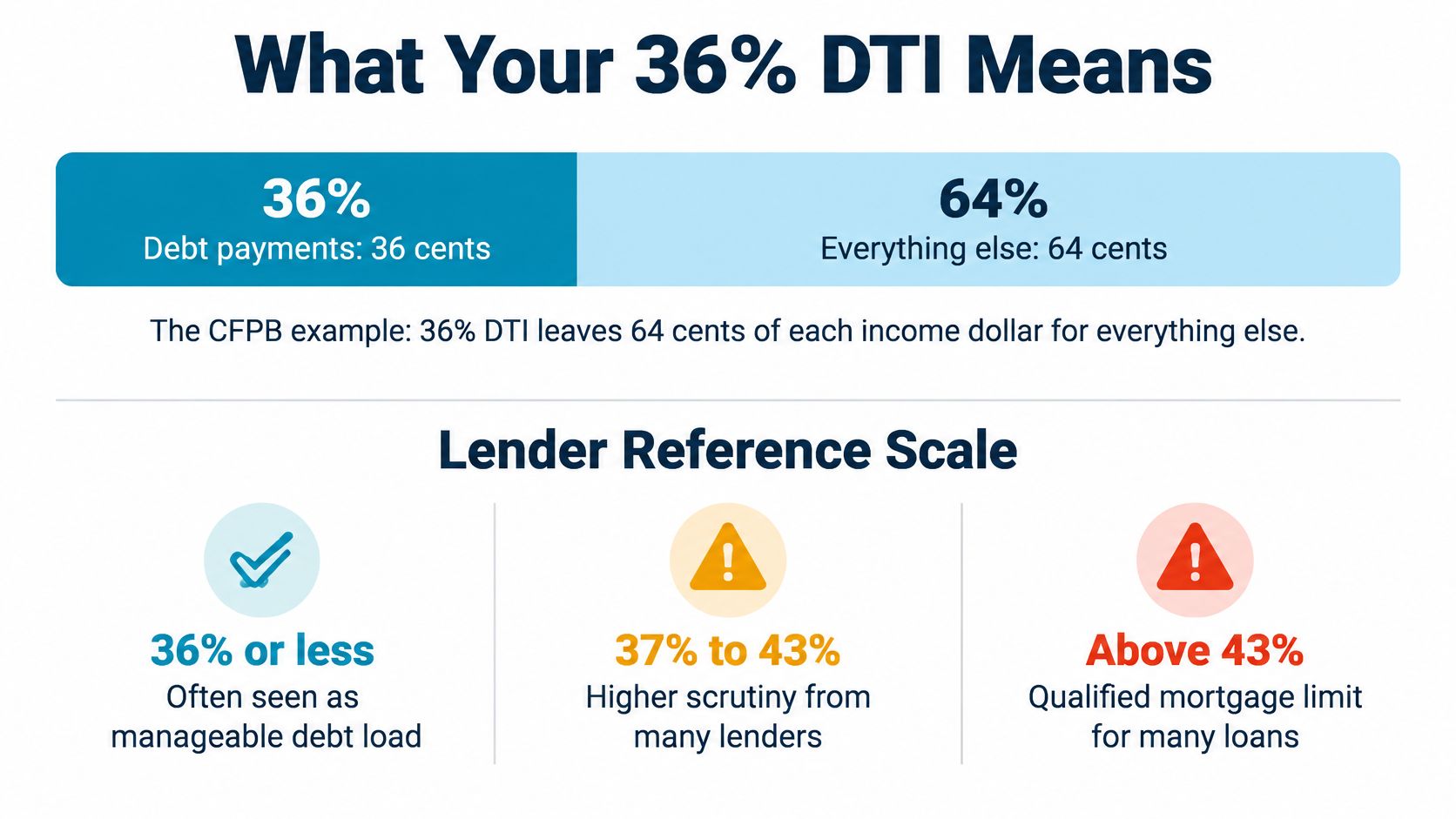
A 36% DTI means 36 cents of every dollar earned goes toward debt, leaving 64 cents for everything else, which is how the CFPB's debt-income calculation tool frames the same idea at 45 cents for a 45% ratio. The plain reading is a measure of how much of your pay is already spoken for.
The figure that usually decides an application is the post-loan version. Income of $5,000 against $1,400 of existing debt gives ($1,400 ÷ $5,000) × 100 = 28% today. Add a $300 installment payment and the ratio moves to 34%. Add $600 instead and it reaches 40%. Same income, same existing debts, two very different files, and the only difference is the payment on the loan being requested.
| DTI band | What it signals | How lenders typically read it |
|---|---|---|
| Below 36% | Room for a new payment | Usually favorable, though other factors still apply |
| 36% to 43% | Manageable but tighter | Depends on credit history, savings and loan type |
| Above 43% | Little room for error | Often exceeds mortgage-style limits; personal and payday lenders set their own cutoffs |
Treat the bands as a first filter rather than a verdict. Lenders weigh the ratio next to credit history, cash reserves, and collateral, and the CFPB describes DTI as one way to measure the ability to manage repayment, not a universal approval rule. It also doesn't prove that what's left over covers your real living costs.
Run both the current and the post-loan calculation before you compare anything, then check the result against the band for the product you want. The personal loan eligibility criteria that sit alongside the ratio are the other half of the picture.
Lower Your Ratio Before You Apply
The numerator is the side you control, and a few deliberate moves can pull it down within a couple of months.
- Retire a nearly finished installment loan. When a car or student loan has only a handful of payments left, paying it off deletes that payment from the numerator entirely, and many lenders disregard a debt that's almost done anyway.
- Target the highest minimum, not the highest balance. Two cards holding the same balance can carry different minimums, and it's the minimum that enters the formula.
- Consolidate to shrink the total minimum. A single installment payment frequently lands below the combined minimums of several cards, and the debt consolidation loan qualifications spell out what lenders review.
- Stop opening new financing for a few months. A new agreement raises the numerator and adds an inquiry at the same time.
- Raise documented income. A raise or a second job counts once a few months of history sit behind it.
Rerun the calculation after each change, one move at a time, so you can tell which one helped.
The step most borrowers skip is pricing the loan before applying for it. Our Loan Calculator estimates the monthly payment, total interest, payoff date, and how the balance could change over time, which gives you the missing numerator for the post-loan version. Checking a rate through NextStopLoans doesn't affect your credit score, and since multiple inquiries to Experian, Equifax and TransUnion may lower a score, register for one loan at a time. Compare offers only once the post-loan figure fits the band for your loan type.
NextStopLoans runs an online marketplace that sends one secure loan request to a network of independent third-party lenders, who make every credit decision and set every term themselves. You can see your estimated payment on a prospective loan, add it to the debts you already carry, and check the resulting ratio before you commit to anything. Visit NextStopLoans when you're ready to run the numbers on a real offer instead of a hypothetical one.