
Personal Loan Term Explained: Length, Payments and Cost

Which monthly payment is the one you can live with?
Two lenders offer you $10,000 at the same 12% rate. One quotes $176 a month. The other quotes $888. The terms differ. The $176 offer runs 84 months and carries about $4,828 in interest. The $888 offer runs 12 months and carries about $662 in interest. Same amount borrowed, same rate, two different personal loan terms. A personal loan term is the number of months you agree to make payments.
The lower payment belongs to the more expensive loan, by more than $4,000.
Term length works like stretching one trip across more rest stops. Each stop costs less, but you pay for every extra stop. On the 84-month loan, the small bill looks kind until an income drop or an unexpected repair lands in the same month. Then $176 is only affordable if that payment still fits after the surprise. The 12-month loan clears the debt fast and saves thousands in interest, yet $888 can crowd out rent, groceries, and any bill you did not plan.
Check the lender's disclosures before you accept a term. The agreement states the APR, the fees, and the repayment schedule, and you do not have to take the offer. Match those figures to a month when money is tight, not only to a month that goes smoothly.
Table of Contents
- Personal Loan Term Lengths at a Glance
- What a Loan Term Means for Your Repayment
- How Term Length Changes Payments and Total Interest
- Reading a Sample Amortization Schedule Line by Line
- Shorter or Longer Terms and the Real Trade-Offs
- Lender Terms to Verify Before You Accept an Offer
- Choosing a Term You Can Afford Next
Personal Loan Term Lengths at a Glance
A loan term is a cash-flow decision, not only a price tag. Stretch the same balance across more months and each payment gets smaller. That lighter draft can feel like breathing room until a thinner paycheck or an unexpected bill arrives and the schedule is still running.
Most personal loans are repaid over 36 or 60 months. Experian's personal-loan usage statistics show those two lengths as the typical repayment periods (Experian). The market stretches wider in both directions. The Wall Street Journal's guide to personal loan term length puts common terms at 12 to 84 months, with some online lenders offering terms as long as 20 years (The Wall Street Journal).
| Term band | Typical length | Typical use |
|---|---|---|
| Short | 12 to 24 months | Small emergency or consolidation balances where fast payoff matters |
| Standard | 36 months | The most common middle ground for personal loans |
| Long | 60 months | Larger balances where a smaller monthly payment is the priority |
| Extended | 72 to 84 months | Big purchases or tight budgets, with more total interest |
| Specialty | Up to 20 years | Some online lenders only, for very large or unusual loans |
The band you want and the band you get are often different numbers. A $2,000 loan rarely comes with a 10-year option. A $40,000 consolidation loan rarely fits into 18 months without a payment that swallows a paycheck.
The term is set by the lender at approval, not picked freely by the borrower. Lender type alone can shift the typical length by years. Federal Reserve research using the New York Fed Consumer Credit Panel and Equifax data found that, as of the fourth quarter of 2022, the median maturity was 4 years at depository institutions, 3 years at sales-finance and miscellaneous companies, and 2 years at personal-loan companies, with finer medians of 2.9 years at banks, 2.7 at thrifts, 2.6 at credit unions, 2.4 at sales-finance companies, 1.5 at personal-loan companies, 1.25 at miscellaneous companies, and 2.3 years for fintech-issued loans (Federal Reserve working paper). A bank and another lender can review the same applicant and return offers more than two years apart.
The monthly payment is the cash that leaves your account. Interest is the extra dollars you pay for using the money. APR is the yearly cost of borrowing as a percentage. A longer term lowers the first of those and usually raises the second, even when the APR looks similar on two offers.
The lenders and lending partners NextStopLoans works with offer terms from 61 days to 84 months, so the spread inside one network is already wide. Match your situation to a band before you compare quotes. Then test the lower payment against a month of reduced income or an extra bill, and read the lender's term, APR, and fees on the agreement before you accept the length.
What a Loan Term Means for Your Repayment
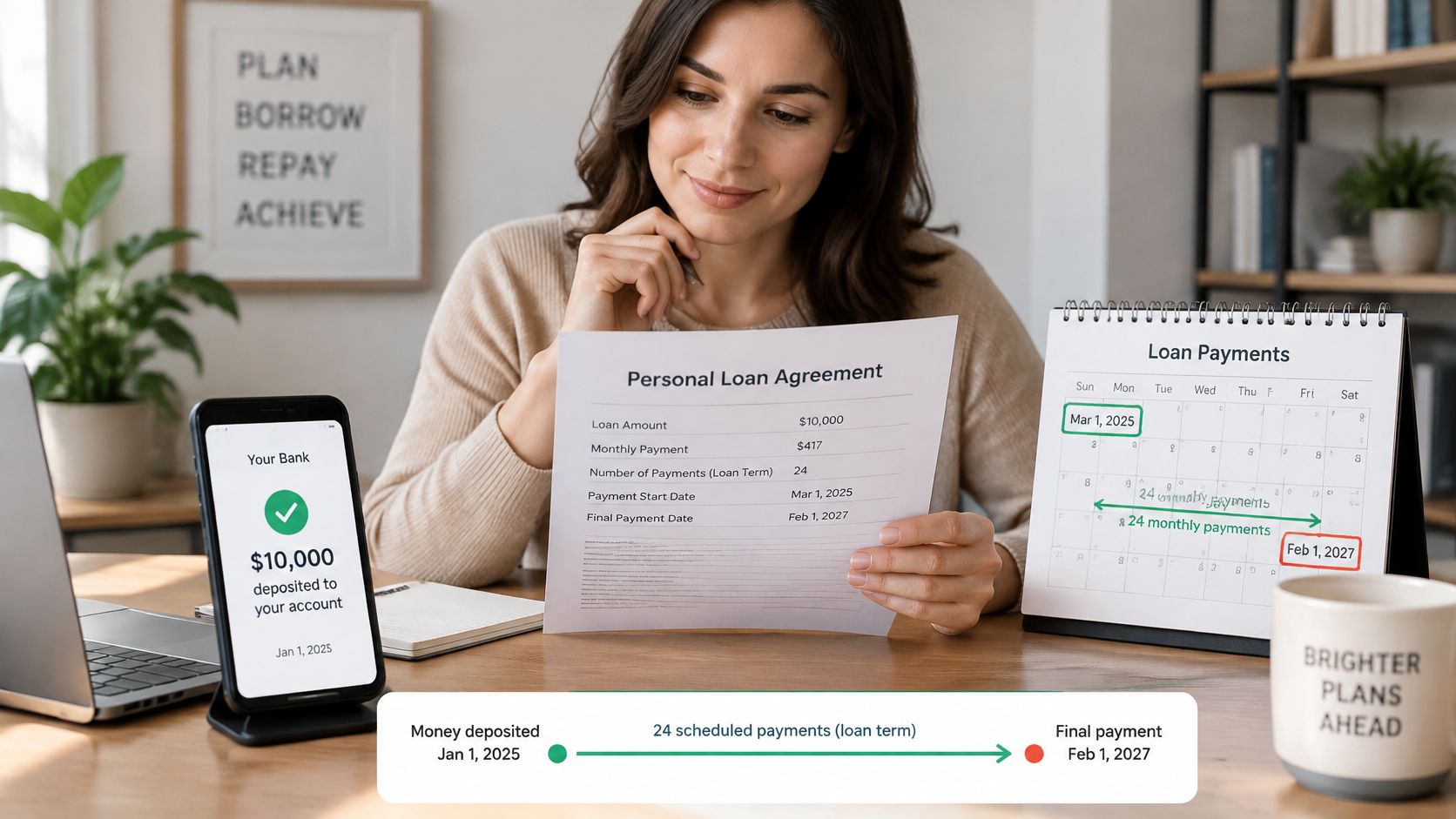
How many payments will you send back, and on which dates? That count is the loan term. It runs from the day the money lands in your account to the final payment, and it is fixed when you sign. The Consumer Financial Protection Bureau describes installment loans as closed-end credit: you receive the funds at origination and repay them in fixed amounts over the agreed period (Consumer Financial Protection Bureau).
The core idea: the term is the number of payments you agree to make, and that schedule starts on the day the money lands, not the day you applied.
A loan works like a staircase. The amount borrowed is the height. The term is how long the stairs are. Each payment is one step. A longer staircase uses smaller steps, so you take more of them to reach the same landing. Interest keeps charging on whatever balance is still left after each step.
Three Numbers People Mix Up
These three figures sit on the same page and get treated as one idea. They answer different questions.
The term is duration. It answers how many months the schedule runs. The APR is the yearly cost of borrowing, written as a percentage. It folds in the interest rate and most fees, which is why you compare offers on APR rather than on the interest rate alone. The monthly payment is the dollar amount due each period. Interest is covered first. Whatever remains reduces the principal you still owe.
A longer term can drop that monthly dollar amount while the APR stays exactly the same. Nothing got cheaper per dollar borrowed. You spread the cost across more months, so a smaller check leaves the account for a longer stretch.
Why You Keep Seeing "24-Month Personal Loan"
A 24-month term is a common comparison point in rate tables. Lenders quote it so rates sit next to each other on a shared length. Your budget is a separate question.
Treat the lower payment as a cash-flow test, not a win by itself. Ask whether that amount still fits if hours drop for a few pay periods, or if an unexpected bill lands before the next due date. A payment that looks easy in a normal month can fail that thinner month. Before you accept the term, read the lender's disclosures: APR, fees, payment frequency, and total of payments. The term is one line in that comparison. Judge the offer on all of them together.
How Term Length Changes Payments and Total Interest
Here's the whole trade-off on one page. Take $10,000 at 12% APR with no fees and repay it over four different terms.
| Term | Monthly payment | Total repaid | Total interest |
|---|---|---|---|
| 12 months | $888.49 | $10,661.88 | $661.88 |
| 36 months | $332.14 | $11,957.04 | $1,957.04 |
| 60 months | $222.44 | $13,346.40 | $3,346.40 |
| 84 months | $176.53 | $14,828.52 | $4,828.52 |
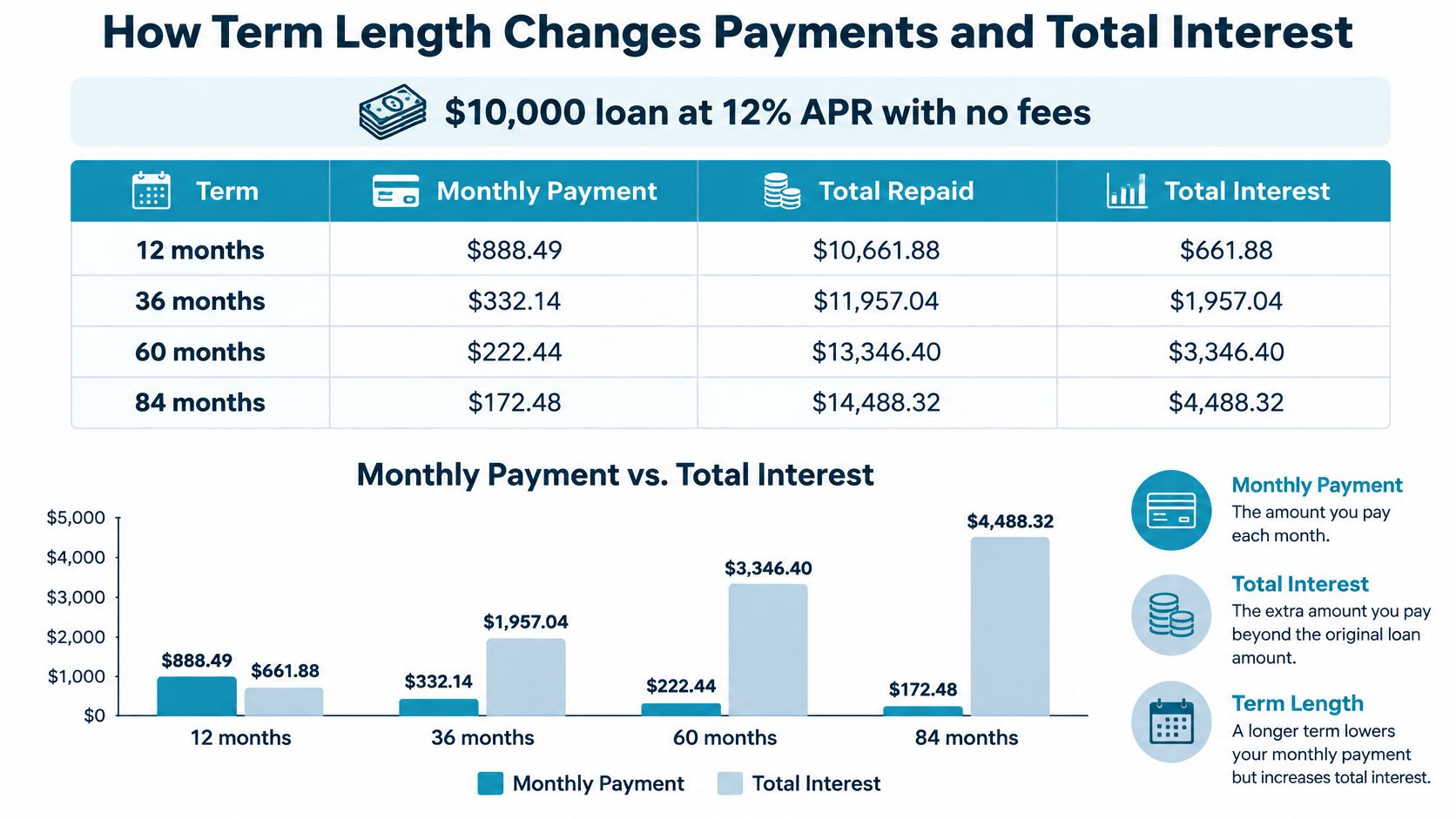
Look at the first column versus the last. Stretching from 12 months to 84 months cuts the required payment from $888.49 to $176.53, a drop of about 80%. The interest bill runs the other way, from $661.88 to $4,828.52. The difference between the cheapest and most expensive term is $4,166.64, and that difference is the price of monthly relief.
Why the Interest Grows While the Payment Shrinks
Interest accrues on the outstanding balance, month by month. At 12% APR the monthly rate is 1%, so the first month's interest on $10,000 is $100 no matter which term you pick. The term decides how long that balance stays large.
On the 12-month schedule, the balance falls by roughly $800 every month and stops generating interest quickly. On the 84-month schedule, the balance barely moves at first, so the lender keeps charging 1% on a number close to $10,000 for years. Smaller payments, longer exposure, more interest. There's no trick and no penalty clause doing the damage, just arithmetic.
The rule that follows: the cheapest total cost belongs to the shortest term you can comfortably afford, not the shortest term available.
Two Adjustments the Table Leaves Out
Fees are excluded above, and origination, documentation and other additional fees may apply to an online personal loan. Any fee added at origination raises every row, and it raises the long rows proportionally more because you carry it longer.
The APR is also held constant here for clarity. Some lenders price longer terms at a higher APR, which makes the extended option even more expensive than the table suggests. Compare offers at the same loan amount and the same term before you decide the longer option is better value, because a 60-month quote at 9% and a 60-month quote at 14% are not the same product.
When you're ready to plug in your own numbers, the NextStopLoans loan calculator runs the payment, total interest and payoff date for any amount and term.
Reading a Sample Amortization Schedule Line by Line
Numbers on a table are abstract until you watch them move. Take the same $10,000 at 12% APR over 36 months, with a fixed payment of $332.14, and follow the first three payments.
Payment one charges $100.00 in interest (1% of $10,000) and sends $232.14 to principal, leaving $9,767.86. Payment two charges $97.68 because the balance is smaller, so $234.46 goes to principal. Payment three charges $95.33. Each month the interest slice shrinks and the principal slice grows, and the payment itself never changes.
| Payment number | Payment | Interest | Principal | Remaining balance |
|---|---|---|---|---|
| 1 | $332.14 | $100.00 | $232.14 | $9,767.86 |
| 2 | $332.14 | $97.68 | $234.46 | $9,533.40 |
| 3 | $332.14 | $95.33 | $236.81 | $9,296.59 |
| 12 | $332.14 | $73.15 | $258.99 | $7,055.88 |
| 24 | $332.14 | $40.30 | $291.84 | $3,738.30 |
| 36 | $332.14 | $3.29 | $328.85 | $0.00 |
By payment 12 the balance sits near $7,056. By payment 24 it's near $3,738. The final payment carries $3.29 of interest and clears the loan.
Why the First Year Feels So Expensive
Add up the first twelve payments and you've handed over $3,985.68, of which roughly $1,042 went to interest. Over the last twelve months, with the same payment and the same number of payments, only about $247 goes to interest. Same loan, same monthly amount, more than four times the interest cost in year one.
That's not a lender tactic. It's the natural result of charging a percentage against a large balance. It does explain why a borrower who pays for a year and then checks the balance feels like nothing happened.
Build Your Own Schedule in Three Steps
- Convert the APR to a monthly rate. Divide by 12. A 12% APR becomes 1% per month, or 0.01.
- Charge interest on what's left. Multiply the current balance by 0.01 to get this month's interest.
- Split the payment. Subtract interest from the payment to get principal, then subtract principal from the balance. Repeat for the next row.
Do that for a few months on paper and the schedule stops being mysterious. It also shows you where extra money does the most work: because the balance falls slowly at first, an extra $100 in month 3 saves far more interest than $100 in month 30, provided the lender doesn't charge a prepayment penalty.
Before you send anything extra, ask the lender one question: does an overpayment reduce the principal balance, or does it just move the next due date forward? If it only advances the due date, you've prepaid a bill without reducing your interest. Our guide on how installment loans work walks through the mechanics of fixed schedules.
Shorter or Longer Terms and the Real Trade-Offs
Choosing the shortest affordable term assumes your income behaves. Most incomes don't. A lower payment is not only a cost decision. It's an insurance policy against the month when hours get cut, the car needs a repair, or a medical bill arrives.
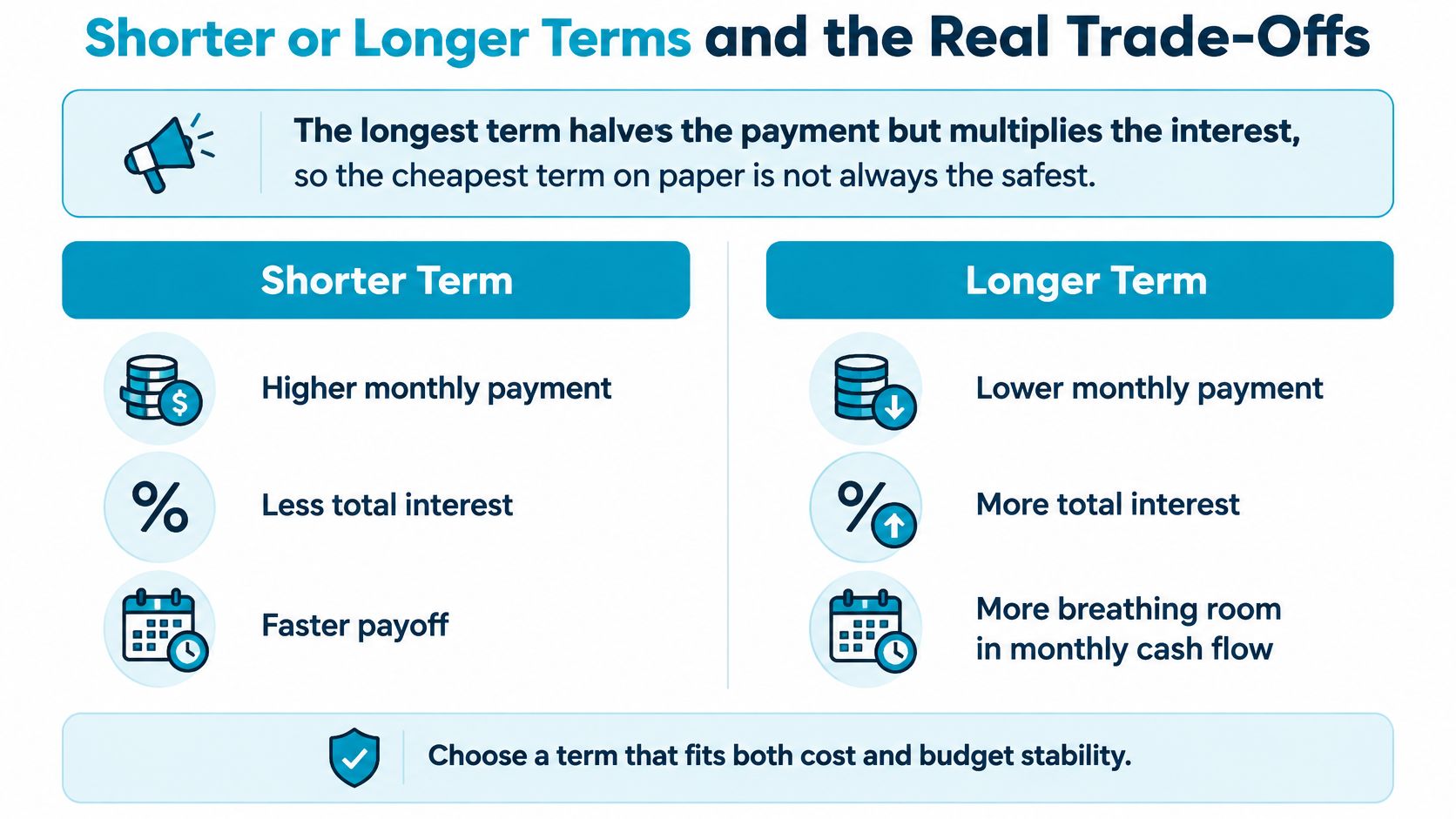
The standard advice covers half of this. Shorter terms raise payments and cut interest. Longer terms do the reverse. What that framing misses is what a missed payment costs: a late fee, an overdraft, a ding on your credit file, or a scramble to refinance at a worse rate. Research in the Journal of Consumer Research on how borrowers frame loan decisions found that consumers often focus on monthly-payment affordability, and for higher-cost borrowing, perceived budget capacity can cap monthly payments at roughly $500. That's a payment ceiling, not a cost calculation.
| Measure | Shorter term | Longer term |
|---|---|---|
| Monthly payment | Higher | Lower |
| Total interest | Lower | Higher |
| Cash cushion after payment | Smaller margin, harder to pass the stress test | Larger margin, easier to pass the stress test |
| Risk of missed payment or refinancing | Higher if income is unstable | Lower, but total cost is higher |
Same principal, more months: a lower payment is cheaper per month and usually more expensive overall. Both statements are true at the same time, and you have to decide which one your life needs.
The Stress Test That Settles It
Take your monthly take-home pay, subtract rent, utilities, food, transport, insurance and the minimums on any other debt. That's your leftover. Now run the payment against it three times.
First, the normal month. Second, the bad month, where take-home drops 15% to 20% because of lost hours or a slow contract. Third, the month a $300 repair lands on top of the income drop. If the payment still clears in all three, the term is safe. If it only clears in the first, you're one event away from a late fee.
Say a warehouse worker takes home $2,900 and has $1,050 left after essentials. A $332 payment clears easily. A $888 payment leaves $162, which fails the moment a shift gets cut. The same person might handle a $222 payment through a slow quarter without borrowing again. For irregular income, such as freelance or seasonal work, the longer term can be the rational choice even at a higher total cost, because the alternative is a missed payment and a worse rate later.
What doesn't hold up is the belief that the lowest payment is the cheapest loan. It's the cheapest month, and sometimes that's what you need. Just name which one you're buying.
Lender Terms to Verify Before You Accept an Offer
Most borrowers assume the risk is picking the wrong length. The complaints suggest otherwise. The Consumer Financial Protection Bureau logged roughly 9,500 personal-loan complaints in 2024, and its 2025 annual report puts personal-loan complaints at approximately 13,500 in 2025, with installment-loan complaints up 70% from the prior two years' monthly average and consumers reporting high rates or fees and difficulty understanding loan terms (CFPB Consumer Response Annual Report).
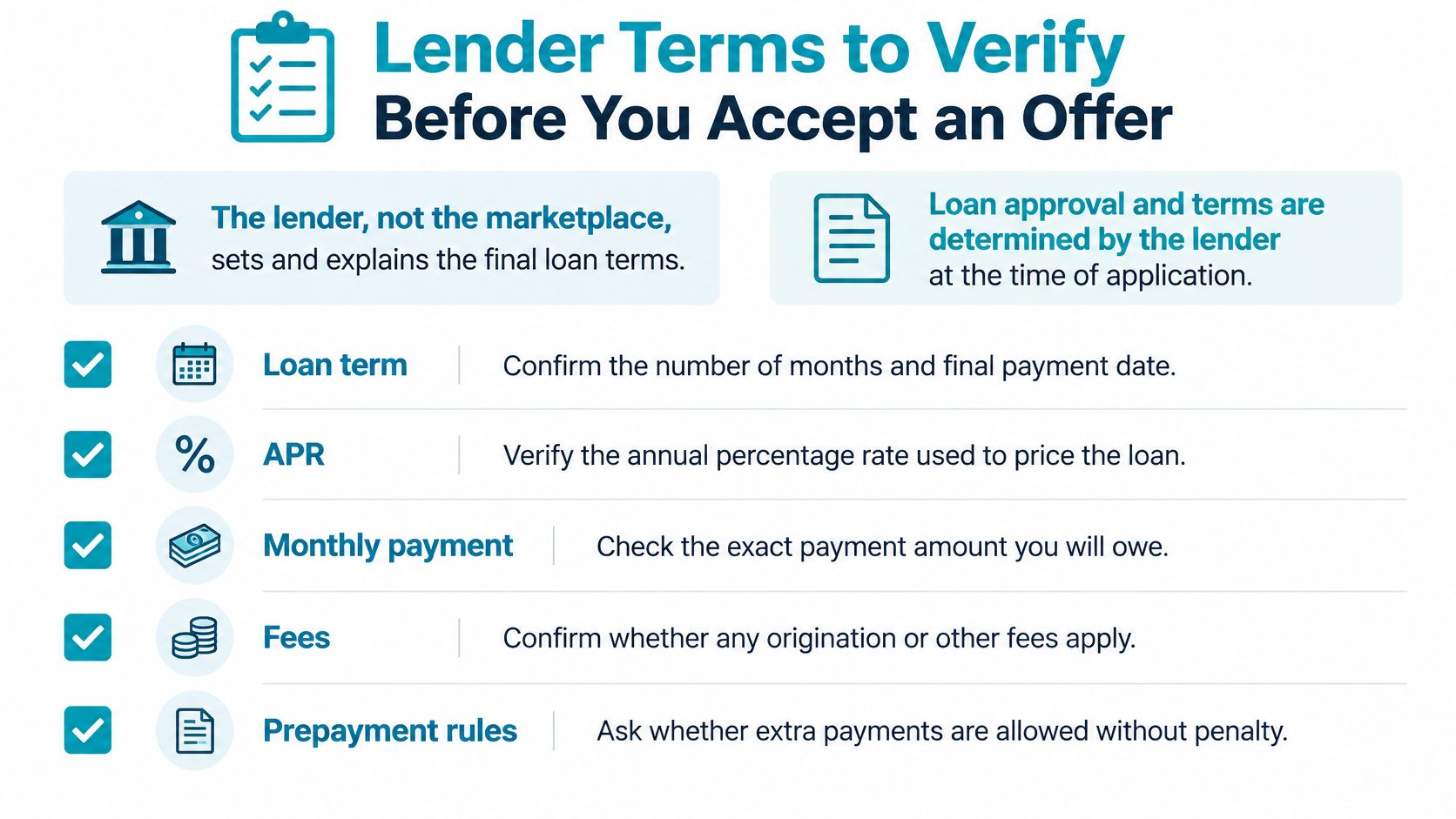
That points to a bigger hazard than choosing 36 months instead of 60. It's accepting a term whose payment schedule, origination fee, prepayment treatment or total cost you never understood. A marketplace matches you with a lender. It doesn't set your terms, and it can't explain a contract it didn't write. All loan approval decisions and terms are determined by the lender at the time of your application with that lender.
The Term Verification Checklist
Work through each line before you sign. One sentence per item is enough.
- Amount deposited: confirm the figure that lands in your account, not the gross amount before fees come out.
- Scheduled payment and number of payments: multiply one by the other and see whether the result matches the total of payments on the disclosure.
- APR: check the rate used to price your specific offer, and confirm whether it's fixed for the life of the loan.
- Fees: origination, documentation and other additional fees may apply, so ask which ones apply to you and whether they're deducted from the proceeds.
- Due date and grace period: repayment dates, terms and conditions are set by each independent lender, so confirm the exact date and time with that lender rather than assuming a standard.
- Late and early repayment consequences: late payment, non-payment fees and other penalties may apply to both short-term and online personal loans, and different lenders set their own policies in the agreement.
The test before you sign: if any line on the agreement can't be explained in one sentence, ask the lender to explain it. Then ask again until it can.
Our rates and fees page shows how fees and APRs are disclosed before an offer becomes binding, and the offer itself always states the APR, fees and term you're agreeing to.
Choosing a Term You Can Afford Next
A smaller monthly bill can look like relief and still leave you short when a paycheck dips. Term length works like a faucet on your cash. Stretch the term and the payment shrinks, but the tap stays on longer, and more of what you send back is interest. Ask which term still clears your leanest month, and what you pay in total for that breathing room.
Choose the shortest term whose payment still clears your lowest realistic income month, then compare offers on total repayment rather than on the payment alone.
Start from last month's actual leftover after rent, food, and other bills you cannot skip. If that leftover is thin, a payment sized for a good month fails the first time hours get cut or a repair bill lands. Treat the new payment as a standing bill that has to survive that lean month. A small emergency should not push you into a second loan just to cover the first.
Two quotes can show almost the same monthly figure and still differ by hundreds of dollars once the terms diverge. Monthly payment is the cash leaving your account. Interest is the extra you pay for borrowing. APR rolls the interest rate and certain finance charges into one yearly price, so offers built differently can be compared on the same scale. A longer term can cut the payment and raise total interest. A shorter term does the opposite.
The loan calculator estimates monthly payment, total interest, payoff date, and how the balance changes over time, with a rate and term preset for each loan type. Run a 36-month term and a 60-month term with your own amount. Keep the shorter one only if it still fits your worst realistic month.
NextStopLoans gives you one place to see what independent lenders are willing to offer for your loan amount, including terms from 61 days to 84 months, so you can set payments beside total repayment instead of guessing. The request process is three steps: request a loan, agree to terms, and get your money. Lender fees, APR, and terms are provided at the time of a loan offer, and you are under no obligation to accept them. If the shorter term fails the lean-month test, or a line on the offer is unclear, decline it. Visit NextStopLoans and start with your amount and the term you think you want.