
Personal Loan Joint Application: Risks and Credit Impact

If adding another person helps you get approved, does that automatically make the loan a better deal? Not necessarily. A personal loan joint application can add qualifying income, but it can also bring a weaker credit profile into the lender's decision and make both applicants responsible for a debt either person might eventually have to repay alone.
The useful comparison isn't approved versus declined. It's applying alone versus applying together, with attention to borrowing cost, usable income, and the repayment arrangement you can realistically maintain.
Table of Contents
- Joint Borrower, Cosigner and Guarantor Roles Compared
- How Lenders Combine Two Credit Profiles
- Benefits, Drawbacks and a Go or No-Go Test
- Documents and Eligibility Each Applicant Needs
- How Joint Payments Affect Both Credit Files
- Confirm Each Applicant's Liability Before Signing
Joint Borrower, Cosigner and Guarantor Roles Compared
Who is borrowing, and who is backing someone else's borrowing? That distinction matters more than whether you call the other applicant your partner, spouse, relative, or friend.
With a joint loan, both people apply for the same credit and accept responsibility for repayment. A cosigner backs the primary borrower and can owe the full unpaid balance without receiving the proceeds. A guarantor generally becomes liable after the borrower defaults, although the contract determines the trigger and scope of that obligation.
Responsibilities by role in a personal loan
| Role | Owes full repayment | On both credit files | Receives funds | Exit from the loan |
|---|---|---|---|---|
| Joint borrower | Yes | Yes | Both, or as the agreement states | Usually needs lender approval or payoff |
| Cosigner | Yes | Yes | Usually the primary borrower only | Usually needs lender approval or payoff |
| Guarantor | Often only after default | Reporting follows the lender's policy and guarantee agreement | Usually no | Release under the guarantee's terms or lender-approved discharge |
Lenders don't always use these labels consistently. Read the actual repayment and guarantee provisions rather than assuming a reassuring label limits your responsibility.
What makes an application genuinely joint
Under U.S. Regulation B, intent to apply jointly must exist at the time of application; signing a promissory note alone doesn't establish that intent. Someone added only because the lender requires another liable party isn't automatically a voluntary joint applicant.
The rule also protects an individually creditworthy applicant from being required to obtain a spouse's or another person's signature. When additional personal liability is necessary under the lender's credit standards, the lender can require an additional party, but can't insist that the person be the applicant's spouse. Married and unmarried applicants must be evaluated under the same standards.
Before you sign: Helping someone qualify doesn't mean you're responsible only for the portion you agreed to pay between yourselves.
If you're considering backing someone rather than borrowing together, our guide to bad-credit personal loans with a cosigner explains that alternative.
Close the role discussion with these questions:
- Applicant status: Is my partner a joint applicant or a cosigner?
- Access to proceeds: Who receives the money?
- Release conditions: What is needed to release either person?
How Lenders Combine Two Credit Profiles
Adding income doesn't erase the credit history attached to it. A lender may examine both applicants' payment histories, existing obligations, earnings, and capacity to manage the proposed installment.
Don't assume the lender averages your scores or automatically chooses the stronger applicant's score. Different underwriting approaches can produce different results from the same pair of applications. The methods below are useful questions to raise, not a promise that every lender offers each approach.
How lenders treat two credit profiles
| Method | How the weaker profile is treated | What it means for applicants |
|---|---|---|
| Minimum-score rule | Lower score can set eligibility and rate | A weak co-applicant can raise the price or block approval |
| Higher-score only | Weaker score isn't used as the deciding score | Adding a weaker partner may add nothing to the score assessment |
| Blended model | Both scores contribute to a combined result | The lender's formula determines each profile's influence |
| Income-weighted assessment | Combined income receives substantial weight | Added income may help, but won't necessarily overcome credit requirements |
Even when a lender uses the higher score for a particular decision, it may still review the other applicant's debts and credit history. Score selection and overall underwriting aren't the same thing.
Compare the income benefit with the credit effect
A Federal Reserve analysis of joint mortgage applications found that approximately 18% of 603,989 applications examined in 2016 needed both applicants' combined income to satisfy the lender's front-end debt-to-income ratio. These are mortgage findings, not personal-loan approval statistics. Their relevance is the mechanism: extra income helps when the lender needs and accepts it.
Consider a hypothetical primary applicant with a credit score of 712 and a co-applicant with 648. Under a minimum-score approach, the lender could assess eligibility or pricing using 648, potentially making the joint offer less attractive than a solo offer.
Under a higher-score-only approach, 712 would remain the deciding score. The second applicant wouldn't improve that score assessment, although accepted income could still help elsewhere in underwriting.
For your own comparison, review personal-loan eligibility factors and ask the prospective lender which score-selection method applies. Also ask whether it counts the co-applicant's income and what obligations it includes. Without those answers, a combined-income calculation can look encouraging while telling you little about the likely offer.
Benefits, Drawbacks and a Go or No-Go Test
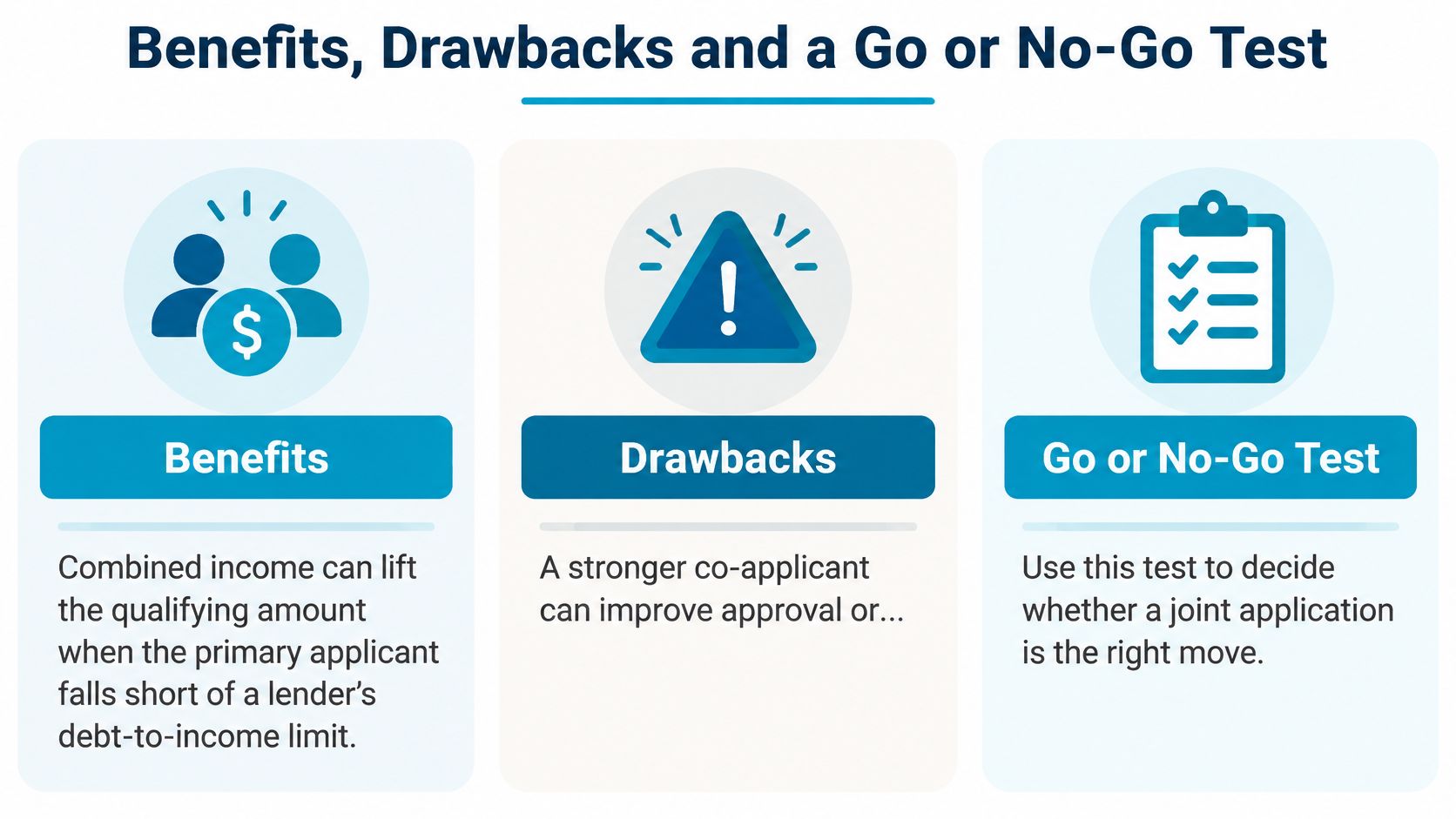
A useful co-applicant contributes something the lender can use: qualifying income, stronger credit, or a more convincing repayment picture. As Experian's joint personal-loan guide explains, lenders may consider both borrowers' income, credit, and debt levels, which can help applicants qualify for better terms or a larger amount.
That benefit has to justify the additional commitment. A lower proposed payment isn't enough if the loan costs more overall or leaves either borrower unable to cover essentials.
Weigh what changes for each person
Combined income can improve repayment capacity, particularly when the primary applicant's income alone doesn't support the requested payment. A stronger credit profile may also improve the offer when the lender's rules recognize it.
The drawbacks aren't limited to the application. The new obligation may affect each borrower's ability to qualify for future credit, and a private agreement about splitting payments doesn't restrict the lender's contractual rights. Credit building can be a secondary benefit, but it isn't a sound reason to accept an otherwise unsuitable debt.
Use this test before sending a joint request.
Calculate income the lender can verify. Add each applicant's gross monthly income, meaning income before taxes and other deductions. Keep uncertain or undocumented earnings separate until the lender confirms it can count them.
Calculate the solo and joint debt-to-income ratios. Add recurring monthly debt payments and the proposed loan installment, then divide by gross monthly income. Use the same debt categories for each comparison so you aren't creating an artificial improvement.
For a hypothetical example, the primary applicant earns $5,000 monthly, has $1,200 in recurring debt payments, and is considering a $350 installment. The solo calculation is ($1,200 + $350) ÷ $5,000 = 31%.
Suppose the co-applicant earns $3,000 monthly and brings $400 in recurring debt payments. Combined existing debts are $1,600, so the joint calculation is ($1,600 + $350) ÷ $8,000 = approximately 24.4%. That improves the calculated ratio, but it doesn't establish approval or a better rate.
Compare credit treatment and actual costs. Determine whether the weaker profile changes eligibility or pricing. Compare annual percentage rate, fees, repayment term, total repayment, and the amount you'll actually receive, not just the monthly installment.
Keep the request separate from approval. Submitting information online doesn't guarantee approval. Loan providers determine approval decisions and terms at the time of your application with them.
Require a meaningful net benefit. Add the co-borrower only when the expected income or credit benefit outweighs the pricing effect and the shared repayment risk.
Same-day decision rule: If the joint calculation doesn't meaningfully improve affordability, or the weaker score makes the offer more expensive without a compensating benefit, don't proceed jointly.
A “go” means the comparison supports continuing to review offers. It doesn't mean you should accept whatever arrives.
Documents and Eligibility Each Applicant Needs
Our basic personal-loan qualification requirements include being at least 18 years old, having a checking account, and being employed with regular income and pay frequency. Those are starting requirements, not a guarantee that a lender will approve either applicant or accept a joint request.
When you submit information through our process, you authorize network lenders to verify your Social Security number and driver's license and review credit history through major and alternative credit bureaus. Each applicant should be ready to document their own information rather than assuming the primary applicant's records cover both people.
Documents each applicant usually provides
| Document | Primary applicant | Co-applicant | Why the lender asks |
|---|---|---|---|
| Government photo ID | Yes | Yes | Confirms identity |
| Social Security number | Yes | Yes | Supports identity and credit verification |
| Recent pay stubs | Yes, when used to verify earnings | Yes, if income is counted | Confirms income and pay frequency |
| Recent bank statements | Be prepared to provide them | Be prepared to provide them | Shows cash flow and account activity |
| List of recurring debts | Yes | Yes | Supports debt-to-income calculations |
| Proof of address | Be prepared to provide it | Be prepared to provide it | Matches application records |
Build a consistent application file
Treat this as a preparation checklist, not a universal document requirement. The lender determines what records it needs and how much account history to provide. Gather consecutive recent pay statements and bank statements, then supply the period requested rather than selecting only the strongest-looking statement.
For debts, use current statements to record the creditor, required monthly payment, and account holder. Include obligations belonging to the co-applicant even when you expect the added income to improve the calculation. Leaving those debts out makes your comparison unreliable.
- Match identifying details: Use names and addresses that agree with your identification and supporting records. Explain a recent move or name change rather than leaving unexplained differences.
- Separate income types: Keep employment earnings, variable pay, and other income clearly labeled so the lender can evaluate each category.
- Protect document contents: Submit complete, readable files through the lender's designated process. Don't alter figures or omit pages that contain relevant information.
A co-applicant whose income isn't counted may still need to provide identity and credit information. Excluding earnings from a calculation doesn't automatically exclude the person from verification.
Use our personal-loan application process guide to prepare for the request workflow. Collect both applicants' records together so inconsistent names, addresses, or income entries can be resolved before submission.
How Joint Payments Affect Both Credit Files
A joint or cosigned account generally appears on both borrowers' credit files. The Consumer Financial Protection Bureau's cosigning guide explains the shared credit exposure: a 30-day-or-more delinquency can damage both profiles, while on-time payments can help establish a record for someone who previously lacked one.
Don't confuse consent to obtain credit information with reporting the resulting account. Submitting our request gives written consent under the FCRA for NextStopLoans and its partners to obtain consumer credit report information. Whether and where the lender reports an opened loan is a separate question.
Set payment controls before accepting
Name a payment owner. Choose who initiates each installment and who checks that it cleared. If you're splitting the cost, arrange transfers early enough that the person paying the lender isn't waiting on the due date.
Maintain a shared reserve. Aim to keep enough for a scheduled installment available as a practical buffer. Agree on when you can use it and how you'll replenish it after an income interruption.
Give both borrowers visibility. Enable statement and due-date alerts for each person where the lender supports them. If account access is limited, arrange a secure way to share payment confirmations without sharing passwords.
Verify credit reporting. Ask whether the account will be reported under both borrowers' names and which credit bureaus receive it. This is especially important if establishing credit is part of your reason for borrowing.
A payment arrangement should let either borrower spot a problem before it becomes a missed installment.
Plan for disruption, not just normal months. Decide how you'll communicate about a lost job, a failed automatic payment, or a bank-account change, and contact the lender promptly if payment becomes difficult.
Separation, marriage, or an agreement between borrowers doesn't itself remove either person from the contract. Leaving the obligation generally requires lender approval, refinancing, or payoff under the applicable terms. Until that happens, continue monitoring the account even if you no longer share a household.
Confirm Each Applicant's Liability Before Signing
A joint application makes both people responsible for repayment, so choose it only when the combined financial picture justifies the commitment. Approval alone isn't evidence that borrowing together is the better choice.
Before continuing, put each person's intended role in writing and compare it with the lender's offer. Gather both applicants' documents, agree on who will receive the proceeds, and confirm the payment arrangement.
Move from preparation to a request
Our online loan request form takes minutes to complete and asks for the loan amount, personal information, and where funds should be deposited. The process has these stages:
- Request a loan: Provide accurate information and confirm whether the prospective lender accepts a second applicant before submitting a joint application.
- Agree to terms: If approved, review the lender's offer together, including liability, costs, and release provisions.
- Get your money: Funding is handled by the lender under its processes and the accepted agreement.
We operate a marketplace that routes requests to independent lenders, rather than lending directly. Those lenders make approval decisions and set loan terms; a marketplace request shouldn't be treated as confirmation that joint borrowing is available.
Don't sign until both applicants' names and roles are correct on the applicable documents. If the offer describes a cosigner when you intended a co-borrower, resolve that difference before accepting it.
NextStopLoans offers an online request process that connects consumers with independent lenders. Visit NextStopLoans to review the process, and confirm whether a prospective lender accepts joint applications before committing either person to repayment.