
How to Get Bad Credit Personal Loans with Cosigner

The most popular advice about bad credit personal loans with a cosigner is incomplete: find someone with better credit and improve your chances of approval. That answers the lender's question, not yours. The better test is whether either person could carry the full payment without borrowing again or falling behind elsewhere.
A cosigner isn't a character reference or a temporary boost to your application. Before you ask someone to sign, compare the cost of borrowing alone, borrowing together, and borrowing less. If the payment only works when everything goes right, the loan is too large.
Table of Contents
- What a Cosigner Changes on a Bad Credit Loan
- Screen the Cosigner as a Full-Liability Co-Obligor
- Alternatives When a Cosigner Is Not the Answer
- Documents and Underwriting Both People Should Expect
- Submit a Request Only After the Payment Fits
What a Cosigner Changes on a Bad Credit Loan
Apply alone if your documented cash flow supports the offer. Add a cosigner only if that person can independently carry the debt. Request less when a smaller payment is the only sustainable option. An approval isn't worth exposing another household to a payment neither household can comfortably afford.
Three ways to approach a bad-credit personal loan
| Path | What the lender weighs | Likely effect | Who owes the debt | Choose it when |
|---|---|---|---|---|
| Apply alone | Applicant credit, income, and existing debt | Higher chance of a decline or a higher APR | Applicant only | Verified income already covers the full payment |
| Add a cosigner | Cosigner credit and income added to the file | May qualify or price better; approval is not guaranteed | Both parties for the full balance, fees, and costs | Cosigner can repay the entire loan independently |
| Request a smaller amount | Same credit profile with a lower payment | May fit a tighter underwriting limit | Applicant, or both if a cosigner is still used | The weaker cash flow covers the reduced payment |
| Delay or skip the loan | No new obligation | No approval and no new inquiry from this request | Nobody | The expense can wait or be paid without new debt |
A stronger cosigner gives the lender another repayment source to evaluate. That can strengthen an application, but it doesn't remove the applicant's late payments, collections, high credit-card balances, or limited borrowing history. The lender still decides whether the combined application meets its requirements.
Don't assume every personal-loan product accepts cosigners, either. Confirm that before supplying another person's information. Ask specifically about a cosigner, because a lender's joint-applicant process may involve a different agreement.
Compare the complete offer, not the advertised payment
For context, the Federal Reserve's Consumer Credit release reported an average interest rate of 12.27% on a 24-month personal loan in 2024. That's a market benchmark, not a promised rate for someone with damaged credit. Budget for the possibility of a more expensive offer rather than assuming a cosigner will secure average pricing.
Compare each offer using the same checklist:
- APR: Use the annual percentage rate to compare the borrowing cost, rather than looking only at the stated interest rate.
- Origination fee: Find out whether the lender deducts it from the proceeds, leaving less cash available for your expense.
- Repayment term: A longer schedule can lower the payment while increasing the total interest paid.
- Total repayment: Record the total scheduled payments and any separately paid charges without counting the same fee twice.
- Net proceeds: Confirm that the amount deposited will cover the necessary expense.
Suppose you need a vehicle repaired to keep working. Separate the essential repair from maintenance that can wait, then request quotes for the necessary work. Reducing the amount at the source is better than stretching an oversized loan across a longer term.
Decision rule: Choose the least expensive workable offer that the weaker household can carry, not the largest loan the stronger credit profile can unlock.
Before choosing, replace normal income with a reduced-hours budget and add an unexpected medical expense. If either person would need a credit card to make the installment, reduce the principal or skip the loan.
Screen the Cosigner as a Full-Liability Co-Obligor
A cosigner can owe the entire debt, including late fees and collection costs, and the lender may be able to pursue that person without first pursuing the primary borrower, according to the Federal Trade Commission's cosigning guidance. Treat the proposed signer as a co-obligor, someone accepting a real repayment obligation, not someone doing an administrative favor.
The account can also affect the cosigner's credit and future borrowing room. The Consumer Financial Protection Bureau's guidance on cosigner obligations and release explains that cosigned debt appears on the cosigner's credit record and warns against assuming release will be available. A missed payment can therefore create trouble for both people, even when they privately agreed that only the borrower would pay.
The liability sequence is straightforward, and it deserves attention before anyone starts an application.
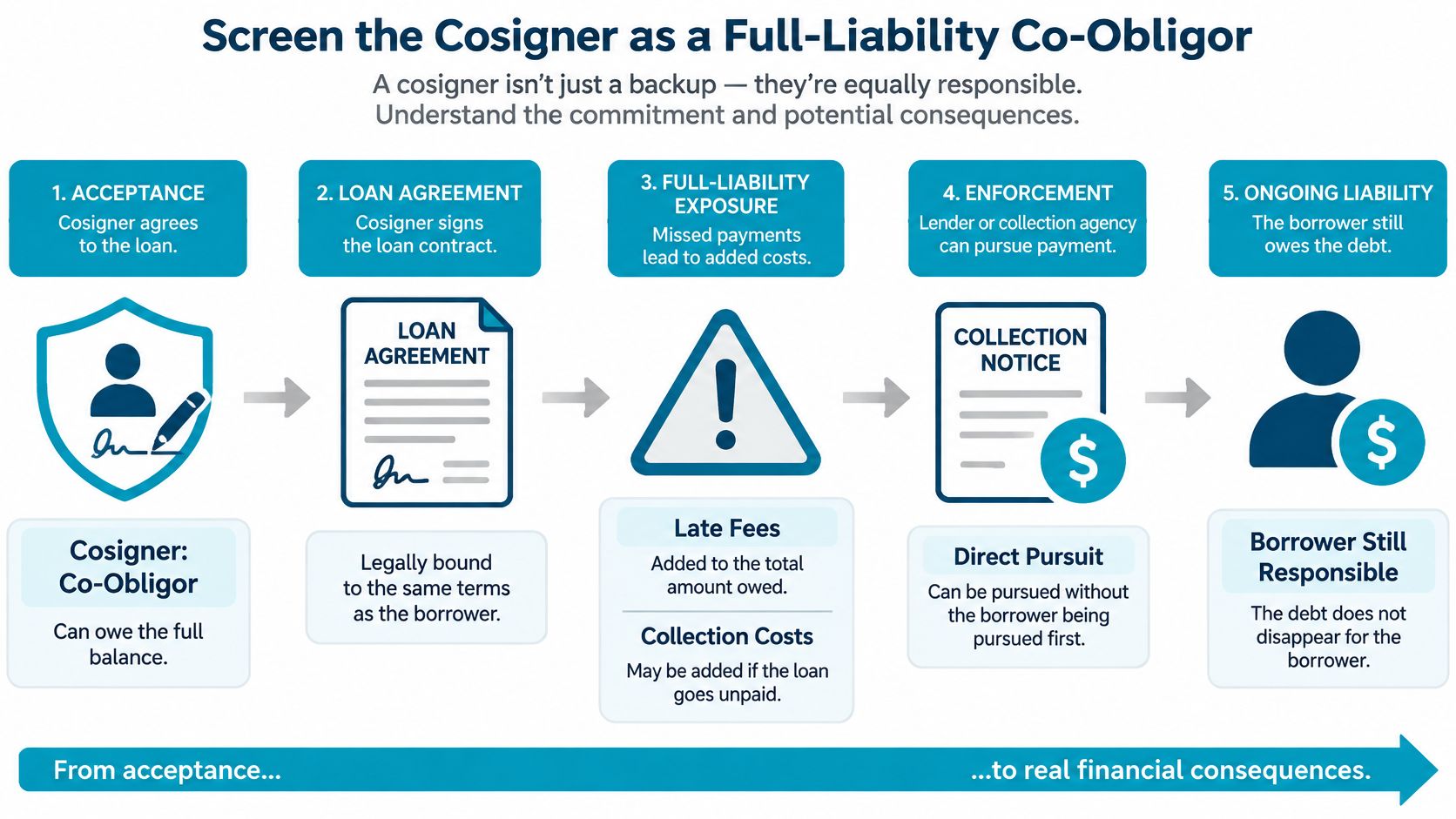
Work through the screen before asking for a signature
Consider a borrower with damaged credit and recent late payments who needs an essential car repair. A parent with steady wages offers to help. The right question isn't whether the parent looks good enough to win approval; it's whether the parent can take over repayment without sacrificing rent, existing debt payments, or retirement security.
Identify someone who could carry the obligation. A spouse, parent, or another trusted adult may be a candidate, but the relationship isn't a qualification. Rule out anyone who would need to borrow, sell essential property, or miss their own bills to help. Stable earnings matter only after existing commitments are accounted for.
Verify both financial pictures. Gather identity, employment, income, housing costs, and current monthly debt payments. Use pay records and bank deposits rather than estimates from memory. For variable income, build the budget around dependable earnings, not unusually strong overtime or seasonal work.
Understand the credit authorization before proceeding. Obtain credit information only with the person's authorization and through an appropriate process. Ask whether the initial review uses a soft inquiry and when a hard inquiry may occur for each person. A marketplace's intake form and a lender's application aren't necessarily the same credit-review stage.
Calculate debt-to-income before and after the proposed loan. Divide required monthly debt payments by gross monthly income, then repeat with the new installment included. Calculate this separately for each person rather than combining their incomes to hide a weak individual budget. For a fixed-rate, fully amortizing loan, a spreadsheet's PMT function can calculate the scheduled payment using the monthly interest rate, number of monthly payments, and amount financed.
Test disruption, not just the ordinary month. Use the actual offered payment, then test a higher-payment offer before accepting a larger obligation. Remove overtime, reduce work hours, or include an unavoidable medical bill. If borrower and cosigner work for the same employer or depend on the same household income, account for the possibility that both lose income together.
Review the contract's exit conditions and charges. Compare APR, origination fees, late charges, and prepayment language. Ask whether cosigner release exists, what conditions apply, and whether a fresh underwriting decision is required. Don't substitute a plan to refinance later for an affordable agreement today.
Write down payment and notice arrangements. Identify who pays, which account funds the installment, and how the cosigner sees statements and overdue notices. Ask the lender what independent account access it supports. A private agreement between borrower and cosigner can clarify expectations, but it doesn't rewrite the lender's contract.
Separate eligibility from safety
Review the lender's personal-loan eligibility requirements before gathering sensitive documents. A stronger file may satisfy underwriting requirements without leaving either household enough money for ordinary emergencies.
Approval means the lender accepted the risk under its terms. It doesn't mean the household should accept it. The lender evaluates its ability to collect; you must evaluate the consequences of having to pay.
Also discuss the cosigner's upcoming plans. Someone preparing to buy a home, replace a vehicle, or change jobs may reasonably decline even if the current payment looks manageable. Their capacity to borrow later has value.
Put the walk-away rule in writing: if the cosigner can't repay the full balance independently under the proposed schedule, don't submit the application.
A refusal doesn't need a long defense. The cosigner can say: “I can't take on this repayment obligation without putting my own bills at risk. I can help you compare a smaller repair or a payment arrangement instead.”
That keeps the discussion focused on financial capacity rather than loyalty. Nobody should have to prove they care by signing an obligation they can't carry.
Alternatives When a Cosigner Is Not the Answer
If nobody can repay the balance independently, stop searching for a more persuadable cosigner. Change the expense, the amount, or the payment arrangement. Moving the same unaffordable obligation to another person doesn't solve the shortfall.
This isn't an unusual budgeting concern. In the J.D. Power Consumer Lending Satisfaction Study, 47% of personal-loan customers described themselves as financially vulnerable, compared with 25% who described themselves as financially healthy in 2025, according to Bankrate's reporting. Size the payment before spending time chasing approval.
The alternatives below work only when they match the household's actual repayment capacity.
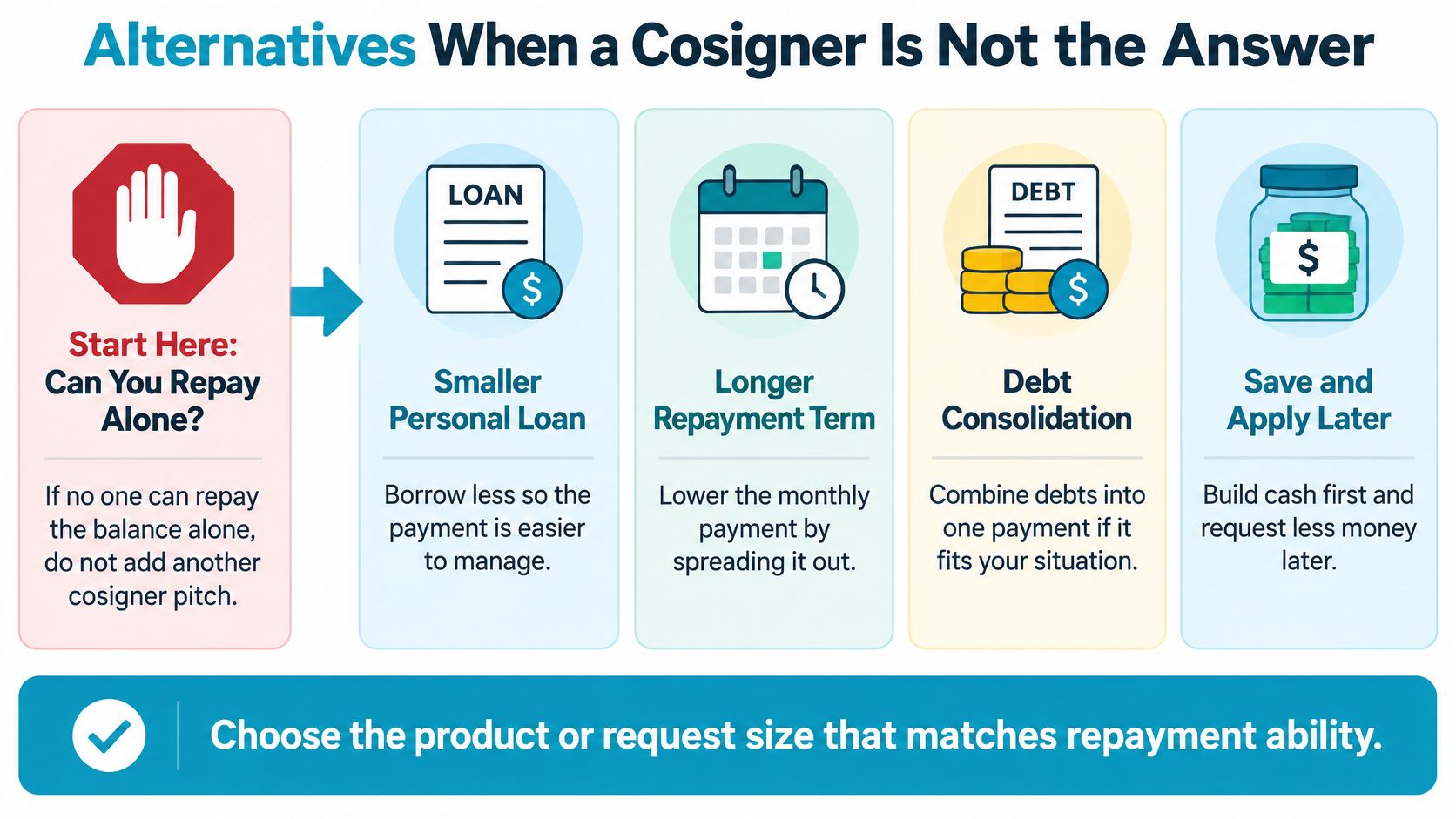
Match the route to the expense
A smaller personal loan makes sense when the expense can be divided. Ask a repair shop to distinguish safety-critical work from work that can wait, or separate an urgent household replacement from optional upgrades. Borrow against the essential quote, not the maximum available offer.
A direct credit-union or community-lender application is worth considering when you need someone to review documented income and the purpose of the expense. Ask about membership requirements, available small-dollar products, fees, and whether the lender accepts your income documentation. Don't assume a community-focused lender automatically approves damaged credit.
A payment plan with the existing provider or creditor can avoid creating a separate loan. Contact the medical billing office, repair provider, utility, or current creditor before the due date. Request the proposed installment, charges, account status, and consequences of a missed payment in writing.
Waiting and saving is usually the strongest choice for a nonessential purchase. Use the delay to reduce the amount needed, bring current obligations up to date, and address credit-report errors. If a delinquency is approaching its reporting removal date, verify the timing on the report rather than relying on a guessed deadline or assuming removal guarantees approval.
Don't confuse emergency products with interchangeable solutions
For a small repair due before payday, compare the exact repayment date with the next paycheck and the bills already assigned to it. A short loan isn't affordable because it ends quickly.
- Installment or emergency options: Examine the scheduled payments, total charges, and whether repayment leaves enough for normal expenses.
- Payday borrowing: Check whether the short repayment window creates another cash shortage immediately afterward.
- Title-backed borrowing: Consider the vehicle at risk, especially if losing access to it would interrupt employment.
- Provider arrangements: Ask whether paying the expense directly over time costs less than borrowing cash elsewhere.
Use this guide to short-term loans for bad credit to distinguish repayment structures before selecting a product. Product labels don't tell you whether the next due date fits your budget.
A longer term and debt consolidation also deserve scrutiny. Extending repayment can increase total cost, while consolidation can simplify bills without reducing the underlying balance. Neither is a substitute for enough dependable income to make the payment.
Documents and Underwriting Both People Should Expect
Build a separate file for the borrower and the cosigner. A lender needs to establish who each person is, what each earns, and what each already owes. Don't assume the borrower's complete file compensates for missing information from the cosigner.
Typical file items for a cosigned personal loan
| Item | Borrower | Cosigner | Why it matters |
|---|---|---|---|
| Government photo ID and address | Required | Required | Confirms identity before a credit review |
| Income proof such as pay stubs or deposits | Required | Required | Tests ability to repay the full payment |
| Housing cost and existing monthly debts | Required | Required | Builds debt-to-income before and after the loan |
| Credit review by the lender | Likely hard inquiry | Likely hard inquiry | Scores and recent delinquencies still drive terms |
| Bank account for autopay or deposit | Payment account | Optional notice access | Shows where payments come from and how funds arrive |
Treat this as a preparation checklist, not a promise that every lender requests identical documents. The lender may also request a Social Security number, employer contact information, additional bank statements, or explanations for inconsistent records. Supply sensitive information only through the verified application channel.
For self-employed, seasonal, or gig workers, bank statements help establish whether earnings arrive consistently. Organize records so the reviewer can distinguish business revenue, transfers between your own accounts, and money available for personal repayment. A credit score doesn't answer those cash-flow questions.
Make the file easy to verify
Underwriters consider more than whether someone clears a credit-score requirement. Recent missed payments, existing obligations, employment information, and the requested amount can all affect the decision. A cosigner's strong history doesn't make conflicting income records irrelevant.
Before uploading anything, check the following:
- Names and addresses: Make sure the application matches current identification and explain legitimate differences.
- Readable documents: Include complete pages, visible dates, and account ownership details rather than cropped screenshots.
- Income consistency: Reconcile pay records with deposits and explain irregular earnings clearly.
- Debt completeness: Include obligations that affect the budget even if they're easy to overlook during an online application.
- Document ownership: Label which files belong to the borrower and which belong to the cosigner.
An initial response isn't the same as final approval or money in the bank. Verification, acceptance, banking schedules, and the lender's own process can affect when funds become available. Don't commit to a contractor or promise a creditor payment based solely on an initial message.
Before either person e-signs, open the final agreement and inspect the APR, disbursement amount, payment schedule, fees, late charges, and prepayment terms. Save the agreement and any authorization documents where both people can retrieve them.
Finish by assigning each outstanding item to its owner. A missing cosigner pay stub should be identified before submission, not discovered when an urgent expense is already overdue.
Submit a Request Only After the Payment Fits
Approval is not the right measure of success. Submit only when both people could manage the full payment without putting their own bills at risk. The cosigner is a co-obligor, not a backup plan.
Before opening an application, agree on the requested amount, who will make each payment, and the maximum total cost you will accept. Use a personal-loan calculator to compare the proposed amount, rate, and term. Then check the lender's actual disclosures, since a calculator cannot account for every contract charge or confirm approval.
Keep control of the request and the offer
A marketplace can send one request to independent lenders and reduce repeated data entry. Each lender sets its own requirements, and not every lender accepts cosigners or offers the same products. Confirm that the lender supports a cosigner arrangement before asking someone to authorize a review.
Follow a clear order:
- Set your ceiling: Decide the highest payment and total cost both people can afford before reviewing offers.
- Prepare both files: Have the borrower's and cosigner's documents ready, and get consent to provide them.
- Read the authorizations: Understand electronic consent, information sharing, and any lender credit-review permissions.
- Review the lender's role: Confirm who sets the terms, handles payments, and answers account questions.
- Accept only a suitable agreement: Decline any offer that exceeds your ceiling or includes unacceptable conditions.
Check eligibility and state availability before entering sensitive information. Review the marketplace's Rates and Fees, Lending Policy, and FAQ, then read the lender's separate disclosures. The marketplace connects applicants with lenders, while each lender controls approval, pricing, fees, and funding.
A fast response is not a reason to accept automatically. You are considering a contract, and you can decline an offer even if a lender approves the request.
If the payment fails the budget test, reduce the amount or walk away. A smaller loan may fit both budgets better. If no amount works without risking either person's bills, skip the loan.
NextStopLoans provides a secure online request that routes information to independent U.S. lenders, some of which may consider bad credit. NextStopLoans is not a lender, and you can decline any offer. Visit NextStopLoans to explore available options, confirm whether a lender accepts a cosigner, and review eligibility and state restrictions before you proceed. Submit only an amount both people can carry, and accept only when the lender's final terms fit that limit.