
Longer Term Loan Payments Versus Total Cost

Federal Reserve Financial Accounts put home mortgages near $13.8 trillion and consumer credit near $5.1 trillion, so most of what U.S. households owe is already scheduled across years, not weeks (Financial Accounts of the United States). Mortgage debt is roughly three-fourths of that stock. Student loans, auto loans, and card balances make up most of the rest. The same record shows older households' share of total household debt rising from 20% in 1989 to 38% in 2016, with their share of mortgages doubling over that span. A balance can still be open long after the purchase that created it.
That is the right frame for a longer term loan. A smaller installment helps only when cash left after rent, utilities, food, insurance, and debts you already owe can cover a missed paycheck. If that cushion isn't there, stretching the term postpones the miss and raises the dollars you repay.
Judge the offer by three numbers you can write on one page: the monthly draft, the extra interest, and the cash that remains after ordinary bills. A short term fails when the payment won't clear in a normal month. A long term fails when the smaller draft still can't survive one bad paycheck.
Table of Contents
- What a Longer Term Loan Costs Each Month
- Longer Term Loan Types Compared
- Stress Test the Payment Before You Sign
- When the Longer Term Actually Fits
- Check Early Payoff Before You Refinance
- Request Longer Term Offers and Compare Totals
What a Longer Term Loan Costs Each Month
Hold one loan still so the trade-off is visible before any product name. Take $10,000 at 11.86% APR, about the average commercial-bank rate reported for a 24-month personal loan in Q2 2026 (CNBC Select). Only the number of months changes. These rows are amortization illustrations, not lender quotes, and they exclude origination, late, and non-payment fees.
| Term | Monthly payment | Total interest |
|---|---|---|
| 24 months | about $470 | about $1,282 |
| 36 months | about $331 | about $1,914 |
| 60 months | about $222 | about $3,322 |
Approximate totals repaid are $11,282, $11,914, and $13,322. Moving from 24 months to 60 months cuts the draft by about $248 a month and adds about $2,040 of interest.
Why the month gets cheaper
Principal is split across more installments, so each draft is smaller. Interest keeps accruing on the unpaid balance, so the cheaper month is not the cheaper loan. You're buying time. You're not getting a discount on the $10,000.
Someone who can send $470 without touching grocery money usually keeps more cash by finishing in two years. Someone who would miss that $470 in an ordinary month is facing a different test: whether $222 still clears after bills that don't negotiate. The middle row, about $331 and about $1,914 of interest, is the compromise only if that payment is the one the paycheck can carry.
The four numbers that decide it
A quote is usable only when you can line up four items on the same page.
- APR: the illustration holds 11.86% so term is the only moving part. A real offer can price a longer schedule higher.
- Fees: origination, documentation, late charges, and non-payment penalties sit outside the table. Add them before you compare.
- Total of payments: $13,322 over five years versus $11,282 over two years is the price of the smaller draft.
- Leftover cash: after rent, utilities, food, insurance, and debts already owed, the payment has to leave room for a missed paycheck.
Sketch your own balance, rate, and term on a loan calculator before you treat any advertised draft as final. The lender sets the APR, the fees, and whether extra principal cuts interest. The illustration does not.
Longer Term Loan Types Compared
A longer term loan spreads repayment over multiple years. Payday and cash loans sit at the short end, where most of the balance is due near the next paycheck. Some lenders in our network may automatically renew a short-term loan that becomes past due. Renewal adds charges the lender sets, and that term is written in the loan agreement.
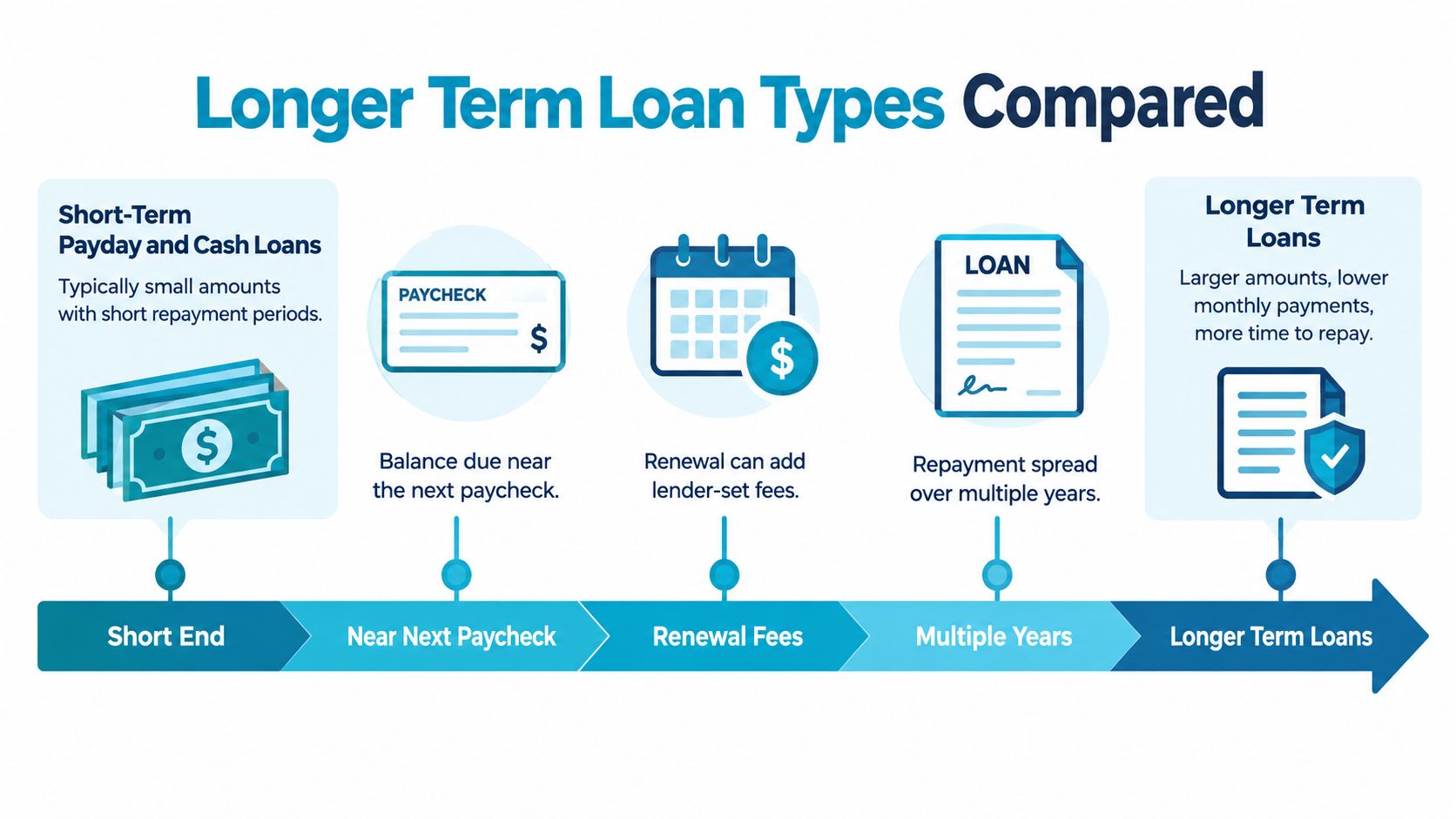
Federal Reserve data identify standard new-vehicle categories at 48, 60, and 72 months. The G.19 rate series for a 48-month new-auto loan starts in February 1972, the 60-month series in August 2006, and the 72-month series in August 2015 (Federal Reserve G.19). Average maturity of new-car loans at finance companies has run about 65 to 69 months recently, including a reported 69-month average in one 2025 release. The rows below are typical shapes, not quotes. A loan from a state with no limiting law, or from a bank not governed by state caps, can carry an even higher APR.
| Product | Typical term | Collateral | Payment effect | Distinctive risk |
|---|---|---|---|---|
| Payday or cash loan | Next paycheck | None | Most of the balance due at once | Renewal charges if past due |
| Short installment | From about 61 days | Usually none | Fewer, larger payments | Tight if income is uneven |
| Personal installment | Often 2 to 5 years | Usually none | Lower payment, more total interest | Rate rises when credit is weak |
| Auto loan | 48, 60, or 72 months | Vehicle | Spread across the car's early years | Balance can exceed vehicle value |
| HELOC or home-secured | Multi-year draw, then longer repayment | Home | Often the smallest payment if the rate is low | Foreclosure and possible rate resets |
| Title loan | Set in the agreement, often months | Vehicle title | Access to a larger sum | Repossession if unpaid |
What each row is actually for
A short installment can start near 61 days. You make fewer payments, and each one is larger, so a short week at work shows up immediately.
An unsecured personal installment commonly runs two to five years, with a fixed draft for a wedding, a medical bill, or card consolidation. The rate follows credit, not a pledged asset. Weak credit usually means a higher APR, which is how a "manageable" payment gets expensive. Read how installment loans work before you treat every fixed schedule as the same contract.
An auto note in the 48, 60, or 72 month buckets spreads the cost across the car's early years. A thin down payment lets the balance outrun the vehicle. You can then owe more than the car is worth if you need to sell, or if the car is totaled, while you're still writing checks.
A home-equity line or other home-secured loan can offer the smallest draft when the rate is low, because the house is the collateral. That small draft comes with foreclosure if you fall behind, and with a reset if the rate isn't fixed for the whole repayment period. Don't pledge the house for an expense that will be gone in a season.
A title loan uses the vehicle's equity and can provide a larger sum when a credit score is thin. The distinctive risk is the car itself. Miss the contract and the lender can repossess it, which removes both the collateral and your way to work.
The repayment period should not outlast the thing you bought.
Write down the amount, the collateral you can afford to lose, and how long the expense should be paid for. If the purchase will be used up before the last installment, you're financing a memory, and a shorter product with a full payoff already sitting in the next deposit is the honest match.
Stress Test the Payment Before You Sign
Run this five-line check on any offer, short or long, before you sign.
- Stack the bills. Write the new payment beside rent or the mortgage, utilities, insurance, food, and minimums you already owe.
- Find the leftover. Subtract that stack from take-home pay. What remains is the only cushion you have.
- Remove one paycheck. Cut a pay period, or add a plausible medical bill or car repair, and see whether the new payment still clears.
- Read the miss. In the agreement, find late fees, a collection referral, credit reporting, and any renewal that adds charges.
- Walk away if step 3 fails. A normal month that looks fine is not enough. The offer has to survive the thin month.
The New York Fed's Consumer Credit Panel, built from anonymized Equifax data, defines serious delinquency as 90 or more days past due. In Q2 2026 the flow into serious delinquency was 2.57% of all household debt and 5.19% for the broader "other" category (New York Fed Consumer Credit Panel). That "other" bucket is wider than personal loans. It is not a personal-loan default rate, and it shouldn't be quoted as one.
What a miss actually costs
A longer schedule can improve monthly coverage. It also lengthens the window in which unemployment, a medical bill, or a repair can cause a miss. Lenders may answer that longer exposure with a higher APR, extra fees, tighter credit rules, or a demand for collateral.
Different lenders set different late policies, and those rules live in the agreement. Typical penalties for non-repayment may include late fees, referral to a collection agency, reporting to a consumer credit agency, and an offer to renew with additional fees and/or interest. Late payment or non-payment can also leave a negative mark on credit history. That mark makes the next loan more expensive, which is the opposite of the payment relief you were chasing.
If the thin month fails, the smaller draft is not affordability. It is a delayed miss with more interest attached.
Compare the lender's payment, the total you'll repay, the late-fee policy, how the loan is reported, and any hardship option before you accept. A quote that only shows the monthly number has skipped the test that matters.
When the Longer Term Actually Fits
Recent New York Fed household credit data show that credit-card and auto-loan delinquencies remain above historical medians, driven largely by nonprime borrowers, even as the household debt-service ratio stays slightly below its pre-pandemic level (New York Fed household credit review). A national average cannot establish whether your budget can carry another payment. Start with the cash left after rent, utilities, food, insurance, and existing debts.

Four situations, four verdicts
A renter with a $10,000 medical or consolidation need. A 24-month payment near $470 would leave almost nothing after rent and food. A 60-month payment near $222 may prevent a missed payment, but adds about $2,000 in interest compared with the two-year schedule. The longer term fits only if the shorter payment already exceeds what a normal month can support and the remaining cash can still absorb a missed paycheck.
A buyer who will keep the car past the loan. A 60- or 72-month auto term may fit the years you expect to drive the car, provided the payment leaves enough cash for ordinary bills and unexpected costs. A small down payment can leave you owing more than the car is worth. If that risk is unacceptable, shorten the term or choose a less expensive car.
A homeowner funding a project that raises the home's usefulness for a decade. A home-secured line may suit a long-lived improvement if you can handle a rate reset and are prepared to put your home at risk. A kitchen you expect to use for years differs from a vacation or a card balance that could be cleared sooner.
A paycheck gap for rent or a small repair. A multi-year loan can leave you repaying next year for a bill that should have been covered by the next deposit. A short-term loan may fit only if the full repayment, including any renewal charges, is covered by that upcoming pay.
Choose a longer term only when the smaller payment leaves enough after ordinary bills to handle a missed paycheck. If that cash cushion is still inadequate, the lower payment postpones the strain and adds cost.
Loan rates, fees, and schedules differ. Compare the payment with the cash left after bills, then weigh that margin against the total repayment. A payment that fits only in a month without surprises does not make the longer term affordable.
Check Early Payoff Before You Refinance
The term you pick at origination is neither permanent nor an easy escape. Lenders may offer repayment of the full balance at a later date, repayment over time in installments, or renewal. Which of those you have is a contract question, and the math has to agree before you treat a refinance as a plan.
Ask three things on the loan you already have. Does extra principal reduce interest under that contract? Is there a prepayment penalty? What payoff amount is owed on a stated date? If the answers aren't in the agreement, you don't yet know whether paying early saves money.
A break-even you can copy
Add every remaining payment on the current loan. That's total one. Separately, add every payment on the replacement loan, plus origination and any other fees. That's total two. Refinance only if total two is lower by enough to matter after the hassle of a new application. A smaller monthly number, by itself, is not a saving.
Restarting a long clock to cut the draft can raise total interest even when the new APR looks similar to the old one. You pay the lender for more months on a balance that had already started to shrink. A new credit inquiry and a longer maturity aren't free either. One can affect the rate you're offered. The other adds months of exposure you had already begun to retire.
In the third quarter of 2025, 4.5% of household debt was delinquent in some stage, and 9.4% of aggregate student debt was 90 or more days delinquent (Federal Reserve Financial Stability Report). Those figures don't mean a longer personal-loan term causes default. They do mean refinancing is not a guaranteed exit when other household debts are already late. Don't plan on a future consolidation to rescue a payment that fails today's leftover-cash test.
A true interest saving shows up as a lower total of payments after fees. A payment cut that only moves the due dates further out is relief, and it has a price. If total two isn't clearly smaller, keep the loan you have and send extra principal when the contract allows it.
Request Longer Term Offers and Compare Totals
Turn the tests into a short sequence so you collect offers once, on your terms.
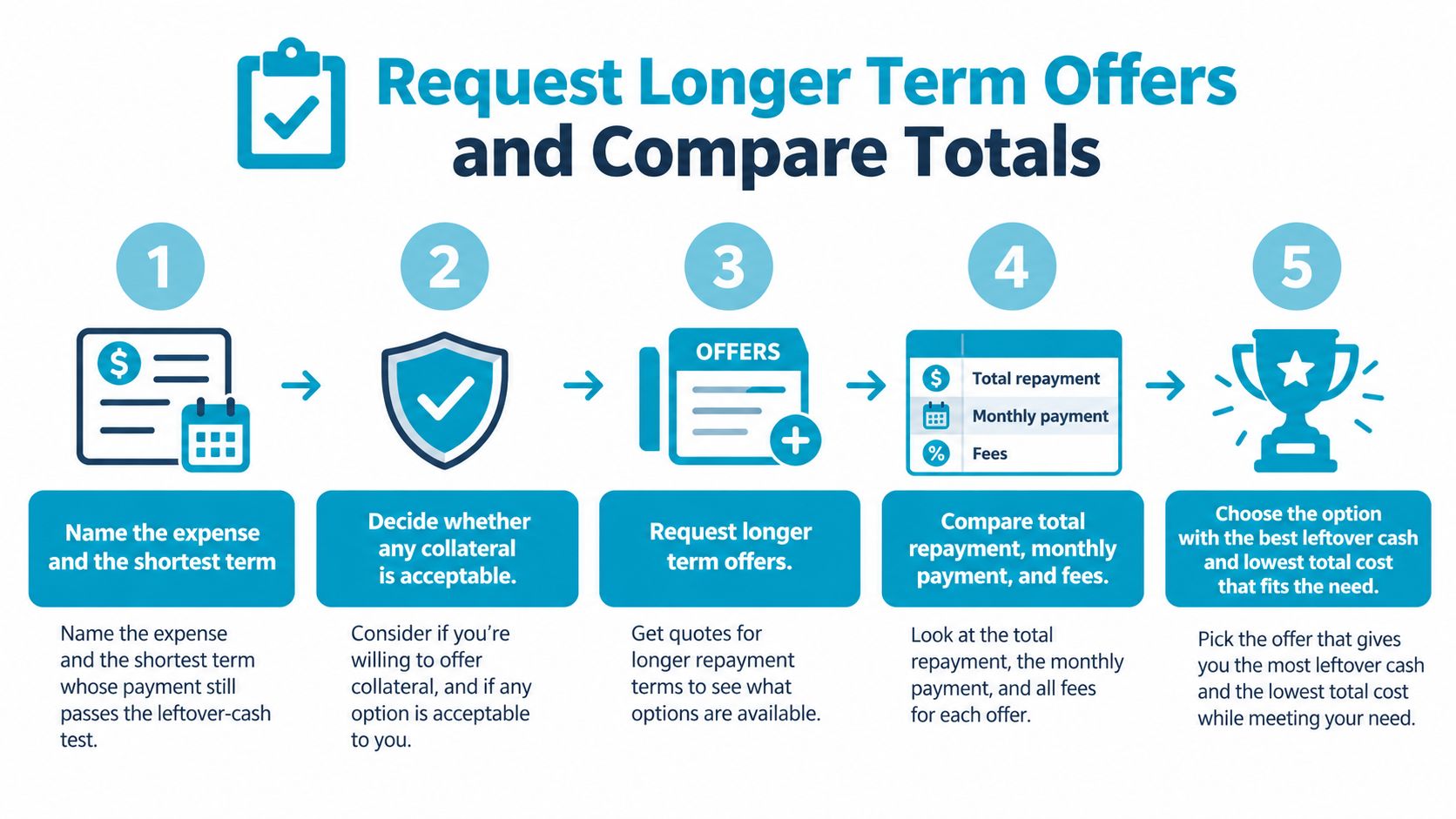
- Name the expense and the shortest term that passes. If a two-year draft clears leftover cash after rent, utilities, food, insurance, and debts you already owe, don't shop a five-year note just because the month looks softer.
- Decide on collateral before you apply. Skip home and title products if losing the house or the car would be worse than a higher unsecured rate.
- Send one secure request. We route that request to more than one lender, so you aren't filling out a full application at every shop. We don't pull credit. Participating lenders may.
- Record the same fields on every offer. Term, APR, fees, monthly payment, total of payments, prepayment rule, and late-fee policy. How personal loan APR is built is the checklist for reading the rate line, including fees that move the APR.
- Accept only a double pass. The total cost has to be the one you can live with, and the stress test has to survive a thin month. Decline the rest. There's no obligation to take an offer.
NextStopLoans connects eligible U.S. residents with lenders. We aren't a lender, and approval and terms are set by the provider at the time you apply with them. Network partners offer terms from 61 days to 84 months, with an APR range of 5.99% to 35.99% that moves with fees, duration, and other factors, and some loans can price higher. Lenders in the network typically respond within minutes. If you're approved and you agree to that lender's terms, funds are deposited to your bank account, usually as fast as the next business day, subject to that lender's process.
The service isn't offered in every state, including Arkansas, New York, Vermont, and West Virginia. Read the rates, fees, and lending-policy pages before you agree to anything. An illustration in this guide is not the offer.
NextStopLoans sends one secure request to independent lenders so you can compare longer term loan offers by payment, fees, and total repaid, not by the smallest monthly number alone. You can decline every offer, and the lender, not the marketplace, sets approval and terms. Start with the expense and the shortest term your leftover cash can carry, then compare real totals at NextStopLoans.