
Loan for Medical Bills: Complete Financing Guide for 2026

A medical bill can arrive when your budget is already committed to rent, groceries, insurance, and other essentials. You may be looking at a balance due soon, wondering whether to use a credit card, request a payment plan, or apply for a loan for medical bills before the account becomes harder to manage.
That pressure can make any fast option feel like the right option. A calmer approach is to understand why medical borrowing is common, compare the full cost of each path, and check whether financial assistance or a provider arrangement can solve the problem without adding new debt.
Table of Contents
- Understanding How Medical Bills Create Financing Pressure
- How Medical Debt Shapes Borrowing Decisions
- Comparing Loan for Medical Bills Options
- How to Choose the Right Financing Path
- Alternatives to Borrowing for Medical Expenses
- Risks and Hidden Costs of Medical Loans
- Next Steps for Responsible Medical Bill Financing
Understanding How Medical Bills Create Financing Pressure
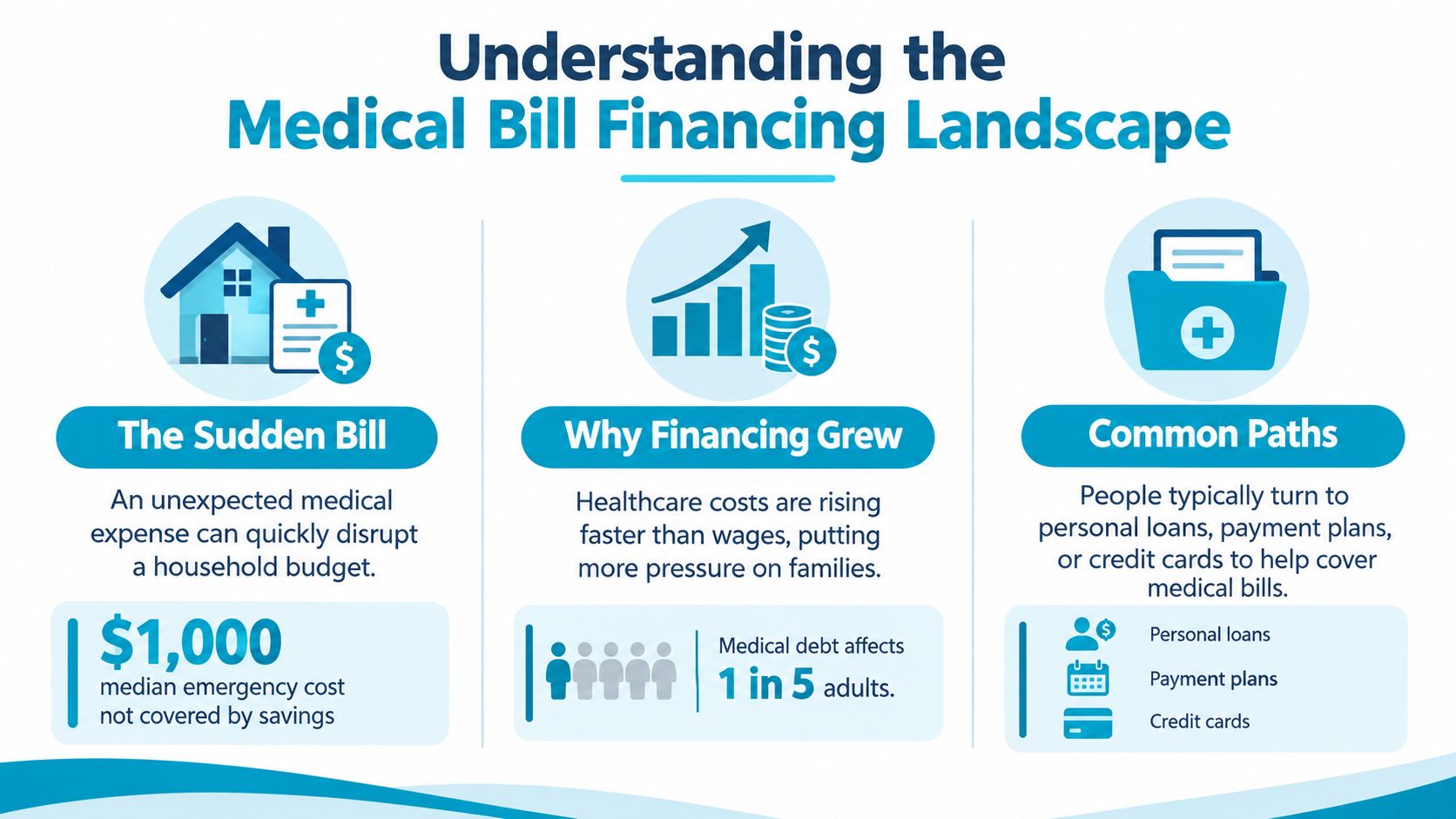
A hospital visit, dental procedure, or urgent prescription can turn a stable monthly budget into an immediate cash problem. Rent and groceries may already be covered, yet the household may not have enough money available for a large bill due at once. This is a liquidity shock, a sudden need for cash that does not necessarily reflect poor budgeting or low income.
Medical debt has become a widespread household credit issue in the United States. A Kaiser Family Foundation analysis of medical debt reported that 41% of U.S. adults had some form of debt from medical or dental bills. It also found that 24% had bills past due or could not pay them, while 21% were paying providers over time. The analysis estimated that adults owed at least $195 billion in medical debt.
A later KFF summary cited government data placing total medical debt at least as high as $220 billion. It also reported that millions of adults owed balances above $1,000, including millions with debts above $10,000. These figures show why a loan for medical bills is only one part of a larger financing decision. The same pressure may lead one household to seek a loan, another to request a provider payment plan, and another to pursue financial assistance before borrowing.
Why medical bills create unusual borrowing pressure
Medical care is often time-sensitive, and the final amount may remain unclear until insurance processes the claim. That uncertainty makes the bill different from a planned purchase such as an appliance or vacation. A household may need care first and learn the full financial obligation later.
Financing can create breathing room, but it changes who receives repayment. Instead of paying a provider directly, you may owe a lender interest, fees, and scheduled installments. Before applying for a loan, compare that full cost with a provider arrangement, charity care, insurance review, or another non-loan option.
The central question is whether the new payment fits the budget after essentials and existing debts. Approval only shows that funds are available. It does not show that borrowing will leave the household financially stronger.
Practical rule: Treat a medical loan as a repayment commitment, not a way to make the bill disappear. The balance remains, and interest or fees can increase the total cost.
How Medical Debt Shapes Borrowing Decisions
Medical borrowing is large enough to affect how households plan for emergencies and how lenders evaluate applications. Gallup reported in 2025 that 12% of U.S. adults, about 31 million people, borrowed an estimated $74 billion during the prior 12 months to pay for healthcare for themselves or a household member. Among those borrowers, 58% borrowed $500 or more, while 38% borrowed less than $500, according to Gallup's survey of borrowing for medical bills.
That range matters. Some applicants need a relatively small amount to bridge a short-term gap, perhaps after an urgent visit or a copay. Others need installment financing for a larger balance that can't be cleared from the next paycheck. A single product category called “medical loan” can therefore include very different borrower needs.
Earlier Census Bureau data cited in the same Gallup report showed that 19% of U.S. households couldn't afford to pay for medical care up front or when care was received in 2017. The underlying challenge is immediate access to cash. A household may have regular earnings and still lack the funds required on the day care is provided.
Medical borrowing is often a cash-flow question
The Federal Reserve reported that 23% of adults had major, unexpected medical expenses during the prior 12 months, with a median cost between $1,000 and $1,999. It also reported that 17% had debt from their own or a family member's medical care. The Federal Reserve medical-expense data summarized here show why applicants may seek relatively quick access to modest or mid-sized amounts rather than discretionary funding.
The same source reported that 63% of adults could cover a $400 emergency entirely with cash or cash-equivalent funds. That leaves a substantial share of adults who may need another funding source when an unexpected charge arrives. For underwriting, this means an application may reflect a temporary cash-flow interruption rather than a desire to spend beyond one's means.
A responsible borrower should still examine the complete budget. A lender may focus on income, existing obligations, and payment history, but you must ask whether the new payment fits after housing, food, transportation, insurance, and any existing provider plan are paid. Approval answers whether a lender is willing to offer credit. It doesn't answer whether the loan is affordable for your household.
Comparing Loan for Medical Bills Options
The lowest-risk option is usually the one that reduces the balance or spreads repayment without adding expensive interest. A loan becomes more relevant when assistance and direct arrangements aren't available, the bill is accurate, and the proposed payment fits the budget.
| Option | Typical Cost | Speed | Best For |
|---|---|---|---|
| Provider payment plan | Often low cost, depending on provider terms | Can be arranged through the billing office | Borrowers who can repay the original bill over time |
| Financial assistance or charity care | May reduce or eliminate an eligible balance | Requires an application and documentation | Patients facing hardship or limited ability to pay |
| Medical credit plan | Promotional terms may be available, but read the expiration conditions carefully | Often quick at participating providers | A known expense with a reliable payoff plan |
| Personal loan | Interest and fees vary by lender and borrower profile | Often faster than negotiating a complex balance | A borrower who needs a fixed payment and has stable repayment capacity |
| Credit card | Interest can be costly if a balance remains | Immediate if available credit exists | A balance that can be paid promptly, not long-term financing |
| Secured borrowing | May offer a lower rate, but an asset is at risk | Depends on application and collateral review | Borrowers who understand the collateral consequences and have no safer path |
Personal loans and medical installment products
A personal loan generally provides a lump sum that you repay in fixed installments. It may simplify several bills into one payment, but it can also add origination charges, interest, and a longer obligation. Before applying, review how personal loans work, including the difference between the amount deposited and the total amount repaid.
A medical installment product offered at a provider's office may appear more convenient, but convenience doesn't guarantee a lower cost. Ask whether the product is a separate medical-financing arrangement or a personal loan marketed for healthcare. Check the annual percentage rate, fees, late-payment consequences, and what happens if you miss a promotional deadline.
Payment plans, cards, and hardship programs
A provider payment plan can preserve the original balance and may avoid the additional interest associated with outside credit. Ask whether the plan charges interest or fees, whether payments are reported to credit bureaus, and whether the account can still be sent to collections while you remain current.
A medical credit card or ordinary credit card may offer speed, but the balance can become expensive if you carry it. Promotional financing requires particular caution. Understand whether unpaid promotional interest is added retroactively, when the promotional period ends, and whether the minimum payment is enough to clear the balance in time.
Financial assistance deserves attention before borrowing. Hospitals and providers may have hardship programs, charity-care policies, discounts, or income-based arrangements. These options can take longer to process, but a reduction in the original balance may be more valuable than a faster loan.
How to Choose the Right Financing Path
Start with the bill, not the loan application. Request an itemized statement, compare it with your insurance explanation of benefits, and ask the billing office to correct unclear or duplicate charges. Borrowing against an inaccurate balance can lock you into repayment for money you never should have owed.
Begin with affordability
Write down the amount you can pay now without missing essential expenses. Then calculate what monthly payment you could maintain after existing debts and household necessities. Don't use the lender's maximum offer as your budget. The appropriate amount may be lower than the amount available.
Next, identify the deadline. If the provider has agreed to hold the account while reviewing assistance, you may have time to pursue a discount or payment arrangement. If the bill is already due and treatment can't be delayed, speed becomes more important, but it shouldn't eliminate a review of the terms.

Match the product to the situation
A provider plan may suit someone who can pay the original bill gradually. A hardship program may suit someone whose income makes the full balance unrealistic. A personal loan may fit a borrower with stable cash flow who has compared offers and needs a predictable installment.
Your credit profile can affect available terms, but it shouldn't be the only consideration. Compare the annual percentage rate, origination fee, late fee, loan term, monthly payment, and total repayment amount. A lower monthly payment may result from a longer term, which can increase the total cost.
Before signing: Confirm the amount you receive, the amount you must repay, the due date of every payment, and the consequence of paying late.
Alternatives to Borrowing for Medical Expenses
A loan isn't the only way to create time. In some cases, the best financial result comes from reducing the bill first and financing only what remains. That approach can lower the principal and make any eventual payment more manageable.
Check and negotiate the bill
Ask for an itemized bill and compare it with your insurer's explanation of benefits. Look for services you didn't receive, duplicate entries, incorrect dates, and charges that don't match the insurer's decision. Contact the provider's billing department with specific questions and keep records of calls, names, documents, and promised follow-up.
After confirming the balance, ask about a self-pay discount, prompt-payment reduction, hardship adjustment, or settlement amount. A provider may not approve every request, but a direct conversation can reveal options that aren't obvious on the statement.
Request assistance before outside credit
Ask whether the hospital has a financial-assistance or charity-care application. Nonprofit hospitals must maintain financial-assistance policies, and other providers may offer discounts or hardship programs as well. Eligibility rules vary, so don't assume that earning an income automatically disqualifies you.
You can also ask for a payment plan. Get the agreement in writing and confirm the payment amount, interest, fees, due dates, and whether the provider will pause collection activity while you remain current. A no-interest or low-cost plan may preserve more of your household cash than a loan.
Decide what to do when alternatives fall short
Assistance may be unavailable, the provider may require a large initial payment, or the plan may demand more each month than your budget can support. In that situation, compare outside financing carefully rather than treating it as an automatic next step. Guidance about how to get emergency cash can help you understand the broader choices, but the specific terms still require individual review.
The key comparison is total cost. Ask whether the loan reduces stress because it creates a sustainable payment, or whether it merely replaces a medical bill with a more expensive obligation.
Risks and Hidden Costs of Medical Loans
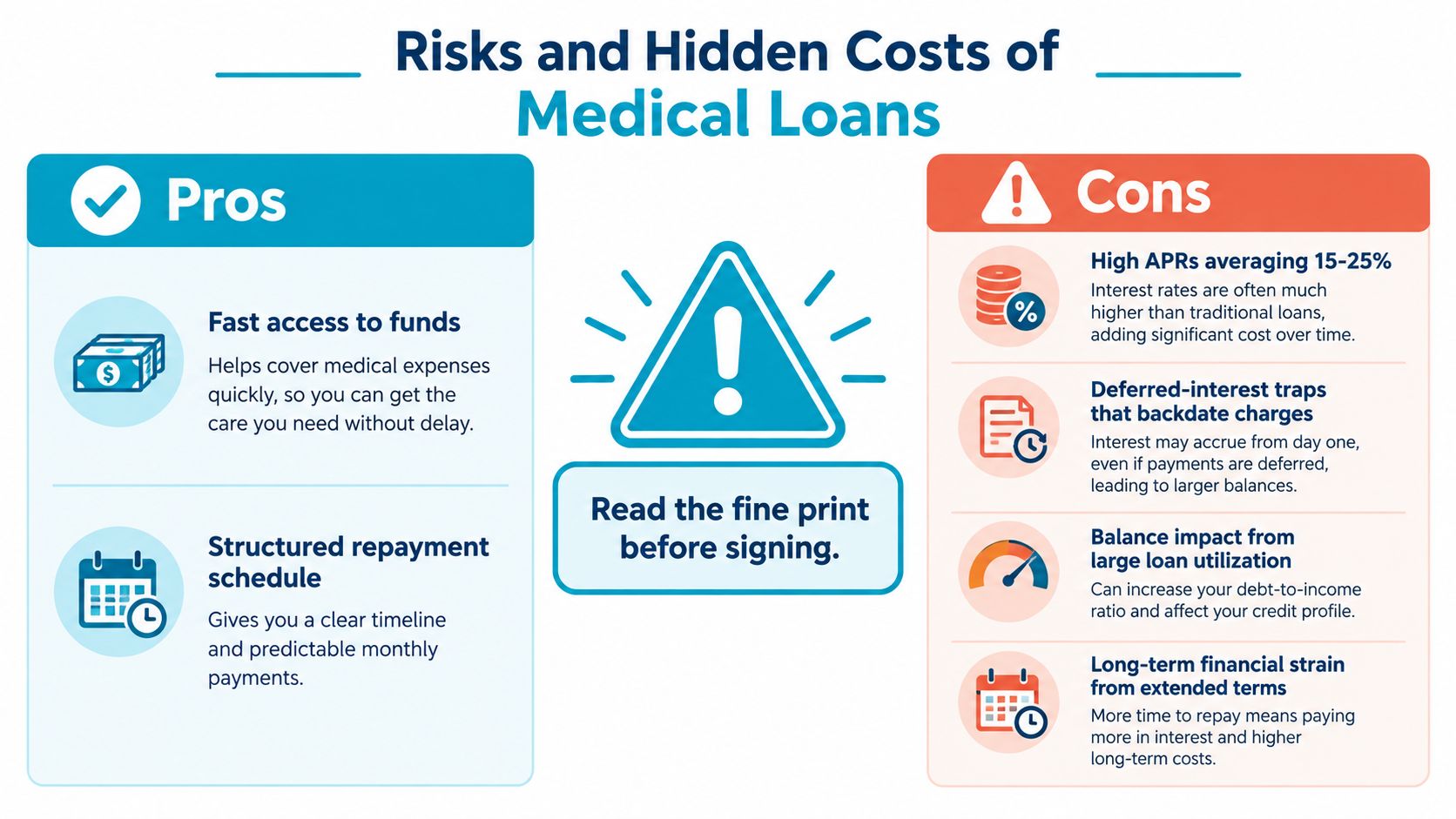
A medical loan can solve an immediate timing problem while creating a longer repayment problem. The most important risk is focusing on the monthly payment and overlooking the total amount returned to the lender.
Interest is only one part of the cost. Look for origination charges, application or processing fees, late fees, prepayment conditions, and optional products added to the balance. A long term can make payments appear manageable while extending the period during which interest accrues.
Promotional medical credit deserves extra scrutiny. A stated zero-interest period may have conditions that require the full balance to be paid before the deadline. If the agreement uses deferred interest, missing that deadline can make the final balance much higher than expected.
Medical debt also shouldn't be treated as the only measure of credit risk. Congress cited a CFPB rule that would remove most medical debt from credit reports and prohibit lenders from using medical debt collection information in underwriting, based on the bureau's finding that it didn't reliably predict repayment of other debts. At the same time, a LendingTree analysis of medical-debt burdens found that in 2024 36% of households had medical debt, 21% had a past-due medical bill, and 23% were paying a medical bill over time directly to a provider.
For borrowers, the practical lesson is to disclose the full budget. A provider payment is still a fixed obligation, even if a medical collection doesn't appear in a credit file. To understand how APR affects borrowing costs, review personal loan APR rates and compare the offer's total repayment amount, not just its advertised rate.
Next Steps for Responsible Medical Bill Financing
Prepare before submitting an application. Gather the itemized bill, insurance explanation of benefits, proof of income, recurring debt payments, and any written offer from the provider. These documents help you identify the exact amount you need and make it easier to compare a loan with a direct payment plan.
Request only enough to resolve the verified balance and any immediate required payment. Borrowing extra can turn a focused medical expense into general-purpose debt. If you receive several offers, place them side by side and record the APR, term, monthly payment, origination fee, late fee, funding conditions, and total repayment amount.
Understand the online application process
An online loan-request marketplace may collect one application and submit it to independent lenders. The marketplace isn't the lender, doesn't make the credit decision, and doesn't set the final terms. Participating lenders may review credit information and determine whether to offer funds, along with the rate, fees, repayment schedule, and funding timing.
Read the marketplace's privacy, consent, rates, and fee disclosures before submitting personal information. A request doesn't obligate you to accept an offer. Review the lender's final agreement separately, because that document controls the transaction.
Make repayment part of the decision
Before accepting financing, place the proposed payment into your monthly budget. Decide which expense will fund it and what you'll do if income drops or another medical charge appears. Automatic payments can reduce the chance of forgetting a due date, but check your account before each withdrawal so an unexpected debit doesn't trigger an overdraft.
If the payment doesn't fit without sacrificing necessities, pause and contact the provider or assistance office again. Responsible financing isn't about accepting the fastest available offer. It's about choosing a path that addresses the bill while keeping your future cash flow stable.
NextStopLoans offers an online marketplace that routes loan requests to independent third-party lenders, including requests for personal or emergency funding that may be used for medical expenses. Visit NextStopLoans to submit a request, review any lender offers you receive, and compare the final terms before deciding whether to accept.