
Loan APR vs Interest Rate: What the Gap Really Costs
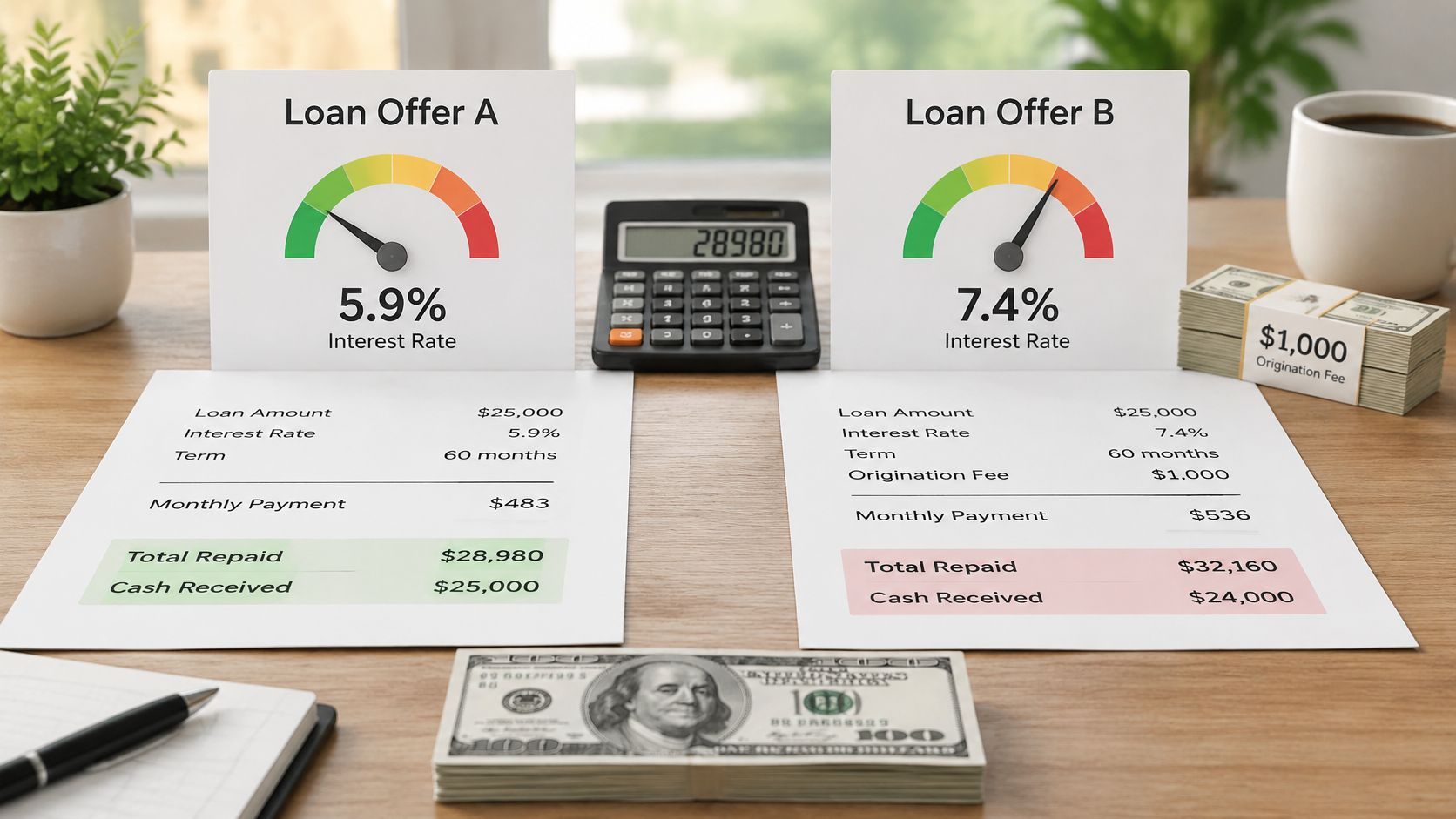
“Choose the loan with the lowest APR” is useful advice, but it leaves out a condition: the offers must give you comparable money on comparable repayment schedules. Otherwise, the loan with the lower APR can require more dollars in total, and the loan with the smaller repayment total might give you less cash.
The key question in loan APR vs interest rate comparisons isn't which number matters. Both do, but they answer different questions. You also need to know what reaches your bank account, what leaves it, and when.
Table of Contents
- APR vs Interest Rate at a Glance
- What the Interest Rate Actually Measures
- What APR Adds and Where Ranking by APR Breaks
- A Worked Example Where the Two Numbers Disagree
- Why Short Terms and Small Loans Push APR Up
- How to Compare Two Loan Offers Before You Sign
APR vs Interest Rate at a Glance
The interest rate prices the principal; APR expresses the broader yearly cost of credit, including applicable fees, and works best for ranking offers that deliver the same cash on the same repayment schedule.
APR versus interest rate on seven criteria
| Feature | Interest rate | APR |
|---|---|---|
| What it prices | The use of the principal itself | The annualized cost of credit, including applicable fees |
| What counts toward it | The lender's interest charge on the outstanding balance | Interest plus charges included under finance-charge rules |
| What usually sits outside | Loan fees, penalties, and optional add-ons | Certain default-related charges, genuinely optional products, and some third-party charges |
| Who sets or calculates it | The lender sets the rate through its pricing and underwriting | Calculated from the rate, counted fees, amount financed, and payment schedule |
| Where you see it | Advertisements, estimates, and the loan agreement | Credit disclosures alongside other borrowing-cost information |
| What pushes it up | A higher rate assigned through the lender's pricing | Larger counted fees relative to the amount financed, or less time over which to spread them |
| Best used for | Understanding the interest component of repayment | Comparing offers with matching amounts, terms, and payment schedules |
Read the figures together rather than choosing one and ignoring the other. A noticeable gap between the interest rate and APR is a reason to inspect the fees, not evidence that the lender has calculated either figure incorrectly.
If the figures match, there may be no additional counted finance charges affecting the APR. That doesn't prove the agreement contains no other fees. A charge excluded from the APR calculation can still matter to your budget.
Collect the comparison inputs first
Before deciding which offer is cheaper, record these details:
- Amount requested: The funding amount you entered on the application.
- Cash received: What reaches your account after any deductions.
- Term in months: How long the scheduled repayment lasts.
- Payment frequency: Whether payments are monthly, biweekly, weekly, or due together.
- Fee treatment: Whether the lender withholds fees, adds them to the balance, or collects them separately.
The distinction between requested funding and deposited cash is especially important. An approval amount isn't necessarily the amount available to pay your expense.
Payment timing matters, too. A manageable-looking payment can become difficult if the lender collects it before your paycheck arrives, even when the overall price looks competitive.
Working rule: Rank comparable offers by APR, check total repayment dollars, and read the agreement for costs the APR doesn't capture.
What the Interest Rate Actually Measures
The interest rate describes the price of using the loan principal. For a typical amortizing installment loan, the lender calculates interest on the outstanding balance, and your scheduled payments gradually reduce that balance.
That's different from charging the annual rate against the original principal throughout the entire loan. As you repay principal, there's less money left on which to charge interest.
Why the balance matters
Consider a hypothetical $10,000 loan at a fixed 12% annual interest rate over 36 months, with monthly payments and no fees. Standard amortization produces a payment of about $332.14 and total interest of about $1,957, subject to payment rounding.
It doesn't produce the $3,600 you'd get by multiplying the original balance by the annual rate and then by the years borrowed. That shortcut assumes the entire original principal remains outstanding throughout the loan.
Extend the same hypothetical balance and rate to 60 months, and the payment falls to about $222.44, while total interest rises to about $3,347. These are illustrative calculations, not lender quotes.
| Hypothetical repayment choice | What changes for the borrower |
|---|---|
| Shorter repayment schedule | Larger installments, faster principal reduction |
| Longer repayment schedule | Smaller installments, more time paying interest |
| Same stated interest rate | Not necessarily the same total borrowing cost |
The rate alone therefore can't tell you whether a loan fits your budget or minimizes your total expense. You need the repayment schedule to translate the percentage into dollars.
What the headline rate leaves unanswered
The lender sets your rate using its own pricing and underwriting. Credit history, income, the requested amount, repayment length, and whether you pledge collateral can influence the offer; none guarantees a particular result.
For the hypothetical loan, an origination charge would create an additional cost beyond the interest calculation. A documentation charge or a deduction from the proceeds would also need its own line in your comparison.
The advertised rate doesn't explain late-payment terms, either. Nor should you treat an advertisement's lowest available rate as a promise that you'll qualify for it.
Use the interest rate to understand the interest calculation. Use the actual offer, rather than a headline or preliminary estimate, to judge the transaction you're being asked to accept.
What APR Adds and Where Ranking by APR Breaks
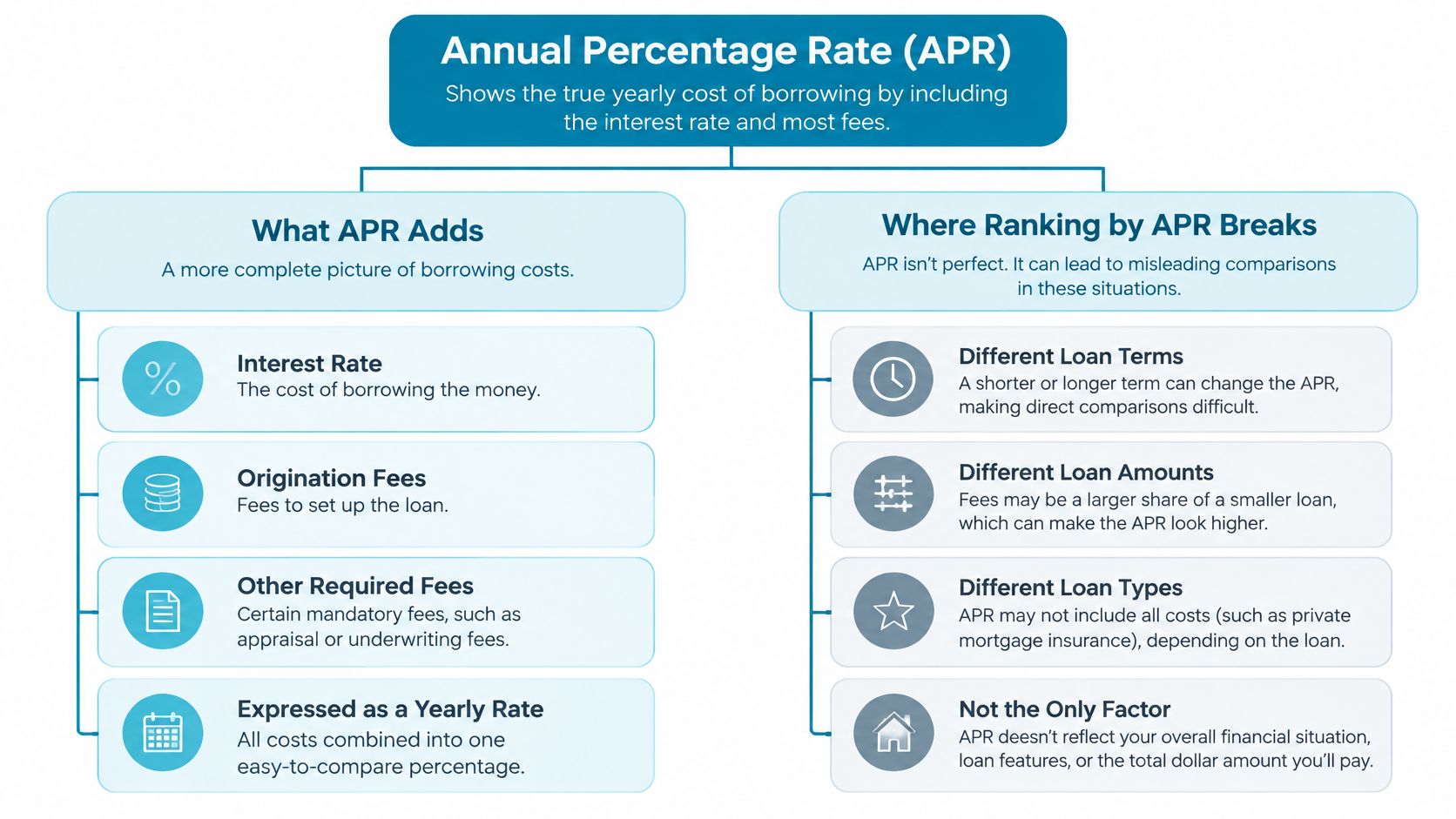
APR adds applicable loan fees to an annualized borrowing-cost measure. The Consumer Financial Protection Bureau's explanation of interest rates and APR distinguishes the interest rate from APR because APR includes additional loan fees.
The important word is applicable. APR isn't every possible dollar you might ever pay under an agreement divided by the loan amount.
Origination, documentation, administrative, and discount charges can count when they qualify as finance charges. The label alone doesn't settle the treatment: what the charge pays for, whether it's required, and the applicable disclosure rules matter.
Scheduled cost isn't worst-case cost
APR describes borrowing under the assumptions used for the disclosure. It doesn't tell you the maximum financial damage possible if payments are missed, the loan is renewed, or additional services are purchased.
Late-payment charges, certain non-payment or default charges, optional insurance, and some third-party costs may sit outside the calculation. Optional products require particular care: confirm that declining the product doesn't change your eligibility or the offered terms.
Through our marketplace, origination, documentation, and other additional fees may apply to online personal loans. Late-payment fees, non-payment fees, and other penalties may apply to both short-term and online personal loans.
Keep these disclosure figures together:
- Interest rate: The percentage used to calculate interest.
- APR: The annualized cost measure incorporating counted finance charges.
- Finance charge: The disclosed dollar cost of credit.
- Amount financed: The amount treated as credit provided to you or on your behalf under the disclosure.
- Total of payments: The scheduled repayment total.
- Payment schedule: The amounts and dates on which repayment is due.
Don't assume the contractual principal, amount financed, and deposited cash are interchangeable. A prepaid finance charge can create a difference between them.
Likewise, don't add a withheld fee to scheduled payments and then also subtract it from proceeds without identifying what you're measuring. To calculate your economic borrowing cost, total your required outflows and subtract your actual net proceeds, counting each charge only once.
When a straight APR ranking becomes misleading
Different terms create a common trap. A longer loan may have a lower annualized cost but leave you paying interest for longer, producing a larger total repayment.
Different proceeds create another. If one lender deducts a fee before depositing the money, the same face-value loan won't fund the same purchase.
Other structures need closer inspection:
- Balloon or interest-only schedules: Smaller early payments can leave a substantial amount due later.
- Variable rates: The disclosed APR depends on the applicable assumptions and doesn't guarantee your future interest expense.
- Single-payment products: A yearly percentage doesn't describe whether you can afford the entire repayment on its due date.
- Bundled add-ons: Optional services can increase your spending without being reflected in the same way as required credit charges.
- Early repayment: Paying sooner may reduce interest, but an already-paid origination fee may not be refundable.
A lower APR doesn't make an unaffordable payment schedule safe, and a lower payment doesn't establish a lower price.
If you expect to repay early, compare offers against that intended payoff date as well as the contractual schedule. Obtain a payoff calculation that includes any prepayment charge and explains how unearned interest or other amounts are handled.
Advertised ranges aren't individualized offers
Our displayed APR range isn't your finance charge. The finance charge is disclosed later, and we can't provide your exact APR before the lender determines the offer.
Our range disclosures describe cost-related factors including calculation methods, duration, loan fees, late-payment and non-payment fees, renewal actions, and other factors. That description shouldn't be read to mean every contingent penalty is included in the originally disclosed APR.
A market average also isn't a personalized quote. It doesn't account for your complete application, the specific fee treatment, or the lender's decision about your eligibility.
The Federal Trade Commission's consumer research on mortgage disclosures found substantial confusion about APR and its distinction from the note rate. Although mortgage structures differ from personal loans, the practical lesson applies: recognize the label, then inspect the transaction behind it.
A Worked Example Where the Two Numbers Disagree
Suppose competing lenders offer the following hypothetical fixed-rate loans. Both use monthly amortization, but one lender deducts an origination fee from the proceeds.
The comparison follows the cash-flow principle discussed in the Federal Reserve's Truth in Lending examination guidance: amounts financed and payment schedules can produce different APRs even when other cost figures appear similar.
Two competing offers for $10,000 over 36 months
| Line | Offer A, 12.00%, no fee | Offer B, 9.00%, fee withheld |
|---|---|---|
| Advertised interest rate | 12.00% | 9.00% |
| Origination fee | $0 | $500, or 5% |
| Cash you receive | $10,000 | $9,500 |
| Term | 36 monthly payments | 36 monthly payments |
| Monthly payment | About $332.14 | About $318.00 |
| Total repaid | About $11,957.15 | About $11,447.90 |
| Total interest | About $1,957.15 | About $1,447.90 |
| APR | 12.00% | About 12.58% |
| Cost per $1,000 received | About $195.72 | About $205.04 |
| Full $10,000 needed | Already funded | Requires a larger principal |
These are hypothetical calculations using unrounded amortization payments; actual payment rounding and the final installment can change totals slightly. Here, cost per $1,000 means repayment above net proceeds, not the repayment of principal itself.
Why the lower rate loses on APR
Offer B requires about $509 less in scheduled repayments, but gives you $500 less upfront. Its lower total repayment therefore doesn't establish that it's cheaper for the same funding need.
For every hypothetical $1,000 received, you repay about $1,195.72 under A versus $1,205.04 under B. That's why B can have both the lower interest rate and the higher APR.
If you need the full hypothetical $10,000 deposited, B must increase the principal to about $10,526.32 so the remaining proceeds cover your need after the fee. Its payment becomes about $334.73, with roughly $12,050.42 repaid, making A cheaper on both APR and total repayment for equal proceeds.
You can test the payment side with our loan calculator, then account separately for withheld fees. A payment calculated from contractual principal doesn't tell you how much money arrives in your account.
Smaller payments need a separate check
Our representative Rates & Fees example shows $5,000 over three years at 10% APR, with $161.34 monthly repayments, $5,808.24 total repayment, and $808.24 total interest.
A separate representative example lists $5,000, an 8% origination fee of $400, 48 months, and 19.25% APR, with $134.16 monthly repayments and $6,439.50 total repayment, including $1,039.50 in interest.
The second example's smaller payment accompanies $631.26 more in total repayment. These published examples illustrate payment trade-offs, not interchangeable offers with identical proceeds and fee treatment.
Normalize cash received first, compare APR second, and check total dollars third.
Why Short Terms and Small Loans Push APR Up
A fixed origination fee takes a larger share of a smaller loan's proceeds. When you also repay quickly, the APR calculation expresses that upfront expense over a shorter borrowing period.
Consider a hypothetical $5,000 contractual principal at a 10% interest rate, with a $500 origination fee withheld. You receive $4,500 regardless of the term, and the payments below repay the contractual principal plus interest.
Hold the fee and rate constant
One $500 fee on a $5,000 loan at a 10% rate, by term
| Term | Monthly payment | Total repaid |
|---|---|---|
| 12 months | About $439.58 | About $5,274.95 |
| 24 months | About $230.72 | About $5,537.39 |
| 36 months | About $161.34 | About $5,808.24 |
| 48 months | About $126.81 | About $6,087.02 |
These hypothetical figures use standard monthly amortization; displayed payments are rounded, and the middle representative total follows the published repayment example. Total repayment excludes a separate addition for the withheld fee because the smaller net proceeds already reflect it.
The short schedule produces the largest payment but the smallest scheduled repayment total. The longer schedule gives you more room each month, while leaving you paying interest for longer.
Annualizing the upfront fee makes the shorter loan look more expensive per year. That doesn't mean you hand over more dollars in total.
Choose a term by checking both your payment capacity and your total repayment, not by trying to make the APR look smaller.
Apply the same reasoning to fee-quoted credit
A flat fee can sound modest when the lender presents it without the repayment period. For single-payment borrowing, inspect how much cash you receive and whether you can repay the full required amount when due.
The Federal Trade Commission's borrowing-comparison guidance emphasizes that knowing only the payment or interest rate isn't enough to compare credit. Read the dollar cost alongside the annualized rate rather than treating either as a substitute for the other.
Our lenders and lending partners offer terms from 61 days to 84 months, with an APR range of 5.99% to 35.99%. Those endpoints describe a marketplace range, not an assurance that every combination is available to you.
Some states cap APR and charges. Loans from a state without limiting laws, or from a bank not governed by those state limits, may carry a higher APR.
Use our guide to choosing a personal loan term to weigh payment size against repayment length. Your target should be a schedule you can sustain without borrowing again to make the payments.
How to Compare Two Loan Offers Before You Sign
Keep both written offers open and compare the same fields side by side. If a field is missing, treat the comparison as incomplete rather than assuming the lenders handle it identically.
Run the comparison in order
Start with deposited cash. Record what you'll receive after withheld charges, not just the approval amount. Make sure either offer fully covers the expense you're trying to fund.
Match repayment length and frequency. Compare the actual calendar of required payments. A monthly-equivalent budget estimate can help with weekly or biweekly installments, but it doesn't replace the contractual due dates.
Put the APRs together. If proceeds or schedules differ, don't declare a winner from the percentages alone. Request comparable structures where available, or explicitly account for the differences.
Calculate scheduled repayment. Multiply each payment by the number due, then include any different final payment or balloon amount. Add separately paid mandatory charges only if they aren't already included.
List costs outside the APR. Record optional insurance, late-payment and non-payment charges, and any renewal costs. Don't assume a fee is excluded merely because it has a particular name.
Check early-payoff treatment. Find any prepayment penalty and determine whether paying early reduces future interest. Identify which upfront charges, if any, remain nonrefundable.
Read the missed-payment terms. Locate the lender's late-payment policy and any default-rate provision. Through our marketplace, these policies are set by the individual lender and appear in the loan agreement.
Save the disclosure before accepting. Keep the agreement and payment schedule in a form you can retrieve. Don't sign while the deposited amount, total repayment, or fee treatment remains unclear.
Use estimates for planning, offers for decisions
Our calculator estimates monthly payment, total interest, payoff date, and how the balance changes over time. It includes rate and term presets for each loan type, so replace those assumptions with the actual proposed terms when evaluating an offer.
Lender fees, APR, and terms arrive with the loan offer, and you're under no obligation to accept them. A calculator result is a planning estimate, not confirmation that a lender will approve those terms.
If you're replacing existing balances, our guide to getting a debt consolidation loan can help you organize that decision. Compare the new loan's full repayment obligation with the debts it would replace, rather than judging consolidation by its monthly payment alone.
A single request through our marketplace can be reviewed by multiple independent lenders. The lender alone makes the approval decision and sets the terms; we don't set your rate or decide whether to fund the loan.
Choose the offer that provides the cash you need, has a payment schedule you can sustain, and gives you the best combination of APR and total dollar cost.
NextStopLoans connects your online loan request with independent lenders so you can review any offered APR, fees, and repayment terms before deciding. Visit NextStopLoans to submit a request, then compare the lender's net proceeds and total payments alongside its interest rate. You're under no obligation to accept an offer.