
How to Apply for a Personal Loan Online the Smart Way
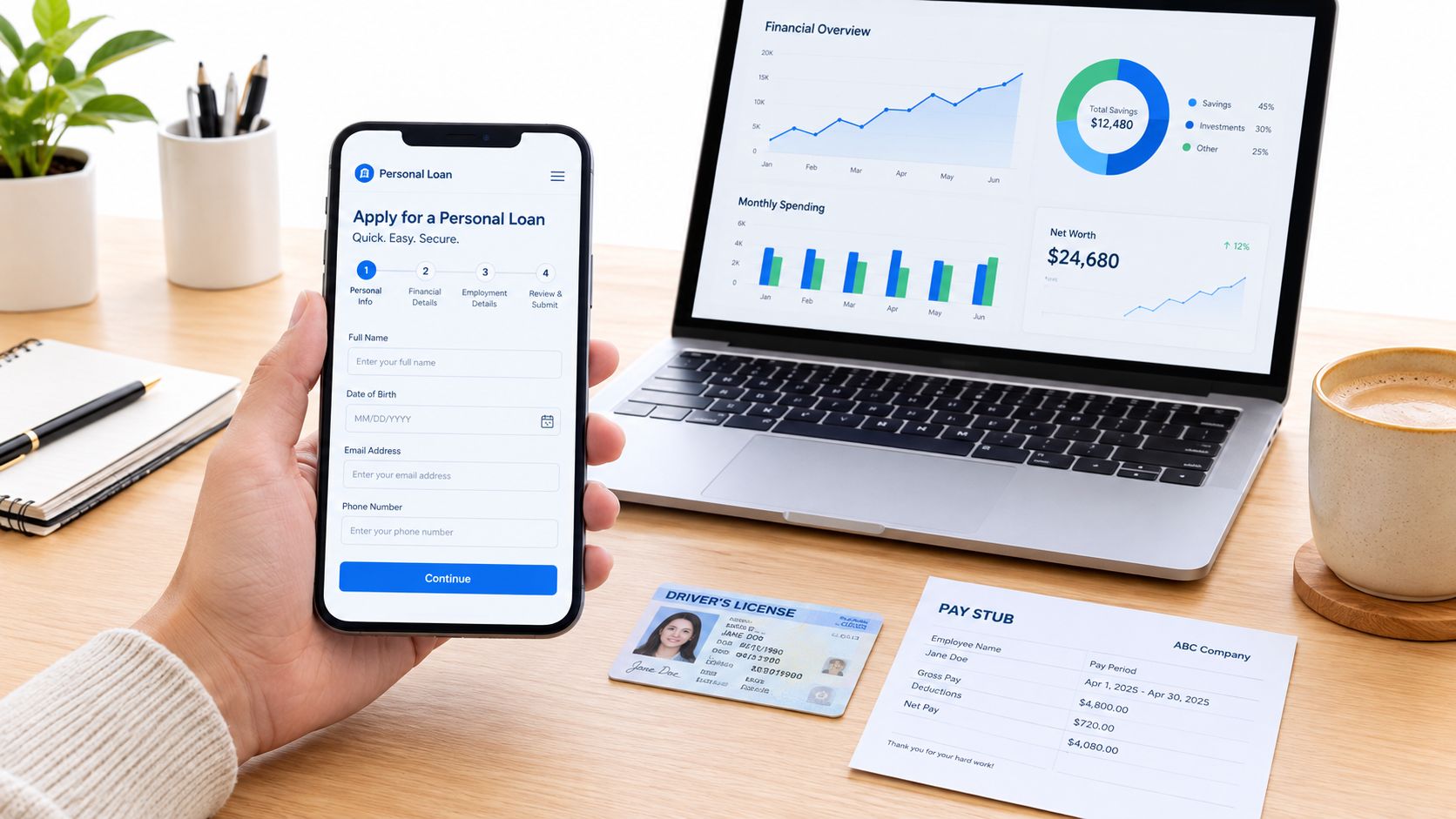
Your car repair estimate lands in your inbox before lunch. By dinner, you're on the sofa with your phone, entering your income and bank details into an online loan form, hoping the word “approved” appears before the repair shop closes. The form may take minutes, but the money follows a separate path. Understanding that difference is the key to applying quickly without overlooking the cost, terms, or security of the loan.
Table of Contents
- Why More Borrowers Are Filling Out Loan Forms From Their Phones
- Eligibility and Document Checklist Before You Apply
- Filling Out the Secure Online Application Step by Step
- E-Consent, Credit Pulls, and Electronic Signatures Explained
- From Submission to Funding and What Affects the Timeline
- Habits That Actually Improve Your Approval Odds
- Quick Action Checklist and Common Questions
Why More Borrowers Are Filling Out Loan Forms From Their Phones
A phone-first loan application makes sense when the expense can't wait. You can open a secure form from home, during a break, or from the repair-shop parking lot. You don't need to arrange a branch appointment, carry a paper file, or wait for one bank employee to review your request.
Digital applications have moved from an unusual alternative to a standard part of borrowing. One consumer-trends study found that 65% of recent loan applicants used a computer or mobile device for at least part of an application, compared with 56% in 2018. You can review that finding in the digital loan approval statistics report.
The advantage isn't just access. Online forms let you begin with prequalification, compare potential offers, and provide information once instead of repeating the same story at several branches. A traditional application might involve printed documents and multiple handoffs. An encrypted web form puts identity, income, requested amount, and banking information into a single digital workflow.
Practical rule: Treat the first submit button as the start of the process, not the finish line.
The lender or marketplace still has to route your request, assess your information, verify your identity, present terms, and release funds. Some lenders can generate an automated decision quickly, but approval and funding aren't interchangeable. A lender can approve the request while your bank transfer remains pending.
That two-stage reality explains why online borrowing feels fast at first and slower afterward. The form is designed for speed. Underwriting and disbursement depend on the lender, your documents, your bank, and whether anything in your application needs a closer look.
Eligibility and Document Checklist Before You Apply
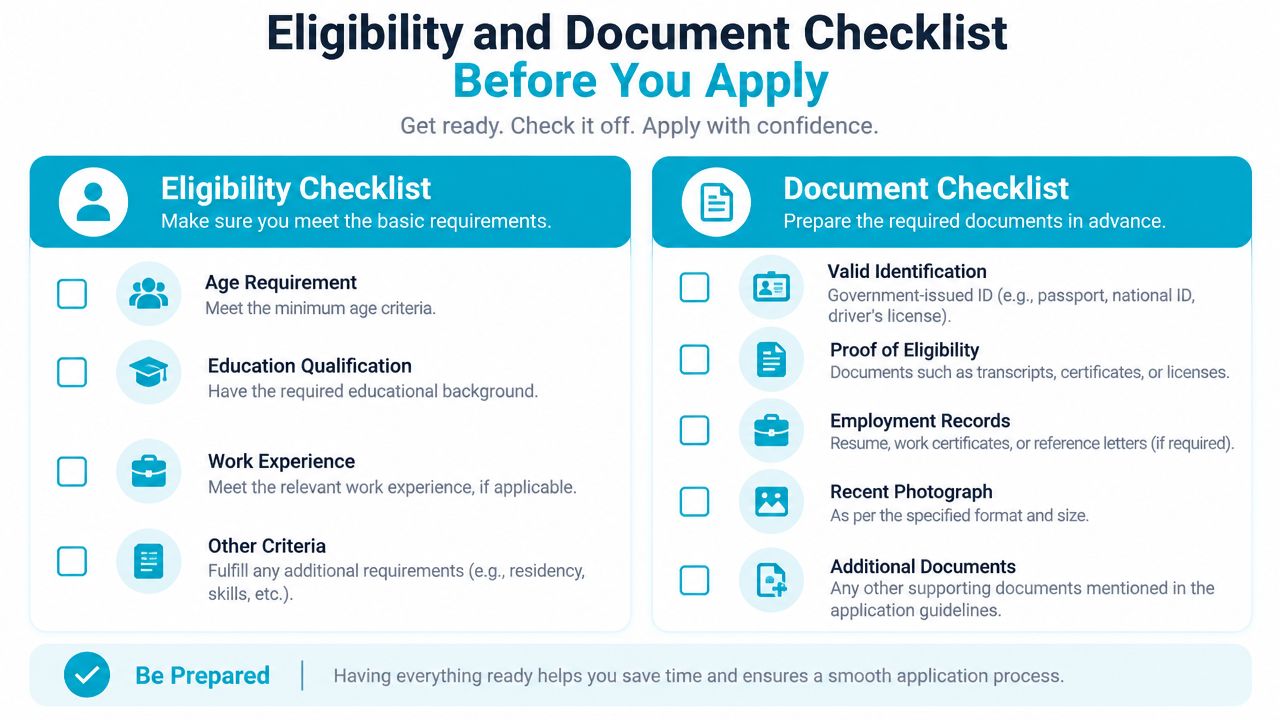
Preparation has more influence over your timeline than rushing through the form. Before you visit a lender or marketplace, confirm that you meet its basic requirements and put your verification documents in one secure folder.
Most online personal-loan providers look for several baseline signals:
- Age and residency: You'll generally need to be at least 18 and eligible to borrow in the United States. Citizenship or permanent-resident requirements vary by provider.
- Verifiable income: Employment income, self-employment income, benefits, or another accepted source must be documented clearly.
- Active checking account: Lenders usually need an account in your name for verification and potential direct deposit.
- Working contact details: Use a phone number and email address you control. Lenders may use both for identity checks and disclosures.
- Affordable repayment: Your income and existing obligations must support the requested payment under the lender's underwriting rules.
Exact credit requirements differ. A baseline score of 580 or higher may open more doors, but no score guarantees approval, pricing, or a particular loan amount. Review your credit report for incorrect accounts, late payments, or outdated personal information before submitting a request.
Calculate your debt-to-income ratio as a practical self-check. Add your recurring monthly debt payments, then compare that total with gross monthly income. You don't need to guess what a lender will approve, but you should know whether the new payment would leave your budget strained.
Stage your documents
Have clear digital copies ready before you start:
- Government-issued photo ID
- Social Security number
- Recent pay stubs or bank statements
- W-2 forms or 1099 forms if you're self-employed
- Proof of address
- Checking-account details for verification and deposit
Your legal name, address, employer, and income should match across the application and supporting documents. Small inconsistencies can lead to additional questions or manual review. For more background on the factors lenders commonly consider, review this guide to personal loan eligibility.
Finally, check state availability before sharing personal data. Online lenders don't all operate nationwide, and a form may redirect you only after you've entered information. Confirm that the provider serves your state and read its privacy, rates, fees, and lender-partner disclosures first.
Filling Out the Secure Online Application Step by Step
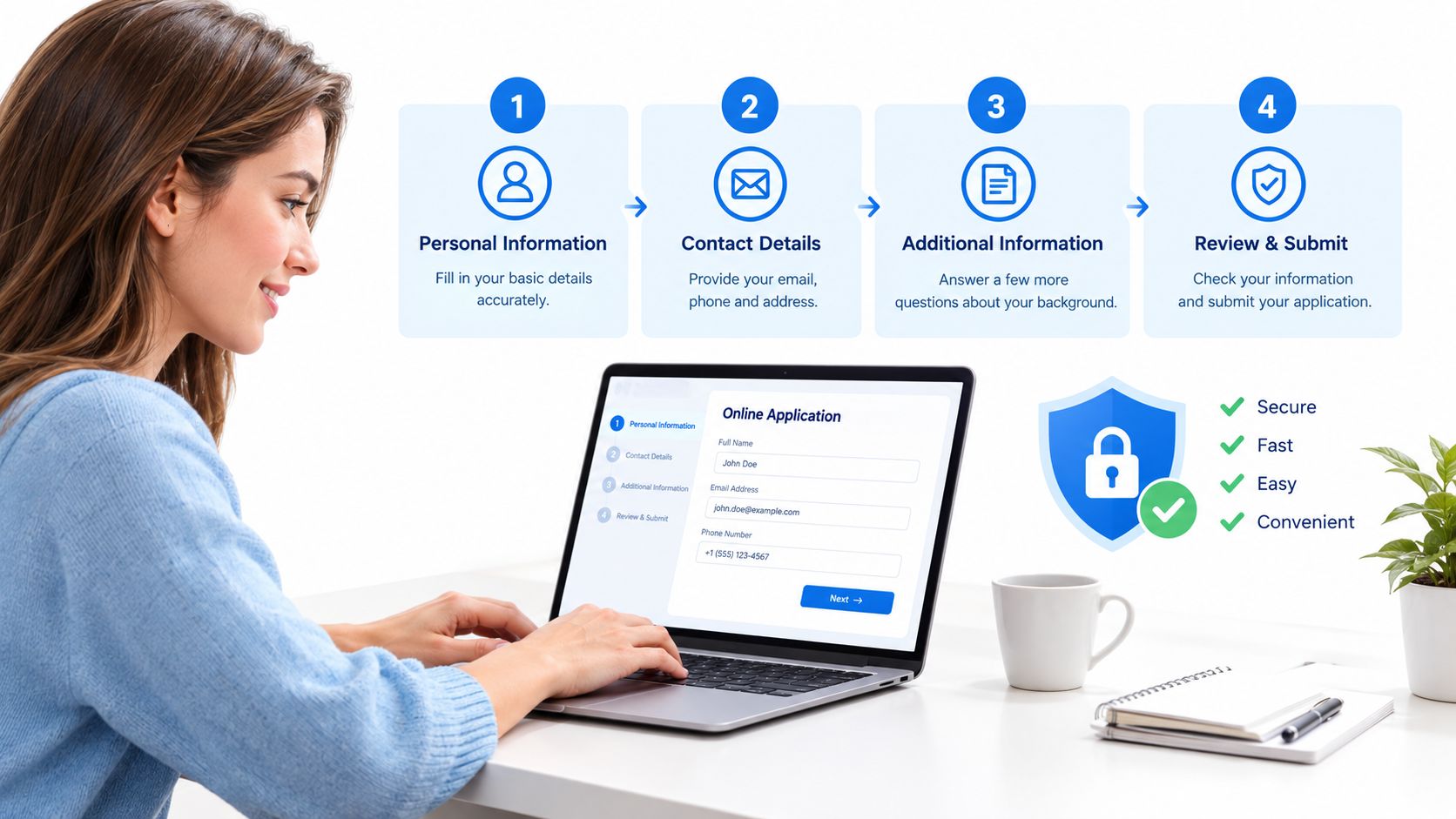
A good application is accurate, complete, and boring. Don't try to make your profile sound stronger by rounding income upward or choosing an employment category that doesn't fit. Automated systems compare the form with identity, banking, and credit data, so consistency matters more than optimism.
Enter personal information exactly
Start with your full legal name, date of birth, Social Security number, phone number, and email address. Use the name shown on your government ID. A nickname or shortened surname can create an avoidable identity-verification problem.
Enter your current address and residence status carefully. If the form asks about address history, provide the requested details in the same format used by your official records. Lenders use this information to help confirm that you are a real applicant and that the bank account and identity data belong together.
Report income with a clear source
Use gross income when the form requests it, not the amount that reaches your account after deductions. Select the correct income source and include only income you can verify. If you have multiple sources, follow the form's instructions rather than combining figures in a way that hides where the money comes from.
Employment details should match your documentation. Your employer name, work status, and income frequency can affect the lender's ability to verify repayment capacity. If you're self-employed, keep tax forms, account records, and business-income documentation available in case the lender asks for more evidence.
Choose the request details
Enter the amount you need and select the most accurate loan purpose. Borrowing more than necessary can increase the payment and total cost. Choosing a longer repayment term may reduce the scheduled payment, but it can extend the time you pay interest. Compare APR, fees, payment amount, and total repayment before accepting an offer.
A marketplace connector works differently from a direct lender. With a connector such as NextStopLoans, one completed request can be routed to participating lenders in its network, so you don't have to retype the same information on multiple lender sites. The connector doesn't make the credit decision or set the terms. Participating lenders decide whether to offer financing and control the final conditions.
Reputable platforms should display HTTPS, explain how they protect submitted information, and identify the parties that may receive your request. Read the privacy and lender-partner disclosures before proceeding. Your next click may authorize electronic communications and permit an initial prequalification review.
E-Consent, Credit Pulls, and Electronic Signatures Explained
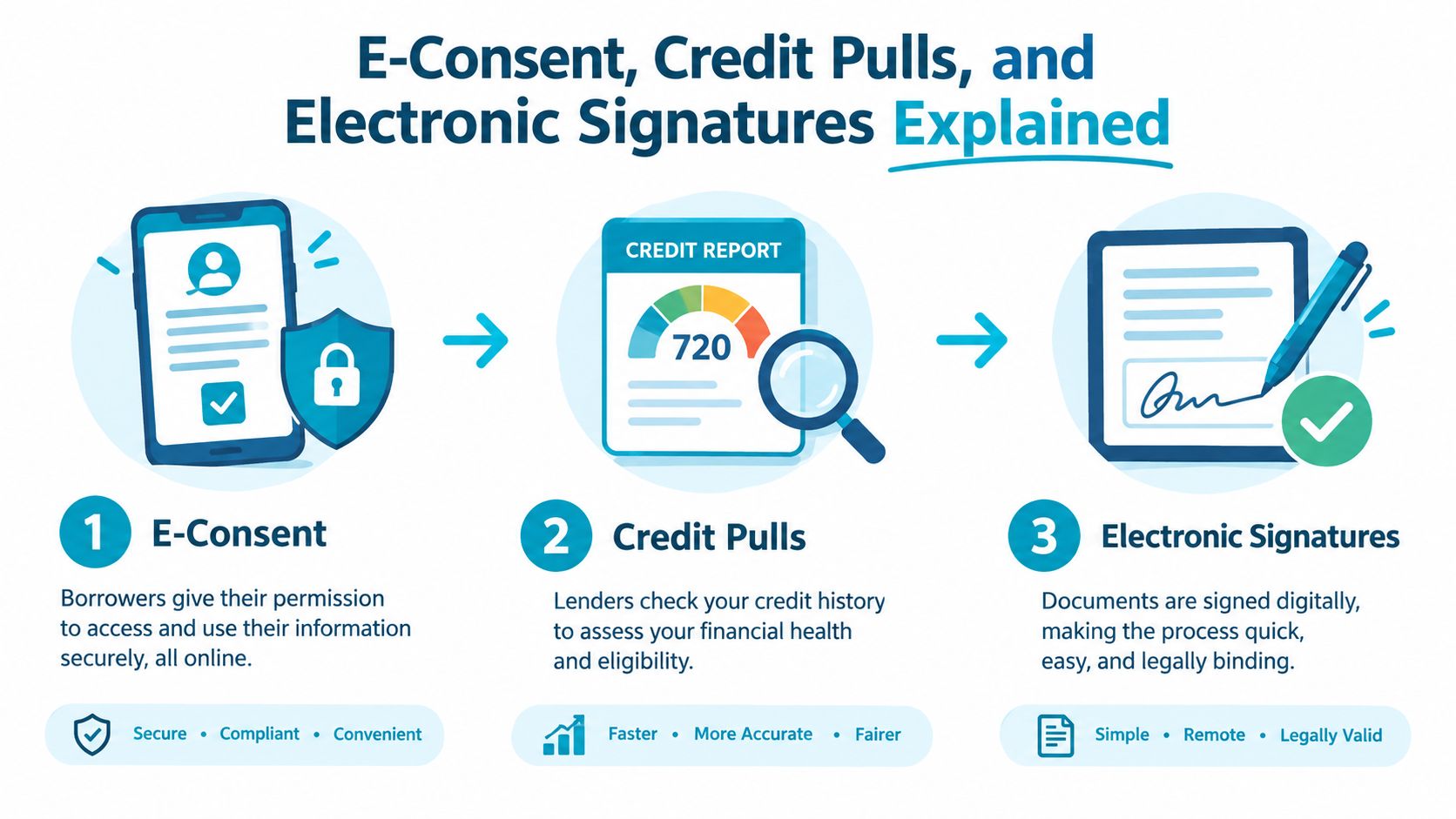
The authorization screens deserve as much attention as the application fields. Borrowers often click through them quickly, then discover later that they agreed to electronic delivery, data sharing, repayment debits, or a formal credit inquiry.
E-consent changes the paperwork
An E-Consent Disclosure gives permission for the lender or platform to provide notices, disclosures, agreements, and other documents electronically. It replaces the need for paper delivery in the digital workflow. You should confirm that you can access, save, and print electronic records before accepting.
A consent required to process the request isn't the same as a marketing opt-in. Promotional emails, text messages, or partner offers may be optional. Look for separate checkboxes and don't assume every box must be selected to continue.
Soft and hard inquiries serve different purposes
A soft-credit prequalification review helps a lender estimate eligibility and potential pricing without the same score impact as a hard inquiry. It isn't a guaranteed offer. The lender may perform a hard pull later, usually when you move forward with a specific loan offer and formally authorize the next stage.
This distinction matters because marketplace platforms may route one request to multiple lenders while the marketplace itself doesn't pull credit. Participating lenders may still review your credit through major or alternative bureaus, and their disclosure should explain when that can happen. Read the explanation of the personal loan soft pull before you agree.
Some lenders use more than a conventional score. They may assess banking patterns, income data, or other information during underwriting. Don't interpret “no credit check” language as “no information is reviewed.” Ask which company performs the check, what type it is, and whether the lender may request more data after prequalification.
Signing creates real obligations
Electronic signing usually confirms the loan amount, APR, payment schedule, fees, and repayment term. It may also authorize ACH withdrawals from your checking account and include dispute-resolution or arbitration provisions. Save the completed agreement, disclosures, and payment schedule immediately.
Use this safety routine:
- Check for HTTPS and the correct website address.
- Read the APR, fees, payment dates, and cancellation language.
- Confirm the lender's legal name before signing.
- Separate required consent from optional marketing permissions.
- Save or screenshot the signed agreement and disclosure package.
From Submission to Funding and What Affects the Timeline
The online process has a fast front end and a less predictable back end. One industry compilation reports an average application time of 15 minutes, with average funding in 24 to 48 hours, while another provider describes instant decisions for many completed applications and funding as fast as the next business day. Review the personal loan application process for an example of how an online lender describes these stages.
A realistic sequence looks like this:
- Automated review: The system checks the submitted information and may produce an initial response quickly.
- Lender underwriting: The lender verifies identity, income, bank details, and affordability.
- Offer review: You compare the loan amount, APR, fees, payment, term, and funding conditions.
- Electronic signing: You accept the agreement and complete any remaining authorization.
- Disbursement: The lender sends funds according to its process and bank-transfer cutoffs.
Typical timing by stage
| Stage | Typical Duration | Most Likely Delay |
|---|---|---|
| Automated review | Minutes | Incomplete or inconsistent information |
| Lender underwriting | Same day to longer | Extra identity or income verification |
| Offer presentation and acceptance | Depends on borrower | Comparing terms or missing a deadline |
| Loan-document signing | A short online session | Unread disclosures or failed identity check |
| Disbursement | Same day to next business day | ACH cutoff, weekend, holiday, or bank processing |
Approval isn't the same as cash in your account. A lender may approve you today, but the transfer can arrive later because the lender has closing steps to complete or the receiving bank doesn't process the deposit immediately. Online lenders may fund faster than banks or credit unions, but each provider sets its own schedule.
The requests that most often slow funding are predictable: a recent pay stub, bank statements showing deposits, proof of address, or tax records for a self-employed applicant. A checking account in your name, matching personal details, and clean documentation give the lender fewer reasons to pause.
A marketplace can speed the early routing process by sending your request to lenders whose criteria may fit your profile. It can't force an approval, override a verification request, or control when a lender releases money. For a practical timing comparison, see how long loans take to process.
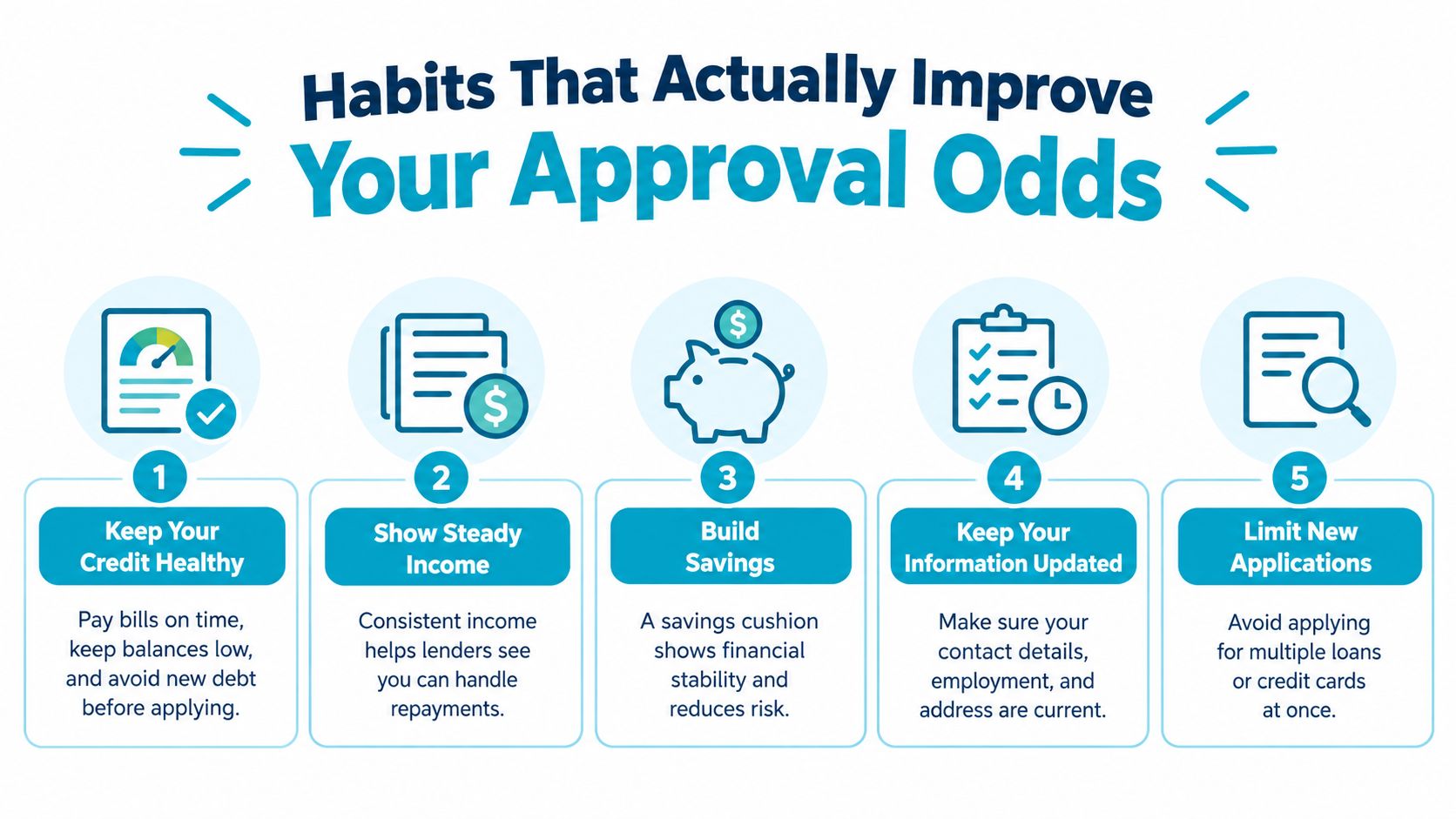
Habits That Actually Improve Your Approval Odds
Approval outcomes depend on lender criteria, but your preparation still controls several important variables. The strongest applications present a stable income story, consistent personal data, and documents that a lender can verify without chasing you.
Focus on these habits:
- Show a reliable income trail: Use the account that receives your regular deposits, and make sure your stated income can be supported by records.
- Reduce existing balances: Paying down revolving debt can improve the affordability picture before you apply.
- Match every field: Enter your legal name, address, employer, and income exactly as they appear on your documents.
- Start with prequalification: Compare potential offers through a soft-credit review before authorizing a formal hard inquiry.
- Prepare verification files: Keep your ID, recent pay stubs, and bank statements ready to upload if requested.
The debt-to-income ratio deserves attention before the application, not after a lender flags it. Paying down a revolving balance may make your monthly obligations easier to manage and may present a cleaner repayment profile. Do not take on a new obligation just to improve an application. The new payment still has to fit your budget.
Avoid scattering applications across several platforms at once. Multiple submissions can create confusion, repeat data-sharing permissions, and lead to more than one lender reviewing your file. A connector that performs an initial marketplace intake and routes the request can be more efficient, but you still need to inspect every offer independently.
Quick Action Checklist and Common Questions
Use this list before you submit:
- Check your credit report and review your debt obligations.
- Calculate whether the proposed payment fits your budget.
- Gather ID, income records, proof of address, and bank details.
- Decide the amount and repayment term you can handle.
- Compare APR, fees, payment, and total repayment.
- Read E-Consent and credit-inquiry disclosures.
- Complete identity and bank verification.
- Sign electronically only after reviewing the final agreement.
- Track the lender's funding timeline and respond quickly to requests.
Common questions
How is a marketplace different from a direct lender? A marketplace collects one request and routes it to participating lenders. A direct lender evaluates the request, sets terms, and funds the loan itself.
Can every state use the same online form? No. State availability varies by provider, so confirm eligibility before applying.
How long does approval take? Prequalification can be quick, while final approval depends on verification and underwriting. Funding can take longer than approval.
What delays funding most often? Missing documents, inconsistent information, identity checks, bank-account issues, and transfer cutoffs are common causes.
Does a marketplace charge borrowers? Review the marketplace's disclosures. The connector may provide the request service without charging the borrower, while participating lenders set their own loan terms and fees.
NextStopLoans offers a secure online request form that can route your personal-loan information to independent lenders in its network, with decisions and funding handled by those lenders. If you want to compare a digital request path without re-entering the same details across multiple sites, visit NextStopLoans and review the disclosures before submitting.