
Is Debt Consolidation Worth It? the Real Math

You're staring at several credit card statements, each with a different due date, minimum payment, and interest rate. You make every payment, yet the balances barely move. The question isn't whether another loan sounds convenient. It's whether replacing those accounts with one loan will leave you with less total debt cost, or merely a lower payment that lasts longer.
Debt consolidation can be worth it, but only under specific conditions. The new borrowing must have a meaningfully lower APR, fees must not consume the savings, and you must stop adding new revolving debt. Otherwise, consolidation is just a reshuffle. The old balances disappear, but the financial problem remains.
Table of Contents
- The Reality of Juggling Multiple Balances
- How a Consolidation Loan Actually Works
- The Math Behind the Interest Rate Spread
- When Consolidation Makes Financial Sense
- The Hidden Risks and Behavioral Traps
- Alternatives to Consider Before Applying
- How to Get Started with a Loan Request
The Reality of Juggling Multiple Balances
Suppose you're paying four credit cards. One payment is due near the start of the month, another in the middle, and the rest later. You track minimums, transfer money between accounts, and watch most of each payment go toward interest. A single installment loan can replace that maze with one fixed payment and a defined payoff date.
That simplification matters. Missed dates become less likely, budgeting becomes more predictable, and the balance follows an amortization schedule rather than a revolving minimum-payment cycle. But convenience isn't the same as savings. Consolidation only creates a financial benefit when the replacement debt is cheaper after all fees and over a comparable payoff period.
A consolidation loan typically pays off multiple unsecured debts, such as credit cards, with one new personal loan. You then owe the new lender instead of the card issuers. A debt management program works differently. A credit counseling agency may negotiate payment arrangements with creditors, and you make payments through the program. It doesn't usually create a new loan that immediately replaces your balances.
The central rule: Consolidation solves a rate and cash-flow problem. It doesn't solve overspending.
That distinction should shape your decision. If your cards are high-interest but your income is stable and your spending is under control, refinancing may reduce the cost of repayment. If you're using cards to cover regular expenses because the budget already runs short, a new loan can create temporary breathing room while leaving the cause untouched.
The right question is therefore more precise than “Can I combine my debts?” Ask: Will this loan reduce total repayment cost, give me a manageable fixed schedule, and prevent the balances from returning? If the answer to any part is no, you should consider another strategy.
How a Consolidation Loan Actually Works
A personal-loan marketplace generally follows a straightforward sequence, although the lender, not the marketplace, decides whether to approve your request and what terms to offer.
Start with one secure request
You provide basic information about your identity, income, requested amount, and intended use. Choose debt consolidation as the purpose when that option is available, then review the disclosures before submitting. NextStopLoans operates as a connector to independent third-party lenders. It doesn't make credit decisions, set loan terms, or fund loans itself.
The marketplace can route one intake form through its lender network. That differs from contacting several lenders separately, although participating lenders may still perform their own credit checks and underwriting.
Review the matched offers
A lender may evaluate your credit profile, income, existing obligations, and other information. Compare the APR, origination fee, monthly payment, repayment term, and total repayment amount. Don't choose an offer because its payment is the smallest. A long term can reduce the payment while increasing the interest paid over the life of the loan.
The marketplace itself doesn't pull credit, but a participating lender may check credit through major or alternative bureaus. Read the terms carefully before accepting anything, especially if the offer includes a variable rate, collateral, or conditions that differ from the initial estimate.
Use the funds to eliminate the old balances
After approval and acceptance, the lender funds the loan according to its process. In some cases, the money goes to you and you pay the card issuers. In others, the lender may send funds directly to creditors. Confirm that every old account shows a zero balance before treating the consolidation as complete.
Keep payment confirmations and statements. Interest or fees can continue to post briefly after a payoff, and an account can remain open even after its balance reaches zero.
Replace revolving payments with one schedule
Your new loan has a fixed installment amount and a scheduled end date if it carries a fixed rate. Set automatic payments from an account with a reliable cash buffer, then redirect the old card payments toward the new obligation or savings. Don't spend the newly available card capacity just because the accounts show zero balances.
The transaction changes your repayment structure. It doesn't erase the principal you borrowed, and it doesn't guarantee that your credit cards will be closed. Your behavior after funding determines whether the new structure produces a lasting result.
The Math Behind the Interest Rate Spread
The strongest case for consolidation is the gap between expensive revolving credit and a cheaper fixed-rate loan. The average credit card APR was 22.15% in Q2 2026, while the average APR on a two-year bank personal loan was 11.86% in May 2026, according to debt consolidation market data. That spread can materially reduce interest costs for a borrower who qualifies, especially when repayment will take many months rather than a short promotional period.
| Debt Type | Average APR (2026) | Repayment Structure |
|---|---|---|
| Credit cards | 22.15% in Q2 2026 | Revolving balance with variable minimum payments |
| Two-year bank personal loan | 11.86% in May 2026 | Fixed-rate installment schedule |
For a different explanation of how loan pricing works, review this guide to personal loan APR rates. Your own comparison should begin with a weighted average APR, not the rate on your highest-cost card.
Calculate it by multiplying each balance by its APR, adding those results, and dividing by the total balance. For example, a card with a large balance should influence the average more than a card with a small balance. Compare that weighted figure with the prospective loan APR, then account for fees and the repayment period.
The break-even calculation
Use this framework:
Net consolidation benefit = interest avoided over the comparable payoff period minus origination fees, transfer fees, and other borrowing costs.
The phrase “comparable payoff period” matters. If your cards could be repaid within a certain period but the new loan stretches repayment substantially longer, comparing only monthly payments will mislead you. A lower payment may reflect slower principal reduction, not a cheaper debt strategy.
Request the loan's total repayment figure and compare it with a realistic estimate of what you'd pay by keeping the cards and following a fixed payoff plan. Include any origination fee in the new loan's cost. If the lender deducts the fee from the proceeds, make sure the net funds are still enough to clear the old balances.
Practical rule: Reject any offer that saves money only because it postpones the final payment.
A positive break-even result isn't enough by itself. The payment must fit your budget without forcing you back onto the cards. The new APR should be meaningfully below your weighted card rate, the term should be no longer than necessary, and the fee-adjusted savings should remain positive.
When Consolidation Makes Financial Sense
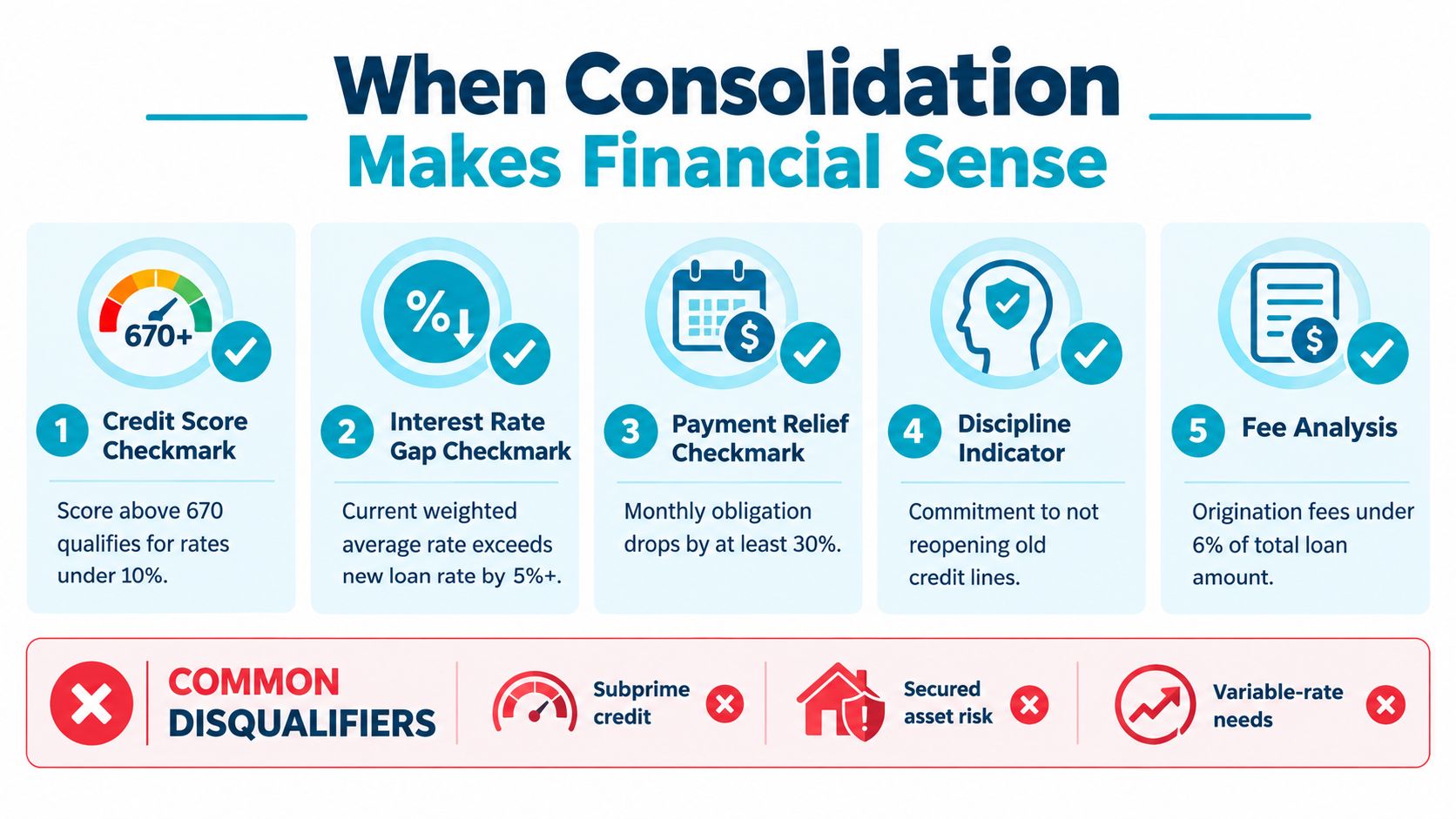
Consolidation works best for a borrower with three characteristics: expensive revolving debt, reliable income, and access to a materially lower fixed rate. Remove any one of those and the case weakens quickly.
Credit quality heavily influences the offer. Lenders generally reserve their lowest pricing for stronger borrowers. Someone with a solid credit profile may receive a rate that creates a clear spread over card APRs. Someone with damaged credit may receive an offer so expensive that replacing the cards increases total interest.
That doesn't mean a borrower with poor credit has no options. Alternative lending networks may consider income, payment history, or other underwriting factors beyond a traditional score. But broader access isn't the same as favorable pricing. Read the APR and total repayment, not the approval message.
Compare the borrower profiles
| Borrower situation | Likely decision |
|---|---|
| Stable income, high card APRs, lower fixed-rate offer | Consolidation may be financially sound |
| Lower monthly payment caused by a much longer term | Usually reject or shorten the term |
| New loan APR near or above the weighted card APR | Consolidation is unlikely to save money |
| Income already falls short of regular expenses | Address the budget before refinancing |
| Strong intention to reuse paid-off cards | Do not consolidate yet |
The size of the debt also affects the decision. Historical market data shows consolidation was the stated purpose for 63.3% of closed personal loans in Q2 2023 and 67.66% in Q2 2026, indicating sustained demand for this use case in the cited market data. Nearly half of debt consolidators borrowed between $10,000 and $20,000, according to survey and loan-amount data. These figures don't prove that consolidation is right for you, but they show why the rate and behavior decisions can have meaningful consequences when balances are substantial.
Set your success conditions
Before applying, write down the cards you'll pay off, each balance, each APR, and the amount you can consistently pay each month. Decide what happens to the old accounts. Freezing them, removing them from mobile wallets, or closing selected accounts can create friction between you and new spending, although closing accounts can affect your credit profile.
Use a personal loan eligibility guide to understand the information lenders may request, then make the decision from the actual offer. If the rate isn't meaningfully lower after fees, walk away.
The Hidden Risks and Behavioral Traps
The most dangerous moment comes after the lender pays off your cards. The balances show zero, your available credit rises, and the old accounts feel harmless. That “freed-up” limit can become an invitation to spend again.
This is how a consolidation plan turns into two debts. You keep the personal-loan payment while rebuilding the card balances. The first loan didn't fail mathematically. The borrower reopened the original borrowing channel.
Survey evidence makes that risk concrete. A 2025 survey cited by Forbes Advisor debt-consolidation reporting found that 45% of respondents had missed a payment on their consolidation loan. The same survey found 18% expected to fall back into debt within six months, while another 35% expected that outcome within six months to one year. Only 4% believed they would remain debt-free after repaying the loan.
Those results don't mean consolidation causes relapse. They show that refinancing alone doesn't change spending patterns. The structure can be sound while the plan fails because the borrower keeps using credit to finance a deficit.
Build a behavioral firewall
- Remove easy access: Delete saved card numbers from shopping accounts, remove cards from digital wallets, and physically destroy cards you won't use.
- Automate the new payment: Schedule the installment payment for a date shortly after income arrives, then monitor the account for failed transfers.
- Find the monthly leak: Review recurring charges, discretionary spending, and irregular expenses. A loan can't compensate for a budget that remains negative.
- Keep one controlled backup: If you retain a card for genuine emergencies, set a low internal limit and don't treat its full credit line as available spending money.
- Track the principal: Check the loan balance regularly. Seeing the balance fall reinforces the payoff objective and exposes missed payments early.
Equifax's guidance emphasizes that consolidation doesn't fix overspending and works best with stable income, a fixed budget, and no new revolving debt accumulation in its debt-consolidation overview. Treat those conditions as requirements, not optional advice.
Alternatives to Consider Before Applying
A consolidation loan isn't automatically the best tool. Match the strategy to the debt, the available rate, and your ability to follow the required behavior.
Balance transfers
A balance-transfer card can suit someone with a manageable balance and a credible plan to clear it during the promotional window. The attraction is a temporary low rate, but the offer can stop being useful if you can't repay before the promotional period ends or if the transfer fee consumes the savings.
This option demands strict calendar discipline. Don't transfer balances to create another open line of credit. Calculate the required monthly reduction and confirm that your budget can support it without using the card for new purchases.
Avalanche and snowball repayment
The debt avalanche method directs extra money toward the highest APR first while maintaining required payments elsewhere. It usually appeals to borrowers focused on interest efficiency. The debt snowball method targets the smallest balance first, which can create visible progress and motivation.
Neither method changes the interest rate. Both can work when your income supports repayment and the balances aren't so expensive that interest overwhelms your progress. They also avoid taking on a new loan, which removes origination costs and a second opportunity to borrow.
Debt management programs
A debt management program may help when the primary problem is payment complexity or when a borrower can't secure a favorable personal-loan APR. A counseling agency can help organize payments and may work with creditors under program rules. This isn't the same as receiving a new loan, so compare the fees, account restrictions, timeline, and creditor requirements before enrolling.
Settlement and secured borrowing
Debt settlement belongs in the severe-distress category, not as a routine first choice. It can involve serious credit consequences, fees, and uncertainty, so obtain professional guidance before signing anything.
Home equity loans and HELOCs may offer secured borrowing terms, but they place the home at risk if payments aren't made. A lower rate isn't worth exchanging unsecured card debt for a threat to your housing.
How to Get Started with a Loan Request
Apply only after you've completed the break-even calculation and decided how you'll prevent new card balances. The application is the easy part. Selecting a loan that improves your position requires careful preparation.
Gather the numbers first
Prepare your outstanding balances, APRs, monthly payments, income information, identification, and preferred loan amount. You should know the exact payoff amount for each account, not just the balance shown on an older statement. Also calculate the payment you can afford without relying on credit cards for routine expenses.
Review the lender's APR range, fees, term, total repayment, late-payment policy, and funding conditions. If the offer doesn't provide a meaningful advantage over your current weighted rate, don't accept it merely because the payment looks simpler.
Submit one secure request
An online marketplace can route a request to independent lenders through one intake process. NextStopLoans describes a secure workflow using 256-bit SSL encryption and electronic consent, with lenders handling approval, terms, and funding. The marketplace isn't the lender, and you aren't required to accept an offer.
For a practical walkthrough of the process, use this guide to apply for a personal loan online. Submit accurate information, read each disclosure, and avoid applying repeatedly without comparing the likely credit-check and underwriting consequences.
Evaluate and close the loop
Matched responses may arrive quickly, but timing depends on the participating lender. Funding may occur by direct deposit as soon as the next business day, subject to lender processes and approval. Don't assume speed means suitability.
After accepting an offer, verify that every intended account is paid in full. Set automatic payments on the new loan, preserve payoff records, and implement your behavioral firewall immediately. The plan succeeds when the cards stay paid off until the installment balance reaches zero.
NextStopLoans provides an online marketplace that routes personal-loan requests, including debt-consolidation requests, to independent third-party lenders. If your math shows that refinancing could reduce your total cost, visit NextStopLoans to submit a secure request and review any lender terms without obligation.