
Is 619 a Good Credit Score? a Clear 2026 Guide

A 619 FICO score is classified as Fair, not Good, and sits 51 points below the conventional Good threshold of 670. It's workable, but borrowers with a score in this range typically face higher borrowing costs than applicants with stronger credit.
You might be checking your score before applying for a personal loan, car financing, or a credit card, hoping the number gives you a clear yes or no. It doesn't. A 619 is a decision point, not a verdict: some lenders may consider your application, while the rate, fees, loan amount, and repayment terms depend on the lender and the rest of your financial profile.
Table of Contents
- Where a 619 Score Leaves You Right Now
- How FICO and VantageScore Define the Bands
- What the CFPB and Industry Data Say About 619
- How a 619 Score Translates Into Real Loan Offers
- Loan Pathways Worth Considering at 619
- Habits That Actually Move a 619 Score Upward
- How a Loan Marketplace Fits Into a 619 Strategy
- Your 619 Credit Game Plan Checklist
Where a 619 Score Leaves You Right Now
FICO's standard scoring model runs from 300 to 850. A 619 sits near the top of the Fair band, which spans 580 to 669, just below the Good band that begins at 670 (FICO's credit-score range guide). That shortfall matters, because lenders may use your score to gauge risk and price your loan accordingly.
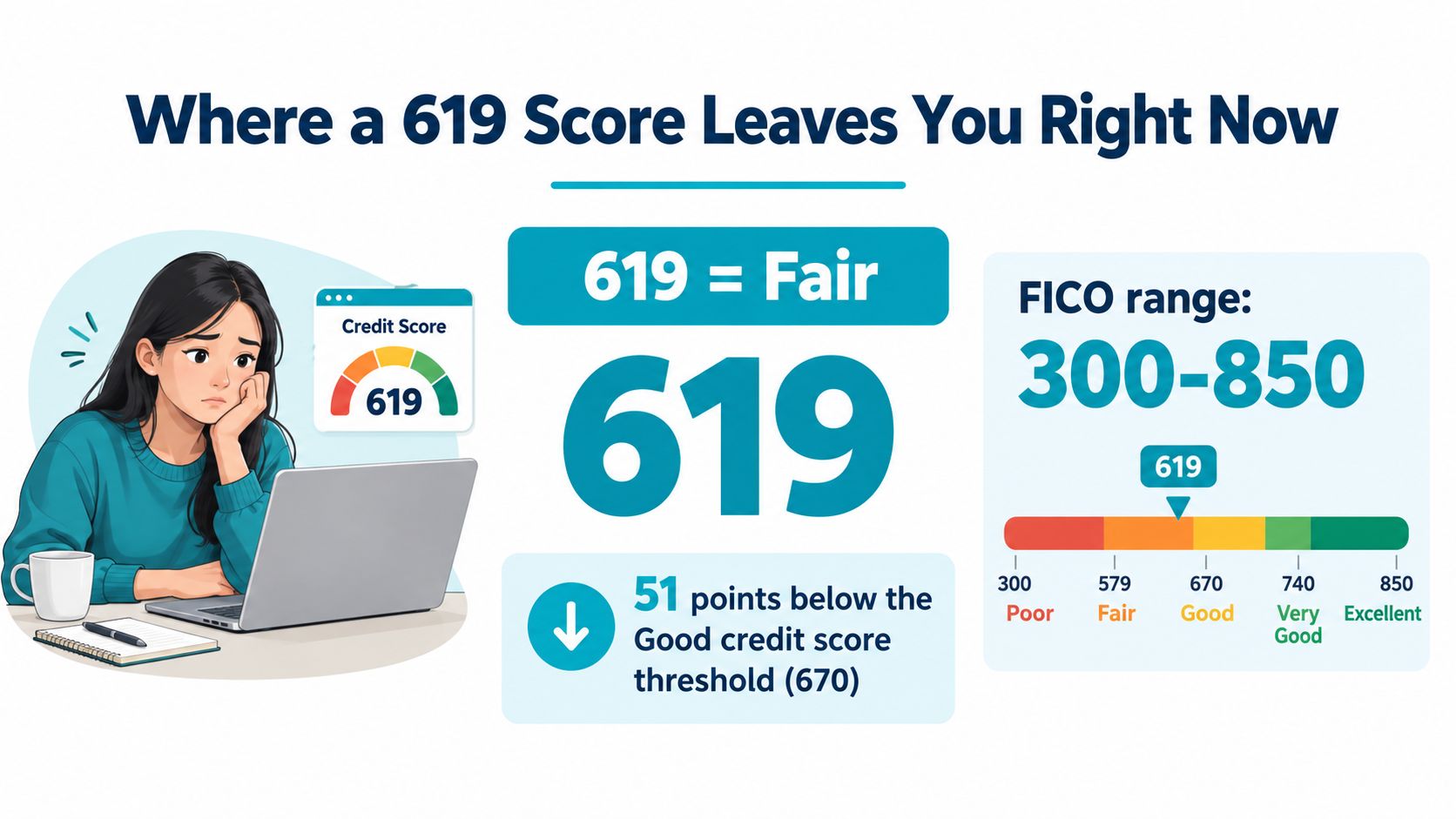
The number does not approve or deny you on its own. Lenders may also weigh your income, employment, debt-to-income ratio, payment history, the loan amount, and any collateral you offer. Borrowers in the Fair band do get approved. The catch is that approval and a good offer are two different things. The Consumer Financial Protection Bureau explains that higher scores generally make qualifying easier and can lead to lower interest rates, so the same application can produce very different price tags at different score levels.
The useful question isn't only “Will I qualify?” Ask what the total cost and repayment obligations would be if you do.
Treat 619 as a starting point for comparing your options and identifying what's holding your credit profile back. Reaching 670 would move you into FICO's Good category, but lenders may respond to improvement along the way, not only at the finish line. Your next step depends on what you're applying for and which parts of your financial profile that lender weighs most.
How FICO and VantageScore Define the Bands
The label attached to a score depends on the scoring model. FICO divides its 300-to-850 scale into five categories: Poor, Fair, Good, Very Good, and Exceptional. VantageScore draws its boundaries in different places, so the same number can carry a different label, the way an 82 might count as a B on one school's grading scale and a B minus on another's.
Both models start from the same underlying information: the payment history, balances, and account ages in your credit reports. They differ in where they set the category lines. As noted earlier, FICO treats 580–669 as Fair and 670–739 as Good, which puts 619 one tier below the Good band. VantageScore's Fair band contains 619 as well, though its upper categories sit higher on the scale. Either way, a band describes where a score falls. It says nothing by itself about the offer attached to it.
| Credit Score Tiers Side by Side | FICO range | VantageScore range | CFPB mortgage cut |
|---|---|---|---|
| Poor / Subprime | 300–579 | 300–600, Subprime | Subprime includes 580–619 |
| Fair / Near prime | 580–669, Fair | 601–660, Fair | Near-prime begins at 620 |
| Good / Prime | 670–739, Good | 661–780, Prime | No matching category specified here |
| Very Good / Superprime | 740–799, Very Good | 781–850, Superprime | No matching category specified here |
| Exceptional | 800–850, Exceptional | No separate category | No matching category specified here |
The third column reflects a separate grouping the Consumer Financial Protection Bureau applies to FICO scores for mortgage-market analysis, rather than a category inside either scoring model. Those labels describe how the bureau sorts borrowers for research purposes; they don't create a universal approval rule for any single application.
One more wrinkle matters before you rely on any label. A lender chooses which bureau, which score version, and sometimes which industry-specific variant to pull, so the 619 displayed in a consumer app may not be the exact score a creditor reviews. When comparing offers, ask which model the lender is using, and weigh the quoted rate and fees rather than the band name attached to the number.
What the CFPB and Industry Data Say About 619
A 619 is common enough to have company, but close enough to a research boundary to create confusion. FICO's April 2025 score distribution placed 12.2% of consumers between 600 and 649, the slice that contains 619. That makes the number less like a rare defect and more like a crowded waiting room near the edge of “Fair.”
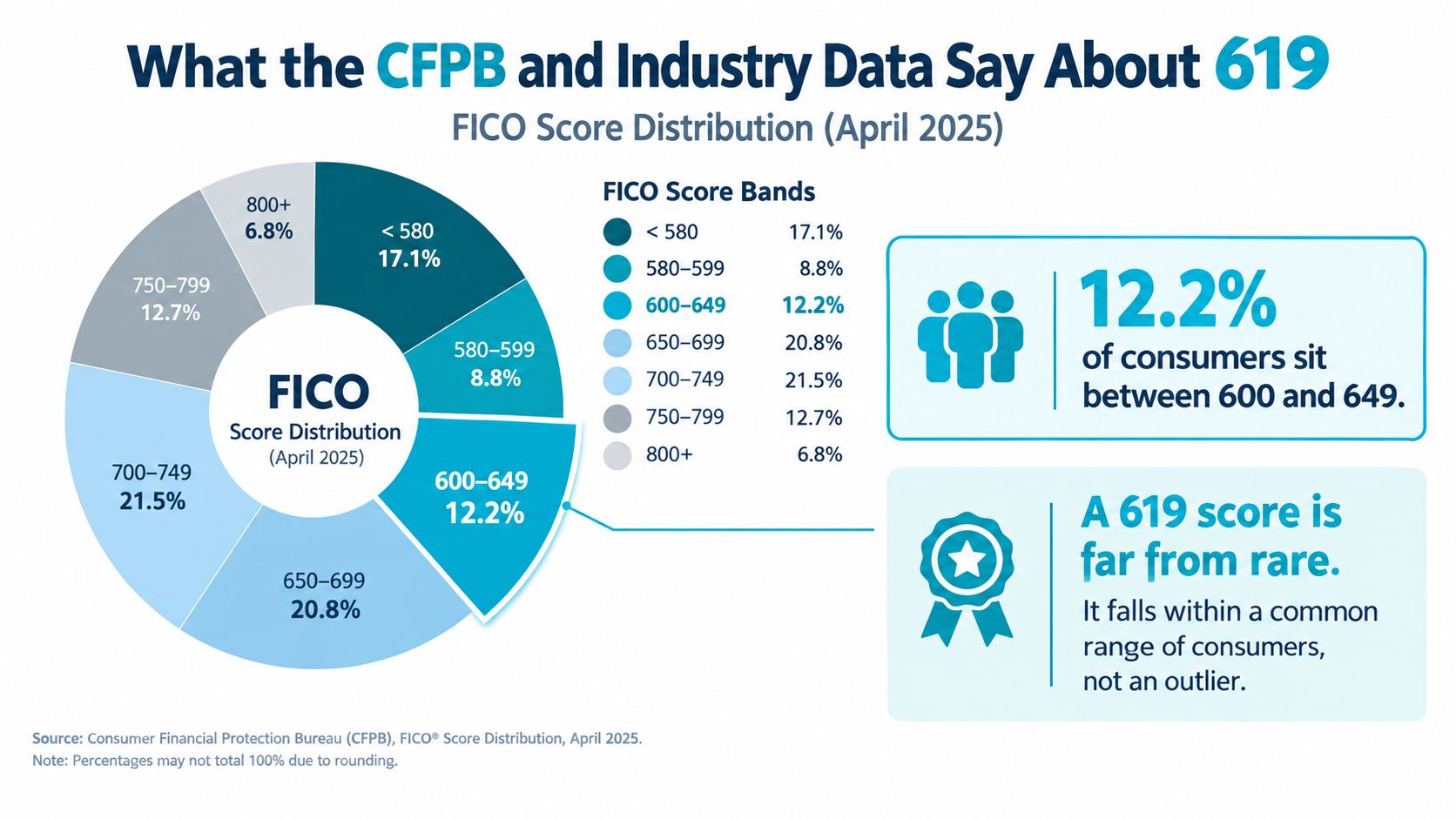
A distribution works like a seating chart. It shows where people are sitting, not which door opens for each person. Two borrowers can sit in the same 600 to 649 row and still face different outcomes because lenders review payment history, income, debts, the requested amount, and the exact score model being pulled.
Why the 620 boundary can matter
As noted earlier, the CFPB's mortgage borrower-risk grouping places FICO scores from 580 through 619 in its subprime category and starts near-prime at 620. One point separates those research labels, which is why 619 can feel unfairly close to a different category.
That boundary is a sorting line for analysis, not a promise that point 620 changes the offer. Some lenders use different score versions or set their own cutoffs, while others weigh the file more heavily than the label. Crossing a published boundary can help in some cases, but approval and pricing still depend on the full application.
Treat 619 as a decision point: confirm which model produced the number, check the report for errors, and compare actual terms rather than assuming the category has already decided the result.
How a 619 Score Translates Into Real Loan Offers
Lenders use risk-based pricing to set rates and fees. In broad terms, they estimate the chance that a borrower won't repay, how much they could lose if that happens, and how much money is at stake. A lower score can signal more risk, which may lead a lender to quote a higher APR, charge fees, offer a smaller amount, or set different repayment terms.
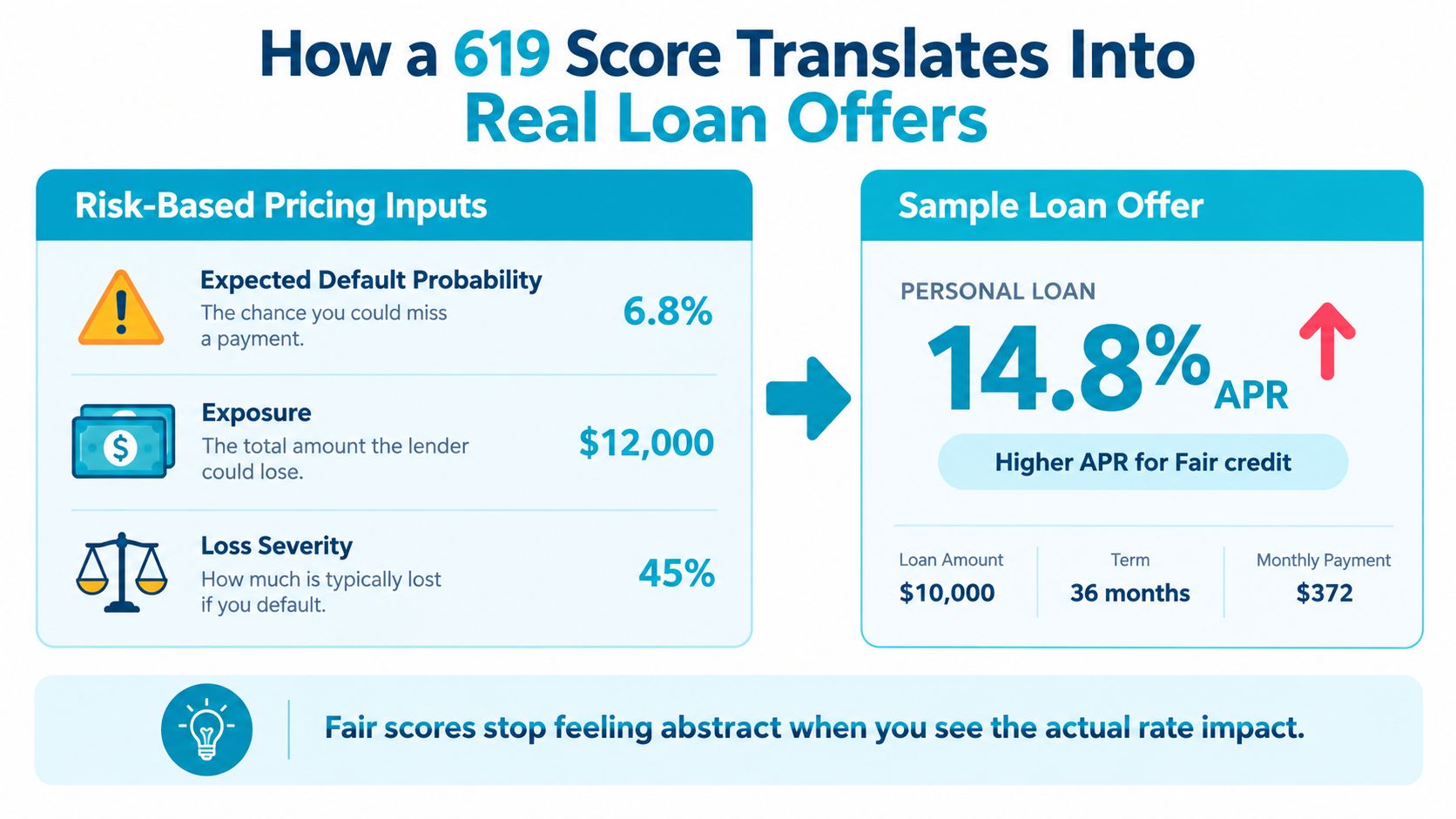
Two applicants with the same score can receive different offers. One might have stable income and modest revolving balances; another might have recent missed payments and substantial debt compared with income. Lenders can also consider the requested amount and, where relevant, collateral. As a result, there isn't one APR or loan limit that applies to everyone with a 619.
A credit card issuer, auto lender, mortgage lender, and personal-loan provider may each assess risk differently. The scoring model and other application details matter, so a score by itself can't tell you what an offer will cost. If you're looking at a personal loan, learn how interest and fees affect the personal loan APR and borrowing cost.
Compare the full repayment, not the approval alone. An approved loan can still be unaffordable if the APR, fees, payment schedule, or total amount due doesn't fit your budget.
Before accepting an offer, check its APR, total repayment amount, origination charges, late fees, and whether the lender reports payments to major credit bureaus. Also find out whether applying involves a hard inquiry. If an offer isn't clear about a fee or repayment obligation, ask the lender for an explanation before agreeing.
Loan Pathways Worth Considering at 619
A 619 is a decision point: the product you choose can matter as much as the score itself. Subprime is a pricing label lenders apply to the file, while the offer in front of you is shaped by collateral, term length, income fit, and the fee schedule attached to that product.
Start with the job the money needs to do. A personal loan can turn consolidation or a planned expense into fixed payments, though approval and pricing still depend on the lender's view of your debts and income. Auto financing adds the vehicle to the decision, so the same borrower may see different terms on a modest used car than on a higher-priced truck. Mortgage underwriting follows program rules that are more specific than a broad “fair” band, so read the lender's criteria rather than assuming the score alone decides it.
Be careful with products built for urgency. CFPB consumer guidance describes payday-style borrowing as costly when the balance comes due before income catches up, and title-backed funding puts a vehicle at risk if payments are missed. An emergency or installment loan can bridge a gap, but only if the payment calendar fits the paycheck calendar.
| Loan Pathways at a 619 Score | Underwriting focus | Typical funding window | Key cost watch-out |
|---|---|---|---|
| Personal loan | Credit profile, income, debts, and lender criteria | Depends on lender and processing | APR, origination charges, and total repayment |
| Auto financing | Borrower profile, vehicle, loan details, and lender rules | Depends on lender and transaction | Interest, fees, and the full repayment obligation |
| Mortgage | Credit model, income, debts, collateral, and mortgage rules | Depends on lender and transaction | Pricing, fees, and qualification requirements |
| Payday or emergency loan | Lender requirements and ability to repay | Depends on product and lender | Short-term borrowing can be costly |
| Installment loan | Credit profile, income, and lender criteria | Depends on lender and processing | Payment schedule, APR, and late fees |
| Title-backed loan | Vehicle equity and lender requirements | Depends on lender and process | Collateral risk and total cost |
If a personal loan is the likely fit, compare qualifications and terms for loans for borrowers with a 600 credit score before submitting applications. Treat any matching result as a comparison starting point and confirm the offer with the lender.
For each path, ask one product-specific question: what secures it, how fast must it be repaid, and which fee can change the total? If the answer depends on rolling the balance over or risking your transportation, the safer option is often the slower one, even when it feels less convenient.
Habits That Actually Move a 619 Score Upward
Start with the habits that address the information lenders and scoring models may use. You don't need to apply for more credit just to try to improve your profile. Focus first on the accounts and report details you already have.
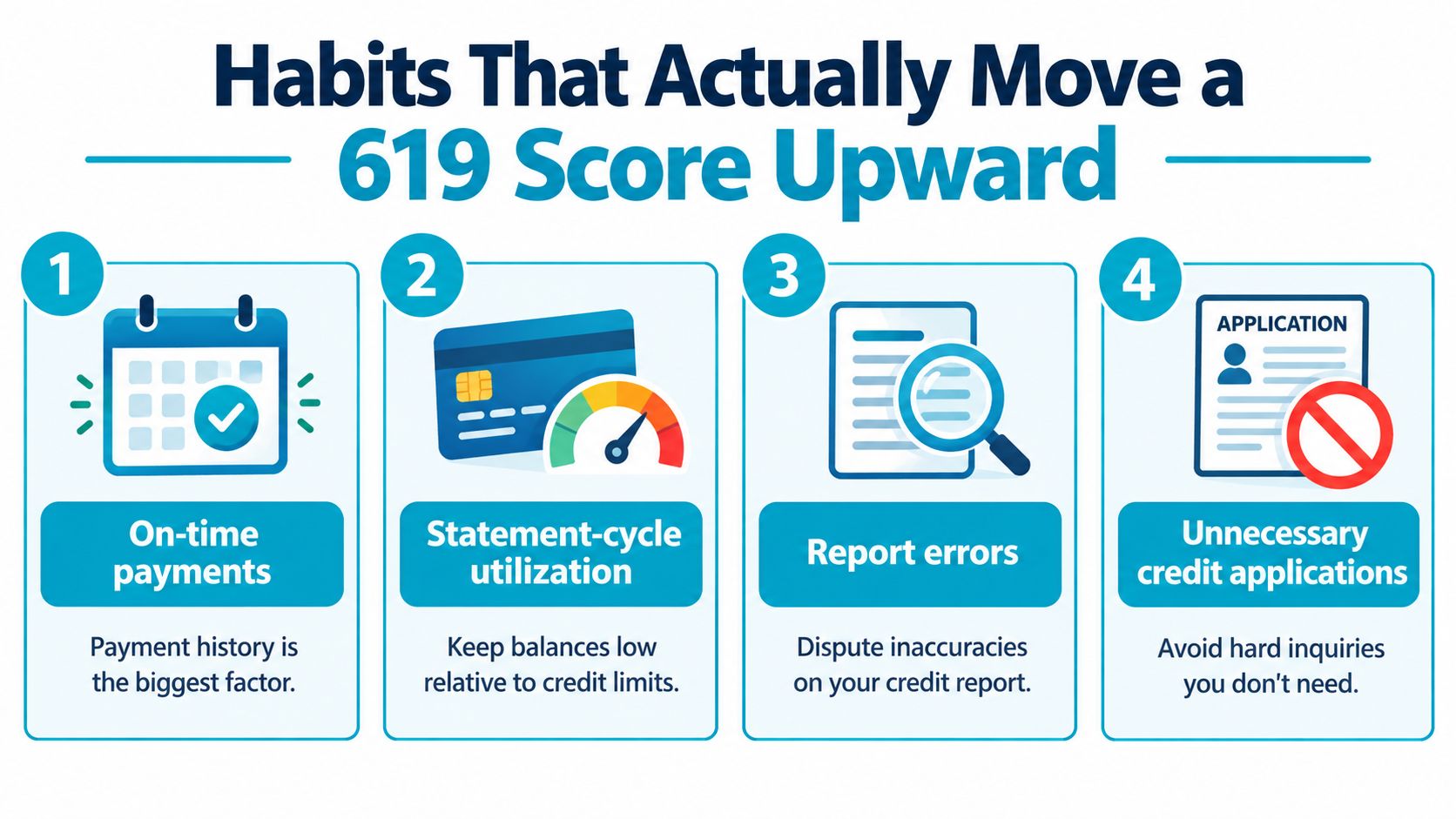
Pay every account on time. Make at least the required payment by the due date, and use reminders or automatic payments if they help. A steady record matters more than trying to open new accounts in a hurry.
Reduce revolving balances before the statement closes. Credit utilization compares revolving balances with credit limits. Paying down a balance before it's reported can help keep the reported amount lower, though score changes depend on your overall file.
Check your reports for mistakes. Review account details and negative items. If information is inaccurate, follow the credit bureau's dispute process and keep records of what you submit.
Avoid unnecessary applications. Applying for new credit can lead to inquiries and additional debt. If you're already preparing for a major loan, avoid adding applications that aren't needed.
Buy Now, Pay Later accounts are another reason to check which scoring model a lender uses. FICO has introduced BNPL-enabled scores. Data summarized from a CFPB study indicate 53.6 million U.S. consumers used BNPL in 2023, about one in five adults, and FICO's analysis found that 85% of BNPL users saw score changes below 10 points when BNPL data were included (FICO's analysis of credit scoring and BNPL data). Those figures show why a newly reported account may not, by itself, produce a dramatic score change.
Begin with two actions you can control: make payments on time and lower revolving balances. Then review your reports for errors before you apply for another account.
How a Loan Marketplace Fits Into a 619 Strategy
You can apply directly with a bank or credit union, contact individual lenders, or use a marketplace that routes a request to participating lenders. Each route has different application steps and eligibility rules. A marketplace can consolidate the initial request, but it doesn't guarantee that a lender will respond with an offer.
NextStopLoans operates as a marketplace, not a lender. It routes consumer loan requests to independent third-party lenders, which make approval decisions and set any terms. A submission doesn't promise approval, a specific APR, or funding. The marketplace itself doesn't pull credit, though participating lenders may check credit with major or alternative bureaus.
Before submitting a request, read the service's disclosures and review the typical eligibility criteria. Check whether the service is available where you live, what information you'll provide, and whether participating lenders may make a hard inquiry. You can also learn how a personal-loan soft pull differs from a hard inquiry before deciding how to compare your choices.
A lender's offer may be worth considering if the amount and repayment schedule fit your budget. Look at the APR, fees, total repayment, due dates, and consequences of missed payments. You're not required to accept an offer because you applied. Review the terms carefully, and decline any offer that doesn't work for you.
Your 619 Credit Game Plan Checklist
Use this checklist before you apply or accept a loan. It keeps the focus on the information behind the score and the actual cost of borrowing.
| 619 Borrower Action Checklist | Why |
|---|---|
| Confirm which score and model you're viewing | Lenders may use a different bureau, version, or scoring model |
| Review your credit reports | You can identify information that may be inaccurate |
| Pay down revolving balances before the statement closes | A lower reported balance can improve utilization |
| Keep payments current | On-time payments support a stronger credit profile |
| Avoid applications you don't need | New credit can add inquiries and debt |
| Compare APR, fees, and total repayment | A lower payment alone doesn't show the full cost |
| Check whether the lender reports payments | Reporting can affect what appears in your credit history |
A 619 is Fair under FICO, not Good, but it doesn't automatically rule out borrowing. Your options and terms depend on the lender, scoring model, application details, and the product you need. A score can improve, but no fixed timeline or target guarantees approval or a particular rate.
Take the next step today: verify the score model, check your reports, and work on the balances or payment issues you can address. If you're considering a loan, compare its complete cost with your budget before you commit.
NextStopLoans connects consumer loan requests with participating third-party lenders, including lenders that may consider applicants with credit challenges. If you're weighing borrowing options with a 619 score, review any offer's full terms and decide whether it fits your needs before accepting. Visit NextStopLoans to learn about the marketplace and submit a request.