
Installment Loans Same Day Funding: What to Expect

A lender decision, an ACH transfer and a posted deposit are three separate events: same-day approval can happen quickly, but same-day spendable money isn't guaranteed. When a stage misses its cutoff, plan for the next business day rather than assuming the money will arrive today.
If your lender says you're approved, can you pay the repair shop before it closes? That's the gap to investigate when comparing installment loans with same-day funding. The useful deadline isn't when an approval email arrives. It's when your bank makes the deposit available to spend.
Table of Contents
- When Same-Day Installment Funding Is Realistic
- What Lenders Check Before Money Moves
- Why Funding Slips to the Next Business Day
- How to Apply So Funds Can Move Fast
- Fees, Repayment and Bank Risks to Check First
- Whether Fast Money Is Worth the Cost
- Confirm Timing and Terms Before You Accept
When Same-Day Installment Funding Is Realistic
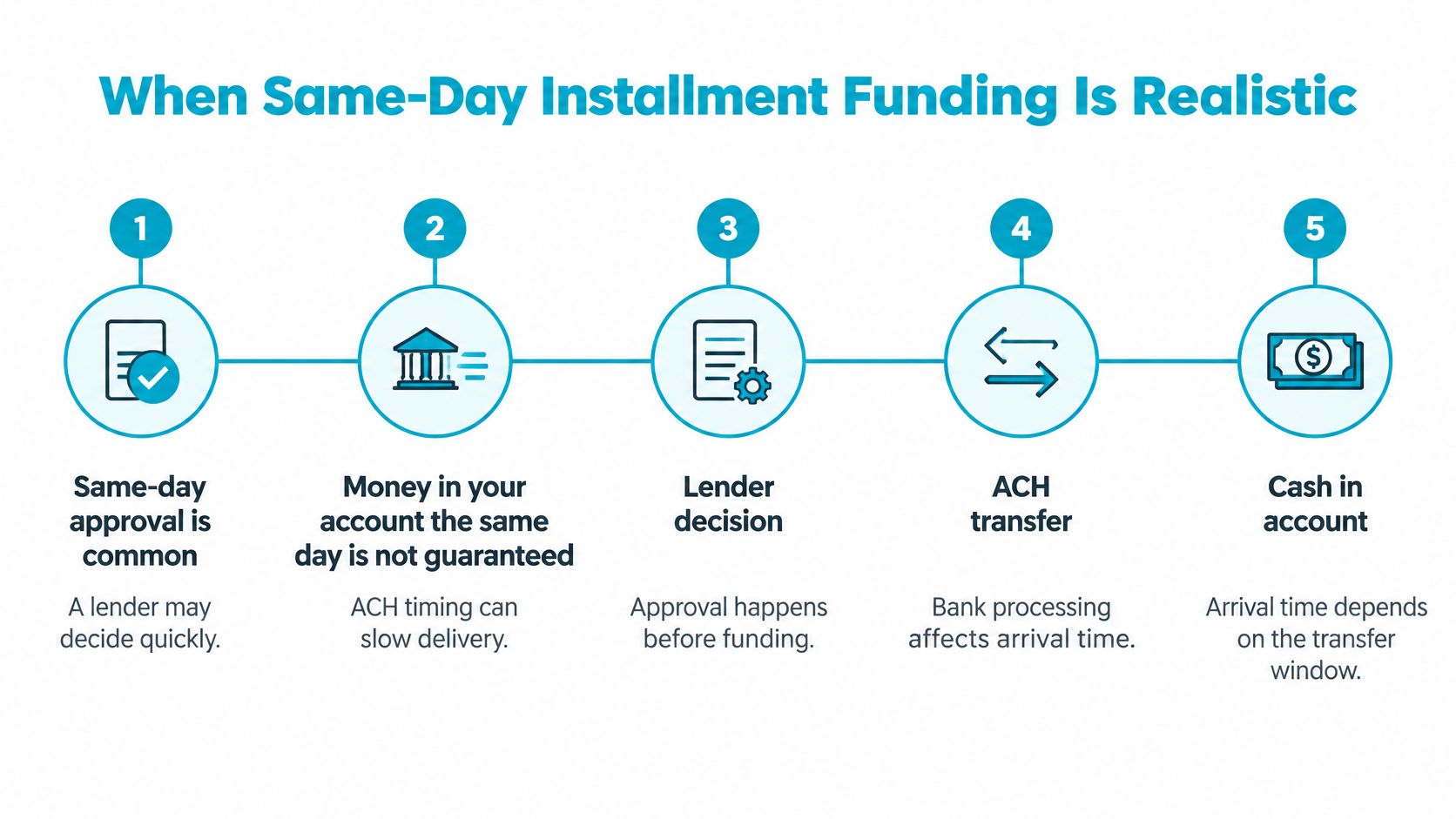
Same-day funding is possible when the lender completes its checks, you accept the agreement, and the payment reaches an eligible processing window. Your receiving bank must then make the deposit available. An approval alone doesn't establish that the remaining steps will finish that day.
The Federal Reserve's history of the Automated Clearing House describes how same-day settlement expanded the ability to move electronic payments faster. That payment capability matters, but it doesn't eliminate the work a lender must complete before sending your money.
Follow the money through each stage
Treat each stage as a separate checkpoint. A completed application means the lender has information to review, not that a transfer is already underway.
Funding stages and whether each can finish the same day
| Stage | What Happens | Can It Finish Same Day? |
|---|---|---|
| Application submitted | Form and data are sent to lenders | Yes, our request form takes minutes |
| Lender decision | Lender verifies identity and income | Possible if the file clears review |
| Terms accepted | You review APR, fees and schedule, then e-sign | Yes, if you respond promptly |
| ACH transfer initiated | Lender sends the payment through the ACH network | Only if processing requirements and the lender's cutoff are met |
| Funds posted to your bank | Your bank makes the deposit available | Possible with eligible same-day processing; otherwise allow additional banking time |
The distinction between transfer initiated and funds available is especially important. A lender can finish its part while your bank account still shows no spendable deposit. Don't schedule an outgoing payment solely because you received a funding confirmation.
Set a usable expectation
Through our request process, approved loan funds are deposited directly into the borrower's bank account, usually as fast as the next business day. That's a planning benchmark, not a promise that every application submitted today produces a deposit tomorrow.
Say you need to collect a repaired car before the shop closes. A quick approval helps only if the remaining funding steps finish before your payment deadline. Until the deposit is available, you may still need to arrange another collection time with the shop.
Practical rule: Judge a funding claim by when you can spend the money, not when the lender announces its decision.
Before accepting an offer, ask the lender: What time is your ACH cutoff, and when should this deposit become available in my account?
What Lenders Check Before Money Moves
A lender may need to resolve a small discrepancy before it can release a large financial commitment. A shortened name, an unreadable statement or an incorrect account number can turn an otherwise straightforward application into a request for more information.
Preparation matters most when you're already short of cash. The Federal Reserve's household financial well-being report found that 12% of U.S. adults said they couldn't cover a hypothetical $400 emergency immediately. For someone facing that situation, avoiding a preventable verification delay can matter as much as receiving a fast response.
Lender checks and how each affects funding time
| Requirement | Why It Affects Timing | What to Have Ready |
|---|---|---|
| Identity verification | Mismatched details can trigger manual review | Government photo ID matching your legal name |
| Bank account in your name | Incorrect account details can cause deposits to fail or stall | Routing and account numbers from your checking account |
| Income proof | Lenders assess ability to repay before funding | Recent pay stubs or bank statements |
| Electronic consent | The agreement must be completed before funding proceeds | A working email and phone to receive and sign the agreement |
| Faxed documents | A lender may require paperwork through an additional channel | Scanned copies and access to a fax option if requested |
Make your documents easy to verify
Use your legal name consistently across the application, identification and deposit account. If a document shows a former name, ask the lender what supporting evidence it accepts rather than submitting conflicting information without explanation.
Copy routing and account numbers from your bank's account-details screen or a bank document. Don't substitute the number printed on your debit card. For income documents, send complete, readable files through the lender's designated secure channel.
Consider two hypothetical applicants. A borrower whose account name matches the application and whose income documents are readable may complete verification without further exchanges. A borrower whose bank statement shows a different name may need to provide supporting documents before the lender continues.
Our lenders' funding times differ, and some circumstances require faxed application materials or other documents. Submitting information online doesn't guarantee approval, even when everything is complete.
Before you submit
- Identification ready: Check that your photo ID is readable and your application uses your legal name.
- Account confirmed: Verify that the deposit account is yours and the account details are correct.
- Income files saved: Keep the requested pay stubs or statements accessible.
- Contact channels working: Make sure you can receive email, calls and verification messages.
- Document backup available: Know how you'll scan or fax paperwork if the lender requests it.
Why Funding Slips to the Next Business Day
A late-afternoon approval can arrive after a lender has closed its funding file. The lender may have completed its decision that day, but the payment must wait for a later processing window. The approval timestamp doesn't override the transfer cutoff.
According to Nacha's explanation of how ACH payments work, the substantial majority of ACH credits settle in one banking day or less, while standard ACH credits can settle up to two banking days later when the sender selects that option. Those are network settlement timings, not a guarantee about an individual loan application.
Situations that move funding to the next business day
| Situation | Likely Result | Why It Happens |
|---|---|---|
| Application after the lender's cutoff | Transfer may start on the next banking day | The lender's payment submission window has closed |
| Friday evening or weekend | Funding moves to Monday or the next banking day | ACH settlement follows banking-day availability |
| Federal holiday | Funding moves to an eligible banking day | Federal Reserve settlement is closed |
| Identity or fraud review | Decision or release waits for further checks | The lender must resolve the flagged information |
| Missing or faxed documents | Funding waits for document completion | The lender can't finish reviewing an incomplete file |
| Bank posting delay | Spendable funds arrive later than expected | The receiving bank must process and make the credit available |
An open website isn't an open settlement window
You can submit an online request while banks are closed. That convenience doesn't mean the payment network is settling transfers at the same time.
For a late-Friday application before a federal holiday, don't promise a creditor that you'll pay over the weekend. Allow until at least the first banking day after the holiday, and leave room for lender review and transfer processing beyond that. An unresolved document request can push the timeline further.
Our process from registration to a lender offer can be as fast as one business day. An offer, however, isn't the same milestone as a deposit.
Find out which party has the next action
If funding appears delayed, start with the lender. Ask whether the loan is still under review, whether you need to submit anything, or whether the payment has been sent.
Once the lender confirms transmission, ask for payment details you can share with your bank. Our guide to how long loans take to process can help you distinguish application processing from delivery.
Before applying, confirm the lender's cutoff and its time zone, its holiday schedule, and whether the stated arrival date assumes all verification is already complete.
How to Apply So Funds Can Move Fast
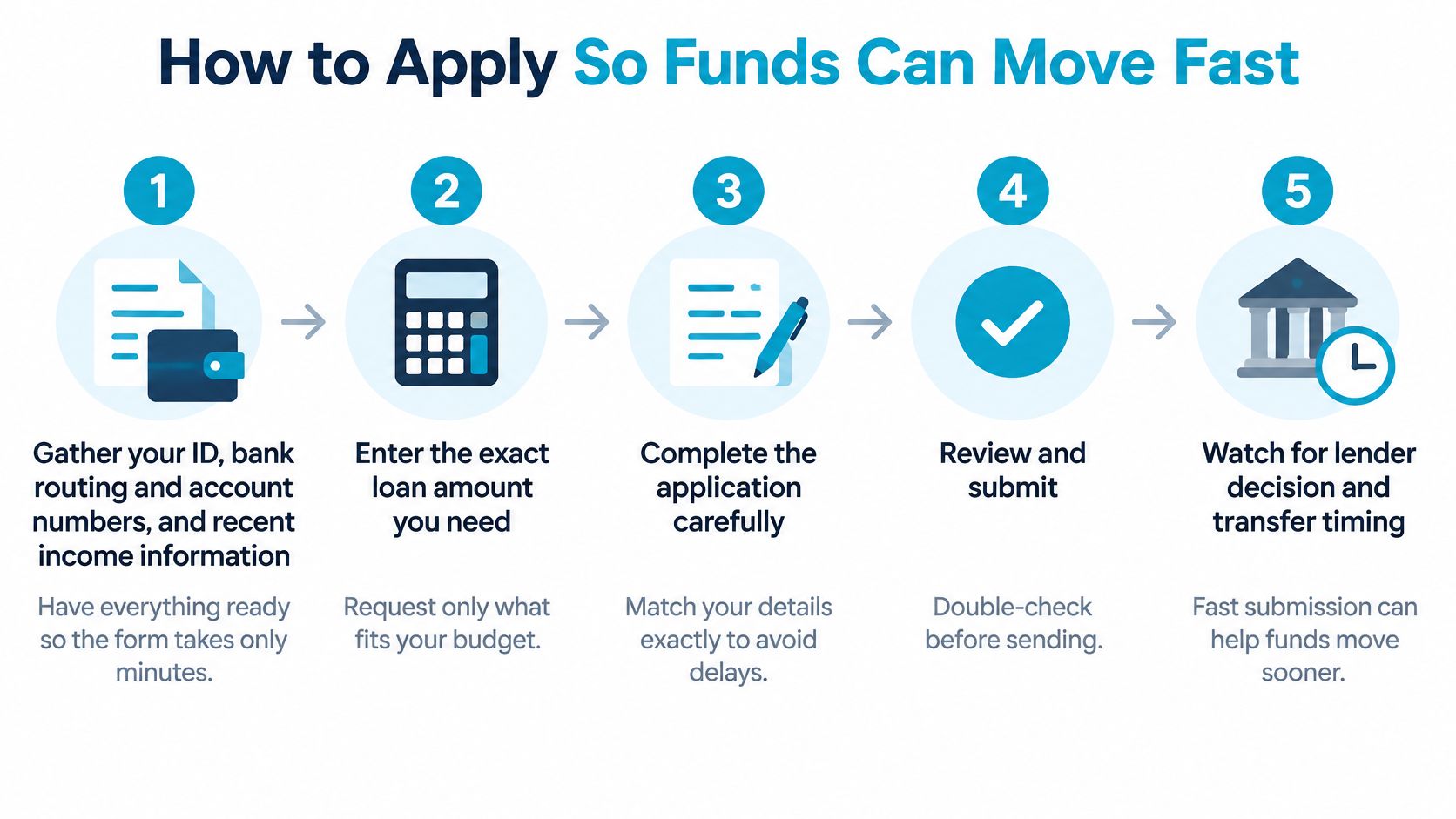
The fastest useful application is accurate, complete and submitted while you're available to respond. Rushing through the form and then missing a verification message can cost more time than careful preparation would have taken.
Our loan request process follows three broad actions: request a loan, agree to terms and receive your money if approved and funded. The installment loan application guide provides additional preparation guidance.
Complete the request without avoidable interruptions
Gather your documents before opening the form. Have your ID, bank routing and account numbers, and recent income information ready. Our online request form takes minutes, but searching for documents midway through can interrupt your progress.
Enter the amount you actually need. Include your personal details and the account where funds should be deposited, checking that the account name matches your identity. Requesting extra money for convenience also creates extra debt to repay.
Submit early in the business day when practical. Our process routes requests in real time, and you can find out whether you qualify in minutes. Early submission leaves more working time for any follow-up before the lender's funding cutoff.
Keep your phone and email accessible. Respond promptly to legitimate lender messages, and use the lender's secure method for sending sensitive documents. If you can't provide something immediately, ask what alternative documentation it accepts.
Read the offer before agreeing. Check the APR, fees, repayment length, payment amounts and due dates against your budget. Don't let a funding deadline pressure you into accepting terms you haven't understood.
Sign only after resolving discrepancies. Confirm that the agreement reflects the offer you intend to accept and that the deposit account is correct. Save a copy of the completed agreement and the lender's contact information.
Check for the deposit on the expected arrival date. Use your bank app's available balance, not just a pending transaction notification. If the money hasn't appeared, contact the lender to confirm the payment status before making another financial commitment.
Leave no request unanswered
A complete submission isn't just a form with every box filled in. It includes any supporting documents the lender requests and a completed agreement if you decide to proceed.
An on-time application has accurate details, readable documents and no unresolved request waiting in your inbox.
Aim to complete the initial form in one uninterrupted session. After submitting, check that uploaded documents were received successfully rather than assuming that selecting a file completed the upload. Keep confirmation messages until the loan is funded or the application is closed.
Fees, Repayment and Bank Risks to Check First
A fixed installment can still be unaffordable on the day it's collected. A payment that looks manageable against your monthly income may leave your account short if it arrives before payday or alongside rent.
Our independent lenders set their own repayment terms. Origination, documentation and other fees may apply, and missed payments may result in late-payment, non-payment or other penalties. Review our Rates & Fees information, then use the actual lender agreement to determine what your offer costs.
Compare cost and cash flow separately
APR helps you compare annualized borrowing costs, but it shouldn't be your only check. Look at the total repayment amount, the amount you'll receive after any deducted fees, and how long you'll remain responsible for payments.
| Check | What to establish |
|---|---|
| Upfront charges | Whether fees reduce the money deposited |
| Total repayment | How much you'll repay over the full agreement |
| Payment frequency | Whether debits are monthly or follow another schedule |
| Missed-payment consequences | Which lender charges and bank fees could apply |
| Early repayment or extension | Whether changing the schedule changes the total cost |
Build a repayment budget using take-home income after essentials. Subtract rent, utilities, groceries, transportation and existing obligations before deciding how much room remains for the installment.
If payments aren't monthly, convert the scheduled payments into a monthly budget equivalent, but also check each actual debit date. An average can hide a crowded payment period.
Check what happens when the account is short
The Federal Reserve's Consumer & Community Context publication reports that more than one in ten buy now, pay later users had an installment payment trigger an overdraft or non-sufficient-funds fee. BNPL isn't the same product as a personal installment loan, but the finding illustrates why scheduled debits deserve a separate cash-flow check.
Say your loan debit is due before your wages arrive. The payment amount hasn't changed, yet your balance may be insufficient when the lender attempts collection. Ask whether you can change the debit date, whether partial payments are accepted, and how unsuccessful withdrawals are handled.
We encourage borrowers who can't make a scheduled payment to contact their lender as soon as possible. Don't assume a partial payment or a request for help automatically changes the agreement.
Before accepting, get clear answers to these questions:
- Debit date: When will the lender attempt collection, and can that date be changed?
- Late fee: What charge applies, and what event triggers it?
- Hardship policy: What assistance is available if your income or circumstances change?
Whether Fast Money Is Worth the Cost
The Federal Reserve's report on economic hardships found that 59% of U.S. adults experienced at least one major unexpected expense during 2025, while 37% would need a response other than cash, savings or a credit card paid in full at the next statement to cover a hypothetical $400 emergency. An urgent borrowing decision often starts with a real shortage, not a preference for convenience.
Still, speed doesn't change the price of a loan. A fast deposit is useful only if it arrives in time to solve the problem and doesn't create a larger repayment problem afterward.
Compare the cost of waiting with the cost of borrowing
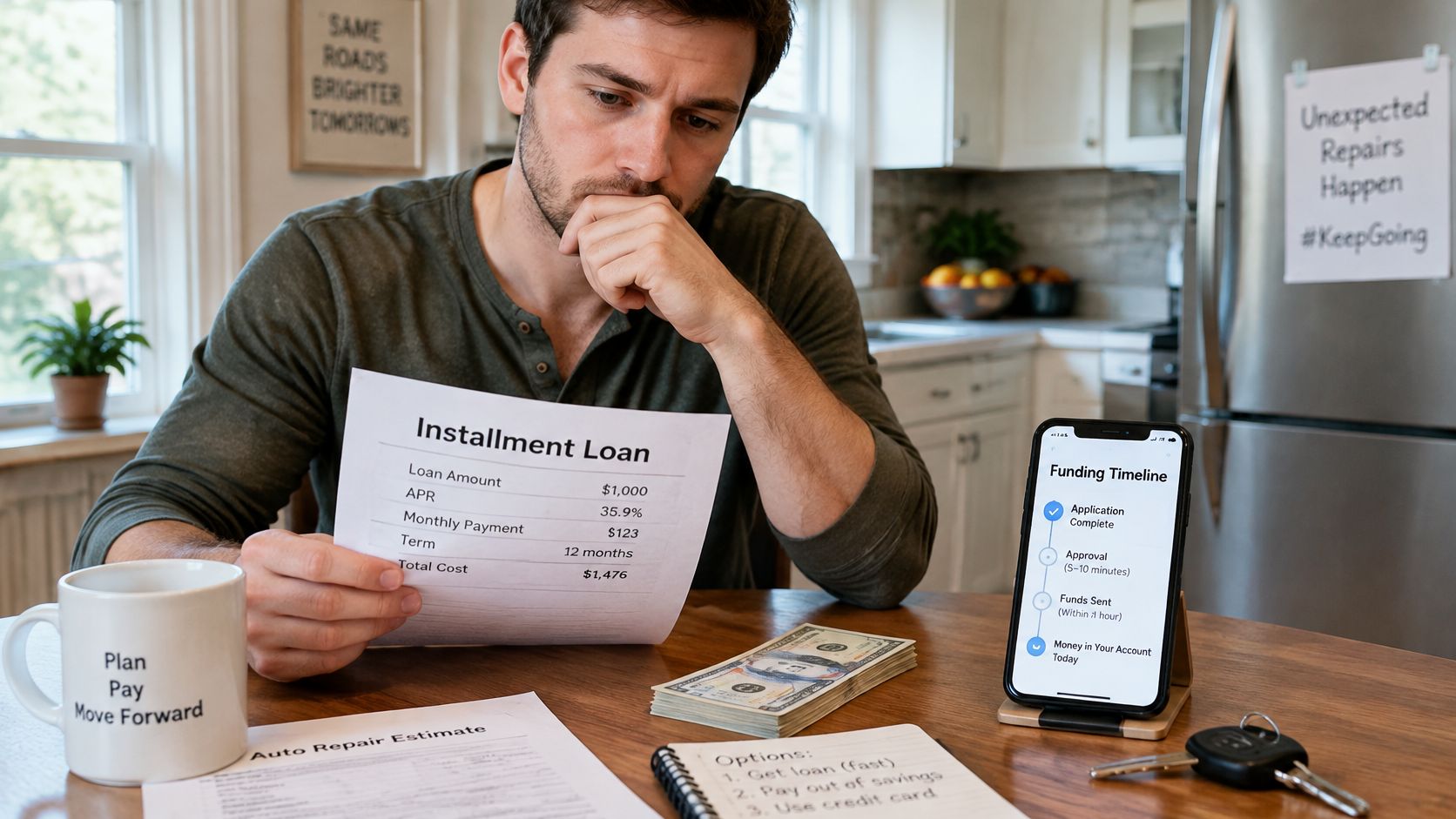
For a car repair, waiting might mean missed work, alternative transportation or towing. For a bill, it might mean a late charge. Write down the consequences that apply rather than assuming every delay will be expensive.
Then compare those consequences with the loan's total borrowing cost. Include any fee deducted before disbursement, because a deposit smaller than the bill may leave you needing another source of money.
Before accepting, test alternatives:
- Creditor payment plan: Ask whether you can split the bill or move its due date.
- Short budget reset: Identify spending you can postpone without missing essentials.
- Credit union option: Check eligibility, cost and realistic funding time.
- Employer advance: Ask whether an advance is available and how repayment would affect your next paycheck.
Our participating lenders determine approval and terms when you apply. Depending on the offer, repayment may involve installments or a full payment at a later date; renewal may also be offered. Don't treat renewal as free extra time.
Borrow only when the money solves the immediate problem and the scheduled payment fits what remains after essentials.
Confirm Timing and Terms Before You Accept
Before signing, turn the offer into a short written plan. Record the expected deposit date beside the deadline for the expense you need to pay. If those dates don't align, the loan may not solve the problem even if approval is fast.
Keep a final acceptance checklist
- Arrival recorded: Save the lender's expected deposit date and any conditions attached to it.
- Expense deadline checked: Confirm that the money should arrive before you need to pay.
- Repayment calendar matched: Compare the debit schedule with your actual pay dates.
- Costs saved: Keep the agreement showing fees, payment amounts and total repayment.
- Help contact stored: Save the lender's contact details and hardship instructions.
Know who makes the decision
NextStopLoans is a marketplace, not a lender. We share your request with our network of independent lenders in real time, with responses typically available within minutes. Those lenders alone decide approval, contract terms and disbursement.
One form can reach multiple lenders without requiring you to complete a separate initial request for each. You may decline any offer, and submitting information doesn't guarantee approval. A fast response is an opportunity to review terms, not an obligation to borrow.
Before submitting a request, review our How It Works, FAQ and Rates & Fees pages. Proceed only when both the expected arrival and the repayment commitment fit your situation.
NextStopLoans offers a single online request process that connects you with independent lenders for review. Visit us to explore a potential match, then confirm the lender's funding cutoff, expected deposit date and complete repayment terms before accepting an offer.