
How to Get Out of a Title Loan: A Safe Exit Plan

The payment is due Friday. The balance is $1,180, the account holds $240, and the lender's text offers the easy fix: renew for another month, pay the fee, keep driving. The fee is money you'll never see again, and the balance behind it doesn't move.
Borrowers who lose a car to a title loan don't lose it in one bad decision. They lose it by taking the least painful option first and the serious options later, when there's less cash and no time left. The order of the decisions matters more than the decisions themselves, and the route that looks easiest, handing back the keys, is the one that can leave you owing more than the loan you started with.
What follows is the sequence, the actual cost of each route, and the exact questions to put to your lender in writing this week.
Table of Contents
- Your Main Ways Out and What Each Costs
- Get a Written Payoff Plan Before the Due Date
- Breaking the Rollover Cycle Before It Costs You the Car
- Checking Your State's Repossession Rules
- What Repossession and Surrender Do to Your Debt
- Free Help and How to File a Complaint
Your Main Ways Out and What Each Costs
A single-payment title loan puts the entire balance on one date. That's the structure, not a run of bad luck. Pew Charitable Trusts reports that the typical title loan averages about $1,000, that borrowers pay roughly $3 billion in fees each year, about $1,200 per borrower, and that typical annual percentage rates run near 300%, though rates vary by state (Pew Charitable Trusts). A lump-sum payment at that level can consume roughly 50% of an average borrower's gross monthly income. Few households can produce half a month's pay on demand, which is why the due date, not the loan amount, is where exits fall apart.
When the money isn't there, the lender offers the path of least resistance: renew, pay the fee, keep the car, come back in thirty days. Each renewal buys a month and adds cost without touching the principal. Five routes out exist, and every one of them has a visible price if you look before the due date. You can pay the balance in full from savings, a cheaper loan or the proceeds of a sale. You can refinance into a lower-cost installment loan. You can negotiate a hardship plan, an interest freeze or a settlement. You can sell or trade the vehicle while it still holds equity. Or you can surrender it. Here is how they compare.
| Route | Works best when | Main cost or risk | When to act |
|---|---|---|---|
| Pay off in full | You can cover the payoff from savings, a sale or a cheaper loan | Payoff includes principal, interest and fees to date | Before the due date |
| Refinance to a lower-cost loan | The new total repayment and APR are clearly lower than the title loan | Origination fees, and a new lien on the car if the loan is secured | Before the due date, with written terms |
| Negotiate a hardship plan | The lender agrees to an extended term, interest freeze or settlement in writing | Added fees or interest may still apply; verbal promises are not enforceable | Before default |
| Sell or trade the vehicle | The car's private-party value is above the payoff | Loss of the car; sale proceeds go to the balance first | Start early, as sales take time |
| Surrender or repossession | Payments are impossible and no other route works | Lender may sell the car; a remaining balance or surplus depends on state law | Triggered after default; act before it starts |
Practical rule: the route you pick matters less than the date you start it. Every option in that table costs more the day after the due date than the day before it.
Match the route to your actual situation rather than your mood. A car worth more than the payoff favors a private sale, because you keep the difference and clear the lien in one transaction. A payment you can afford once the balance comes down favors negotiation. A payment you cannot afford with no equity in the car favors a planned exit built with a nonprofit counselor or a consumer attorney, not a surrender executed in panic at the counter.
If you haven't signed yet, price the offer against what title loans cost before you take a dollar, using this breakdown of car title loan interest rates. If you have signed, the next section is the one that buys you time.
Get a Written Payoff Plan Before the Due Date
If your due date is less than two weeks away, ask for written terms now. The lender may not agree to a change, but a clear payoff figure and repayment plan let you compare your options before missing a payment.
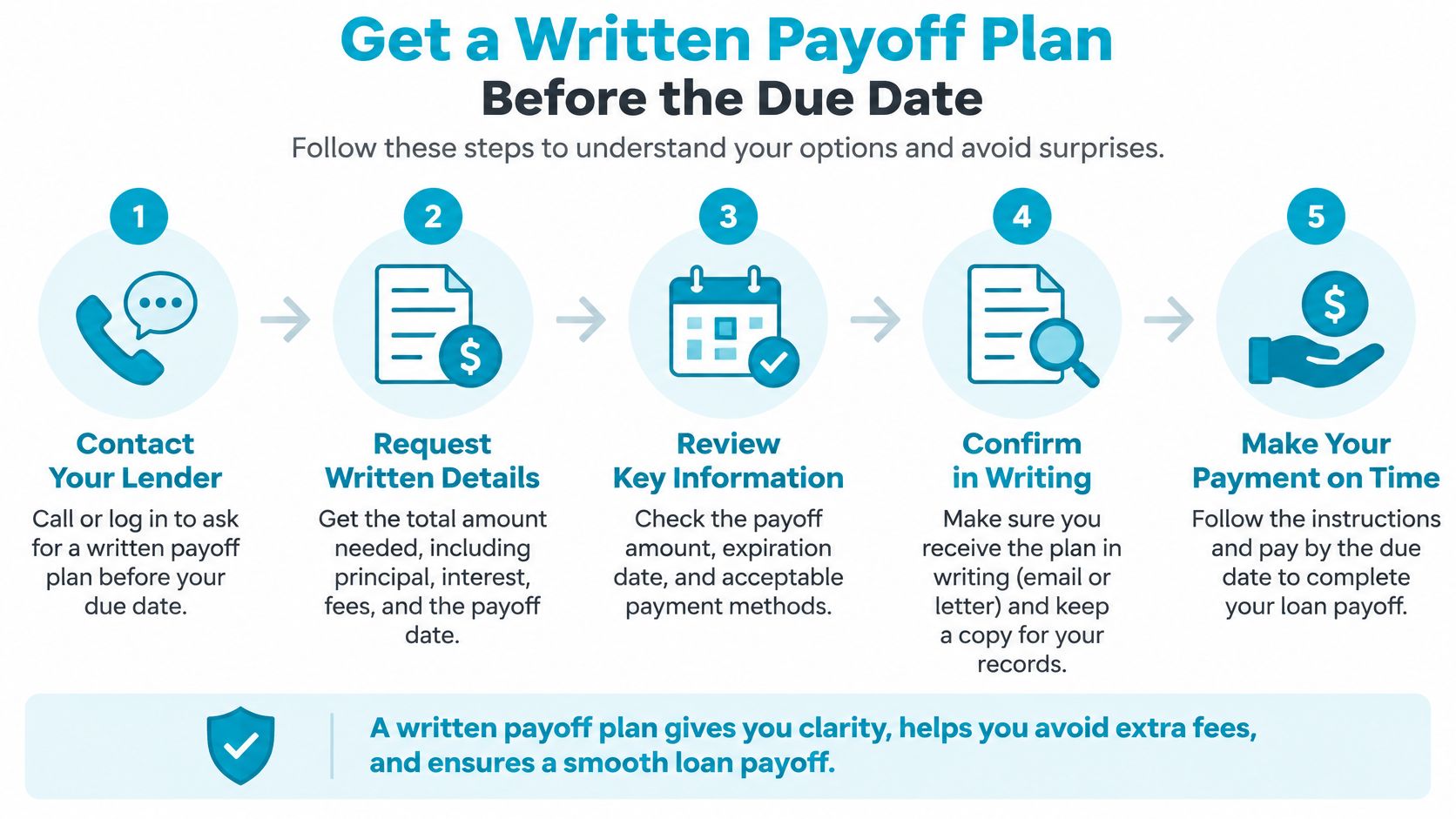
Get the payoff quote in writing. Ask the lender to itemize principal, accrued interest, fees, and the date the quote expires. Interest may continue to accrue, so check whether the amount will still be valid on the day you can pay.
Ask what happens if you miss the due date. Request the cure amount, any grace period, and the date the lender considers the account in default. Ask whether surrendering the vehicle would leave a balance to repay. Get the answers in writing.
Set a payment limit your budget can support. Subtract essential expenses and other required payments from your take-home pay. What remains is the most you can commit without falling behind elsewhere. A payment above that amount is unlikely to hold up on schedule, and partial payments do not guarantee protection from repossession.
Compare the total cost of alternatives. Check the payoff against any other borrowing or payment arrangement you are considering. Use a title loan estimate calculator to compare total costs, not just monthly payments. A smaller payment may still cost more if it extends the repayment period.
Request any hardship terms in writing. Ask whether the lender will extend repayment, freeze interest, or accept a settlement. Do not rely on a phone conversation alone. Before agreeing, make sure the written terms state the payment amounts, due dates, fees, and what happens if you cannot pay as scheduled.
Review refinancing terms before authorizing a payoff. Compare the new loan's total repayment, APR, fees, term, and collateral terms with your current payoff. NextStopLoans connects requests with independent lenders. You can leave the process at any step and are not required to accept an offer. Lenders provide their fees, APR, and terms before you decide.
Get proof when the debt is paid. Ask for a paid-in-full letter and confirmation that the lien release was sent to the state motor-vehicle agency. Keep those records with your loan documents.
A useful payoff plan gives you exact amounts, deadlines, and consequences in writing. Send the request before the due date, then compare the figures against what your budget can realistically sustain.
Breaking the Rollover Cycle Before It Costs You the Car
Renewal is the trap that catches most borrowers, and it's not a rare event. In 2024, 84.5% of U.S. vehicle-title-loan borrowers surveyed by the Center for Responsible Lending reported that their loan had been flipped, renewed or rolled over at least once (American Bankruptcy Institute summary of the Center for Responsible Lending study). Four out of five borrowers in that survey stayed in a structure that was designed to keep them paying.
The mechanics are simple and they always favor the lender. A renewal adds a fee and new interest to the same balance. The principal doesn't fall, the due date comes back around, and you've paid for the privilege of being in the same position. Say you owe a $1,400 payoff and the lender offers a renewal that adds a $300 fee. You pay $300, the balance stays at $1,400, and thirty days later you face the same deadline with $1,700 of pressure and no progress. Run that three months and you've spent $900 to stand still. That example is an illustration, and the arithmetic is the part to remember.
One Test That Catches a Rollover in Disguise
Add up every remaining payment on the offer in front of you, including fees, and compare that total with today's payoff. If the principal doesn't fall and the total grows, you're looking at a rollover with a new name on the paperwork. A refinance earns consideration only when its total cost and its monthly payment are demonstrably lower and it doesn't put the car back up as collateral under a fresh title lien. If a personal loan is the route you're weighing, read how to use a personal loan to pay off debt without recreating the same risk.
A payment your budget cannot cover doesn't solve a rollover. It schedules the next one.
Run the ceiling you calculated from verified take-home pay against the proposed payment. If the new number clears that ceiling, sign with confidence. If it doesn't, the plan isn't finished yet, whatever the paperwork says.
Checking Your State's Repossession Rules
The rules that determine when a lender can take your car and what happens after a sale depend on your state. Florida law, for example, addresses notice of sale and payment of surplus proceeds to the borrower (Florida Statutes Chapter 537). Those details do not establish the rules elsewhere.
| State | Repossession rule | Notice or waiting period | Surplus or remaining balance |
|---|---|---|---|
| Florida | The statute sets rules for repossession and sale of a vehicle used to secure a title loan | Advance notice of sale required | Surplus sale proceeds must be paid to the borrower after permitted deductions |
For your state, ask the financial regulator or attorney general's consumer division what notice is required before repossession, whether sale proceeds above the debt must go to you, and whether the lender can pursue a remaining balance. Confirm the answers against your loan agreement before deciding to surrender the car. The easiest exit can leave you owing more than the loan itself if the sale proceeds do not cover the balance and permitted costs.
What to Gather Before You Call Your Regulator
Have the paperwork ready so you can ask about your specific loan:
- The contract, including addenda, the fee schedule, and the collateral clause.
- The payment history, using your bank records if the lender's portal does not show it.
- Every notice you have received, including envelopes that show postmarks.
- Title records from your state motor-vehicle agency showing who holds the lien.
- Repossession communications, including texts, voicemails, and door hangers.
Check whether your lender is licensed in your state. If the lender's threatened action conflicts with the rules your regulator confirms, contact the regulator and keep a dated record of your communications.
What Repossession and Surrender Do to Your Debt
If your lender takes the car, the loan may still leave a balance. The Consumer Financial Protection Bureau's research found that approximately 6% to 11% of title-loan customers have a vehicle repossessed each year (CFPB research on payday and title lending). The same research found that one in five borrowers ultimately had a car or truck seized for failure to repay.
Among late-paying title-loan borrowers surveyed in 2025 research, 40.7% reported at least one severe consequence, meaning repossession, a lawsuit or wage garnishment, and 22.9% reported that their vehicle was repossessed because of late payments (Center for Responsible Lending research on car-title lending).
What a Sale Actually Settles
Voluntary surrender does not erase the debt. The lender takes the vehicle, sells it, then applies the proceeds to your balance and permitted recovery and sale costs. If the sale proceeds fall short, your state may allow the lender to pursue the remaining balance, called a deficiency. You could lose the car and still owe money.
Before handing over the keys, check the payoff amount against the car's likely sale value and find out whether your state allows a deficiency balance. Ask the lender for a written estimate of the costs and how sale proceeds will be applied. If you proceed, remove personal property, photograph the vehicle's condition, and keep your contract and payment records. Request a written post-sale accounting showing the sale price, fees deducted and any remaining balance.
Surrender can end the risk of losing the car unexpectedly. It does not necessarily end your debt.
Compare the car's value, your payoff, your state's rules and your need for transportation before choosing. If the car is worth more than the payoff, a private sale may leave you in a better position. If you owe more than the car is worth and cannot afford a payment arrangement, plan the next steps before the lender takes possession.
Free Help and How to File a Complaint
A lender's refusal to discuss a workable payment plan is a reason to get help, especially if a lawsuit or repossession is possible. Start with a nonprofit credit counselor to review your budget and options. Contact legal aid for questions about repossession, a lawsuit, or a claimed deficiency balance. You can also take a complaint to your state regulator or attorney general, then use the CFPB's complaint portal to send it to the company and track its response.
Contact the lender in writing first. A written explanation gives you a record to share with a regulator or attorney, even if the lender does not change its position.
- Send a written dispute. State the balance you believe is correct, identify the specific error, and say what correction you want. Use a method that gives you proof of delivery.
- Keep a call log. Record the date, time, representative's name, amount discussed, and any promised action.
- Complain to the regulator if the lender does not address the dispute. Include your contract, call log, written dispute, and any notices.
- Speak with an attorney if the lender reports an incorrect balance, adds fees you believe are unauthorized, repossesses the car before the required notice period, or mishandles the sale.
Keep copies of texts and letters, save screenshots of online messages, and write down what was said as soon as possible.
If a replacement loan is part of your plan, compare its total cost with the payoff and your ability to repay. NextStopLoans connects requests with independent lenders offering title, emergency, payday, installment, personal, cash, signature, and bad credit loans. Registering is free, and you can leave the process at any step without accepting an offer. Review the lender's fees, APR, and terms before deciding. NextStopLoans