
How Many Loans Can You Have at Once: What Sets the Limit

There's no fixed legal cap on how many loans a U.S. consumer can hold at once. The practical limit is the total monthly payments you can afford and what each lender allows.
If there's no legal number, why do some borrowers get a second loan easily while others get declined for a small one? The answer isn't in the loan count. It's in what each new payment does to a monthly budget that usually stays the same size.
Table of Contents
- Why There Is No Fixed Limit on Concurrent Loans
- The Four Factors That Set Your Limit
- How Debt-to-Income Ratio Sets the Ceiling
- How Each Loan Type and State Rule Counts
- How Several Loans Affect Your Credit Score
- Risks of Holding More Than One Loan
- How to Manage Several Loans Without Default
- Check Your Capacity Before You Apply
Why There Is No Fixed Limit on Concurrent Loans
There's no single nationwide numerical cap across personal, auto, student, credit-card, installment, payday, and title loans. You're not restricted to one active loan, and holding different types at the same time is normal.
The Federal Reserve Financial Stability Report on household borrowing shows U.S. households held approximately $16.149 trillion in total credit in the fourth quarter of 2019. Mortgages accounted for about $10.610 trillion, while roughly $4.191 trillion consisted primarily of consumer credit such as student loans, auto loans, and credit-card balances.
That mix only exists because borrowers routinely carry several obligations together. A lender doesn't ask first whether you've hit a legal loan count. It checks your total existing obligations, income, credit history, and ability to repay, then applies its own rules on debt-to-income, minimum income, concurrent loans, or total exposure.
Requesting Is Not the Same as Funding
Three steps get mixed up often, and they carry different risks.
- Requesting: You submit one marketplace request. That alone doesn't open several accounts.
- Approval: Each lender decides separately. A submission doesn't guarantee that any lender will approve you.
- Funding: Accepting an offer creates a real payment obligation. Accepting several creates several.
Count every required monthly payment before you apply, not after an offer arrives.
The practical limit is underwriting capacity. Each additional payment raises your monthly burden and can reduce eligibility for the next loan. So the useful question behind how many loans can you have at once isn't "what number am I allowed?" It's "how many payments can my income absorb after essential living costs?"
The Four Factors That Set Your Limit
Think of your borrowing room as a bucket. Each loan pours in water as a required monthly payment, and four factors decide how big the bucket is and how full it already sits. A small bucket overflows with two loans. A larger one might hold four without strain.
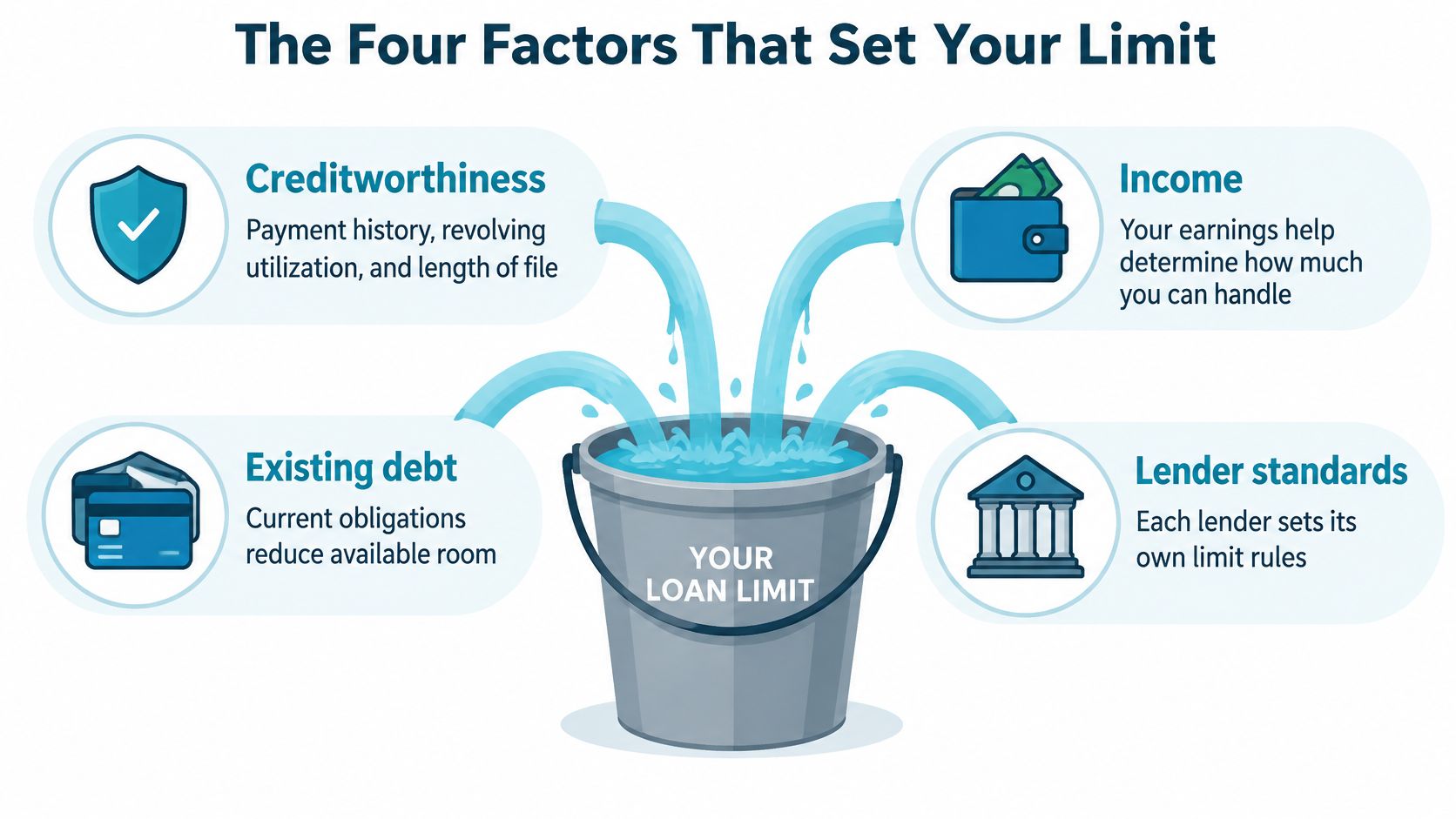
Creditworthiness and Income
Creditworthiness comes first. Lenders look at your payment history, how much of your revolving credit you're using, and how long your credit file has existed. A thin file, or one with recent missed payments, narrows your offers even if your income looks fine on paper.
Income sets the ceiling the payments have to fit under. The basic requirements to qualify for a personal loan are being at least 18 years old, having a checking account, and being employed with regular income and pay frequency. Lenders screen for that stability early because irregular pay makes fixed due dates harder to meet, no matter how small each payment looks.
Lender Policy and State Law
Debt-to-income ratio, your monthly debt payments divided by gross monthly income, shows how much of the bucket is already full. You'll see the math worked out in the next section.
Lender policy varies more than most borrowers expect. Each lender sets its own caps on concurrent loans and total exposure to one borrower, so one lender may decline a second loan while another accepts it. Neither decision is a legal ruling on your limit. It's that lender's risk rule.
State law sits underneath all of it. States can cap APRs and charges and decide whether a product is available at all where you live.
| Factor | What the lender checks | How it limits you |
|---|---|---|
| Creditworthiness | Payment history, revolving utilization, length of file | Weak history shrinks or blocks offers |
| Income | Employment, regular income, pay frequency | Sets the total payment load you can carry |
| Lender policy | Concurrent loan caps, total exposure rules | One lender's no isn't another's |
| State law | APR caps, charge limits, product availability | Can remove a loan type entirely |
These factors interact. Strong income won't fully offset a damaged credit file, and a clean file won't help if state law bars the product. Weakness in one factor can cap the others, so check all four before you assume another loan fits.
How Debt-to-Income Ratio Sets the Ceiling
Start with one borrower earning $5,000 gross per month with $1,500 in existing monthly obligations. That's a 30% DTI, and it looks comfortable. Watch what two modest loans do to it.
Debt-to-income ratio divides your qualifying monthly debt obligations by your gross monthly income. Each new loan raises the top number by its required payment. Your income, the bottom number, usually doesn't move. That's why the ratio climbs fast even when each loan seems small.
| Stage | Monthly debt | Gross monthly income | DTI |
|---|---|---|---|
| Current obligations | $1,500 | $5,000 | 30% |
| After one additional $300 loan | $1,800 | $5,000 | 36% |
| After a second $300 loan | $2,100 | $5,000 | 42% |
One $300 payment moves this borrower from 30% to 36%. A second identical payment reaches 42%. Nothing about the borrower's job or habits changed. Two ordinary payments consumed the room that made the original profile look strong.
What the Benchmarks Actually Mean
The Fannie Mae Selling Guide on debt-to-income ratios shows manually underwritten loans generally have a 36% maximum total DTI, with possible expansion to 45% when specified credit and reserve conditions are met, while automated Desktop Underwriter casefiles may permit up to 50%. Read those numbers carefully. They're mortgage-specific benchmarks, not universal limits for personal, payday, installment, or title loans.
They're still useful as a reference point. They show how quickly a constraint can bind once payments stack up, and why a lender might approve your first additional loan and decline the second at the same income. If you're checking where you stand, reviewing personal loan eligibility basics alongside your own DTI math gives you a fuller picture before you apply.
Short-term lenders run a different version of the same test. They consider major financial obligations and basic living expenses, and whether you can make payments while still covering essentials. The formula differs, but the logic doesn't.
Practical rule: Run the DTI math with the new payment included before you apply. If one payment flips you past a threshold, you've found your limit without risking a decline.
That test takes two minutes with a pay stub and a list of payments. It's the closest thing to a real answer on how many loans you can carry, because it's built from your numbers instead of a generic loan count.
How Each Loan Type and State Rule Counts
Lenders count every required monthly payment, not just the loans they issued themselves. A personal loan lender will weigh your mortgage, your car payment, and your card minimums alongside the new loan you're requesting.
| Loan type | How lenders usually count it | Key caution |
|---|---|---|
| Mortgage | Full monthly payment in DTI | Largest payment; benchmarks are mortgage-specific |
| Auto loan | Full monthly payment | Vehicle secures the loan |
| Student loan | Required monthly payment | Deferred loans may still be counted with an estimated payment |
| Credit card | Minimum monthly payment | Utilization affects credit score as well |
| Personal installment loan | Fixed monthly payment | Fixed schedule; check the lender's concurrency policy |
| Payday loan | Usually due on the next paycheck | Short term; rollover can stack costs |
| Title loan | Repayment schedule set by lender | Vehicle equity at risk; state rules vary |
Payday and Title Loans Work Differently
A payday loan is usually short-term and due around your next paycheck. Because the whole balance comes due at once instead of spreading across months, lenders often weigh it differently from a long installment loan. It also lands on your budget differently. A single lump due date can collide with rent week in a way a small monthly payment never would.
A title loan is secured by your vehicle equity, which means the car itself is at risk if you can't pay. Title loans can cover larger sums regardless of credit score, since the collateral does the work your credit history would otherwise do. That easier approval is exactly why the payment deserves extra scrutiny before you add it to an existing stack.
Installment loans sit between these extremes, with fixed payments on a set schedule. If you're comparing structures, understanding installment loans versus revolving loans helps you see why a fixed payment counts differently from a card minimum that changes with your balance.
Check Your State Before You Count on a Product
Some states cap the APR and the amounts of charges for an online personal loan, and some products aren't available in certain states. That means your state can change your loan count more than any lender policy can. A loan type you've budgeted for may not exist where you live, or may exist only at smaller amounts.
Check your state's rules before you build a plan around a particular product. Rules vary enough that general advice can't substitute for that one local check.
How Several Loans Affect Your Credit Score
Rate-shopping for one loan and opening several accounts aren't the same thing, and scoring models treat them differently. That distinction matters more than the raw number of loans on your file.

The FICO guide to credit score components states that amounts owed represent 30% of a FICO Score, while credit utilization, the amount of revolving credit used compared with available limits, is an important component of that category. So a new revolving balance can move your score before any payment is due.
FICO also considers how many new accounts you've recently opened and distinguishes between rate-shopping for one loan and applying for multiple new credit lines. Several installment loans aren't automatically disqualifying. But a rapid sequence of applications can signal increased risk, particularly when it produces multiple hard inquiries or raises your monthly obligations.
Your complete profile counts too. FICO recognizes credit cards, retail accounts, installment loans, and mortgages, so a lender reads the whole mix rather than just your personal loan count. That's also why consolidating debts raises its own scoring questions, covered in the guide on whether debt consolidation hurts your credit.
We suggest registering for one loan at a time, because multiple inquiries to the Big 3 credit bureaus, Experian, Equifax and TransUnion, may lower your credit score. Before adding another application, list your recent ones, skip submissions you don't need, and confirm the lender even permits another loan while an earlier balance is open.
Risks of Holding More Than One Loan
Say your car payment is due on the 3rd, a personal loan on the 11th, and a card minimum on the 19th. You miss the first one by a week after an unexpected repair bill. A late fee lands, the next payment gets harder, and by the 19th you're choosing which account absorbs the shortfall.
That's the main risk of stacking loans. It isn't one big failure. It's a cascade of small obligations due on different days, where one slip makes the next payment tighter.
Fees, Reporting, and Rollovers
Different lenders have different late payment policies, which are set out in the loan agreement. With several loans, you can't assume one grace period or fee schedule covers them all. You have to read every contract, because the terms that protect you on one loan may not exist on another.
The credit damage can outlast the fee. Lenders may report a failure to repay to one or all of the major credit reporting agencies, including Experian and Equifax. A missed stretch during one rough month can mark your file long after you've caught up.
Short-term products add a rollover trap. You pay a fee to extend the loan instead of repaying it, the balance survives, and the cost repeats. Across several loans, those extension fees stack into a payment of their own. Title loans carry a sharper version of the risk, since a missed payment puts the vehicle securing the loan at risk, and losing the car can threaten the job that pays everything else.
Warning Signs You've Passed Your Limit
- Borrowing to repay: You take a new loan to cover an existing loan's payment.
- Minimums everywhere: You're paying only minimums across several accounts with no balances shrinking.
- Fees driving borrowing: New loans exist mainly to cover late fees or rollover charges.
- Due date dread: You can't say, without checking, which payment leaves your account next.
Any one of these means the stack is managing you. That's the point where adding another loan stops being a financing decision and becomes a way to postpone a shortfall.
How to Manage Several Loans Without Default
Underwriting is exposure-based rather than loan-count-based, so managing several loans means managing total payments, not tracking accounts one by one. The Fannie Mae Selling Guide on liabilities requires lenders to determine each debt's unpaid balance, repayment terms, and payment history, and to verify liabilities that do not appear on a credit report when relevant. Borrowers should run the same inventory on themselves.
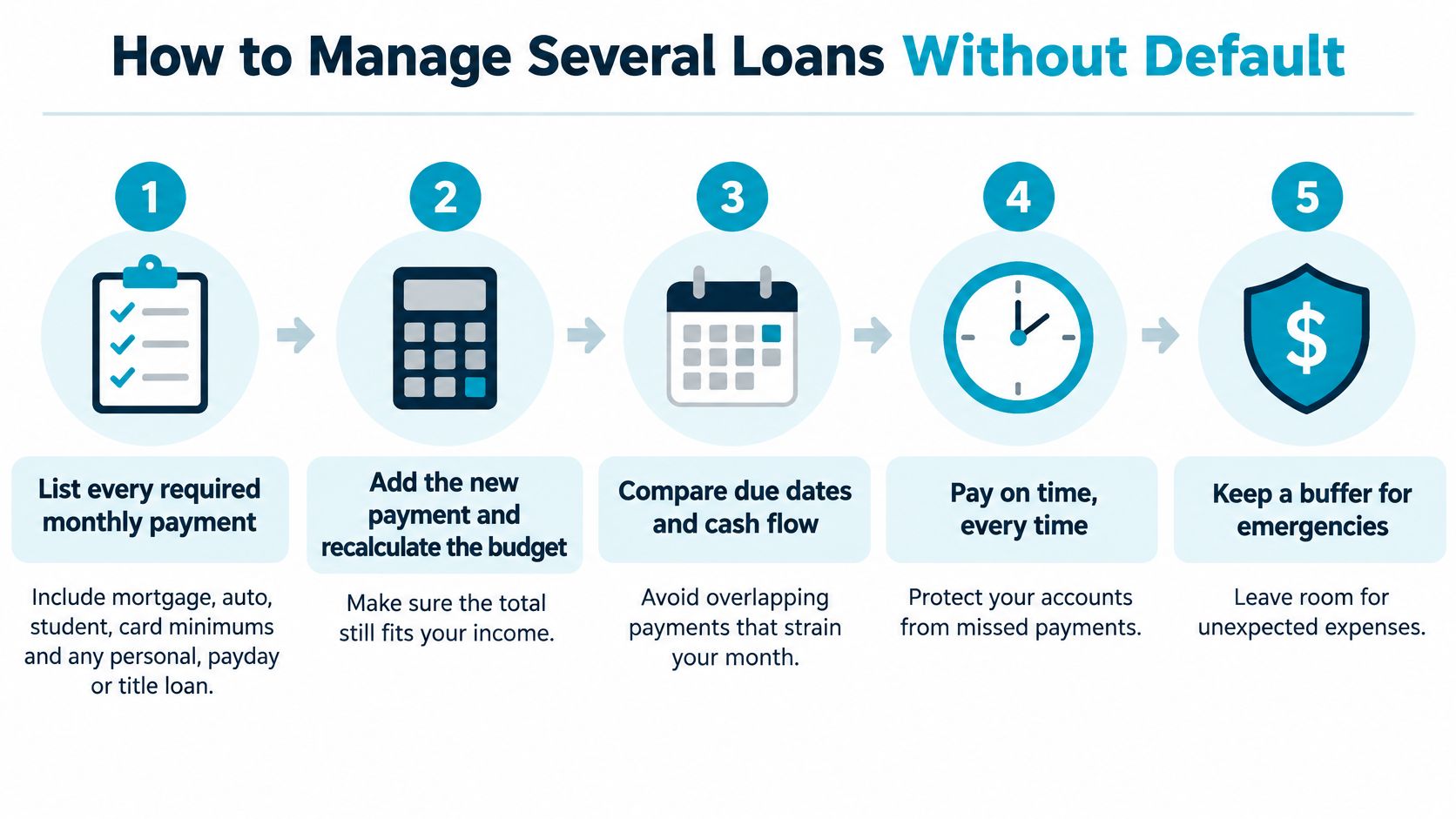
- List every payment. Write down your mortgage, auto, student, and card minimums plus any personal, payday, or title loan, including leases, alimony, and child support. The common slip is forgetting obligations that don't show on a credit report.
- Add the new payment and recalculate DTI. Use gross monthly income and the full new payment. Skipping this step is how a manageable stack crosses a lender's threshold.
- Test affordability after essentials. Ask whether the payment fits after rent, food, utilities, and transport, not merely whether a lender will approve it. Approval alone is the weakest affordability test there is.
- Read each agreement. Check the late-payment policy, due date, and renewal charges for every loan. The frequent mistake is assuming one loan's terms describe them all.
- Ask about repayment options. Lenders may offer repayment options such as repaying the full loan at a later date or repaying over time in installments, in addition to renewal. Confirm which option fits your pay schedule before you're under pressure.
- Build a payment calendar. Spread large payments so two don't land in the same week when you can control timing. Most defaults start as cash-flow collisions, not annual budget failures.
- Pay the highest-cost debt first. Keep minimums current on everything, then direct extra money to the most expensive balance. This cuts total interest while protecting every account's standing.
- Pause new applications. Stop adding loans until balances and payments are stable for a few cycles. Accepting several marketplace offers at once can create overlapping inquiries and duplicate obligations even when each loan looked affordable alone.
A lender's approval tells you the loan fits their risk model. It doesn't tell you the payment fits your month.
Run steps one through three again any time your income or expenses change. The inventory is what turns how many loans can you have at once from a guess into a number you've actually tested.
Check Your Capacity Before You Apply
Use a simple go or no-go rule. Apply only if all three checks pass, and wait if any one fails.
- Affordability check: Total monthly payments, including the new one, stay manageable after essential living costs.
- DTI check: Your ratio with the new payment stays within a range a lender is likely to accept.
- State check: The product you want is permitted where you live.
NextStopLoans is a marketplace that submits one request to a network of independent lenders, so a single intake can reach several lenders. Each lender still makes its own credit decision and sets its own terms, and no submission promises approval. Applicants must be at least 18 years old and a United States resident, and must not live in a state where the loan they're applying for is illegal.
You're also free to walk away. Borrowers may exit the process at any step and are under no obligation to accept the loan offered, so you can compare terms before committing.
List your payments, run the DTI test, check your state rules, then decide whether one request fits your budget. If it doesn't pass on paper today, it won't get easier once the payment is real.
If your payment list and DTI test show room for one more loan, NextStopLoans lets you submit a single request to its network of independent lenders for personal, installment, payday, title, and other loan options. You'll see each lender's terms before deciding, and you're under no obligation to accept any offer.